In the mid-1920s, John Ringling stood at the absolute summit of his world. He owned the circus—not just any circus, but the one billed as the greatest show on earth, the annual spectacle that arrived in towns across America by train. In 1925, he was named one of the richest men in the world, with a fortune once estimated at around $50 million. Eleven years later, on December 2, 1936, he died in a New York City hospital bed.
According to the Florida historian Gene Bernett, the bank account under his name held $311. Not $311,000, not $311 million. Just $311. What sets John Ringling apart from every other wealthy man who died broke is not the loss itself, but the manner of it.
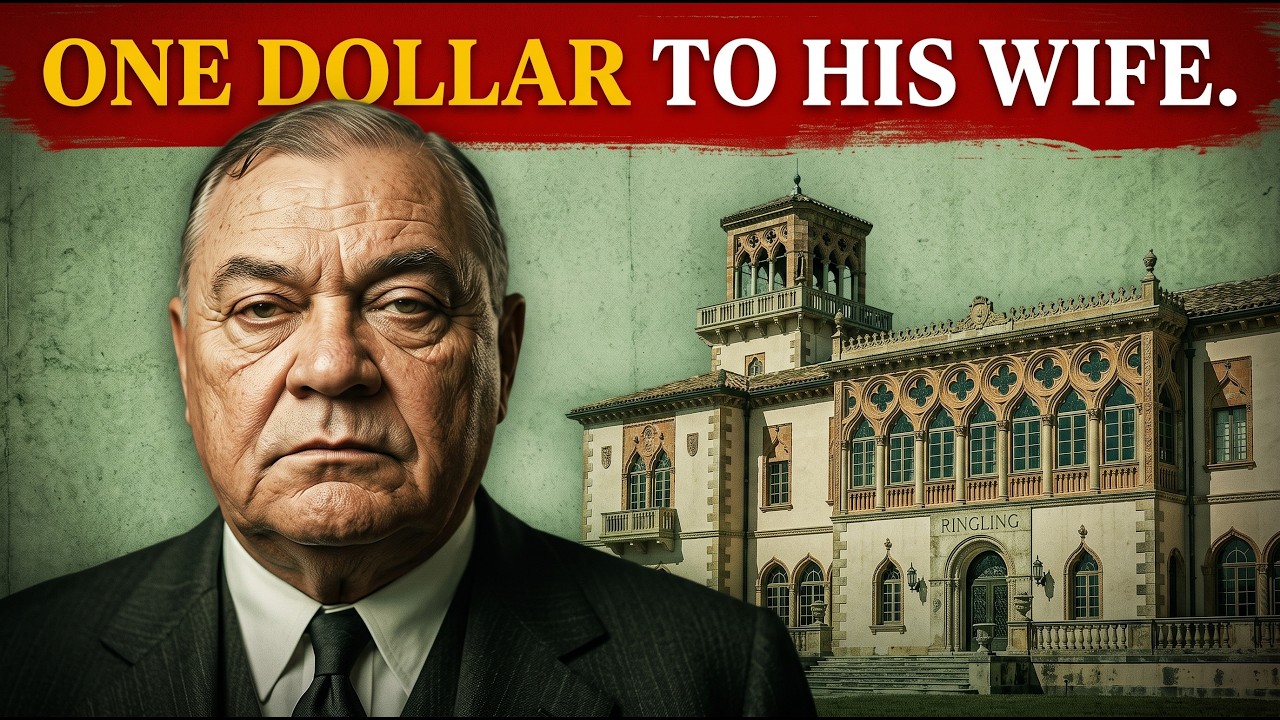
He did not gamble the money away. He did not drink it, lose it at cards, or hand it to a swindler. He saw his ruin coming, understood precisely what was about to happen, and made a series of decisions so cold and deliberate that the last of them reached past his own death to cut his family out of nearly everything he had. His will left his mansion and his art collection to the state of Florida.
To his own flesh and blood, he left almost nothing: one dollar to his wife, five thousand a year to his sister, and nothing at all to his nephews. The road to that end began with five brothers and a wagon. The Ringlings came from Baraboo, Wisconsin, and in 1884, five of them put on their first show—a small affair with a few cheap seats and a handful of animals. They were disciplined in a way the circus world had never seen.
While rival shows drank, brawled, and cheated their customers, the Ringlings ran a clean operation and poured every dollar back into the show. In 1907, they bought the Barnum and Bailey company for $400,000, taking ownership of the most famous circus name on the planet. By the 1920s, John Ringling had outlived or bought out his brothers and stood alone at the head of the entire enterprise. He did not stop at the circus.
He invested in railroads, oil, and land, and began collecting art on a scale that embarrassed museums. With his wife, Mabel, he started building a Venetian-style palace on the water in Sarasota, Florida. Sarasota in the mid-1920s was in the grip of the Florida land boom, the wildest real estate mania the country had ever seen. John Ringling did not just join the boom; he tried to own it.
He bought around 2,000 acres of Longboat Key and the surrounding islands, planning to transform them into a millionaire’s playground of grand hotels and waterfront estates. To connect his holdings to the mainland, he built a causeway with his own money, opening it on February 2, 1926. On the island, he began raising the centerpiece of his vision: a Ritz-Carlton hotel meant to draw the wealthy of the entire country to his stretch of the Gulf Coast. For himself and Mabel, he built a mansion that cost around $1.
5 million in 1920s money. Every dollar of this—the islands, the causeway, the hotel, the palace—came straight out of John Ringling’s own pocket. He was not borrowing against the circus to build in Florida. He was pouring his liquid fortune into land and concrete along the Gulf Coast, converting millions in ready cash into property that could not be sold and would not earn.
Land does not spend. You cannot meet a payroll with a half-finished hotel. Then the ground shifted. In September 1926, a monstrous hurricane came ashore near Miami, killing hundreds and causing around $100 million in damage.
The storm broke the back of the land boom. Buyers vanished. Prices fell straight through the floor. Ringling was caught holding land nobody wanted in the middle of projects nobody would finance.
His Ritz-Carlton, with roughly $650,000 already sunk into it, was halted in November 1926. It never opened its doors, not once. Between 1925 and 1926, the taxes on his Sarasota holdings quadrupled. He was now land rich and cash poor, bleeding money every month to carry acreage that no longer produced a dime.
The circus still ran. It still printed money every summer, and it was his alone. It was the one great asset he had never borrowed against. He was about to change that.
By 1929, the Florida disaster had drained his cash, and he saw a chance to do the thing that had made him great: swallow his last serious rival. The American Circus Corporation owned five separate circuses, the only competition that still mattered. The price was $1. 7 million, and John Ringling did not have that in cash.
So he did the thing he had never done in his life. He went to a lender named William Greve, president of New York Investors, and borrowed the money. As security, he pledged one half of all his circus stocks. He also guaranteed the note himself, putting his own name behind it.
On paper, his plan to pay it back was sound. He would turn the combined circus into a public corporation and sell shares to the investing public, using the flood of money to clear the loan. The entire plan depended on one thing: a healthy, rising stock market. He set it all in motion in the autumn of 1929.
On October 29, 1929, the stock market collapsed. The opening blow of the Great Depression wiped out fortunes across the country in hours. Ringling’s escape plan died in a single afternoon, because nobody in the last days of October 1929 was buying shares of anything. The debt sat there—half his circus pledged, his own name on the guarantee, and no way to pay it off.
Then his body took the decision out of his hands. By February 1932, John Ringling suffered an acute attack of thrombosis, a blood clot, from which he never fully recovered. While he lay weakened, a single missed interest payment—around $18,000, pocket change against a $1. 7 million debt—gave the lender the opening he had been waiting for.
In 1932, control of the circus was taken out of John Ringling’s hands. The company was reorganized as a stock corporation of 1,000 shares. The creditors ended up holding 100 of those shares. John Ringling himself was left with 300.
But the decisive block—600 shares, 60 percent of the whole company—sat in the hands of two women: Edith Conway Ringling, the widow of his brother Charles, and Aubrey Black Ringling, the widow of his nephew Richard. They had folded their holdings into a single family trust, and that trust controlled an unshakable majority. When it came to a vote on who would run the circus, the two widows voted against John. A showman named Sam Gumpertz was brought in from outside the family to run the day-to-day operations.
John Ringling, the last of the founding brothers, kept the title but lost the command. For the last four years of his life, John Ringling was a defeated man. His first wife, Mabel, had died in 1929. He married a second time, into a union that curdled fast and soured into a bitter divorce granted only months before his death.
His health was going, the money was gone, and whatever power he had left had been voted away. But he still had one move left. If he could not keep his fortune, he could decide who would never get their hands on it. His will, dated May 19, 1934, with a codicil added on November 2, 1935, was extraordinary.
To the state of Florida, he gave his art museum and residence at Sarasota: the mansion he called Ca’d’Zan, the museum beside it, the enormous collection of paintings inside, and an endowment of $1. 2 million to keep the whole thing running. He did this, according to the state of Florida itself, to protect his art collection from annihilation by his creditors. A thing owned by the state of Florida is a thing creditors could never seize or auction away.
He could not save the fortune for himself, so he put the crown jewels somewhere the debt collectors could never follow. He attached conditions: the museum had to open to the public free of charge one day every week, the name could never be changed, and not a single work of art could ever be sold or traded. The same will slammed the door on his family. To his wife, the woman he was in the middle of divorcing, he left the sum of $1.
To his sister, Ida, he left $5,000 a year for the rest of her life. To his nephews, the next generation who might have expected to inherit an empire, he left nothing at all. John Ringling died on December 2, 1936, of pneumonia, and by Gene Bernett’s account, the fortune once estimated at $50 million had come down to $311. The lawsuits began before the body was cold.
On December 22, 1936, his former wife Emily went back to court to overturn the divorce and claim instead as his widow. The state of Florida had to fight for years to take hold of what Ringling had willed it. The case, recorded in the law books as North against Ringling, climbed to the Florida Supreme Court in 1938, 1939, and 1940. The estate sat tangled in probate for ten years.
It was not until 1946 that Florida prevailed and opened the mansion to the public. But the version of the story that ends with a disinherited family and a decade of lawsuits is not the full picture. In the fine print of that exacting will, John Ringling made one mistake, and that single mistake handed the whole circus to the one man he had tried hardest to cut out. One of the nephews left with nothing was named John Ringling North.
The will cut him out of the inheritance, but it left him named as an executor of the estate. That meant he held the legal keys to the estate itself. In 1937, the estate bought back the 100 shares of circus stock controlled by the creditors for a reported $28,000. Of those 100 reclaimed shares, 70 went to John Ringling North.
The nephew who had been left nothing now held the single largest block of the company his uncle had built. Using his position as executor and building on that block of stock, he maneuvered for years, and in 1946, he bought his way to full control of the circus. The man his uncle had struck out of the will ended up sitting in the owner’s chair of the greatest show on earth. John Ringling died with $311.
His command had been taken from him years before the end. His creditors spent years in court and were bought out for $28,000. John Ringling North seized the circus only to spend decades fighting over a company that would in time slip out of the family’s hands for good. The winner was the state of Florida.
Everything John Ringling tried to keep for himself—the cash, the land, the circus, the fortune—was borrowed away, voted away, or spent into the sand. The only things that survived whole were the things he gave away. The house on the bay and the art inside it, handed to the government so that no creditor, no court, and no grasping heir could ever break them apart. Today, the mansion and museum still stand in Sarasota, still open to the public, still carrying the name that was never allowed to change.
The circus was never the fortune. It was the collateral. And in the end, the only inheritance John Ringling ever protected was the one he made certain his own family would never touch.