In May 1944, the Pacific War reached a critical turning point. American forces were advancing toward the Mariana Islands, and the Imperial Japanese Navy was preparing to counter the threat. To detect American carrier task forces, Admiral Soemu Toyoda ordered the Seventh Submarine Squadron to establish a patrol line north of the Admiralty Islands. The operation was called the NA line, and it consisted of seven submarines: I-16, Ro-104, Ro-105, Ro-106, Ro-108, Ro-109, and Ro-116.
The Japanese submarines were positioned at intervals across the likely American approach routes. Their mission was to report enemy fleet movements and then support the decisive surface battle that Japanese doctrine had anticipated for decades. What the Japanese commanders did not know was that American codebreakers at Fleet Radio Unit Pacific had already intercepted and decoded the orders. The Americans knew where the submarines would be, when they would arrive, and what their mission was.
On May 13, 1944, codebreakers intercepted a message from the submarine I-16 reporting its estimated time of arrival near Bougainville. This intelligence was passed to Commander Hamilton Haynes, commanding Escort Division 39 at Tulagi. He ordered three destroyer escorts to intercept: USS George, USS Raby, and USS England. The ships departed Purvis Bay on May 18 and formed a scouting line, searching with sonar as they steamed north.
At 0150 on May 19, England’s sonar operator detected a contact 300 feet below. The target was I-16, a large fleet submarine that had participated in the attack on Pearl Harbor. England’s commanding officer, Lieutenant Commander Walton Pendleton, gave his executive officer, Lieutenant John Williamson, authority to conduct the attack. Williamson had drilled the crew relentlessly during their voyage from San Francisco, focusing on a relatively new weapon called the Hedgehog.
The Hedgehog was a forward-firing weapon that launched 24 small projectiles in a circular pattern. Unlike depth charges, which required a ship to pass directly over a target and lose sonar contact at the critical moment, the Hedgehog allowed continuous tracking. The projectiles only exploded on contact with a submarine hull. A miss meant silence. A hit meant immediate confirmation.
At 0226, Williamson gave the order. The Hedgehog fired, and the crew waited. Then the ocean erupted. Six distinct detonations were followed by a massive blast that rattled England’s hull. The sonar operator heard the sounds of a submarine dying: bulkheads collapsing, compressed air escaping. At 0245, debris surfaced, including wooden planking, cork insulation, Japanese papers, and an officer’s cap. I-16 was gone, sunk with all 94 men aboard.
It was a significant kill, but the crew did not know it was only the beginning. Over the next 12 days, England and her companion ships would systematically destroy the entire Japanese submarine picket line. The success was not accidental. It was the result of intelligence, training, and a doctrine that had evolved dramatically since the war began.
At the start of the Pacific War, the Imperial Japanese Navy possessed one of the most technologically advanced submarine fleets in the world. Japanese submarines were larger, faster, and had greater range than their American counterparts. The I-15 class displaced 2,584 tons surfaced and measured 358 feet in length. American Gato-class submarines displaced 1,525 tons and were 311 feet long. Japanese submarines carried 5.5-inch deck guns, while American fleet submarines carried 3-inch guns.
The Japanese also developed the Type 95 torpedo, which used pure oxygen instead of compressed air. It left no telltale wake and could travel 20,000 yards at 49 knots. American torpedoes had a maximum range of 9,000 yards at 46 knots. Japan built 41 submarines capable of carrying aircraft. The United States, Britain, and Germany built none.
These capabilities produced early successes. In January 1942, the submarine I-6 torpedoed the carrier Saratoga, putting her out of action for months. In June 1942, I-168 penetrated the destroyer screen around the damaged carrier Yorktown and sank her. In September 1942, I-19 fired a spread of six torpedoes at the carrier Wasp. Three struck Wasp, which was scuttled that evening. The other three torpedoes continued through the formation, striking the battleship North Carolina and the destroyer O’Brien. One salvo, three warships hit.
Despite these tactical victories, the Japanese submarine force failed to achieve strategic impact. The reason was doctrine. Japanese naval thinking was rooted in the Battle of Tsushima in 1905, where Admiral Togo Heihachiro destroyed the Russian Baltic Fleet in a single decisive engagement. For 40 years, Japanese planning focused on preparing for a similar climactic battle. Submarines were assigned the role of scouts and advance pickets. They were to locate enemy fleets, report their movements, and attack damaged ships fleeing the main engagement.
Commerce raiding was considered dishonorable. Japanese submarines were not used to attack merchant shipping, and they were not used to protect Japanese convoys. This doctrinal rigidity had devastating consequences. During the entire Pacific War, Japanese submarines sank approximately 184 merchant ships totaling 900,000 gross registered tons. American submarines sank 1,314 Japanese ships totaling 5.2 million tons. German U-boats, operating in the Atlantic, sank 2,840 Allied ships totaling 14.3 million tons.
The difference was not technology or crew quality. It was mission focus. German submarines hunted merchant convoys. Japanese submarines hunted warships, which were the most difficult targets in naval warfare. Destroyers could make 35 knots and turn sharply. Carriers were surrounded by destroyer screens equipped with sonar and depth charges. Success rates were inherently low.
By 1944, the consequences of this doctrine were becoming catastrophic for Japan. Oil shipments from the Dutch East Indies had fallen to a trickle. Factories lacked raw materials. The Combined Fleet had to be stationed in Singapore because fuel shortages made operations from Japan impossible. Japanese submarines were being pulled from combat to serve as supply vessels, hauling rice and ammunition to isolated garrisons.
Meanwhile, American anti-submarine warfare had evolved into a systematic, scientific discipline. The British had developed the Hedgehog in 1941, and it began arriving in the Pacific in 1943. Destroyer escorts, smaller and more numerous than fleet destroyers, were equipped with the weapon. They carried the latest sonar and were specifically designed for convoy escort and submarine hunting.
USS England was a Buckley-class destroyer escort commissioned in December 1943. Her commanding officer, Lieutenant Commander Pendleton, gave his executive officer extraordinary authority to conduct operations. Williamson drilled the crew relentlessly on Hedgehog attacks, emergency procedures, and coordination between sonar operators, the bridge, and the weapon crew. By the time England reached the Solomon Islands, her crew could execute attacks with remarkable precision.
The combination of intelligence, training, and the Hedgehog proved devastating. After sinking I-16 on May 19, the three destroyer escorts continued north. On May 20, USS George detected a surfaced submarine, but her Hedgehog attacks missed. England regained contact and was ordered to stand clear while George and Raby conducted repeated attacks over the next 20 hours. Every attack missed.
At 0501 on May 22, Commander Haynes finally ordered England to attack. Williamson fired one salvo. At least three Hedgehog bombs detonated, followed by a massive underwater explosion. Ro-106 was destroyed. Fifty-six men died.
On May 23, George detected Ro-104 on radar. England made sonar contact and attacked at 0154. Multiple detonations, breaking-up noises, oil, and debris followed. Ro-104 sank with all hands. Three submarines in four days.
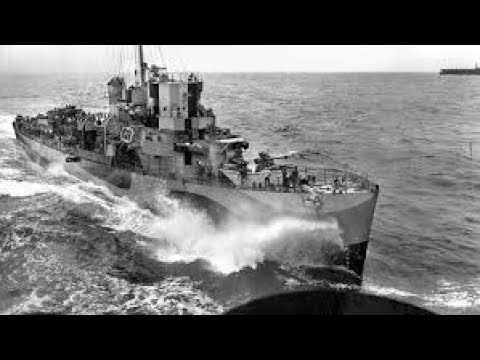
On May 24, the ships detected Ro-108. England attacked at 0405. The first salvo missed, but a second attack at 0421 scored multiple hits. The submarine broke apart underwater. The explosions were so violent that men on England’s deck were knocked down by the concussion. Four submarines in five days.
Admiral William Halsey, commanding the Third Fleet, sent a message to England: “May we borrow you for the opening of the Tokyo season.” The joke concealed growing concern. Intelligence knew seven submarines had been positioned on the NA line. Four had been sunk. Where were the other three?
On May 26, a hunter-killer group arrived to relieve the destroyer escorts, but intelligence indicated two more submarines remained in the area. England, George, and Raby refueled at sea and resumed patrol. At 0120 on May 26, George detected Ro-116 on radar. England made sonar contact at 0150 and fired Hedgehogs at 0214. Three to five detonations followed. Oil and debris appeared after sunrise, eventually covering several square miles. Ro-116 was declared lost with all hands on June 25.
Five submarines in seven days. Only one remained: Ro-105. The hunter-killer group searched for days without contact. Then, on May 30, sonar operators on England picked up a faint contact. Commander Haynes ordered George to attack first. George made multiple Hedgehog attacks over 25 hours, expending over 20 salvos. All missed. The submarine was evading skillfully.
Finally, Haynes sent a message to England: “Okay, England, it’s your turn.” At 0736 on May 31, England fired her Hedgehog. At least 10 bombs exploded 180 feet below the surface. Five minutes later, a massive underwater explosion shook the ocean. Oil, debris, and human remains surfaced. Ro-105 was destroyed. Fifty-five men died.
England had sunk six submarines in 12 days. No ship in naval history had achieved such a record. Admiral Ernest King, Chief of Naval Operations, sent a message: “There’ll always be an England in the United States Navy.”
The destruction of the NA line demonstrated that American forces had mastered anti-submarine warfare to a degree that made Japanese submarine operations suicidal. Every advantage the Japanese had possessed in 1941 had been neutralized. Superior range and endurance became liabilities when codebreakers could predict patrol areas. Superior torpedoes mattered little when submarines never got within firing range. The Hedgehog allowed American ships to attack from 200 yards away while maintaining sonar contact throughout the engagement. There was no point where the attacking ship lost contact, no opportunity to turn and dive away.
The human cost was staggering. Six submarines destroyed, over 350 Japanese submariners killed. These were career sailors, some with decades of service. They died because their navy’s doctrine placed them in positions where American advantages could be applied systematically. They died because their commanders refused to abandon a conception of submarine warfare that had been obsolete since 1942.
After the destruction of the NA line, Japanese submarine operations in the central Pacific effectively ceased. Submarines continued to operate, but they avoided areas where American hunter-killer groups patrolled. They transported supplies to isolated garrisons. They conducted occasional reconnaissance missions. The dream of using submarines to locate and weaken American carrier task forces before the decisive battle was dead.
The Battle of the Philippine Sea in June 1944 illustrated the new reality. American submarines detected the Japanese fleet before it could launch strikes and sank two carriers, including Ozawa’s flagship Taiho. American carrier aircraft destroyed more than 400 Japanese planes in what pilots called the Great Marianas Turkey Shoot. Japanese submarines played no meaningful role in the battle.
By late 1944, Japanese submarines were being used primarily as cargo vessels. Submarines designed to sink enemy warships were hauling rice and ammunition to garrisons that would be starved into surrender. It was the ultimate admission of doctrinal failure.
The contrast with American submarine operations was stark. American submarines conducted unrestricted warfare against Japanese merchant shipping. They sank tankers carrying oil from the Dutch East Indies. They torpedoed transports carrying troops to defend island garrisons. By the end of 1944, Japan’s merchant marine had been reduced to less than half its December 1941 tonnage. Factories shut down for lack of raw materials. The Combined Fleet could not sortie from Japanese bases because fuel oil was unavailable.
American submarines achieved this strategic impact while losing 42 boats to enemy action in the Pacific. Japanese submarines lost 130 boats while achieving minimal strategic impact. The difference was not technology or courage. It was doctrine. American submarines hunted merchant ships. Japanese submarines hunted warships.
England’s story illustrates this principle at the tactical level. A relatively small, lightly armed destroyer escort destroyed six submarines because she possessed better intelligence, better weapons, and better tactical doctrine than her opponents. The submarines she destroyed were larger, faster, and more heavily armed. Their technological superiority was irrelevant.
Lieutenant Williamson later reflected that the crew’s confidence grew with each success. After destroying I-16, they believed they could sink any submarine they encountered. After destroying six submarines, they understood they had achieved something that would be remembered as long as naval warfare was studied.
Pendleton’s unusual command style contributed to this success. He allowed Williamson to conduct attacks with minimal interference. He trusted his crew’s expertise. He created an environment where initiative was rewarded and training was prioritized. England’s success vindicated this approach.
When England was struck by a kamikaze off Okinawa in May 1945, killing 37 men, the crew fought the fires and saved their ship. The same competence that had destroyed six submarines in 12 days now saved England from sinking. The ship survived, damaged but afloat.
Admiral King’s promise that there would always be an England in the United States Navy honored those 12 days. From 1963 to 1994, the guided missile cruiser USS England carried the name. When that ship was decommissioned, the name passed from active service.
The Japanese submariners who died on the NA line served their country with loyalty and courage. They executed missions they believed would contribute to victory. That their doctrine was flawed was not their fault. They died because their leadership failed to understand how submarine warfare had evolved and refused to adapt when evidence of failure became overwhelming.
War kills skilled and courageous men on both sides. Doctrine determines which side sacrifices advance strategic objectives and which side sacrifices merely add to the casualty lists. England’s 12 days in May 1944 demonstrated that doctrine matters more than technology, intelligence matters more than courage, and systematic application of lessons learned matters more than initial advantages. That is England’s legacy.