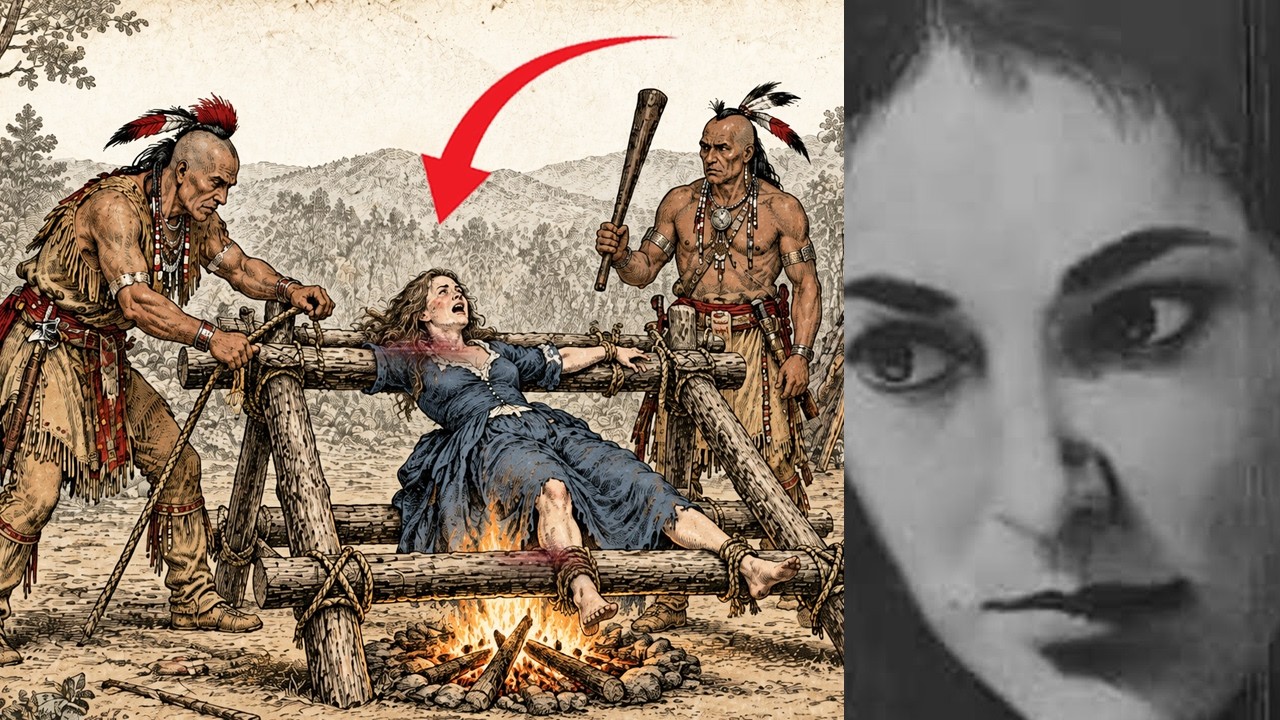
On the evening of October 1, 1789, Jenny Wiley stood in the doorway of a log cabin at the southwestern edge of Virginia, holding an infant on her hip while four other children moved behind her inside the single-room home. She was pregnant with a fifth child. Within the next ninety seconds, three of those children would be dead on the cabin floor, her teenage brother would die beside them, and she would be dragged into the forest to begin an ordeal that would last most of a year and end worse than death for the children she had left. The raiding party approaching the door had not come for scalps or plunder.
There is a strong likelihood they were hunting Matthias Harmon, one of the most feared Indian fighters on the frontier, and believed the cabin on Walker Creek belonged to him. It did not. Jenny paid the price for a stranger’s reputation. The children who survived the cabin did not die quickly either.
They died in stages, one on the trail at the hands of a warrior who would not tolerate crying, another months later in a ritual involving a piece of bark, a frozen creek, and an old man who read signs in the water to decide whether the child would live. The question that haunts the rest of this story is why they kept Jenny alive. Everyone in that cabin was killed within two minutes. She was a pregnant woman who would have to cross mountains with a screaming infant, slower and louder than the corpses they had just left behind.
Yet for reasons that reveal something dark about frontier warfare, they took her with them. Jenny Wiley was in her late twenties, possibly just past thirty. Born Jenny Evans into a poor Virginia family, she had followed a man named Thomas Wiley to Walker Creek because he believed a life could be built at the edge of the map. That day Thomas was out hunting.
The cabin had one or two rooms, a dirt floor, a single hearth, and hides on the walls. Four children moved around her, the oldest no more than ten, while she carried a fifteen-month-old on her hip. Fifteen miles away, across the mountains in the Big Sandy Valley, stood a small fort called Harmon’s Station, owned by Matthias Harmon, a man who had killed enough Shawnee and Delaware warriors to carve his name into their villages the way certain names are spoken, with hatred. Somewhere to the north, a small band of warriors moved through the hills.
Most historians estimate their number at eight to twelve men. Shawnee, Cherokee, and possibly some Delaware. They were survivors of tribes whose hunting grounds had been cut into cabins like this one over a full generation. They were not an army.
They were men who had watched the treaty line move west, then west again, and they had come for revenge or hostages or both. They had been told there was a station on Walker Creek belonging to the man who had killed their people. Late in the afternoon, Jenny’s younger brother came running. He was fifteen, perhaps nineteen.
Even his name is uncertain now, lost in two centuries of storytelling. He had seen signs, footprints in the mud, smoke where there should be none. He told his sister to take the children and flee to the neighbors. Jenny gathered the infant and turned toward the door.
The door opened by itself. The children in that cabin ranged from the oldest son, not yet ten, through three middle children, down to the fifteen-month-old infant Jenny carried. Their names were never reliably recorded. History kept the mother’s name and let the children vanish, a particular form of erasure.
Jenny herself was strong from years of frontier labor, having carried water up from the creek every day of her adult life. Her brother was a teenager, unarmed or nearly so, having run the last quarter mile toward the cabin. The nearest neighbor was Jenny’s sister, a distance away. A man named John Borders would not arrive until dusk.
The raiding party carried single-shot flintlock rifles, tomahawks, knives, and war clubs. The tomahawk mattered more than the rifle. A rifle fires once. A tomahawk kills as long as your arm can continue.
Local tradition and more careful modern historians point to something that changes the entire meaning of this raid. The group may have been chasing Matthias Harmon. They believed his cabin sat somewhere on this creek. They were wrong.
They found the Wiley family instead. Everything that followed, the killings on the floor, the march through the mountains, the infant on the piece of bark, happened because a raiding party could not read the trail well enough to tell one cabin from another. Every child who died in the next four months died because of a name the raiders never learned to spell, not strategy, not war, but a wrong address. Walker Creek lay in a narrow valley of dense hardwoods and broken hills.
Winter was coming. In the seconds before the door opened, Jenny’s brother made a decision that no logic supports. He had seen something in the woods and run toward his sister’s home instead of away from it. He could have kept running.
He could have gone to the neighbors. He chose the cabin. The accounts differ on whether he shouted through the door or entered it, but they agree that he arrived, told Jenny what he had seen, and stood in front of her when the raiders burst in. He stayed.
He is the first person killed in this story, his body on the ground before Jenny’s mind understood what was happening. His name was not preserved in a single letter. He died refusing to leave her. The door opened, and suddenly the cabin was full of men.
The sound came first, a sudden cry designed to paralyze anyone who heard it. The brother fell first, tomahawk and knife, the first body on the floor at the entrance he had just run through to save his sister. The children were next. Three died in those first minutes, the oldest first, then the next two in age.
The killing was done with edged weapons, not guns, because guns were loud and the raiders did not know how close the militia might be. The killings happened so fast that Jenny, standing with her child, would later describe the silence of the room before she understood what that silence was. Every child in that cabin was scalped. Scalps were both loot and proof.
The raiders made a decision in seconds. The pregnant white woman had value. The child she carried was either a burden or a bargaining chip. She lived.
The child lived, for now. Four bodies lay on the floor, and a woman was dragged toward the door. Dusk came. John Borders arrived at the cabin expecting to find Jenny and the children at her sister’s house.
He carried a lantern. The lantern is what showed him what was on the floor. Borders roused the settlers. A pursuit party formed.
By dawn on October 2, the men were on the trail. They found an abandoned campfire still warm to the touch. They found a torn piece of cradle cloth among the leaves. Then, in a hollow off the path, they found the fifteen-month-old infant.
The baby had been killed on the trail because it cried. The men buried him under leaves and piled stones on top. They had no time for better, and they turned back because the raiders were miles into country the settlers did not know as well as the men they were chasing. Three weeks later, Lieutenant Walter Crockett of the Montgomery County militia sat down and wrote a letter to Governor Beverly Randolph of Virginia.
He described what had happened at Walker Creek in the driest possible sentence: On the first of this month, a group of Indians kidnapped the Wiley family, killed and scalped four of his children, and took his wife and youngest child as captives. That single sentence is the entire archival record of the massacre. Jenny, meanwhile, was on the trail. Pregnant, barefoot within a day or nearly so, forced to walk at the pace of men who had been traveling for weeks, carrying the infant.
They crossed the hills by climbing, the streams by wading. They did not stop when she fell. Someone pulled her up, sometimes by hand, sometimes by rope. The march covered somewhere between one hundred and one hundred fifty miles of mountain country as October turned to November.
No roads. No trail wide enough for two people to walk side by side. Copperheads still active in the leaves. Rivers that flooded overnight.
She did it pregnant, carrying a child, sleeping four hours a night, eating what her captors left her, which was not much. They argued about her the way men argue about a slow horse. Kill her, keep her, kill her, keep her. She lived from decision to decision, from day to day.
In the first days of the march, the youngest child died in Jenny’s arms. In some accounts a warrior killed him by striking him against a tree; in others, by a different means. Jenny was not allowed to bury him. By the time the leaves fell, they were deep in country no white settler had mapped, and winter had not yet begun.
Her clothes wore out and tore apart. Her feet bled. The group bound them with rawhide. The cold came, first frost, then snow.
Food was what the men hunted, what they carried, what was given to her last. She began to pick up words of their language, listening the way a prisoner listens, searching for names, numbers, anything that told her where she was. She had seen five people she loved die in less than a month: her brother, three children in the cabin, another child on the trail. She was pregnant with the sixth.
Reason for her survival was not strength or luck but that the group decided a pregnant white woman had value to someone, while children had none. That is the cruelest arithmetic of frontier warfare. They reached the mouth of Cherokee Creek in what is now eastern Kentucky in late autumn. The rock house was a natural shelter in a cliff face, an overhang, a sloping floor, a fire pit near the entrance.
Jenny was allowed to live there alone with her remaining child. This was not kindness. The group did not want her in the main camp. She was a resource, kept like grain in a separate storehouse.
The rock was cold in a way wooden walls are not. Water seeped through the stone and froze in threads along the back wall. She slept with the child pressed to her chest, wrapped in whatever was available. When she woke, the moisture in her hair had crystallized.
In the account she gave to a preacher sixty years later, she recalled the winter in the rock house in the language of endurance, not complaint. She said, I am not afraid to die. She did not mean she wanted death. She meant fear had left her, and once fear was gone, a person could do many things the fearful cannot.
The child survived the winter in the rock house with her. He did not survive the spring. When the ice began to break on Cherokee Creek, the men came for her son. There was an elder in the group, described in the accounts as Cherokee, old enough that the younger men gave him respectful silence when he spoke.
He was the one who performed the test. They bound the child to a piece of bark, a kind of cradle. They placed the bark on the water. The current carried it away.
They forced Jenny to watch. This was a way of asking a question the world had the right to answer: Would the child live? Would the water return him? The infant cried.
Jenny rushed into the water after him in an act that cannot be logically justified. The men interpreted the crying as a bad sign. The water had spoken. The child was killed there at the creek.
Jenny was allowed to carry his body back to the rock house. She buried him in a corner of the shelter, in a small hole in the floor, using stones. It was the only funeral any of her children received at her hands. At some point in the same season, before or after the test at the creek, the records do not allow certainty, she gave birth to the child she had been carrying since before the raid.
A live birth in the rock house on a Kentucky creek, attended by no one. The infant was killed shortly afterward. The reasons the records give are always the same: it cried. They were on the move.
It was another body that could not run. After the rock house, the group moved south and west through the Big Sandy Valley, crossing rivers at Tug Fork and later the main Big Sandy near what is now Louisa, Kentucky. The warriors held her arms while swimming. She was wet and frozen, three seasons into captivity.
She had learned enough of the language to understand fragments. She heard, somewhere in camp talk, the name of a station, Harmon’s Station. She knew it was on a river. She knew it was close.
She had been a captive long enough that her captors had stopped watching her as closely as before. She did chores. She seemed resigned. She made herself, in the terrible arithmetic prisoners learn, useful and unremarkable.
The trust the men gave her was not kindness. It was habit, and habit was what she had been waiting for. The group left camp. She does not tell us exactly what they left to do, hunting, raiding, meeting another party.
What she tells us is that the camp emptied, and for the first time in nearly a year, no one was watching her. She walked. One word. One decision.
A woman who had watched her children die and borne another in a rock house put down what she was carrying and walked out of camp. She had fifteen to twenty miles of Appalachian forest between her and the station. No shoes worth mentioning, no food, no weapon, no map. She walked at night.
She hid by day. She followed water, because water runs downhill, and downhill leads toward people. It took days. When the trees finally parted and she saw a wall of logs and a chimney with smoke rising, she was, by the testimony of everyone who saw her, beyond the limit that allows a human body to keep walking.
They almost did not recognize her as a woman. She was barefoot. Her clothes were rags in the literal sense, torn strips of what she had been wearing when they took her. Her hair was matted.
She had lost so much weight that hollows showed in her face, at her temples, along her collarbone. When they finally understood what they were looking at, she was a white woman. A moment later, they knew she was the missing woman. They had heard, last autumn, about the family on Walker Creek.
The story of the cabin and the four children who had been scalped had crossed the mountains the way such news always does. And here she was, standing at the edge of the clearing, the woman that story had ended with. They brought her inside. They fed her carefully, because someone who has starved cannot eat quickly without getting sick.
They wrapped her. They sent word. The length of her captivity became a second historical dispute. Family tradition says eleven months, nearly a year.
But a letter dated July 4, 1790, from Lieutenant J. D. Smith of Russell County, Virginia, to Governor Randolph, mentions Jenny Wiley and describes her capture as having lasted only a few months. Five or six months is what the official papers suggest, meaning she was taken October 1 and came out by spring, roughly nine months rather than eleven.
It is a small correction, but small corrections are the difference between the story a family tells about itself and the story the evidence supports. Thomas Wiley came for her. Whatever he said to her and whatever she replied is not in any surviving letter. The records simply state that he came, that she returned to him, and that they left the station together and began the extraordinary task of a second life on the Big Sandy.
The count of the dead, depending on the source, is four children or five. The letter says four were scalped in the cabin. Family tradition says her brother and five of her children were killed. The difference is the child no settler ever saw alive, the one born in the rock house.
He belonged to Jenny alone and appears in no official correspondence. They came for Harmon. They found the Wiley family, and everything that followed was the price of that mistake. They kept her alive because a pregnant white woman on the frontier was worth something a corpse was not.
It was not mercy. It was inventory. She survived because she was worth more moving than still. And in the end, she made herself worth less than the trouble of watching, and she walked.
Jenny and Thomas moved to the Big Sandy. She bore five more children: Ezekiel, Jane, Sally, Adam, and William. She lived to be an old woman on a farm in what is now Johnson County, Kentucky. A creek near Paintsville was named for her, Jenny’s Creek.
Her descendants are still there. In her later years, a preacher came to visit her. He brought papers. He asked her to tell him what had happened at Walker Creek and after, and she sat with him for hours.
During those hours, an old woman of the frontier gave the only firsthand account of the captivity of Jenny Wiley anyone ever recorded. That manuscript is the reason this story survives at all. But the story that manuscript created was not entirely the story that happened. By the time William Elsey Connelley published his account in the early twentieth century, Jenny Wiley had become more than a woman on a creek.
She had become a symbol, a figure in frontier mythology alongside Daniel Boone and Simon Kenton and the other names white Appalachia chose to immortalize. Connelley’s account, based on family tradition, stated plainly that the Indians killed her brother and five of her children. Five, not four. The difference between four and five is the difference between the letter Walter Crockett wrote in 1789 and the story the family had practiced telling for one hundred twenty years.
Every dramatic detail of the captivity, the cry at the door, the test at the creek, the old Cherokee man, the piece of bark, the burial in the rock house, comes to us through one manuscript. As one modern historian puts it: When Jenny was an old woman, a preacher sat with her and wrote down the story of her captivity. Although Jenny may have embellished it many times, it is the only direct account we have. Read that carefully.
The only account, from a woman who had told it for sixty years in a culture that expected certain patterns in captivity stories, to a clergyman who had his own reasons for writing it down. Everything known about what happened on that creek passed through that room. What myth built, it also cut away. The teenage brother lost his name.
The children lost their names. The band that captured her lost their reasons for coming, the land, the treaties, the burned villages behind them. In frontier teaching, they became simply the Indians, a category instead of a group of men with fathers and grievances. That flattening worked.
It made the story easier to tell. It made the settlement of the Big Sandy Valley easier. It made Matthias Harmon, the man the raiders may have been hunting in the first place, a hero rather than a cause of conflict. Back at the cabin door, October 1, late afternoon, the light beginning to fade.
A woman in her late twenties, a child on her hip, four more children in the room behind her, a pregnancy she could feel in her back, a brother running through the trees, and a door about to open. She does not yet know that the men on the other side of it have come to the wrong house. She does not know she will walk a hundred miles by the time the leaves fall, or that she will bury a child in the corner of a rock house before spring, or that she will be the one to walk out of this ordeal. All she knows is that the door opens.
And when it opens, the frontier changes. The name on the creek in Kentucky is Jenny’s. There is a reason it is not anyone else’s.