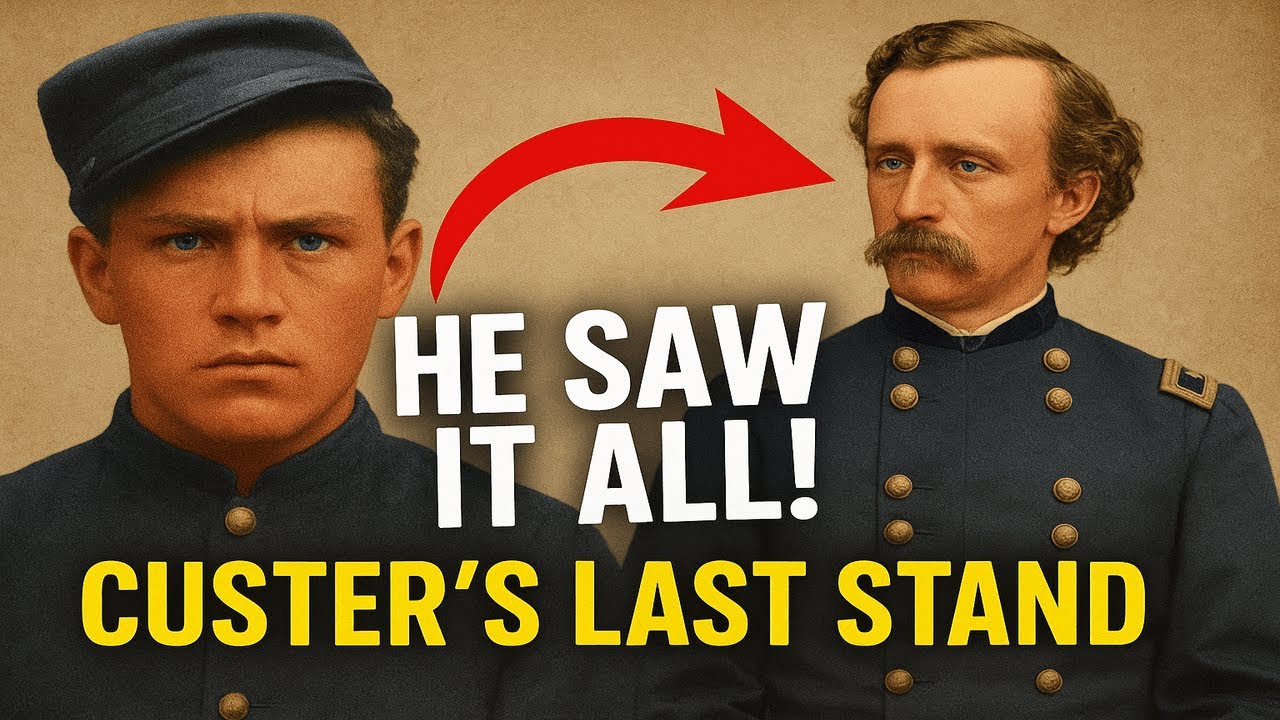
On June 25, 1876, Private William O. Taylor of Company A, Seventh Cavalry Regiment, rode into a valley that would become one of the most infamous battlefields in American history. Taylor, who joined the army in pursuit of excitement, was one of the few survivors of the Battle of the Little Bighorn.
His detailed eyewitness account, written later that same year, has become a vital primary source for historians seeking to understand the catastrophic defeat of General George Armstrong Custer’s command.
Taylor’s testimony begins on the evening of June 24, 1876, when the regiment made camp along the Rosebud River. The location was strikingly beautiful. A tall bluff rose to the right, and a clean stream ran between the bluff and the river.
The grassy tableland, scattered with wild rose bushes and trees, reminded Taylor of a cultivated garden. He found it difficult to believe that such a serene place could become the final resting ground for so many of his comrades.
That night, Taylor observed Custer sitting alone in his tent for a long time, absorbed in thought. The general’s face bore an expression of sorrow that Taylor had not noticed before. Whether Custer was thinking of his wife Libby back at Fort Lincoln or felt a premonition of what lay ahead, Taylor could not say.
Later, a group of young officers gathered near a bivouac and sang "Annie Laurie," a slow, mournful tune that struck Taylor as odd for cavalry troops on the trail of a hostile force. They followed with the doxology, a hymn petitioning for divine favor, before shifting abruptly to a boisterous rendition of "For He’s a Jolly Good Fellow." Taylor found the sudden change somewhat disrespectful, but he noted that pious gravity was never the most dominant characteristic of fighting men.
The camp settled into an uneasy quiet. Taylor and his comrades had no way of knowing that just a week earlier and not far off, Crazy Horse had turned back General Crook’s troops. Nor could they foresee that within a month, the same native forces would camp beside the same stream before being scattered by General Terry’s advance from the north.
At approximately 10 p. m. , the men were roused and ordered to saddle their horses for a night march.
They followed the Rosebud River, crossed the high ground dividing it from the Little Bighorn, and stopped around 2 a. m. to await word from scouts.
When dawn broke, a few men prepared coffee from poor-quality water. General Custer rode forward to a high point on the divide and returned with the report that scouts had observed smoke from a native village and herds of ponies feeding in the valley some 12 to 15 miles distant.
A little before 8 a. m. , Custer rode without a saddle or hat from company to company, telling officers that the Indians had been sighted and that they would depart at once.
The regiment climbed the ridge between the Rosebud and Little Bighorn Rivers, halting around 10:30 a. m. in a gully roughly four or five miles from the top of the divide.
The men were ordered to keep hidden and maintain silence. Taylor heard Captain Godfrey state that Custer’s initial strategy had been to postpone the attack until the next day, but once their position was discovered, they had no choice but to move immediately.
Shortly after noon, the regiment was divided into battalions. Major Reno led the forward battalion, composed of Troops M, A, and G, accompanied by 30 Indian scouts and two interpreters. Captain Benteen’s battalion, made up of Troops D, H, and K, advanced to the left front.
Custer commanded Troops C, E, F, I, and L, moving to the right. Captain McDougall guarded the pack train with Troop B.
As Reno’s battalion advanced down the valley, they came across a funeral tepee holding the body of a dead warrior. The Indian scouts set it on fire. They later learned the body was that of Old She Bear, brother of Circling Bear, who had been slain in the fight with General Crook on the Rosebud eight days earlier.
Approaching the Little Bighorn River, Reno ordered an increase in speed. The stream was 50 to 70 feet across, with clear, frigidly cold water. Taylor remembered forming the rim of his hat into a cup to drink what would be his final taste of water for the next full day.
After fording the river, the men pushed through thick timber and out onto a wide plain. Herds of ponies and riders moving in every direction came into view. The order came to trot, then faint wisps of smoke appeared in the distance, followed by the crack of bullets.
The command to charge was shouted. Reno called out the order, and some men began to yell in response to the warriors’ cries, but Reno hushed them. Taylor glanced back and saw Reno and Lieutenant Hodgson riding behind the company.
Reno lifted a half-filled bottle to his mouth, took a drink, and handed it to Hodgson. The image remained fixed in Taylor’s memory.
Taylor’s position in the numbering made him the fourth man, tasked with remaining with the horses. This duty kept him from entering the fray directly. He had earlier attempted to exchange positions with Cornelius Crowley, the third man, but the switch failed.
Crowley was already showing signs of mental strain, and the impending combat would severely aggravate his condition.
As the charge progressed, Taylor’s focus shifted to the forward positions. The recklessness of their situation became clear. Roughly 150 cavalrymen were rushing directly into an enormous Indian village containing no fewer than 2,500 Sioux fighters, and they were attempting this on foot.
The camp boasted over 1,800 lodges. Taylor felt it was pure insanity.
The troopers on the skirmish line held their position for perhaps a quarter of an hour, though it felt much longer. Then the situation dissolved into chaos. Men began retreating, desperately trying to locate their mounts in the heavy brush.
Taylor shouted at Crowley, who was frantically searching for his horse, and threw him the reins of his animal.
As Taylor mounted his own horse, he saw a party of mounted Indians storming through the woods, aiming to intercept their retreat. One warrior drew his attention: an imposing man wearing a splendid war bonnet whose long feathers streamed behind him as he galloped. Taylor felt a powerful urge to shoot at him, but the thick tree cover made it a difficult shot, and he knew his marksmanship was inferior.
He focused on getting away.
Breaking out of the woods onto the open plain, Taylor saw a vision he would never forget. Just 200 yards distant, an immense line of Indian warriors was galloping toward them at full speed, yelling and screaming. They had moved around the flank and were now blocking the route back to the river.
The warriors nearest to them began shooting from behind their ponies’ necks.
Taylor saw his men make a frantic run for the bluffs, half a mile or more in the distance, with the river running below them. The high sheer banks and dense thicket made their predicament even more desperate. Only minutes before, they had been pushing the Indians back.
Now they were fighting for their lives.
Taylor resolved to save a single round in his revolver for his own use, determined not to be taken alive. Their retreat led them through a town of prairie dogs, where holes and earth mounds made the ground perilous at such a desperate speed. Taylor feared his horse might trip and throw him to the earth, where he would certainly be slain.
Finally, Taylor arrived at an ancient river channel with banks several feet below the level of the plain. His horse jumped down the embankment. As Taylor reached for the saddle’s pommel while still holding his revolver, his grasp failed.
The weapon slid from his fingers and vanished into the deep grass. There was no time to search for it.
The river’s edge was a scene of struggling soldiers and horses, the water discolored by blood. Taylor noticed Lieutenant Hodgson among the injured, his shout of agony ringing in Taylor’s memory as he went down. Taylor directed his horse toward the right, forded the river, and clambered up the sharp incline on the opposite shore.

His mount, a horse named Steamboat, was completely drained. The horse had a respiratory ailment and was marked for disposal, but due to a scarcity of cavalry horses, he had been issued to Taylor. His labored whistling exhalations were the source of his name.
Now totally worn out, he would not move another step.
As rounds continued to snap past him, Taylor spurred Steamboat a final time, took his carbine from his shoulder, and began climbing the bluff on foot, completely exposed to hostile fire. The climb was sharp and hazardous, bordered by profound gullies. It seemed as if some providential hand had led them to this slender trail, the only location where they could have ascended so rapidly and with relative security.
About a third of the way up, Taylor saw his friend Meyers, called Tinker Bill, come up beside him. They proceeded together for a brief stretch before Meyers collapsed forward, lifeless. A bullet had struck him in the head between his left ear and his eye.
Taylor moved in a weaving pattern for the remainder of the climb, resolved that he would not be the next.
Near the summit, Frank Neely, a longtime friend from M Troop, passed him on his horse and offered a lift. Taylor accepted gratefully, climbing onto the horse named Old Dutch. At last, they arrived at Reno’s position on the bluff’s crest, where a handful of other men who had also had close escapes had already assembled.
The warriors, compelled by a powerful need to defend their families, had broken off their attack. Major Reno, now clearly distressed, walked back and forth in a condition of high anxiety. His hat was gone, and he had tied a red bandana around his head, a peculiar and decidedly unmilitary appearance.
Captain Benteen soon came up with his column, logged by Reno at 2:30 p. m. Not long after, Captain McDougall arrived with Troop B and the baggage train.
The arrival of the pack train ought to have been reassuring, but the persistent uncertainty remained. Where was Custer?
For over two hours, the men stayed on the bluffs, undisturbed and ignorant of Custer’s fate. They could detect the far-off sound of gunfire from the direction Custer had taken, yet nobody appeared inclined to take action. The abrupt withdrawal of such a substantial native force pointed to a single conclusion: a fresh assault on their village was occurring from a different quarter.
At approximately 4:30 p. m. , a small party of 12 soldiers came into view, picking their way up the bluffs.
These men had lost their horses in the timber and had concealed themselves until the warriors appeared to depart. Two individuals had remained in hiding, unwilling to attempt an escape while it was still light. They were later found and slain by the Indians.
Not long afterward, the Indians began another vigorous assault, encircling the defensive perimeter. The men positioned the pack train and wounded in a depression between two rises while the rest took places on the ridges, lying prone to evade hostile fire. The engagement started around 6 p.
m. The Sioux assailed them with great determination throughout the night.
Captain Benteen, though later faulted for not advancing more promptly with his battalion, displayed exceptional courage that evening. His troop was stationed on a rise several hundred yards to the right, but the soldiers there had not excavated rifle pits or fashioned any protection. No fewer than 10 of his men were hit because of their vulnerable situation.
Benteen walked calmly over to Captain Moylan and asked for a share of the materials used for the defensive barricade. Taylor observed with admiration as Benteen paced back and forth fully exposed to the Indians, with bullets throwing up dirt near his feet.
That night, Taylor was detailed with a party tasked with transporting materials to strengthen Benteen’s defenses. A bullet hit the case of hardtack he was carrying, almost knocking it from his shoulder, but by some providence he was not injured. When he returned to his station, he saw Frank Mann, a civilian packer, lift his head to take aim.
Before Taylor could cry out, a round hit Mann directly in the forehead. He collapsed to the earth, killed instantly. Taylor assisted in pulling Mann’s body back a few paces, as it was too grim a spectacle to leave him lying among the men.

Having lost his own sidearm earlier, Taylor took the one Mann was carrying.
As daybreak neared, Benteen rode across to Reno’s post and asked for additional men, concerned that the Indians would shortly storm his part of the line. A party of scouts dispatched earlier in the night returned with disturbing information: they had observed no indication of Custer’s battalion, but the territory was swarming with native fighters. A bugle call was played from a neighboring rise in the hope that Custer’s men might hear it and unite with them.
The bugler sounded several calls, the final one being taps, the mournful tune frequently performed at military funerals.
Taylor was assigned to picket duty that night alongside six other privates and a corporal. They positioned themselves some 300 yards ahead of the defensive line. Throughout the night, the Indian village below was vibrant with the noises of triumph: the beating of drums, celebratory shouts, and sorrowful wails.
The Indians had captured horses, saddles, blankets, firearms, and even currency from the deceased troopers.
As the night progressed, they detected the call of a bugle originating from the enemy’s camp. Initially, some men believed it was Custer’s command signaling to them. But as the notes grew more distinct, they recognized that the melody was not one of the army’s standard signals.
The bugle had been taken from one of their fallen cavalrymen, and the Indians were now employing it to taunt them.
By the first light of dawn around 3 a. m. , two gunshots cracked out from the distance.
It was the signal for the Indians to commence their assault. A storm of lead followed, and the men fell back to the security of the barricades built the previous night. The Indians renewed their offensive, shooting continuously from every direction.
Revealing any part of oneself above the barricade, even for a second, was fatal. Captain Benteen’s soldiers, still lacking adequate protection, endured the most severe punishment. Benteen himself stayed composed, moving about among his men while bullets whipped around him.
The improvised defenses proved to be their deliverance. The Indians tried to rush the lines on multiple occasions, but on every attempt they were greeted with determined opposition. Without those barricades, Taylor was certain they would have been overwhelmed exactly as Custer’s men had been the day before.
The combat persisted through the afternoon without any indication of rescue. By this time, they understood that Custer’s battalion had been wiped out, though the complete scope of the calamity was still unknown. What was clear was that they were surrounded by a superior force, and unless rescue columns reached them shortly, their own position would become untenable.
At last, on the afternoon of June 26, salvation appeared. General Terry’s command came into view on the horizon, bringing desperately needed soldiers and provisions. As Terry’s men forded the river and ascended the bluffs, the Indian forces started to pull back.
They had accomplished their goal, and with Terry’s fresh troops arriving, they recognized they could not maintain their siege.
The cost of the engagement was overwhelming. Over 250 troopers from the regiment had been slain, including General Custer and his two brothers, Thomas and Boston. Their remains, robbed and disfigured, were strewn across the field of battle.
In the following days, the men came down from the bluffs to examine the consequences of the fight. The battlefield presented a dreadful spectacle. The corpses of their fallen companions were lying in every direction, many robbed of their clothing and possessions.
For Taylor, the Battle of the Little Bighorn would leave a permanent scar. The atrocities he had seen, the death of so many friends, and the pure ferocity of the combat would pursue him for all his remaining years. His written testimony of the engagement would subsequently function as a vital original document for researchers, furnishing an eyewitness viewpoint on one of the most notorious engagements in American history.
When Taylor looked back on those terrible days in June 1876, his mind inevitably turned to the men who fell near him. Their lives ended abruptly in service of a purpose they held to be just. The Battle of the Little Bighorn endures as a sobering monument to the human price of war, and Taylor’s account persists as a witness to the courage, miscalculation, and sorrow that played out across that field.