On April 12, 1865, columns of Confederate infantry moved through the village of Appomattox Courthouse for a final military ceremony. There would be no breakthrough attempt, no order to form a battle line, no road west waiting to be forced open. The surviving infantry of Robert E. Lee’s Army of Northern Virginia came forward to surrender.
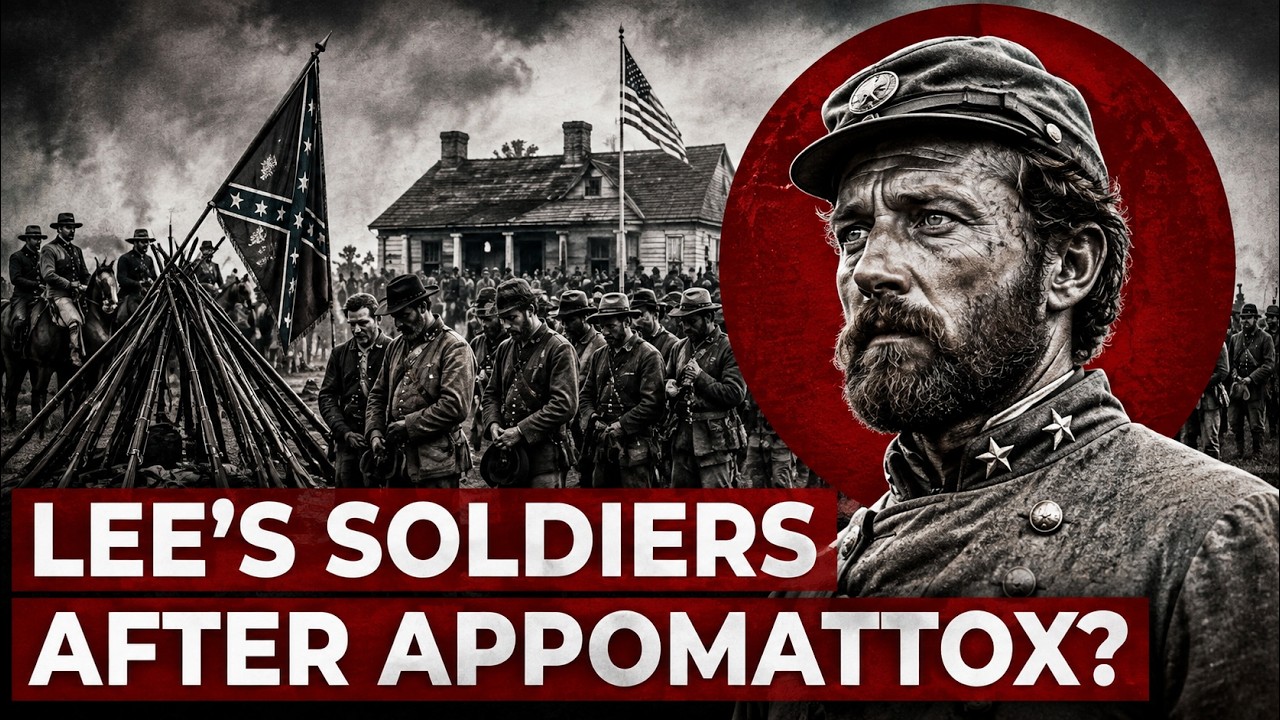
Rifles were stacked, battle flags were surrendered, and artillery and other government property changed hands. Roughly 22,000 infantrymen participated in the formal surrender process, while thousands of other members of Lee’s army were processed separately. By the end of the paroling operation, 28,231 Confederate officers and men had officially received paroles at Appomattox. Then something remarkable happened.
They were sent home. Not to prison camps, not to mass trials, not to execution grounds. But home was no longer the place they remembered. Their money was collapsing into worthlessness.
Farms, railroads, livestock, and towns had been damaged or destroyed. Slavery, the labor system upon which much of the Confederacy’s wealth and political order had rested, was dying with the Confederacy itself. Federal troops now occupied southern communities. Formerly enslaved people were claiming freedom, and many returning soldiers did not even know what legal rights they still possessed.
To understand what Appomattox took away, it is important to understand what the Army of Northern Virginia had become. When Robert E. Lee took command of Confederate forces defending Richmond in 1862, he inherited an army that would become the Confederacy’s most celebrated military institution. For almost three years, it fought in Virginia, Maryland, and Pennsylvania against successive United States commanders.
Its campaigns included the Seven Days, Second Manassas, Antietam, Fredericksburg, Chancellorsville, Gettysburg, The Wilderness, Spotsylvania, Cold Harbor, and Petersburg. The army was not socially uniform. Some soldiers came from wealthy slave-holding families. Many more came from modest farms, villages, and trades.
Some volunteered enthusiastically in 1861, others entered under the Confederacy’s conscription laws. Motivations ranged from commitment to Confederate independence and protection of slavery to loyalty to state, community, family, or comrades. But the political government the army defended had been created by slave-holding states that seceded in the crisis over slavery, and the survival of slavery remained inseparable from the Confederacy’s social and economic order. By 1865, the army had also become a society.
Men who had spent years marching, fighting, starving, burying friends, and surviving battles together understood themselves through regiments, brigades, and comrades. For young men who had entered the war as teenagers, military life could represent nearly their entire adult experience. Lee became its central symbol. Victories such as Second Manassas, Fredericksburg, and Chancellorsville created a reputation for resilience that survived Gettysburg.
As Confederate fortunes deteriorated elsewhere, Lee’s army remained one of the principal barriers between Union forces and Richmond. Appomattox would destroy the institution around which tens of thousands of men had organized their lives. In the spring of 1865, the army was already being destroyed before anyone raised a white flag. For approximately ten months, Lee’s forces had defended Richmond and Petersburg against Ulysses S.
Grant’s armies. Grant did not need to capture every Confederate trench. He needed to keep extending the pressure until Lee lost the railroads and roads that fed his army. One supply line after another disappeared.
The men suffered from shortages of food, clothing, horses, and equipment. Desertion increased as soldiers received letters describing hunger at home. Then the structure collapsed quickly. On April 1, Union forces won the Battle of Five Forks, southwest of Petersburg.
On April 2, Grant launched a major assault against the Petersburg defenses. The Confederate line was broken, and Lee informed the government that Richmond and Petersburg would have to be evacuated. That night, the army began moving west. Lee intended to obtain supplies, move south, and eventually join General Joseph E.
Johnston’s army in North Carolina. If the two forces could combine, organized resistance might continue. But retreat required time, and Lee was running out of it. Union cavalry moved aggressively against his routes while federal infantry covered extraordinary distances to remain close behind.
On April 6 came the disaster at Sailor’s Creek. Separate portions of Lee’s retreating army were cut off and attacked. More than 8,000 Confederates were killed, wounded, or captured, including numerous senior officers. The losses represented roughly one-fifth of the army Lee had possessed immediately before the battle.
The surviving columns reached Farmville and continued west. Grant began sending messages proposing surrender. Lee was not yet prepared to accept. His remaining hope lay farther west, where supply trains carrying badly needed food had been sent toward Appomattox Station.
If the Confederates could reach those supplies and keep moving toward Lynchburg, perhaps they could still turn south. But Union cavalry under George Armstrong Custer reached the station first on April 8. The trains and large quantities of Confederate supplies were captured. Union forces now occupied the route Lee needed.
On the morning of April 9, Confederate troops pushed Federal cavalry backward at first. Then John B. Gordon saw Union infantry arriving behind them. Approximately 13,000 soldiers from the Army of the James were moving into position west of Appomattox.
Gordon informed Lee that his command could go no farther without major support. James Longstreet could provide none, as his troops were holding the rear against approaching Federal forces. The road west had closed. The army could continue fighting, but it could no longer escape.
Lee requested a meeting with Grant. The two commanders entered the home of Wilmer McLean at Appomattox Courthouse. Grant’s written terms were brief. Confederate officers and soldiers would give paroles promising not to take up arms against the United States until properly exchanged.
Weapons, artillery, and public military property would be surrendered. Officers could retain their side arms, private horses, and personal baggage. Once those conditions were fulfilled, the men could return home and would not be disturbed by United States authority as long as they obeyed their parole and the laws where they lived. Lee raised one additional practical issue.
Many Confederate cavalrymen and artillerymen regarded the horses and mules they rode as their own property and would need animals for planting crops. Grant agreed to allow men claiming private ownership to take them. Lee’s men were also hungry, and Grant offered 25,000 rations for three days. Some of those supplies had actually been captured from Confederate trains during the campaign and were now being issued back to the men whose army had lost them.
Implementation took several days. On April 10, officers from both sides worked out the details. A printing operation was established at the Clover Hill Tavern, and printers worked to produce more than 30,000 forms. The paroles identified their bearers as paroled prisoners, provided practical protection on the journey home, and could be used to obtain federal rations and transportation on government railroads and steamships.
On April 12, Confederate infantry marched forward by organization and surrendered rifles, flags, and equipment. Fitzhugh Lee, who had escaped the encirclement with much of the cavalry, returned and surrendered on April 12 as well. The Army of Northern Virginia had not been annihilated in one final battle. It had been administratively dissolved.
Men received slips of paper, surrendered government weapons, broke apart into small groups, and began walking away. But Appomattox did not end the entire Civil War. Johnston’s major force surrendered later in North Carolina, Richard Taylor surrendered forces in Alabama in May, the Trans-Mississippi Department followed in June, and Stand Watie’s Confederate Allied Command surrendered later that month. Lee’s soldiers could be traveling home through a South where the larger political war was still ending.
Then the political atmosphere changed dramatically. President Abraham Lincoln was shot on April 14 and died the following morning. The assassination intensified northern anger at the rebellion. A parole was not identical to a presidential pardon, and political restoration became a separate federal question.
On May 29, President Andrew Johnson issued an amnesty proclamation. Many former Confederates could obtain pardon by taking an oath of allegiance, but fourteen categories of people were excluded, including important Confederate officials and officers. Even Lee submitted an application for pardon and signed an amnesty oath in October 1865, though he never received full restoration of citizenship during his lifetime. For ordinary soldiers, courtroom theory was often less urgent than survival.
They returned to a damaged economy, wrecked transportation systems, and destroyed agricultural resources. Confederate currency had lost its value. Emancipation transformed the labor system. For four million formerly enslaved Americans, Union victory meant the destruction of legal slavery.
Formerly enslaved people negotiated wages, searched for separated family members, established churches and schools, and entered political organizations. Former Confederates had to decide how they would respond. Most former soldiers did not become governors or famous writers. They returned to farms and workshops, entered railroads or trades, or moved west.
Disabled men faced decades of life with missing limbs and chronic wounds. The United States government did not treat Confederate service as deserving the federal veterans system. Southern states eventually created their own programs. Virginia began assisting severely disabled veterans with artificial limbs and later cash payments, and by about 1910 roughly 15,000 people were receiving Virginia Confederate pensions.
Some former soldiers moved far from the Confederate political world. James Longstreet went to New Orleans and became a Republican. In 1868, he endorsed Grant for president. During the violent confrontation in New Orleans on September 14, 1874, Longstreet helped command the largely black Louisiana state militia against the Crescent City White League, a white supremacist organization attempting to overthrow Louisiana’s Republican government.
He was shot and briefly captured. A lieutenant general who had spent four years fighting United States armies was now serving a reconstruction government and facing armed white southerners who believed that government illegitimate. John B. Gordon followed almost the opposite path.
He became one of the most influential former Confederates in Georgia, opposed reconstruction, and became associated with the campaign to restore white democratic control. Historical evidence connecting Gordon to the post-war Ku Klux Klan is substantial, and he is generally acknowledged to have headed the Klan in Georgia during that period. He later became a United States Senator, Governor of Georgia, and one of the leading public interpreters of Confederate memory. William Mahone took yet another route.
He assembled railroad lines across Virginia and then organized the Readjuster movement, which argued that part of the state debt should be renegotiated so more money could be spent on public schools. Poor and middle-class whites joined African-American voters in the Readjuster Party. Mahone entered the United States Senate in 1881 and caucused with Republicans. Former Confederate identity did not dictate one inevitable post-war political position.
Perhaps the strangest transformation belonged to Fitzhugh Lee. Robert E. Lee’s nephew escaped the surrender, gave himself up on April 12, and was later pardoned. He became governor of Virginia.
Then in 1896, President Grover Cleveland appointed the former Confederate cavalryman United States Consul General in Havana. When the Spanish-American War began in 1898, Fitzhugh Lee was appointed a major general of United States Volunteers. Thirty-seven years after leaving the US Army to join the Confederacy, he put on the American uniform again and finished his career as a brigadier general in the regular United States Army. The Army of Northern Virginia never reformed.
As an organized military institution, it ended at Appomattox. But its veterans created another institution in its place: memory. During the decades after the war, former Confederates wrote memoirs, attended reunions, joined veteran associations, and helped determine how younger generations understood the conflict. Out of these efforts emerged the Lost Cause, which portrayed Confederate soldiers as heroic defenders of home, minimized slavery’s central role in secession, and claimed Confederate armies had been defeated only by overwhelming Northern resources.
Appomattox itself became a national parable of honorable warriors reconciling after a tragic family conflict. There was truth inside that story. Grant’s terms really were restrained. Lee really did surrender rather than sacrifice his remaining army.
Tens of thousands of men really were permitted to go home instead of being confined as prisoners. But the simplified story left people out. Thirty-nine black people received paroles with the Army of Northern Virginia at Appomattox, identified not as Confederate soldiers but as enslaved or free black people impressed into labor as cooks, teamsters, blacksmiths, musicians, and servants. The harder question was what those men would do with defeat.
That answer took half a century to unfold. Most were paroled and sent home, not collectively imprisoned or permanently outlawed. But they did not return to the society they had left. Slavery was ending, Confederate independence was dead, federal power had expanded, and black Americans were free and demanding citizenship.
Each veteran had to decide what defeat meant. Some accepted the new nation. Some tried to rebuild the old racial order. Some crossed party lines.
Some eventually served the United States they had once fought. The Army of Northern Virginia therefore disappeared twice: first as a military organization at Appomattox, then much more slowly as its veterans died. What survived was memory and the fight over what their defeat was supposed to mean.