On October 12, 1964, less than three weeks after the Warren Report declared that Lee Harvey Oswald had acted alone in killing President John F. Kennedy, Mary Pinchot Meyer was shot twice on a quiet towpath along the Chesapeake and Ohio Canal in Georgetown. The first bullet struck her in the back. The second was fired point-blank into her head.
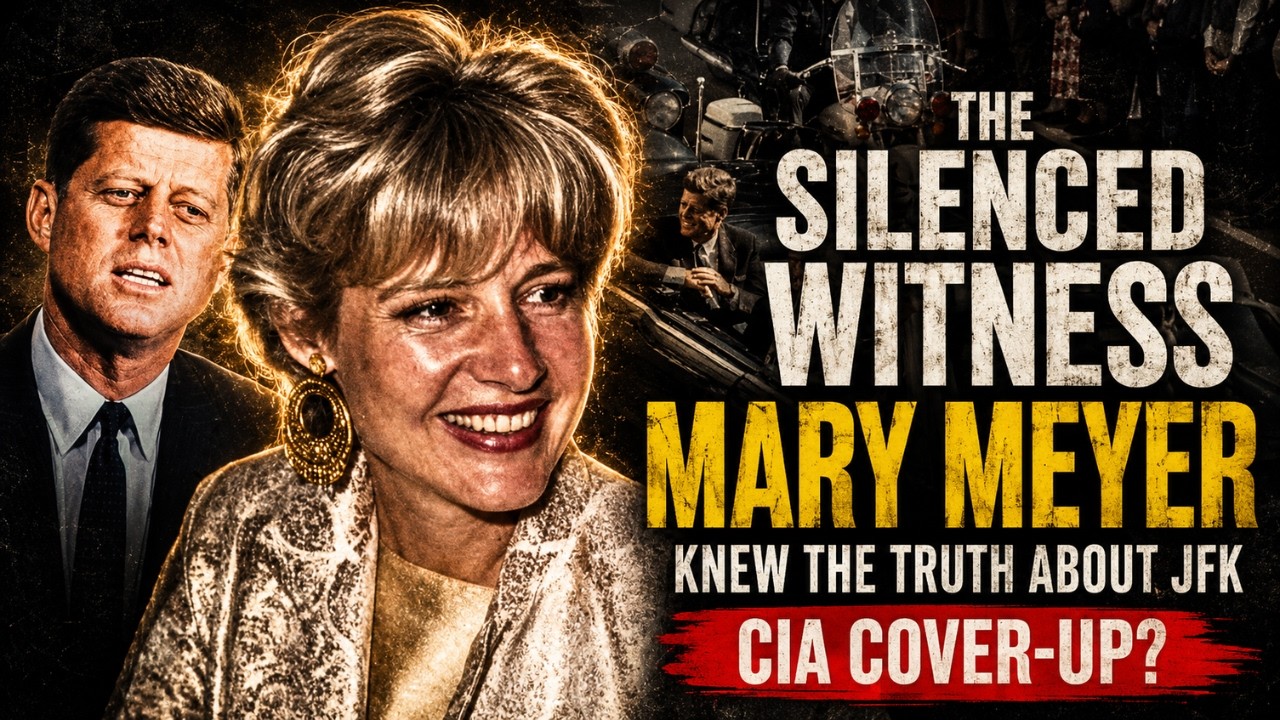
Nothing was stolen. Her purse lay untouched. Within forty-five minutes, police arrested Ray Crump Jr. , a small, soaking-wet day laborer found a half mile away, and charged him with first-degree murder.
The case appeared closed before the body was cold. Mary Pinchot Meyer was born on October 14, 1920, into the upper reaches of the American elite. Her father, Amos Pinchot, was a wealthy lawyer and political activist. Her mother, Ruth Pickering Pinchot, was a journalist and feminist.
Their homes in New York and Pennsylvania operated as political salons. Mary grew up at dinner tables where senators and union organizers debated the machinery of government, and she was trained from childhood to question authority. She attended the Brearley School, entered Vassar in 1938, and developed a deep suspicion of corporate power and the military-industrial complex. After graduating in 1942, she worked as a journalist for United Press, learning how the media could be manipulated by those in power.
In 1944 she married Cord Meyer, a decorated Marine Corps officer scarred by combat in the Pacific. Together they became leading figures in the United World Federalists, a movement pressing for world government to prevent future war. But the Cold War rendered their idealism obsolete. In 1951, CIA director Allen Dulles recruited Cord into the agency.
He rose through the ranks and took charge of international operations, including the manipulation of global media outlets. Mary found the work morally repulsive. Their marriage deteriorated. In 1956 their nine-year-old son was killed by a car.
Two years later, Mary divorced Cord and moved into a converted garage studio in Georgetown, where she immersed herself in abstract painting. By late 1961, she had begun a private romance with President Kennedy. She was unlike the other women in his orbit. She was an intellectual peer who challenged his policies and pressed him to move away from the aggressive Cold War posture advocated by the Pentagon and the CIA.
After the disastrous Bay of Pigs invasion in 1961, she reinforced his growing distrust of the intelligence community. During the Cuban Missile Crisis in October 1962, according to accounts later reported by insiders, she was brought secretly into the White House and urged him to resist the military’s demand for an airstrike and to pursue a diplomatic resolution. In the spring of 1962, she traveled to Cambridge and met Dr. Timothy Leary, the Harvard psychologist conducting clinical research on psychedelics.
She told him she wanted to administer LSD to powerful men in Washington to shift their worldviews away from war. Leary taught her the protocol and supplied her with laboratory-grade substances. Over the following year, Kennedy’s foreign policy moved dramatically toward de-escalation. In June 1963, he delivered the American University address, called for a reexamination of the Cold War, pushed for a nuclear test ban treaty, and began planning a withdrawal from Vietnam.
The intelligence community tracked the connection between her visits and the president’s shift. She was an unvetted civilian with dangerous influence over the commander in chief. She was marked. On November 22, 1963, Kennedy was assassinated in Dallas.
Mary did not accept the official narrative. She had the instincts of an intelligence insider from her years married to a CIA operative. She recognized the silencing of Oswald on live television as a classic operation, and she saw Allen Dulles’s presence on the Warren Commission as a guarantee of a cover-up. She began investigating on her own, using her access to Washington’s elite social circles to gather information.
Everything she learned went into a sketchbook bound in sandpaper, which she filled with names, dates, details of her conversations with Kennedy, and her evidence connecting the assassination to factions within the intelligence apparatus. The Warren Report was released on September 24, 1964. Mary openly mocked it in Georgetown social circles and told friends she was continuing her investigation. Less than three weeks later, she was executed in broad daylight on the towpath.
The killing bore the signature of a professional operation: the shot to incapacitate, the point-blank kill shot, the weapon taken from the scene. The police needed a suspect and found Ray Crump. Crump matched no physical evidence. He weighed 130 pounds.
He had no scratches. A paraffin test showed no gunshot residue. The murder weapon was never found. The police pursued him anyway.
His defense attorney, Dovey Johnson Roundtree, was a Black woman who had fought her way through the racism of the legal system. She took the case for one dollar. She dismantled the prosecution’s case through the lack of physical evidence, the inconsistencies of the only eyewitness, and the physical impossibility of the state’s story. After eleven hours of deliberation, the jury acquitted Crump on July 23, 1965.
The verdict proved an innocent man had been framed. No new investigation followed. No new suspects were named. The case was closed.
The night of the murder, Mary’s sister Tony and her husband Ben Bradlee discovered that James Jesus Angleton, chief of counterintelligence for the CIA, was inside Mary’s studio with lock picks. Angleton told them he was there to protect the family and the legacy of President Kennedy. Days later, Tony found the diary hidden in a steel box. Under the belief that she was protecting Mary’s memory, she handed it to Angleton on the condition that he read it and destroy it.
He took it to his personal safe at CIA headquarters and kept it there for years. It was returned to the family only after Angleton was forced out in the late 1970s. Tony then burned the diary herself. The sole physical record of Mary’s investigation was erased.
The murder inquiry was never reopened. The people who knew the most kept silent for decades. Ben Bradlee concealed the Angleton break-in until his 1995 memoir, and even then softened its meaning. Cord Meyer remained loyal to the agency and rose to become CIA station chief in London.
But in 2001, dying of cancer, he gave one final answer about the murder of his ex-wife. Asked who pulled the trigger, he replied: “The same sons of bitches that killed John F. Kennedy killed Mary. ”
The towpath remains quiet.
No one has ever been convicted of killing Mary Pinchot Meyer. The killer vanished. The diary was burned.
The story of the woman who tried to change the minds of the men who controlled the nuclear arsenal was buried by the very system she tried to dismantle.