In the summer of 1997, twenty thousand people stood soaking wet outside Detroit. It was not rain. It was soda—two-liter bottles of Faygo, grape and orange and red pop, launched from the stage in long arcs, exploding on impact and drenching the crowd from the floor to the back wall. The audience screamed, held out their arms, and opened their mouths to catch the spray.
At the center of it all was the most controversial music act in America, Insane Clown Posse, and the cheap Detroit soda they had turned into the defining ritual of their live shows. Newspapers called the music degenerate. Parent groups called it dangerous. Radio stations refused to play it.
And every single bottle thrown was Faygo. Three years later, the company that made it quietly reported its best regional sales numbers in a decade. But the real story of Faygo is not what happened in 1997. It is what the brand was before any of that, and why, alone among the great regional soda empires of the twentieth century, it was still standing when every one of its rivals had already disappeared.
The story begins in Detroit in 1907. The city was not yet the Motor City. Henry Ford had incorporated four years earlier; General Motors was still a year away. The population was pushing three hundred thousand and climbing fast, swollen by thousands of workers arriving from Poland, Hungary, and Ukraine, from the Jewish communities of Eastern Europe.
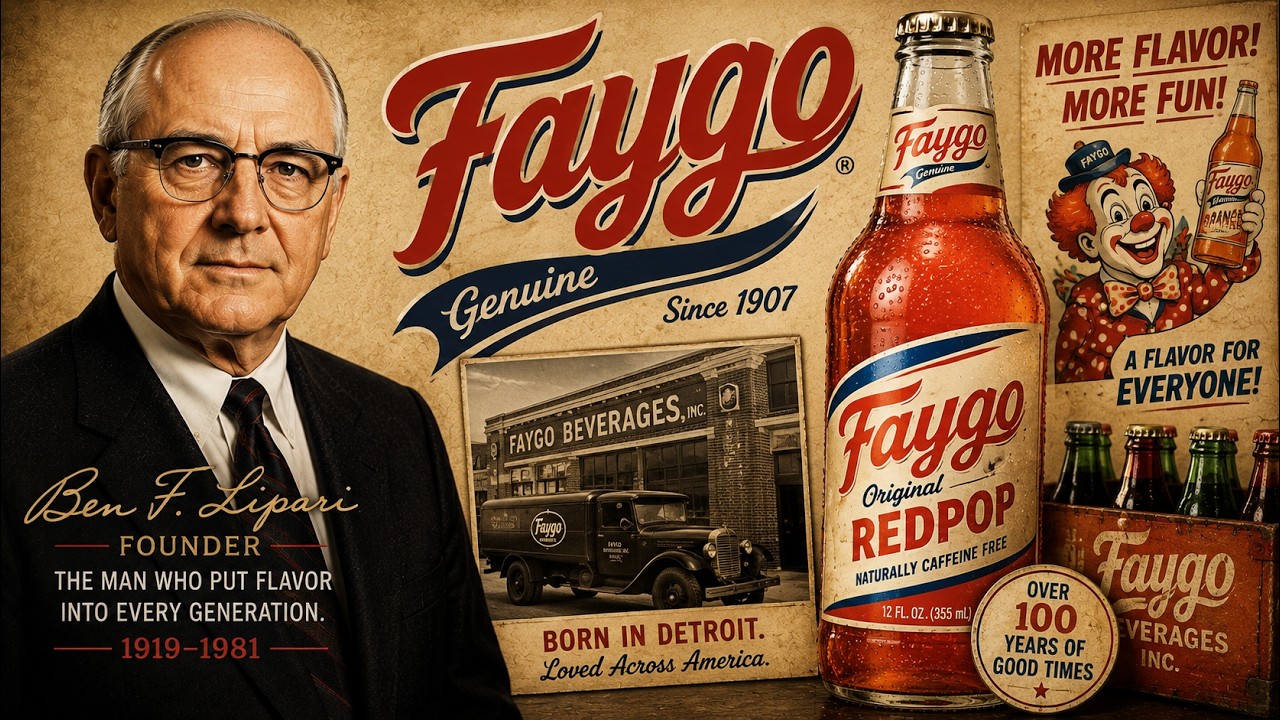
Among them were the Figen brothers, Ben and Perry, Russian immigrants brought to Detroit as children. Their father settled the family in the city’s Jewish immigrant corridor, where Yiddish was spoken on the street and a man’s credibility was judged by his trade. Ben and Perry had learned theirs early. Both had been professional bakers, running a small commercial operation that supplied bread and cake flavorings to the city’s growing working-class neighborhoods.
They knew sugar. They knew how to build flavor from cheap ingredients. Most of all, they knew how to price a product so a man earning factory wages could still afford it. In 1907, they looked at the beverage market and saw a gap.
Soft drinks in Detroit were expensive, inconsistent, and controlled by regional distributors serving the middle-class grocery trade. A Coca-Cola cost a nickel at a soda fountain, fine for a Saturday afternoon but not a daily habit for a man pulling ten-hour shifts. Nobody was making a soda specifically for the factory worker, the immigrant family, the household that bought in volume because buying in volume was the only way to make the money stretch. The Figen brothers did not think like chemists or marketers.
They thought like bakers who understood one thing with precision: if you make something good enough and cheap enough, the customer will find you. They founded the Figen Brothers Bottling Works, operating out of a rented facility on Gratiot Avenue on Detroit’s east side, loaning approximately two thousand dollars against family connections within the immigrant community. The first bottling line was secondhand. The first flavors—fruit punch, grape, and a cream soda variant—they developed themselves, drawn directly from the flavoring knowledge they had built in the bakery trade.
First-year production was modest, roughly a thousand cases in the opening months, sold door-to-door and through small grocery operations. The price was set deliberately below every competitor, not slightly below but meaningfully below, a price that communicated without a word of advertising exactly who this soda was for. The name Faygo came later, a compression of Figen, shortened for the bottle label. Easier to say, easier to remember.
By the time it appeared on their first standardized label in the early 1920s, the brothers had built what most soda operations of that era never achieved: a loyal repeat customer base that did not need to be convinced. They already knew the product. They already trusted the price. They came back because nothing else in their neighborhood gave them what Faygo gave them—variety, reliability, and a cost that did not require a second thought.
That foundation was not a marketing strategy. It was a survival philosophy. By the 1930s, Faygo was offering over a dozen flavors. By the postwar years, more than thirty.
Eventually, it would exceed fifty, a number no national brand ever matched, and no regional competitor came close to sustaining. Two flavors became permanent anchors of the brand’s identity. Red pop, a red cream soda of ambiguous fruit origin, became the emotional signature of the brand, the flavor children asked for by name, the flavor that appeared at birthday parties throughout the 1940s, 1950s, and 1960s in working-class Detroit households. Rock and Rye, a rye-whiskey-flavored soda with a cream base, became the adult anchor, tasting like the bar-and-grill culture of the upper Midwest, like Detroit itself.
The packaging strategy was equally deliberate. Faygo moved early into large-format bottles, the 28-ounce returnable glass bottle becoming a Detroit household staple through the 1950s and 1960s. A family of four could get through a Sunday afternoon on one bottle of Faygo; the same money spent on Coca-Cola bought half as much. In a household where the weekly grocery budget was fixed, that arithmetic was not a minor consideration.
It was the entire decision. The returnable bottle system also created what the national brands could not replicate: a local distribution infrastructure built on neighborhood loyalty. The empty bottles came back, were sanitized, refilled, and went out again. The plant was in the neighborhood.
The trucks were in the neighborhood. The price was built for the neighborhood. The postwar years were very good to Detroit, and they were very good to Faygo. Between 1945 and 1965, the automobile industry entered the most sustained period of prosperity in its history.
Union wages were rising. A family that had survived the depression on fourteen dollars a week was now bringing home eighty to one hundred dollars, buying houses in the suburbs, televisions, a second car, and, on Saturday afternoons, soda by the case and by the crateful. In 1956, Faygo launched what would become its most enduring campaign, a jingle built around a simple repeating hook listing flavors in sequence over a melody simple enough for a six-year-old to memorize. It ran on Detroit television throughout the late 1950s and into the 1960s.
It embedded the brand in the childhood memory of an entire regional generation. If you grew up in Michigan between 1950 and 1965, you heard that jingle before you started school. You knew the flavors before you could read the labels. By 1960, Faygo was producing an estimated sixty million bottles annually, holding commanding market share across southeastern Michigan, with significant presence in northern Ohio and growing distribution into Indiana and western Pennsylvania.
One in three soft drinks sold at independent grocery stores in Detroit’s east side neighborhoods in 1962 was a Faygo. The 1960s brought the first serious pressure. Coca-Cola and Pepsi, having consolidated national distribution, turned their attention in the early 1960s to regional markets they had never fully penetrated. The strategy was not subtle: drop prices in targeted zip codes, flood local grocery chains with promotional allowances, fight for refrigerated shelf space.
Faygo did not flinch. The response was characteristically practical—more flavors, lower prices, and a new packaging innovation. Faygo moved aggressively into the returnable 64-ounce bottle format in the mid-1960s, a full half-gallon of soda priced at a point that made any national brand competitor look extravagant. The national brands could undercut a 12-ounce can.
They could not undercut a half gallon. When the 1967 Detroit uprising left forty-three dead and more than a thousand buildings burned, the aftermath accelerated the suburban exodus that had been building for a decade. Businesses left. The tax base collapsed.
Faygo stayed. It was a decision made by a family company with deep roots in a specific place, not a strategic calculation by a corporate board. The plant remained on Gratiot Avenue. The trucks kept running the same routes through neighborhoods that national brands had written off as commercially marginal.
Because Faygo stayed when others left, it inherited loyalty in Detroit’s black working-class communities that sustained its market position through the economic devastation of the 1970s. By 1980, Faygo remained the dominant regional soft drink brand across southeastern Michigan, and the flavor count had reached fifty-five distinct varieties, more than any American brand, national or regional. In 1987, the Figen family sold Faygo. The buyer was National Beverage Corporation, a Fort Lauderdale holding company run by a businessman named Nick Caporella.
National Beverage already owned several regional soda labels. Faygo was the largest acquisition it had ever made. The sale price was not publicly disclosed. For loyal customers, the immediate impact was invisible.
The flavors did not change. The trucks kept running. Nothing a drinker could see or taste or feel was different. But something structural had shifted.
A brand built on the logic of a family company—stay local, stay cheap, stay present—now answered to a holding company whose core incentive was return on capital. For several years, that conflict did not surface. Caporella’s approach to regional brands was hands-off by design; he understood that the value he had purchased was the local loyalty that heavy corporate interference would destroy. Distribution continued.
Flavor development continued. The price discipline held. The late 1980s and early 1990s changed the competitive landscape. This was the era of the discount cola wars.
Walmart’s Sam’s Choice Cola, launched in 1992, undercut nearly every regional brand in the country. Cott Corporation supplied store-brand sodas to major grocery chains at costs that made regional brands looked expensive. The structural advantage Faygo had held since 1907 was being attacked from below. The brand had always won on price; now there were competitors with lower prices.
The brand had always won on variety; now grocery chains offered their own store brands in a dozen flavors. The brand had always won on local loyalty; now local stores were being replaced by national chains whose shelf-space decisions were made in corporate offices in Arkansas and Minnesota. Distribution territory contracted. The western Pennsylvania presence became difficult to justify.
Indiana distribution thinned. In Cleveland, presence dropped by an estimated forty percent between 1990 and 1997. In Pittsburgh, distribution became sporadic enough that retailers stopped dedicating permanent shelf space. The empire was not collapsing; it was contracting, market by market, route by route, pulling back toward the Michigan core that had always been its foundation.
And then in 1997, something happened that no contraction could have predicted. Insane Clown Posse was not looking for a brand partnership. Joseph Bruce and Joseph Utsler, two Detroit natives who performed as Violent J and Shaggy 2 Dope, had been using Faygo at live shows since the early 1990s. The origin was practical, not theatrical.
They needed something cheap to throw at the audience, something in two-liter bottles costing less than a dollar, purchasable by the case from any Detroit grocery store. Faygo was the obvious answer, not because of what it meant but because of what it cost and where they lived. The ritual escalated with the audience. By 1997, a gathering involved thousands of two-liter bottles per show.
Getting soaked in Faygo the central physical experience of attending a show, a baptism of sorts, grotesque and communal, deliberately transgressive. The media noticed the music first and the soda second. Articles about Insane Clown Posse mentioned Faygo the way you mention a prop. What none of those articles tracked was the sales data in the markets where the group had strong followings.
Faygo began appearing in stores that had never carried it before, not because of distribution pushes from National Beverage but because fans requested it, because a nineteen-year-old in rural Ohio wanted to bring a two-liter to the next party and recreate something he had experienced. National Beverage said nothing publicly, no endorsement, no distancing statement. Endorsing the association risked alienating the core customer; denouncing it risked alienating new customers buying the product in genuine volume. The holding company found itself unable to control what the brand meant.
Faygo existed in two separate realities. In Michigan, it remained what it had always been: cheap, reliable and familiar. In the secondary markets where Insane Clown Posse’s fan base had established itself, it was a symbol, a tribal marker meaning you had been to the show. The product was identical.
The meaning was unrecognizable. The brand meant something it had never meant, to people it had never targeted, in a context it had never chosen, and it could not go back. Faygo is still made in Detroit. In the context of American regional soda history, that is extraordinary.
RC Cola is brewed under license by a subsidiary disconnected from its southern roots. Nehi exists as a trademark held by a holding company producing it sporadically for nostalgia retail. Shasta, Squeeze, NuGrape survive as ghost brands. Faygo survived with the plant, with the city, with the roots.
National Beverage made one decision no analyst would have predicted from a holding company: it left Detroit alone. The Gratiot Avenue facility, updated and modernized through the 1990s and 2000s, remains the production center for every bottle of Faygo sold in the United States. The price discipline held. A two-liter bottle of Faygo in a Detroit grocery store today costs roughly eighty-nine cents.
A two-liter of Coca-Cola in the same store costs two-forty-nine. The arithmetic built into the brand in 1907 survived every ownership transition, every market pressure, every identity crisis. The Insane Clown Posse association did not destroy Faygo. Evidence suggests it may have extended the brand’s commercial life into markets it would never have reached through conventional distribution, Tennessee, Missouri, the Carolinas, states where fans sought the product out and retailers responded.
What the association cost is harder to quantify. A certain kind of customer, the one who remembered the jingle, who bought red pop for the grandchildren, who carried the brand as a piece of personal regional identity, found the new visibility uncomfortable. Not offensive, not a reason to stop buying, but a reminder that the thing they thought they owned exclusively was now shared with strangers who had arrived through a completely different door. The Gratiot Avenue plant is still there.
The sign still reads Faygo. A short distance from where two brothers from Russia first rented a building, filled secondhand bottles with grape soda, and sold them to the people who lived nearby, a truck backs up to the loading dock. Cases come off the line—red pop, rock and rye, moon mist—still made there, still priced for there, still poured cold by someone who grew up with it in a city that outlasted almost everything built to serve it.