The covered wagon that carried American families west was never the grand Conestoga of popular imagination. It was a plain farm wagon, a wooden box roughly four feet wide and ten feet long, two or three feet deep, fitted with curved wooden bows and a cover of oiled canvas. Some beds ran to twelve feet, and with the bows the whole rig stood about ten feet tall, stretching nearly twenty-three feet from tongue to tail. There were no real springs; the bed sat almost directly on the axles, so every rock and rut over two thousand miles of unpaved country came straight up through the floorboards.
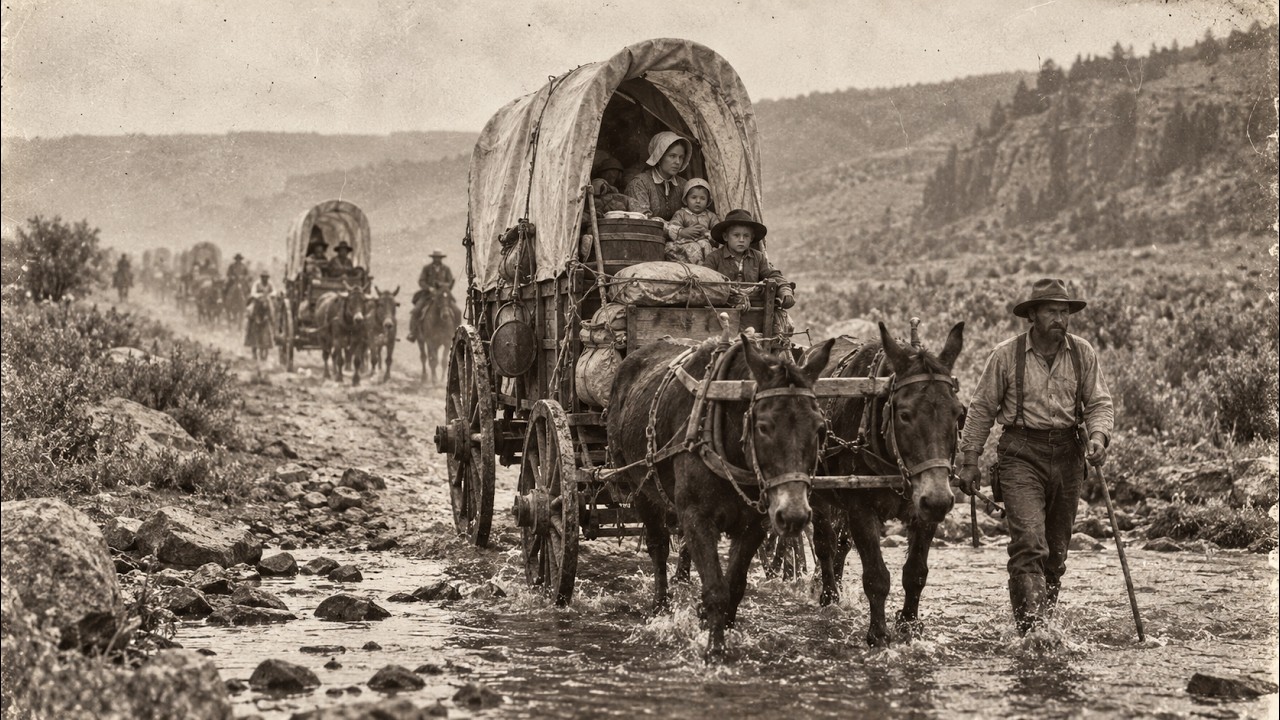
Built tight, the box could be caulked with tar and floated across deep rivers like a barge, with oxen swimming alongside. It was warehouse, shelter, and sometimes a boat. It was also the only home a family had for months, separated from the open country by nothing but a sheet of canvas. The real master of the journey was arithmetic.
A loaded wagon was meant to carry around two thousand pounds, with an absolute ceiling of about twenty-five hundred if the oxen were to survive the distance. Food was non-negotiable. Guidebooks told a family to carry 150 to 200 pounds of flour per person and around one hundred pounds of bacon per person, plus cornmeal, dried fruit, beans, coffee, sugar, and salt. For a family of five, the flour alone came to 750 to a thousand pounds.
Add the bacon and they were past twelve hundred pounds before loading a single tool, blanket, or child’s shoe. Food consumed most of the allowance, leaving perhaps seven or eight hundred pounds for every other object they would own for the rest of their lives: tools to build a house and break ground, pots, bedding, spare clothes, a rifle and ammunition, spare wagon parts, seed for the first crop. In whatever was left, if anything, went the clock, the books, the good dishes, the rocking chair. Most families chose oxen over horses or mules.
An ox cost a fraction of a good mule, was stronger and had greater endurance, ate the grass it found along the trail, held up better in bad weather, and was far less likely to be stolen. In exchange, the family accepted the single most important limitation of the journey: speed. An ox walks at about two miles an hour, and that plodding pace set the tempo of the entire migration. On a good day over decent ground a train made twelve to fifteen miles; on a bad day, far less or nothing at all.
The family kept this up for four to six months, from the Missouri River to the Pacific slope. They did not ride in the wagon. The box was packed to its limit, and a springless wooden box dragged over rocks and ruts was one of the most punishing rides ever devised, but the deeper reason was weight. A grown adult was 150 pounds the oxen could not afford.
So the mother and father walked, and the children who could walk walked, herding loose cattle, gathering buffalo chips, chasing the little ones. The wagon was a creaking warehouse, and the family were foot travelers escorting their own possessions across a continent. A few hundred miles in, the arithmetic everyone ignored at the outfitting store came due. Grass grew thinner as thousands of animals ahead ate it down, water got farther apart, grades got steeper.
Oxen began to weaken, stumble, go lame, and die in their yokes. There was no third choice: lighten the wagon or be stranded where being stranded meant death. The cast-iron stoves went over the side, then the heavy furniture, the wardrobes, the bed frames, and the pianos, the single most valuable object many families owned, hauled five or six hundred miles and then abandoned in the dirt. Sewing machines, iron plows, kegs of whiskey, blacksmith anvils, chests of China, trunks of books.
At Fort Laramie in what is now Wyoming, where the easy first third of the trip ended and the hard climb began, so many wagons lightened their loads that families called it Camp Sacrifice. During the Gold Rush year of 1849, the piles of cast-off goods included roughly twenty thousand pounds of rotting bacon, thrown out by men who had overpacked and needed the weight gone. Ask almost anyone what killed pioneers on the way west, and the answer comes back as attacks and circled wagons. It is almost entirely false.
The historian John Unruh counted roughly 362 immigrants killed by Native Americans between 1840 and 1860; over the same two decades, immigrants killed more than 425 native people. Most of the trouble was theft, an ox or horse taken in the night. The circled wagon and the last stand were, for the most part, a myth. What actually killed one in every ten people who set out was disease, above all cholera.
The trail was a perfect machine for spreading it. Thousands of people and animals moved along the same narrow track, drinking from the same rivers and springs, camping in the same fouled ground. A person could be healthy at breakfast, feel the first cramp by noon, and be dead and buried by dark. After disease came accidents.
Rivers were the worst; there was no bridge for most of two thousand miles, and people drowned at crossings again and again. Small children walking beside the wagon all day would stumble under the wheels and a loaded wagon weighing a ton did not stop for a child. Being run over by the family’s own wagon was one of the commonest ways for a child to die. There were accidental gunshots, weather, cold, and plain exhaustion.
At least twenty thousand people are thought to have died along the route, about ten graves for every mile. The National Park Service still calls it the nation’s longest graveyard. The worst demonstration of what happened when this arithmetic went catastrophically wrong came in the summer of 1846, when a group of families left Springfield, Illinois, bound for California. About 87 people in 23 ox-drawn wagons, led in part by a farmer named George Donner, were well outfitted, some of their wagons famously heavy and slow.
At Fort Bridger they turned off the proven trail onto the Hastings Cutoff, a shortcut promoted by Lansford Hastings. It was a catastrophe: about 125 miles longer than the road they left, through country nobody had ever brought wagons through. They hacked a road through mountains tree by tree, nearly died of thirst crossing a waterless salt desert that took days when they had been promised one. Oxen died, wagons were abandoned, and every lost day pushed them later into the season, toward the one deadline that does not negotiate: snow.
They reached the eastern slope of the Sierra Nevada in late fall with barely a hundred miles to go. An early savage blizzard closed the pass and buried the trail in snow too deep for a wagon, an ox, or a person to cross. They built rough cabins near a lake and waited. Food ran out.
The first rescuers did not reach the survivors until February 19, 1847. Of the roughly 87 who set out, only about 47 were still alive, and some of those who lived did so by eating the bodies of those who had died. The Donner Party was the whole logic of the journey pushed to its terrible conclusion: a wagon too heavy, a route too long, oxen that gave out, and a clock running down toward the snow at the pace of a walking ox. Most families made it.
Somewhere between 300,000 and 500,000 people crossed on those trails, most often reckoned around 400,000, and the great majority survived to reach Oregon and California and start the farms and towns they had crossed a continent to build. But every one of them arrived with less than they left with. The wagon that rolled into the Willamette Valley was lighter because the family had spent two thousand miles deciding, object by object, what their lives were actually made of. The people are gone now, but the trail is not.
In places like Guernsey, Wyoming, and at South Pass, the wagons crossed the same soft rock so many thousands of times that the wheels cut ruts several feet deep, still there today. Iron tires on stone carved a groove in the earth that has outlasted everyone who made it. The object left a deeper mark than the people did. The box, the weight, and the slow grinding wheels wrote themselves into the ground in a way a life never could.
That is what a covered wagon really was: a decision, four feet wide and ten feet long, about what a family could bear to keep and what it would have to leave lying in the grass behind it.