On the 3rd of September, 1939, a 25-year-old Englishwoman sat alone on a park bench in Munich. She was holding a small pistol. It had been a gift from Adolf Hitler. Her name was Unity Valkyrie Mitford, and by that point she had spent more time in the Führer’s personal company than any other British citizen alive.
She had been named after Wagner, and had been conceived near a town in Ontario called Swastika, where her father once owned a gold claim that produced nothing. These facts sound invented. They are not, and they are not even close to the strangest part of her story, or the story of her family. Unity had five sisters.
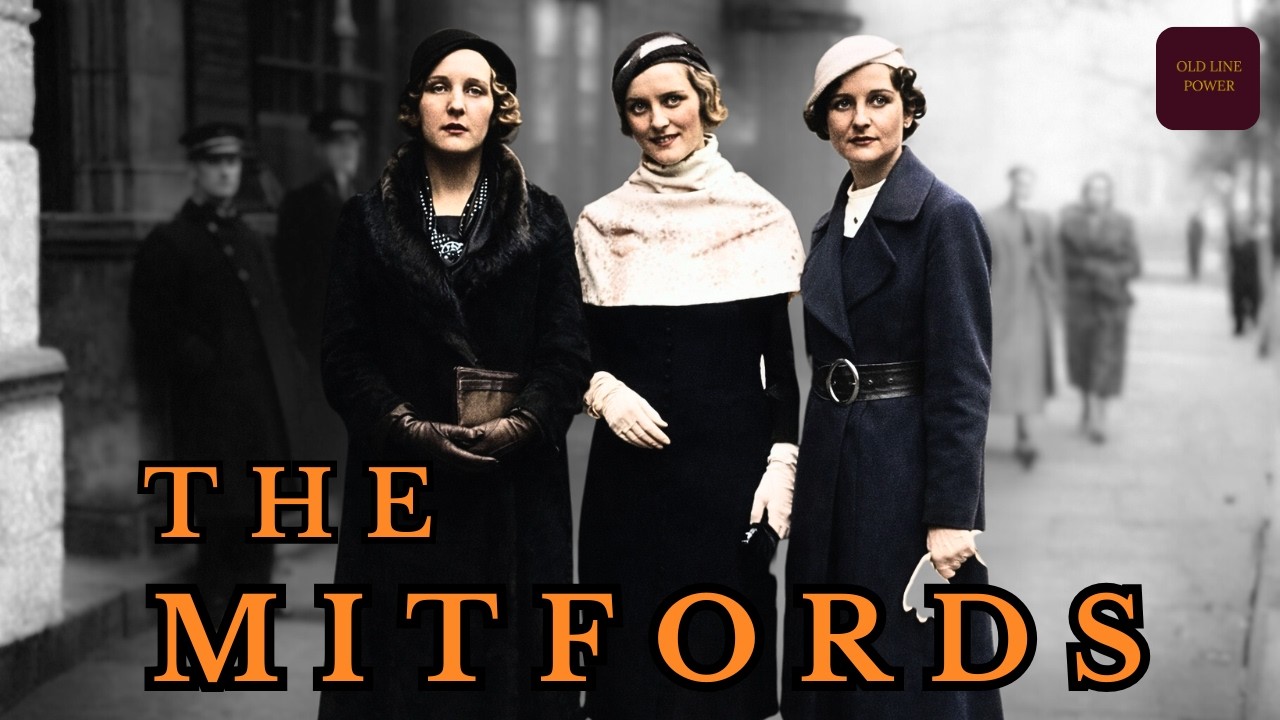
All six were raised in the same Oxfordshire countryside, by the same parents, under the same roof. None of them went to school; their father thought educating girls was a waste of time, and their mother believed most illnesses could be cured without a doctor. Out of that house came a fascist, a communist, a novelist who reshaped English literature, a duchess who saved one of the greatest country estates in England from demolition, a woman who stalked Hitler across Munich until he agreed to have lunch with her, and one sister who did none of these things and instead raised chickens in Gloucestershire. Their father, David Freeman Mitford, the second Baron Redesdale, was a man held together by contradictions.
He had fought in the Boer War and come home missing a lung, served again in the First World War with the Northumberland Fusiliers, inherited a title, and then spent the next forty years failing at nearly everything except fatherhood. The title came with estates in Gloucestershire, Oxfordshire, and Northumberland but almost no liquid money. He claimed, apparently sincerely, that he had only ever read one book in his entire life, White Fang by Jack London, and said he enjoyed it so much he saw no reason to risk disappointment with another. Their mother, Sydney Bowles, was his opposite.
Her father had founded The Lady magazine and the original Vanity Fair, and from him she inherited an absolute certainty about how the world should operate. She believed children should spend as much time outdoors as possible, that doctors were largely unnecessary, and that formal education for girls was a waste of money. Their only son, Tom, was sent to Eton; the six daughters received governesses of varying quality who came and went with regular frequency. The family produced seven children in sixteen years: Nancy in 1904, Pamela in 1907, Tom in 1909, Diana in 1910, Unity in 1914, days after Britain declared war on Germany, Jessica in 1917, and Deborah in 1920.
The home the children remembered with real warmth was Asthall Manor, a Tudor house beside the River Windrush. It had a stone barn converted into a library with a piano, and it was in that barn that the Mitford children discovered books, music, and each other. They invented a private language, called their parents Moove and Farve, gave each other nicknames that stuck for decades, and held meetings in a warming cupboard beneath the stairs that they called, with total seriousness, the Hons’ cupboard. Then David built Swinbrook House in a nearby village, and the daughters never forgave him.
The bedrooms were small, the girls were packed in together, and the house felt to its youngest inhabitants like a punishment. Nancy was the first one out. She was twenty when the 1920s arrived, and she attached herself to the social scene the newspapers called the bright young things. She fit in immediately, funnier than most and sharper than almost all of them.
She fell in love with Hamish St. Clair Erskine, a charming, well-connected young man who was not interested in women; their engagement dragged on for five years and produced nothing except what Nancy herself later called five years of humiliation and wretchedness. What no romantic disaster could damage was her ability to write. Her first novel, Highland Fling, appeared in 1931; a second and third followed.
The real books were still more than a decade away, but the habit of turning private life into public comedy was already fixed. Diana, six years younger, occupied entirely different territory. She was, by near unanimous testimony, extraordinarily beautiful. At eighteen she was presented at court and within months had secretly become engaged to Bryan Guinness, heir to the Guinness brewing fortune.
They married in 1929 and became the golden couple of London society. It lasted four years. In 1932, at a house party, Diana met Oswald Mosley. He was forty-five; she was twenty-two.
He was married, a sitting member of Parliament, and in the process of founding a political movement that would consume her life and define her reputation for the next seventy years. By the time Diana met him, Mosley had just launched the British Union of Fascists, modeled on Mussolini’s movement. Diana left Bryan Guinness. Her family was appalled.
Within a year she was effectively Mosley’s mistress; his wife died in 1933, and when Diana made her first visit to Nazi Germany that summer, Unity went with her. Together they attended the Nuremberg rally, the first since the Nazi rise to power. It was a spectacle engineered to overwhelm, and on Unity it worked completely. On the 6th of October, 1936, Diana and Oswald Mosley married in secret, in the drawing room of Joseph Goebbels’s Berlin home.
Hitler was present as a guest of honor. No member of Diana’s family was there, and no announcement was made in the British press. The marriage remained hidden until the birth of their first son in 1938. Unity’s obsession had begun even earlier.
In the autumn of 1934, a nineteen-year-old English girl began appearing at the Osteria Bavaria, a small Italian restaurant in Munich where Hitler regularly ate lunch. She came alone, sat at a nearby table, and waited. For ten months, Unity Mitford sat in that restaurant, sometimes for hours, waiting for Hitler to acknowledge her existence. In February of 1935, he sent the restaurant owner to her table with an invitation to join him.
They talked for over thirty minutes, and he began seeing her regularly. He was intrigued by a series of coincidences: her birthplace was a town called Swastika, her middle name was Valkyrie, after Wagner, and her grandfather had translated the works of Houston Stewart Chamberlain, a foundational anti-Semitic thinker whose writing Hitler admired. He awarded her a golden swastika badge and arranged a private box at the 1936 Berlin Olympics. Unity’s diaries, authenticated by historians in January of 2025, record 139 meetings between 1935 and 1939.
Eva Braun despised her. Albert Speer noted that Unity was the only person in the private circle who dared to discuss politics openly. MI5 took her seriously; the head of British counterintelligence believed her access to the German leadership constituted a genuine security threat and recommended consideration for prosecution under treason laws. Nothing came of it.
Jessica, five years younger than Unity, shared a bedroom with her at Swinbrook. Unity covered her wall with swastikas; Jessica pinned up a hammer and sickle and a small photograph of Lenin. Their parents, as far as anyone recorded, did not intervene. Jessica had been planning to leave since the age of twelve, when she opened a savings account she called her running away account.
The clearest catalyst for her politics was probably the simplest: her sisters Diana and Unity had chosen fascism, so Jessica chose the opposite. In 1937, at nineteen, she met Esmond Romilly, her second cousin and a nephew of Winston Churchill, who had fought with the International Brigades against Franco. Within weeks they eloped, and the story made front page news across England. They settled briefly in London; Jessica gave birth to a daughter in December of 1937, who died five months later in a measles epidemic.
In February of 1939 they left England for America. When the war began, Esmond enlisted in the Royal Canadian Air Force, and on the 30th of November, 1941, his bomber failed to return from a raid over the North Sea. He was twenty-three. Jessica was twenty-four, alone in Washington with their small daughter, and she made a decision that held for the rest of her life: she would not go back.
She never spoke to her father again. At 11:15 on the morning of September the 3rd, 1939, Neville Chamberlain addressed the nation by radio. Britain was at war with Germany. The Mitfords were scattered across three countries, and the news hit each of them in a different place.
Unity was in Munich; she had refused to leave despite repeated warnings from Hitler himself. On the afternoon of the broadcast, she walked to the Englischer Garten, sat down, and shot herself in the head with a pistol. She survived; the bullet entered her right temple and lodged in her brain. Hitler visited her and arranged for her hospital bills to be paid, and through diplomatic channels, for her eventual transfer to a clinic in Bern.
When her sister Deborah arrived to bring her home, she found someone she barely recognized: Unity had lost nearly thirty pounds, and the bullet was still in her head, too dangerous to remove. Diana was in England, under surveillance for months. In May of 1940, she and Mosley were both arrested under defense regulation 18B, which allowed the government to detain anyone suspected of being a threat to national security without charge or trial. They would remain imprisoned for over three years.
What made Diana’s arrest particularly bitter within the family was the role Nancy played in it: Nancy had been in contact with MI5 and had provided information about her sister, telling intelligence officers Diana was far cleverer and more dangerous than her husband. Tom joined the army. He had sympathized with Germany throughout the 1930s, but he would not fight against her; when the European war reached its final phase, he requested a transfer to Burma rather than take part in the invasion of Germany. Lord Redesdale, who had supported appeasement, reversed himself completely the moment war was declared.
His wife did not; she had written articles praising Hitler, and she held to those views. The disagreement cracked their marriage open, and they separated. Tom was killed on the 30th of March, 1945 in Burma, struck by a bullet during an assault near Sagaing; he died six days later from the wound. He was thirty-six.
Nancy learned of his death while finishing a novel; she kept working. During the war she had worked at the Heywood Hill bookshop in Mayfair, and in September of 1942 she met a Free French colonel named Gaston Palewski, a close confidant of Charles de Gaulle. Nancy fell completely; he became the love of her life, though the feeling was never equally returned. The affair gave her a subject.
In 1944, encouraged by Evelyn Waugh, she began writing a new novel, given three months leave from the bookshop. The result was The Pursuit of Love, published in December of 1945. It sold 200,000 copies within a year, a barely disguised portrait of her own family. After the war she moved to Paris and stayed in France for the rest of her life.
Palewski never married her; in 1969 he married a duchess without formally ending his relationship with Nancy. Nancy was diagnosed with cancer in the early 1970s and died on the 30th of June, 1973, at her home in Versailles. She was sixty-eight. In Washington, Jessica had read about Unity’s suicide attempt in a newspaper.
After Esmond’s death, she rebuilt from almost nothing. She met Robert Treuhaft in 1943, a civil rights lawyer whose politics aligned with hers, and they married that same year. Jessica became an American citizen in 1944. In 1963, her book The American Way of Death appeared, an investigation of the American funeral industry that documented selling techniques, false claims that embalming was required by law, and casket manufacturers marketing sealed bronze containers with no scientific basis.
The entire first print run sold out on the day it was published. It prompted a Federal Trade Commission investigation. Her first book had been Hons and Rebels in 1960, telling the story of her childhood from the perspective of the one who had rejected it most completely. She never reconciled with Diana.
Jessica died on the 23rd of July, 1996, in Oakland. She was seventy-eight. Deborah, the youngest, married the second son of a duke. Four years later, Andrew’s elder brother was killed in action, making Andrew heir to the dukedom.
When the 10th Duke died unexpectedly in 1950, Deborah and Andrew inherited Chatsworth House, 35,000 acres of Derbyshire, and a tax bill of 7 million pounds, roughly 300 million in today’s money, at an 80% inheritance tax rate that the law’s timing had failed to avoid. It took twenty-four years to clear the debt. Deborah moved in during 1959 and built a business, restoring the house room by room, opening a farm shop in 1977, adding restaurants and gift shops, and operating the ticket office herself on busy days. By 2002, Chatsworth was financially self-sufficient for the first time, covering its annual costs entirely through its own income.
Deborah died on the 24th of September, 2014, at ninety-four. The last Mitford sister gone. Pamela never made headlines. She married Derek Jackson, a millionaire physicist; after their divorce in 1951, she spent the next two decades living with an Italian horsewoman in the Gloucestershire countryside, keeping horses, growing vegetables, and known primarily for her expertise with poultry.
She died in 1994 at eighty-six. Unity never recovered. The bullet remained in her brain for the rest of her life. She was brought back to England and cared for by her mother, first at Swinbrook and later on an island in the Scottish Hebrides.
She could walk; she could speak, but she was not the person she had been. In May of 1948, swelling around the wound became infected, and she died of meningitis on the 28th of May. She was thirty-three. Diana and Mosley were released from Holloway in November of 1943, denied passports until 1949.
They settled near Paris, where Diana lived for the rest of her life. She published a memoir in 1977, never disavowed her political views, and in a 1989 television interview denied the Holocaust and spoke of Hitler with warmth. She died in August of 2003, aged ninety-three, during the Paris heatwave. Their father had died in 1958, frail and largely alone in Northumberland; Sydney survived him by five years.
They never reconciled. Four of the sisters are buried in the churchyard at St. Mary’s Church in Swinbrook: Nancy, Unity, Diana, and Pamela. Tom’s memorial tablet is inside the church.
Jessica is buried in Oakland; Deborah is buried on the Chatsworth estate. Six sisters, one nursery, every direction the twentieth century had to offer. And in the end, most of them came home.