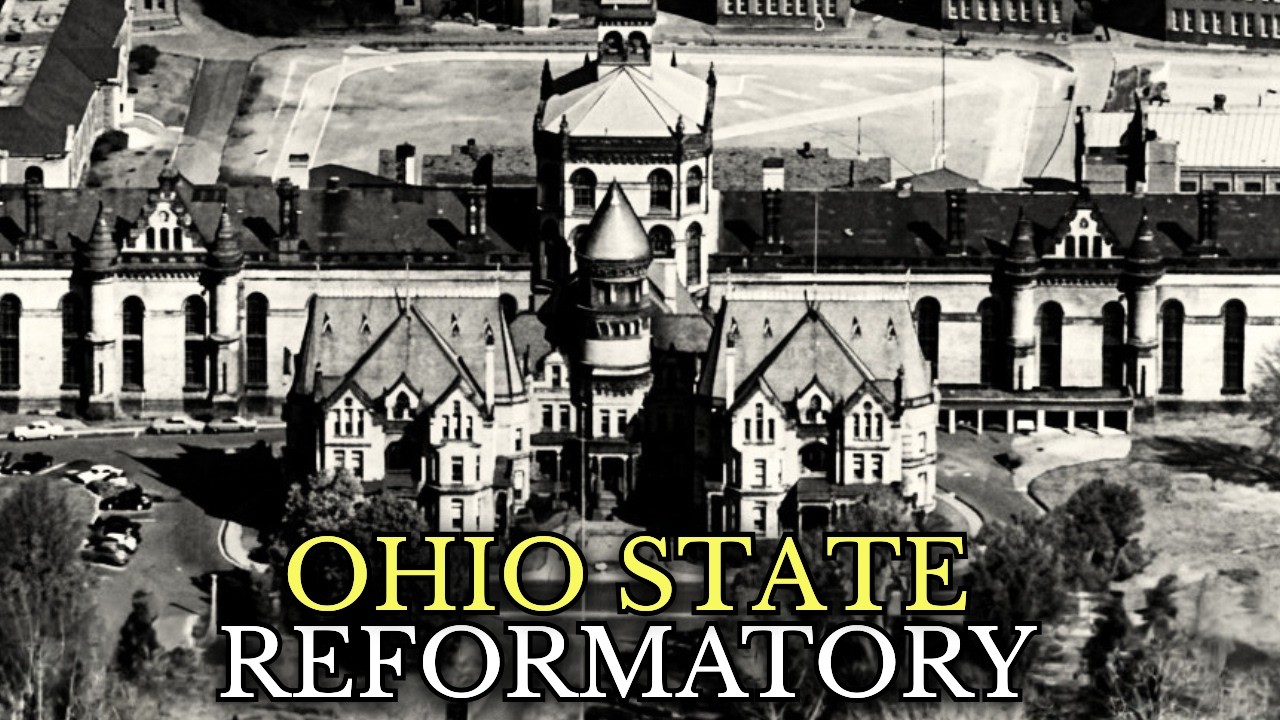
The Ohio State Reformatory in Mansfield, Ohio rises from the flatlands with Gothic spires and castle towers, its limestone facade stretching nearly the length of a city block. Millions of people recognize it as the fictional Shawshank State Prison from the beloved film about Andy Dufresne and Ellis Boyd Redding, a story of hope and endurance inside brutal walls. But before Morgan Freeman ever walked through those gates, the building had another history entirely. A warden’s wife was shot dead there, in her own quarters, by a pistol that was dislodged from a closet and discharged on impact.
Guards were beaten to death. Men lost their minds in total darkness. A federal judge found that conditions inside the walls violated the Constitution of the United States. The same building that became the world’s most famous symbol of hope was one of America’s most condemned prisons.
In 1886, Ohio began building something new. The Civil War had been over for two decades, and the country was wrestling with rising poverty and crime. Prisons of the era were dark, overcrowded, brutal places that operated on the philosophy that suffering was its own deterrent. But a new idea was gathering force: crime was not simply a moral failing to be punished, but a social condition to be treated.
A young man who made a wrong turn could be remade, with the right environment, guidance, faith, labor, and education, into a productive human being. This was the Reformatory ideal, and in 1884 the Ohio State Legislature decided to build it. The chosen ground already carried history. During the Civil War it served as Camp Mordecai Bartley, a military training ground where young men prepared for the violence of war.
Now a different kind of young man would be sent there, not to prepare for battle, but to be saved from the battle they had lost with themselves. The city of Mansfield raised $10,000 to secure the site. The state acquired 150 more acres for $20,000. By completion, the total cost reached $1,326,000.
This was not a political gesture; it was a statement of institutional intention in stone and iron. The architect was Levi T. Scofield of Cleveland, who approached the commission more like a mission than a contract. He did not design a prison.
He designed something resembling a German cathedral with the proportions of a feudal castle, towers reaching upward, arched windows catching light. The architecture was part of the rehabilitation program itself. The idea was that a man walking through those doors every day, looking up at those towers, would feel that he was in a place that took him seriously as a human being capable of becoming better. Construction was a twenty-four-year ordeal.
Ground was broken in 1886; the building was not considered complete until 1910. Funding shortfalls and legislative delays stretched the project at every turn. Supervising architect Friedrich Ferdinand Schnitzer orchestrated the physical reality of construction, and his name is carved into the cornerstone, the only signature in stone on the entire structure. When the facility was finally complete, the governor presented Schnitzer with a silver double inkwell at a formal ceremony.
It was the last uncomplicated moment the building ever had. The Ohio State Reformatory officially opened in September 1896. The first 150 inmates arrived by train from Columbus and were handed tools to build the prison sewer system, then the twenty-five-foot stone wall that would surround the complex for the next ninety-four years. The men sent here to be reformed began their reformation by building their own prison, raising the wall that would contain them.
For a time, the system worked. Inmates were not given fixed sentences proportional to their crimes; they were given eighteen months regardless of the charge. At the end of those eighteen months, the institution determined whether the man had been reformed. If yes, he was released.
If no, another eighteen months was added. The burden was placed on rehabilitation, not punishment. In the 1890s, that was a philosophical revolution. The program rested on three pillars: religion, with both Protestant and Catholic services held in the main chapel connecting the east and west wings; education, with inmates able to earn the equivalent of a high school diploma; and trade, with every inmate learning practical skills that translated directly into employment upon release.
The East Cell Block rose six tiers, the largest freestanding steel cell block in the world, a record it still holds. Each cell had its own sink and toilet, private facilities that were a luxury in an American prison of the 1890s. The reformatory ran its own power plant, farm, and workshops, modeling a productive society in miniature. And former inmates came back voluntarily, after their release, to thank the staff and lead tours for visitors.
For a period in the early decades, the institution was producing exactly the outcome it was designed to produce. Then it started to bleed. In 1926, Urban Wilford, a seventy-two-year-old guard, was shot and killed by Philip Orlik, a paroled inmate who returned to the grounds during what appears to have been a failed escape attempt. Orlik was arrested two months later and executed in the electric chair.
The building absorbed the incident, filed the paperwork, and continued operating. Four years later, in 1930, a fire broke out at the Ohio State Penitentiary in Columbus. More than three hundred inmates died in a single night. The survivors were redistributed across Ohio, and hundreds arrived at the reformatory, hardened, violent men who had survived one of the worst nights in American penal history.
The institution did not choose to become something different; something different was imposed on it by a fire forty-five miles away. In 1932, twelve prisoners attempted a mass escape. They beat guard Frank Hanger, age forty-eight, to death with an iron bar for his keys. Two ringleaders were convicted and executed in 1935.
In the summer of 1948, former inmates John West and Robert Daniels kidnapped the honor farm superintendent, his wife, and their twenty-year-old daughter. All three were murdered. Their bodies were found in a cornfield. West and Daniels went on a two-week crime spree across Ohio that the press labeled the Mad Dogs.
Six people were dead by the end. West was shot and killed by police; Daniels was executed by electric chair. Over the reformatory’s operational lifetime, more than two hundred inmates died within its walls. Most were never claimed by their families and were buried in a cemetery on the prison grounds, their headstones carrying numbers, not names.
In 1935, Arthur Lewis Glattke became warden. The appointment was political, a reward for work on Governor Martin Davey’s campaign. But by every available account, Glattke grew into the role with genuine care. He was remembered for arranging radio music to be piped into the cell blocks, a modest but human gesture.
The warden’s quarters occupied a section of the administrative wing. The reformatory was not where Glattke went to work; it was where he lived. Helen Bauer Glattke had been living inside those walls since 1935 as well. In November 1950, she was in the closet retrieving her jewelry box.
A pistol was dislodged, fell, struck the floor, and discharged. Helen was shot inside her own home. She survived the initial wound, but pneumonia set in, and on the third day she died. Glattke stayed.
On February 10, 1959, he suffered a massive heart attack in his office and died at his desk, twenty-four years of service inside the institution that had taken his wife and then him. Across the late 1940s and through the 1960s, the rehabilitation mission was quietly set aside. Trade apprenticeships were discontinued or reduced. Educational programs shrank.
The chapel became a diminished space. Overcrowding filled the void. By the late 1970s, 2,200 men were confined in a facility designed for a fraction of that number. Cells built for one held two or three.
The private sinks and toilets were shared among men with no privacy. The ratio of inmates to staff made supervision structurally impossible. Violence became a feature of the environment rather than a deviation from it. In the lowest section of the facility was the hole: ten small cells with no natural light, temperatures at extremes, where men were placed for days without hearings.
Some men who went in did not come back mentally intact. On at least one occasion, two men were placed in the same solitary cell; only one came out alive. There was also an instrument of punishment known among inmates as the butterfly, a category of cruelty this account will not detail. Rats moved through the cell blocks as a persistent presence.
Disease moved through the overcrowded population, and inmates died from neglect, from the simple failure to provide adequate care. In 1959, a man named Frank Freshwaters arrived, convicted of manslaughter. His behavior was exemplary, and he was transferred to the honor farm for his compliance. Then he escaped.
He kept escaping for decades, not found until 2015, in his eighties, one of the longest active fugitive cases in Ohio history. In 1978, the Council for Human Dignity helped 2,200 inmates sue. The case, Boyd v. Denton, filed in the United States District Court for the Northern District of Ohio, argued that conditions inside the reformatory violated constitutional rights.
The suit succeeded. A court mandated that the facility could house no more than 500 inmates at a time. There were 2,200 men inside it. In the early 1980s, federal judge Frank J.
Battisti examined the facility, reviewed the overcrowding, the violence, the solitary confinement cells, the disease, the neglect. He found that the conditions constituted cruel and unusual punishment, language from the Eighth Amendment to the Constitution. In 1983, he determined that the Ohio State Reformatory, as operated, violated the supreme law of the land. The Boyd Consent Decree required the facility to cease operations as a correctional facility by the end of December 1986.
The deadline was extended. On December 30, 1990, the last inmate walked out. The following day, the facility officially ceased operations as a correctional institution, ninety-four years after the first 150 men arrived by train and were handed tools to build their own walls. Most of the outbuildings were demolished.
The twenty-five-foot stone wall was torn down. The main building was left standing, left to peel and rust and deteriorate. In 1993, three years after the last inmate walked out, a film crew arrived. The production was an adaptation of a Stephen King novella, an adaptation of a story about an innocent man’s unbreakable hope inside a corrupt prison, about friendship and endurance.
They found the Ohio State Reformatory. Morgan Freeman and Tim Robbins walked corridors where men had lost their minds in total darkness, where more than two hundred inmates had died and been buried by number rather than name, where a federal judge had walked years earlier and found violations of the Constitution. The warden’s office in the film is the same office where Arthur Glattke died at his desk. The building’s exterior provides the establishing shots.
The production moved through the building, repurposing its spaces without having to work hard. The building had been telling its story for ninety-four years. The Shawshank Redemption was released in September 1994. It climbed every ranking it touched, finding audiences who saw in it the insistence that hope is the most durable thing a human being carries.
The Mansfield Reformatory Preservation Society was founded in 1995, the year after the film found its audience. The society was formed to save the building from demolition, reportedly acquiring it from the state of Ohio for $1. The state donated the dollar back. A building that a federal court had declared unconstitutional, abandoned and left to rot, was saved by a movie about the endurance of hope.
Today the Ohio State Reformatory is open to the public year-round. Guided tours move through the filming locations. The warden’s office looks as it did during production. The cell blocks are open for examination.
People come for the film or for the history, and find a building that has been, in documented historical sequence: a Civil War training ground, a reformatory built on sincere ideals, a maximum security prison defined by overcrowding and documented cruelty, a building condemned by a federal court as unconstitutional, a film set, and a museum. The gothic towers are still visible from the road. The east cell block still holds the world record. The warden’s office still looks the way it did when the cameras were rolling.
The prison cemetery is still there, beyond where the outer wall once stood, its numbered headstones marking places where men were laid into Ohio ground without their names. Ninety-four years of human lives passed through this building. It is still there. It does not resolve into a lesson, a warning, or a symbol of any single thing.
It simply stands, and the building gets inside you the way it has always done, and it stays there.