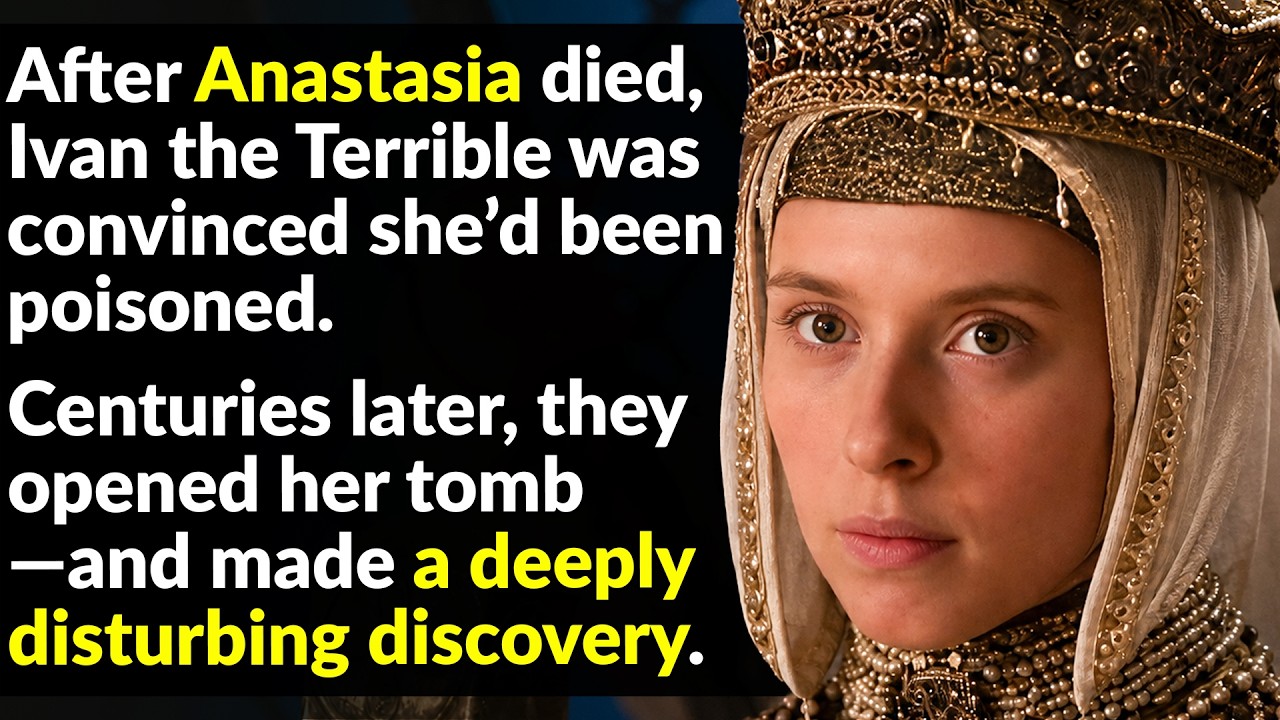
After the death of his wife Anastasia, Ivan the Terrible became convinced that she had been poisoned. For more than four centuries, the question went unanswered. In the 1990s, a team of forensic experts opened her grave to test the theory, and what their examinations revealed was deeply troubling. Anastasia Romanovna was never far from the heart of Russian imperial power.
Born around 1530, she was the youngest child of a noble family with excellent connections, although not at the very top of the Russian aristocratic hierarchy. Her father, Roman, was no ordinary boyar. He held the rank of okolnichy, the second-highest position in the medieval Russian royal court, serving during the reign of Grand Prince Vasily III. The family had spent decades cementing its closeness to the throne.
Her mother’s lineage was even more impressive, tracing directly back to the Rostislavich branch of the legendary Rurik dynasty. But Anastasia’s quiet childhood was about to be turned upside down. On February 16, 1543, her father died while she was still a child, leaving her, her siblings, and her mother to navigate court life without him. It was a blow that could have ended the hopes of any noble young woman.
Instead, fate made her the most influential woman in Russia. Four years later, in January 1547, a sixteen-year-old boy stood in the Cathedral of the Dormition and accepted a title no Russian had ever officially held before: Tsar of All Russia. That boy was Ivan, soon to be known as the Terrible. He was not yet terrible.
In fact, he was the most eligible bachelor in Russia. But rather than arranging a quiet diplomatic marriage, the young tsar had another idea. He opened the gates of the Kremlin and announced a formal bride show. Every noble family in Russia was invited to send its eligible daughters to Moscow.
Anastasia Romanovna traveled to the Kremlin to take part. Once she arrived, her life changed forever. When the bride show convened, the Kremlin filled with hopeful candidates. Estimates of how many noblewomen were paraded through its halls vary widely, but the most common figures range from five hundred to fifteen hundred.
Amid that crowd of silk, jewelry, and ambition stood a quiet noblewoman named Anastasia. The odds seemed overwhelmingly against her. But she had a special advantage: her uncle had been one of Ivan’s guardians during his turbulent childhood, meaning she had met the future tsar long before entering the bride show. According to legend, her future was sealed even earlier.
While passing through Moscow on religious business, Saint Gennady of Kostroma stopped at her father’s home, met the young Anastasia, and prophesied that she would one day become tsaritsa. Nobody present believed him. The prophecy came true. When Ivan’s eyes finally fell on Anastasia Romanovna during the bride show, the decision came quickly.
From among hundreds, perhaps thousands, of noblewomen, Ivan chose her at once for her beauty. Contemporaries described her as beautiful, with captivating eyes and a gentle face. But beauty was not her only asset. One source described her calming influence, her soft voice, and her unwavering kindness.
For a teenage tsar prone to fits of rage, those qualities proved invaluable. Ivan did not wait long. Two weeks after his coronation, on February 3, 1547, he stood before Anastasia Romanovna in the Cathedral of the Annunciation in Moscow and took her as his wife. Metropolitan Makary, who had crowned Ivan only days earlier, presided over the wedding.
And just as Makary had crowned Ivan, he granted Romanovna a title of her own. The moment she exchanged vows with Ivan, she became something no woman in Russian history had ever been: tsaritsa of All Russia. From the moment Anastasia entered Ivan’s life, those around him noticed a change. The young tsar, known for his volatile temper and tendency toward cruelty, seemed to soften in her presence.
Ivan adored her so completely that he swore to stay away from other women, a pledge almost no monarch made. According to one account, he never even looked at another woman during their entire marriage. The English envoy Sir Jerome Horsey witnessed the dynamic closely and later wrote that Ivan was a straightforward young man, and that Romanovna governed him with impressive gentleness and wisdom. But even if Ivan loved her, Romanovna was not safe.
The boyars watched with growing resentment as she exercised a quiet influence over her husband, the tsar. Sources record that, unlike her husband, the boyars received Romanovna at court with hatred and hostility. Their jealousy only grew when she strengthened her position by bearing Ivan heirs. Her thirteen-year marriage was far more fruitful than anyone expected.
The couple had six children in total: three daughters and three sons. But despite producing three male heirs, she barely secured the dynasty’s future. Of the six children she bore, only two survived to adulthood: her sons Ivan Ivanovich and Feodor. The other four, three daughters and one son, were lost to the brutal infant mortality of sixteenth-century Russia.
In 1554, Anastasia gave birth to another son, named Ivan after his father. For a time, the young tsarevich seemed like the heir who would secure his mother’s bloodline. Fate had darker plans. Six pregnancies in thirteen years of marriage to a tyrant had taken a brutal toll.
According to historical records, Romanovna was never in good health, weakened by frequent childbirth and illnesses that no one could treat. In the autumn of 1559, she was in the town of Mozhaysk when illness struck without warning. It was no passing fever or temporary chill. Court doctors did their best, but their efforts made little difference.
After nearly a year of prolonged illness, her strength finally gave out. On August 7, 1560, in Moscow, the tsaritsa of All Russia died at about the age of thirty. The marriage that had reshaped the Russian court and Ivan himself ended that simply. After her death, her body was taken to one of the most sacred sites in Russia, the Ascension Convent, where she received a burial befitting her unprecedented title.
For nearly four centuries, that was where she rested. In 1929, the convent was destroyed. Her remains, along with those of other royal women buried there, were carefully transferred to the crypt of the Archangel Michael Cathedral, also within the Moscow Kremlin. Her departure shattered her husband’s already fragile mind.
Sources describe her loss as a cruel personal blow to the tsar, one that worsened his volatile temper and unstable mental state. Without her, nothing restrained his bloodiest impulses. Her death also dismantled the political structure around him. The Chosen Council, an informal advisory body led by Ivan’s favorites, had been a stabilizing force during her lifetime.
Without her support, their influence faded by the early 1560s. Even Ivan knew nothing would be the same without her. In his later years, after earning the title “the Terrible,” he made a confession that echoed through history. He admitted that if Romanovna had not died, none of the atrocities he committed would have happened.
In his final moments, according to legend, Anastasia made one last plea: that he never marry a pagan. Overcome by grief and rage, Ivan did not honor her wish. Soon after her death, he married Maria Temryukovna, a Circassian princess, exactly the kind of bride Romanovna had warned him against. Shortly after her death, Ivan did not simply grieve.
He collapsed entirely, suffering a severe emotional breakdown. Worse, he became convinced that his beloved wife’s end had not been natural. He suspected that the nobles who had resented Romanovna at court had finally found a way to eliminate her with poison. He had no evidence, but he had power.
In the absence of any real proof, Ivan did what only a tsar could do: he made them pay anyway. He ordered the arrest of several nobles, subjected them to brutal interrogation, and eventually executed them. It was the first taste of what was coming. His suspicion did not come from nowhere.
Ivan had spent his childhood at the mercy of those very nobles, who were said to have mistreated him during his vulnerable early years. Any fragile peace he had made with the aristocracy shattered the moment Romanovna died. The most consequential decision of Ivan’s reign came directly from his grief. In response to her death and the poisoning he was certain had caused it, he created a terrifying new force of black-clad executioners known as the Oprichnina.
They answered only to him, always dressed in black, and existed for only one purpose: to terrorize people on his behalf. But perhaps Ivan was not wrong to seek vengeance. For more than four hundred years, the question of whether Anastasia Romanovna had truly been poisoned remained unanswered. Then, in the 1990s, a team of archaeologists and forensic experts opened her grave and began a careful examination of her remains.
Using a technique called neutron activation analysis, modern scientists examined her sixteenth-century remains and revealed the chemical traces left behind. The result was startling: acute mercury poisoning was confirmed beyond doubt. It seemed the nobles had indeed poisoned the tsaritsa of All Russia. Yet there was another explanation for the same evidence.
In Romanovna’s era, mercury was actually used as a medical treatment for a range of illnesses, meaning its presence in royal remains was not unusual. But the experts who examined her remains were firm on one point: the mercury levels in her bones were far too high to be explained by any medical dose. Even so, the question of whether she was murdered remains unresolved, because many royal remains from that era carry similarly elevated levels of toxic substances. It is possible she was not poisoned by malicious intent at all.
The treatments for her illness may have been the true cause of her death. Whatever the truth, Romanovna would have the last laugh. Her only surviving heir, Tsar Feodor I, ruled Russia from 1584 to 1598. When his reign ended, something far older ended with it.
Feodor died without leaving a child, and with him the entire Rurik dynasty, which had ruled Russia for centuries, came to an end. His childlessness plunged the country into the chaotic period known as the Time of Troubles, unintentionally paving the way for an entirely new ruling family: his mother’s own. Through her marriage to Ivan the Terrible and her blood ties to a family that would one day produce a new dynasty, Anastasia Romanovna became the link between two major ruling houses in Russian history: the Rurikids and the Romanovs. The Romanov name itself traces directly back to her family.
Her brother, Nikita Romanovich, had a son named Feodor Romanov, the first family member to use the Romanov surname, chosen in honor of her father, whom she had lost in 1543. The dynasty that ruled Russia for the next three centuries was in essence named after her father. When the Time of Troubles finally ended, the search for a new tsar led directly to her family. With Ivan’s direct line extinct, Russian authorities looked to the mother of the last Rurik tsar to find his successor.
The man they ultimately chose was none other than the grandson of her brother Nikita: Michael I, also known as Michael Romanov. Her memory still shapes Russian history today. In August 2010, the head of the Russian Imperial House, Grand Duchess Maria, established a new honor known as the Imperial Order of the Holy Great Martyr Anastasia, created in memory of the tsaritsa herself. Unlike her husband, her legacy inspired faith rather than fear.
The order is awarded to women who distinguished themselves in fields ranging from charity and culture to medicine, education, and science. Only those whose work served the nation and society receive the honor, exactly the kind of legacy Romanovna was known for during her lifetime. In the years after her death, Ivan married seven more times. Each was a hollow attempt to fill the void she left behind.
None succeeded. The fates of those later wives read like a sequence of horrors: poisoning, imprisonment, drowning, exile, and worse. Romanovna was his only true love, the beauty who met his brutality, the luminous side of his terrible character. That pattern hardened in 1581 in a horrifying incident.
In a fit of rage, Ivan attacked his pregnant daughter-in-law, causing her to miscarry. When his son, Tsarevich Ivan, rushed to intervene, the argument escalated. In a mad fury, Ivan seized his royal staff and smashed it against his son’s temple. As the young tsarevich lay bleeding on the ground, Ivan finally returned to reality.
He threw himself over his boy, sobbing and kissing his face, crying out: “I have killed my son. ” Anastasia Romanovna was fortunate she did not live to see it.