On July 3, 1863, two cousins stepped off together into the open fields south of Gettysburg, Pennsylvania. Cornelius and Everett Laprade had marched together since the early days of the war, crossed Virginia together, and even missed the Battle of Antietam together after falling sick at the same time. Now they were part of Pickett’s Charge, moving toward the stone wall on Cemetery Ridge. Somewhere between Seminary Ridge and that wall, one of them disappeared forever.
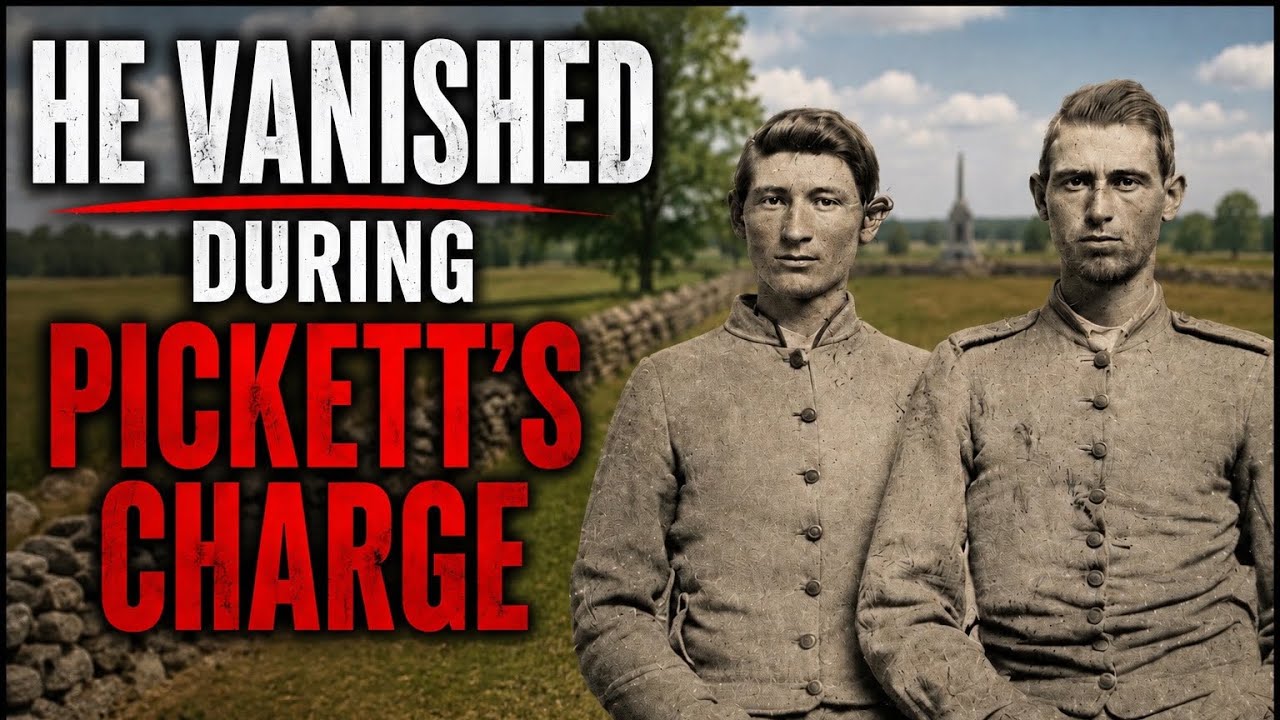
Cornelius and Everett Laprade were cousins from Chesterfield County, Virginia, just outside Petersburg and Richmond. One was a carpenter, the other a farmer. In 1861 they enlisted in Company I of the 14th Virginia Infantry. Because they served in the same unit, their military careers mirrored each other almost exactly.
They fought at Seven Pines, Malvern Hill, and through the Seven Days battles. Their simultaneous illness before Antietam kept them out of that bloodiest day, which may have saved their lives. But by the summer of 1863 they were healthy again and ready to follow their division north into Pennsylvania. At Gettysburg, the 14th Virginia served under Brigadier General Lewis Armistead in Pickett’s division.
On the afternoon of July 3, after a massive Confederate artillery bombardment, roughly 13,000 to 15,000 Southern soldiers stepped out of the woods on Seminary Ridge and began the long advance across roughly a mile of open farmland toward the Union line on Cemetery Ridge. The Laprade cousins were somewhere in that formation. Their route took them past the Codori house and barn, across the Emmitsburg Road, and then at a shifting angle toward the cluster of trees and the stone wall that became known as the Angle. The ground they crossed was not empty.
Union artillery on the heights fired down the length of the Confederate lines, and infantry packed behind the stone wall waited with loaded muskets. The Confederate soldiers had to break through fence rails and navigate uneven ground while under fire. Men began to fall long before they reached the Emmitsburg Road. The 14th Virginia had roughly 422 men in the fight that day, and about a quarter of them became casualties during the charge.
When the Confederate line reached the Emmitsburg Road, it broke apart. The advance had become a chaotic press of men pushing forward, stumbling over fences, and trying to keep formation while the guns tore into them. Ahead, the first wave of attackers had stalled at the wall. Armistead’s men, with Trimble’s division nearby, were supposed to provide the push that would break the Union line.
The 14th Virginia crossed the road and moved at the double quick toward the fighting. For a moment, their effort seemed to succeed. They drove some of the Pennsick Pennsylvania defenders back behind the stone wall at the Angle, and Confederate flags went over the wall. On the far side of the ridge, Robert E.
Lee saw that flag cross the wall and believed the charge had succeeded. He was mistaken. Around the Angle, the fight degenerated into a brutal, chaotic struggle. Men packed together so tightly that units lost all cohesion.
Armistead climbed over the wall with his hat raised on his sword, but all along the line the Confederate attack was failing. The Union line held. Confederate soldiers who had made it that far were being shot down, captured, or driven back. In the confusion, the Laprade cousins became separated.
It was impossible for them to keep track of each other in that press of men, smoke, and gunfire. Only after the fight was over would they realize that one of them was missing. Not every Confederate who reached the field pressed on to the wall. Many turned back across the open ground rather than throw themselves into a fight they knew was lost.
But Cornelius and Everett had come as far as the wall area with Armistead’s men. When the survivors finally sorted themselves out after the retreat, Cornelius Laprade could not be found. The initial reports suggested that Cornelius had been wounded and captured. But no hospital record in the Gettysburg area ever confirmed that he was treated or held as a prisoner.
No marked grave exists for him in Gettysburg or the surrounding countryside. He simply vanished. The aftermath of the battle made such disappearances easier to understand. The Union army controlled the field and buried its own dead promptly, with marked graves.
Confederate dead were treated differently. Many were gathered up and buried in mass pits, sometimes without any identification at all. Some were left where they fell until civilians came to bury them. Many local citizens did not regard the Confederate soldiers as Americans, but as rebels against the United States, and the treatment of their dead reflected that view.
Countless Southern soldiers who died at Gettysburg ended up in unmarked graves, their identities lost to history. There is another possibility, grim but plausible, that explains why Cornelius Laprade left so little trace. A man struck directly by an artillery projectile in that battle could be torn apart so completely that there was little left to identify. The fields around Gettysburg were littered with body parts in the days after the fight.
Soldiers gathering the dead often had to collect what remained of a man and bury the pieces together. When those improvised graves were later opened, the remains were moved to the cemetery, where they were interred among the unknown dead. Cornelius Laprade may well have died somewhere on that field, his remains gathered up with others and placed in an unmarked grave. No one will ever know for certain.
More than 160 years later, the landscape of Pickett’s Charge has changed. Tourists now walk the same fields where the Confederates advanced. The monuments scattered across the battlefield tell the stories of the commanders and the famous units that fought there. Armistead’s monument stands near the stone wall, and the ground in front of it is worn bare from the thousands of visitors who come to stand where he fell.
The Virginia monument across the field marks the starting point of the charge. But there is no monument to Cornelius Laprade. His memorial is the story of the common soldier, one of the thousands of ordinary men who crossed that field, fought in the chaos at the wall, and never went home.
His fate remains one of Gettysburg’s forgotten mysteries, a reminder that for many who fought there, the record of their last hour was never written down.