At its peak in 1999, CompUSA operated 229 stores across 84 American cities, employed nearly 20,000 people, and generated $6. 3 billion in annual revenue. It was the largest computer retailer in the United States, the Saturday morning destination where a generation of families drove to buy the machine that would change their household forever. The first location had opened only 13 years earlier at the intersection of Marsh Lane and Beltline Road in Addison, Texas, under a name nobody remembers: Soft Warehouse.
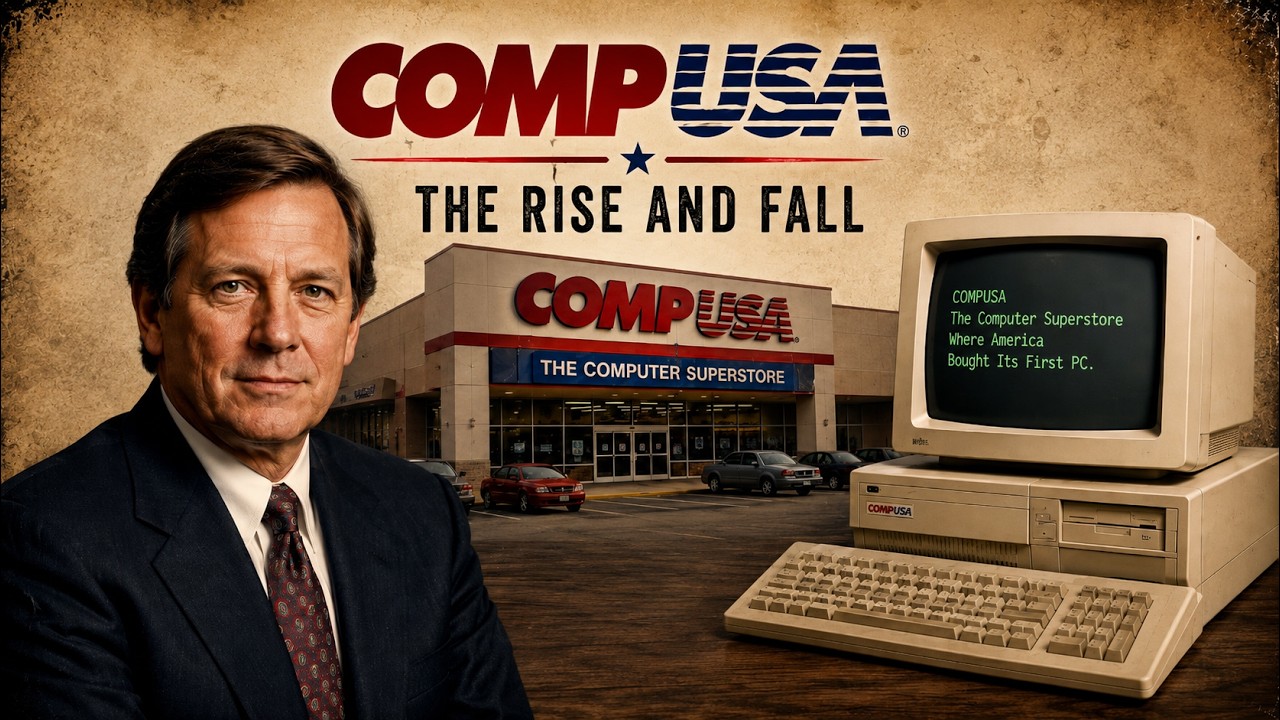
Within eight years of that peak, the richest man in Mexico would pour roughly $2 billion into the company trying to keep it alive. A liquidation firm would shutter over a hundred locations in 15 weeks, and the brand, the trademarks, and the last 16 stores would sell for $30 million. Today, the CompUSA website redirects to a coupon aggregator. The name survives.
Nothing else does. Before there was a computer superstore, there was a problem nobody in American retail wanted to solve. In 1984, the personal computer was three years past the arrival of the IBM PC and five months past the launch of the Apple Macintosh, and buying one was still closer to buying a used car than buying a television set. The machines were expensive.
A Macintosh retailed for $2,495, and for that price you got a 9-inch black-and-white screen and 128 kilobytes of RAM. The IBM PC XT with its 10-megabyte hard drive ran close to $5,000. These were serious purchases in a country where the median household income was roughly $22,000 a year. The places that sold them reflected the price tag: small specialty shops with commissioned salespeople, mall kiosks staffed by part-timers who could explain the brochure and nothing else, and mail-order catalogs where you circled a model number, mailed a check, and waited weeks hoping the correct box showed up at your door.
Corporate buyers had their own dedicated sales channels. But a family that wanted a home computer in the fall of 1984 had almost nowhere to go that felt trustworthy. The technology had outrun the infrastructure for selling it. Nobody had figured out how to sell these things to ordinary Americans at scale.
Nobody except two men in a Dallas suburb who had a theory about warehouse floors and cardboard boxes. Errol Jacobson and Mike Henikawitch founded Soft Warehouse in 1984 in Addison, Texas, with a concept the rest of the industry considered foolish: sell computers the way a warehouse club sold groceries. Stack the inventory high, price it low, put thousands of products under one enormous roof, replace commissioned salespeople with floor staff who could point customers to the right aisle, and let the sheer volume of selection do the persuading. They started not as a retailer but as a software distributor.
The first retail store opened two years later, in 1986, at the corner of Marsh Lane and Beltline Road in Addison. It was a modest storefront selling shrink-wrapped software and a modest selection of peripherals. But the second location, which opened in 1988 in Atlanta, was something entirely different. At roughly 25,000 square feet of floor space dedicated to personal computers, monitors, printers, accessories, and software, it was the first computer mega store in the United States.
Customers who had been intimidated by small specialty shops walked into a warehouse full of choices and, for the first time, felt like they could compare machines side by side without a commission salesperson hovering behind them. Then the money arrived. In January 1989, an investment firm called Dubin Clark, led by Ronald Dubin, acquired Soft Warehouse and changed its trajectory entirely. Dubin brought in Nathan Morton, a former Home Depot executive who had spent his career in lumber and hardware and had never worked a single day in the computing industry.
Morton recruited his management team the same way: executives from Kmart, managers from Hechinger’s, talent from Wickes Lumber. Not one of them could have assembled a personal computer from components. That was the entire strategy. Morton looked at Soft Warehouse and saw not a technology company but a retail logistics problem waiting to be solved with the same tools that had worked for home improvement.
He saw square footage, supply chains, vendor agreements, and foot traffic patterns. He saw Home Depot, but for personal computers. The people who designed and manufactured the machines had been struggling to sell them to consumers for a decade. Morton had spent those years selling two-by-fours and sheets of plywood.
That turned out to be the skill that mattered. The expansion under Nathan Morton was among the most aggressive in American retail history in any category. In fiscal 1988, Soft Warehouse generated $66 million in revenue. By 1990, the number hit $600 million.
By 1992, it reached $820 million. There were 18 superstores open by the end of 1989 and 36 by the end of 1992. Each store covered roughly 25,000 square feet and stocked more than 5,000 products, from IBM-compatible desktops and color monitors to dot-matrix printers, cables, peripherals, and boxed software lined up on shelves that ran the length of the back wall. Among them was the company’s private-label desktop, the Compudyne, a machine manufactured by Acer and sold under CompUSA’s own brand at prices that undercut everything else on the floor.
Nobody bragged about owning a Compudyne. It was plain, functional, and cheap. It sold by the thousands. Morton also installed training centers inside the stores, small classrooms where customers could pay for hands-on courses in word processing, spreadsheets, and basic computing.
Those training centers generated nearly $700,000 per month in revenue across the chain, almost all of it profit, making them one of the highest-margin operations in computer retail. For a customer who had just spent $1,500 on a machine and had no idea how to use it, a $60 course felt like a lifeline. CompUSA was selling the computers and then selling the education to use them, a closed loop no mail-order catalog could replicate. In 1991, Morton accomplished something the rest of the industry had considered unlikely: he secured a distribution deal with Apple, making his company the first discount retailer authorized to sell the Macintosh.
He added Compaq distribution rights the same year. The company changed its name to CompUSA in 1991, shedding the Soft Warehouse identity, and in December of that year it went public on the New York Stock Exchange. Shares opened at $15 and climbed to $40 within months. From a strip-mall storefront in Addison to the NYSE in five years.
But the numbers told two stories. Quarterly sales increases of 65 percent were not producing matching gains in net income. In the first quarter of 1993, sales jumped 65. 8 percent.
The company reported a loss of $986,000. In the second quarter, sales surged again, and the loss widened to $5. 5 million. CompUSA was opening stores faster than its margins could absorb them, and the interest costs of expansion were consuming the revenue the stores generated.
Over the prior 12 months, the company had lost $20 million. In December 1993, Nathan Morton resigned. He had built one of the fastest-growing retail chains in the country and could not make it turn a profit. He died in 2005, a decade before the last store carrying a name that descended from his work would close.
His replacement came from the home-improvement aisle. James Halpin had been running Homebase, a warehouse-format home-improvement chain with no connection to the computing industry. He stepped into a company that was burning cash nearly as fast as it generated revenue. By August 1994, CompUSA’s stock had collapsed to $6.
75, and the company was approaching insolvency. Halpin did what a man trained in warehouse logistics does when the operation is bleeding. He outsourced the Compudyne PC assembly entirely, ending the expense and complexity of building machines in-house. He centralized inventory management across all stores, pulling control away from individual store managers who had been placing orders independently and creating costly inconsistencies in stock levels.
He eliminated executive positions, cut low-margin product categories like computer furniture from the sales floor, and redirected the merchandise mix toward higher-profit items: cables, surge protectors, printer ink, cartridges, software. The products customers grabbed on their way to the register without comparing prices. The turnaround was specific, measurable, and remarkably fast. By mid-1996, CompUSA reported record annual sales of $3.
5 billion. Some 105 stores were operating. The company held $300 million in cash, where just two years earlier it had held a negative cash position. The stock price climbed from $6.
75 to nearly $35 a share. Halpin had not invented a new type of store. He had taken Morton’s superstore format and imposed the financial discipline it needed. What neither man questioned was the load-bearing assumption underneath the entire business: the premise that Americans would always need a physical building full of products and salespeople to buy a personal computer.
In the middle of the 1990s, with customers pouring through the automatic doors every weekend, that assumption felt as permanent as the concrete beneath the parking lot. On August 24, 1995, Microsoft launched Windows 95, and Americans lined up at midnight outside computer stores across the country to buy a piece of software sealed inside a cardboard box. CompUSA was one of the stores where those midnight lines formed. The personal computer was no longer a business tool or a hobbyist’s indulgence.
It was crossing into the American living room at a scale nobody in the industry had fully anticipated. Home internet adoption accelerated alongside it. AOL mailed installation discs to what felt like every mailbox in the country. The average price of a personal computer, which had held above $2,000 for most of the early ’90s, began its long decline through $1,500, through $1,000, and eventually below it.
Families who had never considered owning a computer were now buying them for homework, for email, for access to a worldwide web that seemed to double in size every few months. CompUSA rode this wave as well as any retailer in the country. For millions of American families, it was the front door to the digital age. But the machine in that trunk was connecting to something.
Every personal computer CompUSA sold plugged into a phone jack and dialed into an internet that was building, month by month, the commercial infrastructure to sell those same computers without any physical store at all. Amazon launched in 1995 as a bookstore, but its logistics platform was engineered to scale across every product category. Dell proved that a build-to-order model shipping PCs directly to homes could undercut any retail price on the floor. Newegg would follow in 2001, becoming the preferred vendor for buyers who knew exactly which components they wanted and did not need a salesperson to walk them through it.
The technology CompUSA put into American living rooms was quietly constructing the channel that would replace CompUSA entirely. In November 1997, Steve Jobs had been back at Apple for roughly two months as interim CEO. The company had just posted a $161 million loss. Its market share was eroding.
The iMac G3 was still nine months from its August 1998 launch. Apple products sat badly in retail stores, shoved onto back shelves by floor staff who could not explain them and did not try to sell them. Jobs needed a retail foothold immediately, and he struck a deal with CompUSA. The agreement created dedicated Apple sections inside CompUSA stores, what the press labeled a store within a store.
Forty locations received the treatment by Christmas 1997, and 57 were built out by January 1998. Jobs hired the same architectural firm that designed his product launch events to build the spaces. Each Apple section occupied roughly 15 percent of the CompUSA floor with its own displays, signage, and product layout. The results were disappointing.
The Apple sections often ended up near the back of the store, foot traffic was thin, and sales failed to move the needle. But the concept mattered more than the numbers. Four years later, in May 2001, Apple opened its first standalone retail store in Tyson’s Corner, Virginia, drawing directly on lessons learned inside CompUSA about layout, product display, and the value of a controlled environment. CompUSA had given Apple the rehearsal space, the room to prototype an idea cheaply and learn what worked.
Apple took the lessons, then it left. While Jobs was experimenting with store layouts, James Halpin was consolidating the industry. In June 1998, CompUSA announced the acquisition of Computer City, a competing superstore chain owned by Tandy Corporation, the parent company of RadioShack. Computer City operated over a hundred locations in the United States and five in Europe.
The acquisition cost CompUSA roughly $275 million. Halpin shut 51 of the Computer City locations outright and converted the remainder into CompUSA stores. In a single transaction, he eliminated his most direct national rival and absorbed dozens of prime retail sites. CompUSA was now, by every available measure, the dominant computer retailer in the country.
The store count reached 229, spanning 84 metropolitan markets. The payroll carried nearly 20,000 names. Annual revenue pushed toward $6. 3 billion.
The stores themselves had become something between a warehouse and a cathedral. Rows of desktop PCs sat powered on at display tables, their CRT monitors glowing with Windows screen savers, inviting customers to sit down and type. Printers, scanners, joysticks, external drives, and cables filled aisles that seemed to stretch toward the horizon. For a window that lasted roughly from 1996 to 1999, CompUSA was to American computer retail what Sears had been to the hardware aisle and what Toys R Us had been to the Christmas season.
Families did not ask where to buy a computer. They asked which CompUSA was closest. But the arithmetic was shifting underneath the dominance. The sub-$1,000 PC had arrived.
Gateway and Dell were selling functional machines at price points that could not generate enough margin to sustain a 25,000-square-foot retail store with a full staff, training centers, and a service department. Halpin’s team kept promoting higher-end machines, the $1,500 and $2,000 configurations, while the mass market was moving toward commodity hardware. Every machine on the floor, regardless of price, now connected to an internet where someone else was selling the same configuration for less with free shipping and no need to find parking. By June 1999, CompUSA reported an operating loss of $54.
2 million on declining sales. The stock price collapsed back to the low single digits, erasing the entire value of Halpin’s turnaround in a matter of months. He scrambled to adapt. The company launched Cozone.
com, an online retail subsidiary intended to compete with the very internet retailers that were draining its foot traffic. It pushed aggressively into consumer electronics, filling floor space with digital cameras, handheld computers, cellular phones, and smart toys. But CompUSA had been designed from the ground up to sell personal computers inside a physical building, and the economics of that singular purpose were disintegrating beneath it. Best Buy was diversifying into home entertainment, kitchen appliances, and installation services, building a retail operation that did not depend on computer margins alone.
Dell was shipping millions of PCs directly to front doors, eliminating the retail floor from the equation entirely. Amazon was growing at a pace that made every brick-and-mortar retailer in the country look like it was standing still. In January 2000, Grupo Sanborns, a Mexican retail and telecommunications conglomerate controlled through Carlos Slim’s Grupo Carso business empire, acquired CompUSA for approximately $1 billion at $10 per share. The board approved the deal unanimously.
Carlos Slim, by some measures the richest man in the world, had just purchased the largest computer retailer in the United States. Over the next seven years, he would pour roughly $2 billion into CompUSA, attempting to stabilize it, diversify it, and reverse a decline that had structural causes no amount of capital could fix. It was not enough. In 2003, the company acquired The Good Guys, a California-based consumer electronics chain with 46 locations, hoping to broaden its appeal beyond computers and into the wider home electronics market.
By 2005, every single Good Guys store had been shut down. In 2005, CompUSA attempted a customer loyalty program called CompUSA Network, offering 13 points for every dollar spent. The program was suspended within a year, and the company was forced to issue refunds to enrolled members. In 2006, 15 CompUSA locations were permanently closed.
In February 2007, the company announced 126 more would follow. By the third quarter of 2007, CompUSA reported a loss of $45. 7 million on just $425 million in revenue. Carlos Slim had invested approximately $2 billion since acquiring the company.
He made the decision to divest. Potential buyers were approached. Circuit City was contacted, Micro Electronics was contacted, Systemax was contacted. None of them wanted the whole operation.
In December 2007, Gordon Brothers, a Boston-based firm that specializes in the disposition of distressed retail assets, acquired CompUSA’s remaining equity and debt, and began the process of shutting everything down. Over 15 weeks, 103 stores were closed. More than $500 million in retail inventory and fixed assets were liquidated. Roughly $700 million in secured and unsecured debt was settled.
More than 4,000 individual creditor claims were resolved. The process was not a bankruptcy. Gordon Brothers structured the wind-down so that unsecured creditors received what the firm described as a cash return in excess of their expectations, larger and faster than a bankruptcy proceeding would have delivered. CompUSA did not die in court.
It was disassembled piece by piece across 103 parking lots in cities from Dallas to Miami to Chicago. Employees who had sold computers and run training centers and stocked shelves for years found out their stores were closing from the same local news broadcasts that announced the liquidation sales. On January 6, 2008, Systemax purchased the CompUSA brand, its trademarks, its e-commerce platform, and 16 remaining retail locations in Florida, Texas, and Puerto Rico for $30 million. A chain that had generated $6.
3 billion in annual revenue at its height sold its name, its website, and the inventory of 16 stores for the price of a single commercial property in the Dallas suburbs. Nathan Morton, the Home Depot man who had transformed a two-story software warehouse into a national retail chain, had died in 2005. He never saw the liquidation. James Halpin, who had pulled CompUSA back from insolvency and built it into the country’s dominant computer retailer, was long gone from the company by then.
Systemax folded the CompUSA brand and the Circuit City name, which it had acquired separately, under the TigerDirect banner in November 2012. In November 2015, Systemax sold TigerDirect itself to PCM, a direct-marketing company, for $14 million in cash. The last three physical stores with any connection to the CompUSA lineage, one in Miami, one in Georgia, and one in Puerto Rico, closed their doors. In October 2018, a small company called Deal Central acquired the CompUSA.
com domain and relaunched it as a coupon aggregation website. The URL that had once processed hundreds of millions of dollars in online orders now hosts discount codes and affiliate links. In recent years, the site has largely ceased to function, displaying pages that appear unchanged since 2007. There is no plaque at the corner of Marsh Lane and Beltline Road in Addison, Texas.
No historical marker, no sign indicating that the building at that suburban intersection was once the first location of a company that would grow to become the largest computer retailer in the United States. The strip mall is still there. CompUSA is not. It did not lose to a better store.
It lost to the machine on its own shelf. Every computer it sold connected to a network that taught its customers they did not need the store to buy the next one. The product was the weapon. The shelf was the target.
And the families who carried those beige towers home had no idea they were carrying the thing that would make the trip unnecessary.