Catherine de Medici was born on 13 April 1519 in Florence, the capital of the Florentine Republic, a city long dominated by her family, the Medici banking dynasty. She was the great-granddaughter of Lorenzo the Magnificent, the patron of Leonardo da Vinci and Michelangelo, and she grew up in the heart of the Italian Renaissance. But that era of artistic brilliance was also one of deep political instability, as France and Spain fought for control over the small Italian states. At the time of her birth, the Medici family was gravitating toward France, and when Catherine was just fourteen, she was married to Henry of Valois, the second son of King Francis I of France.
The marriage was not easy at first. The alliance had been negotiated by Pope Clement VII, himself a Medici, but when he died in 1534, his successor threw papal support behind Spain and cut off the pension Catherine had received. Prince Henry showed little interest in his bride, keeping a string of mistresses and falling in love with one of them, Diane de Poitiers, a woman twenty years his senior. For the first ten years of their marriage, the couple produced no children, which made Catherine, already seen as a foreign outsider, deeply unpopular in France.
She tried strange concoctions in hopes of becoming pregnant, and when she finally did, suspicion began to spread that she dabbled in the occult. In time, her position improved. The French court came to admire her learning and sophistication, and she played a significant role in bringing Renaissance culture north to Paris. Beginning in 1544, Henry and Catherine had their first child, and more followed quickly.
In total, they had ten children over the next fourteen years, seven of whom survived into adulthood. Catherine had moved closer to the throne in 1536, when Henry’s older brother died of a fever, making Henry the heir to the crown. When Francis I finally died in 1547, Henry became King Henry II, with Catherine as his queen. Yet her husband kept her out of political power.
Henry lavished attention, titles, property, and gifts on Diane de Poitiers, and he even appointed his mistress as one of Catherine’s ladies-in-waiting. Kept in the background, Catherine turned to the sciences, developing a fascination with astrology, astronomy, and physics. She became friendly with the reputed seer Nostradamus, and tales began to spread that she had an interest in black arts and necromancy. It was also claimed that she employed agents to poison her enemies.
While much of this is questionable and likely exaggerated, it was reported that sales of antidotes soared in France during her time there. In 1559, Henry died in a bizarre jousting accident during games held to celebrate peace with Spain. Catherine, until then a political outsider, was thrust into the role of ruling France as queen regent on behalf of her son, the new King Francis II. She would remain a prominent figure in French politics for the next thirty years.
Francis II’s reign was brief; he died in December 1560, just seventeen months after becoming king, likely of meningitis, at the age of sixteen. He was succeeded by his younger brother, Charles IX, who was only ten years old. Catherine would spend years fighting for his interests as he grew up inside the labyrinth of French politics. France needed strong leadership at exactly the moment it had a child on the throne.
At the center of the crisis was religion. Protestantism had spread westward from Germany into the Low Countries and the Swiss cantons, but France was deeply divided. The north and northwest remained overwhelmingly Catholic, while large parts of the south, especially near Geneva, embraced Protestantism. These French Protestants became known as Huguenots, and they were agitating for freedom of worship.
In 1562, they went to war with the French government to obtain it, beginning the French Wars of Religion that would plague the country for the rest of the century. Catherine found herself trying to negotiate between two hostile camps: the Huguenots, led by Gaspard de Coligny, and the ultra-Catholic House of Guise, which sought to control the monarchy and dominate the young king’s government. Throughout the 1560s, Catherine’s goal was to steer a middle course and secure the best possible position for her son when he came of age. She joined the ranks of the politiques, French figures who put political stability above the cause of either radical Catholicism or Protestantism.
She oscillated between favoring military action against the Huguenots and negotiating with them, often trying to counter the enormous influence the Guise family had gained among France’s Catholics. She also negotiated a series of marriage alliances. Charles IX married Elizabeth of Austria in 1570, and Catherine tried, unsuccessfully, to arrange a union between one of her younger sons and Queen Elizabeth I of England. It was another marriage alliance that led to the events for which Catherine is most remembered.
In 1572, she arranged for her daughter Margaret to marry Henry of Bourbon, the Prince of Navarre, a small principality in southwestern France. Henry was a Protestant and had become one of the leaders of the Huguenots. The marriage was intended to bring the Wars of Religion to an end and to reduce the influence of the Guise family. Henry and Margaret were married on 18 August 1572 in Notre Dame Cathedral in Paris.
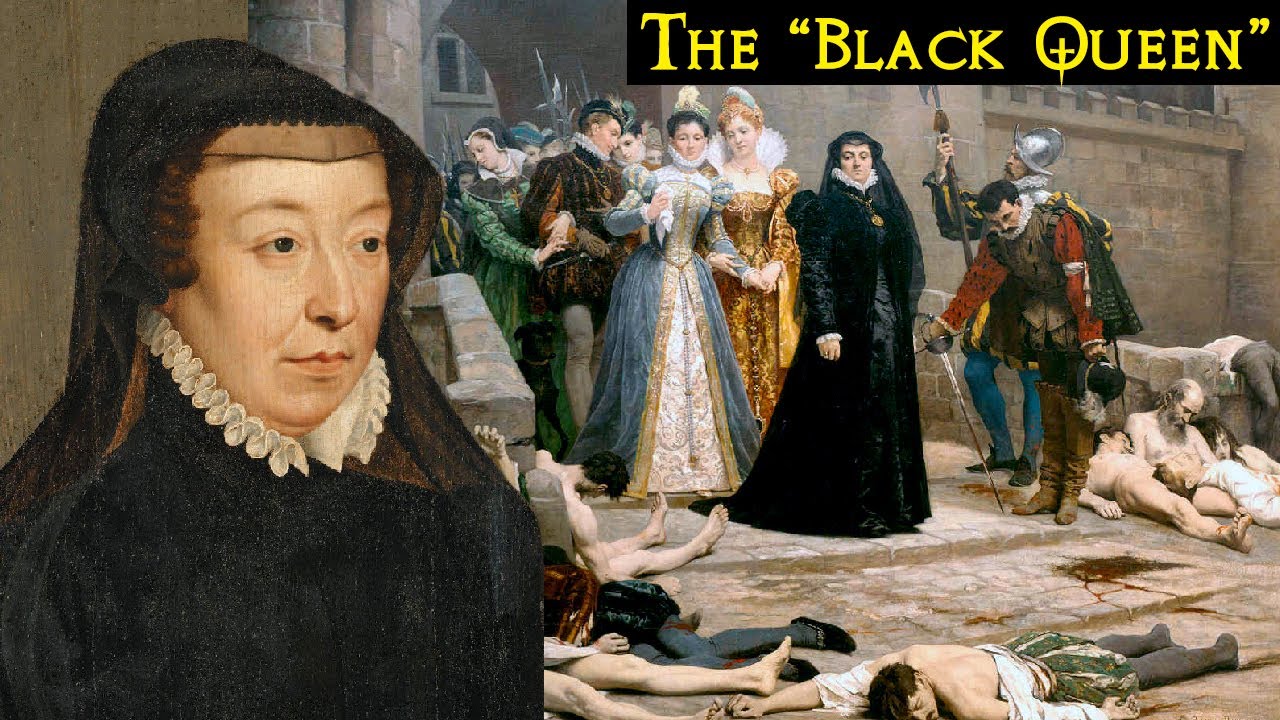
The wedding brought thousands of Huguenot supporters into Paris, and tensions in the Catholic city began to rise. Five days later, on the night of 23 August, they boiled over. The immediate spark was an attempt on the life of Gaspard de Coligny on 22 August. On the night of the 23rd, and into the morning of the 24th, the feast day of Saint Bartholomew, Catholics throughout Paris began attacking the Huguenots who had gathered in the city.
The violence spread well beyond Paris, and by the time it ended, at least five thousand people, mostly French Protestants, had been killed, possibly as many as twenty thousand. Dead bodies and blood lined the streets of central Paris. Catherine was quickly vilified as the instigator of the Saint Bartholomew’s Day massacre. The accusation was that she had organized the wedding to draw the Huguenot leadership to Paris, then arranged for them to be slaughtered.
This reputation as a master manipulator, as the Black Queen, would follow her for the rest of her life. But the source does not support this view of her role. The attempt on Coligny’s life was likely the work of the Guise family, who wanted to wreck the alliance between the crown and the Huguenots. Catherine did convene the royal council on 23 August in an effort to restore order before blood was shed.
Her son Charles IX, weak and ineffective as a ruler, failed to act, and his failure was compounded by reports that he muttered to his advisors on that day that they should kill them all. Catherine’s reputation as the mastermind of the massacre is almost certainly unwarranted. Her role in French politics continued long after 1572. Two years later, Charles IX died of tuberculosis without an heir, and Catherine’s next eldest son became King Henry III.
The new king was in Poland at the time, where he had been a candidate for the throne of the Polish-Lithuanian Commonwealth. For a time in 1574, Catherine once again served as queen regent on behalf of her absent son, and she remained his adviser throughout his reign. She was not well liked by the French public, and she was frequently blamed for whatever went wrong. In 1574, an anonymous author published a piece extremely critical of her, further cementing her reputation as an evil queen.
Accusations piled up: that she had poisoned the mother of Henry of Navarre, that she kept a room full of poisons in her castle, that she had provided prostitutes to her young son. Around 1577, Pierre de L’Estoile described a banquet held by Catherine at which the most beautiful women of the court served as half-naked waiting ladies, but he was not even present, and the account was likely exaggerated. Into the 1570s and 1580s, Catherine worked to keep France from descending into greater unrest. The Wars of Religion continued, but she managed to steer her sons away from a new war with Spain in the late 1570s, a war the crown was completely unprepared for.
She also limited the power of the Guise family to some extent, though they remained a threat, at times negotiating their own alliance with Spain and threatening to bring Spanish troops into the country against the Huguenots. By the mid-1580s, Catherine was elderly and increasingly ill. She died on 5 January 1589 at the age of sixty-nine. Just nine months later, her son Henry III was assassinated near Paris by Jacques Clément, a Catholic fanatic unhappy with the king’s willingness to confront the Huguenots.
Henry died without a male heir, and his younger brother had died some years earlier. In a strange twist, Henry of Navarre, whose wedding to Catherine’s daughter had triggered the Saint Bartholomew’s Day massacre, became King Henry IV. He agreed to convert to Catholicism to end the wars, famously saying that Paris was well worth a mass. In 1598, he issued the Edict of Nantes, granting French Protestants the freedom of worship they had long sought.
The French Wars of Religion were ended not by Catherine’s sons, but by the man she had married to her daughter in 1572, just days before one of France’s most tragic and notorious incidents.