In May 1871, a column of about 100 Kiowa warriors descended on a freight wagon train in north Texas near Salt Creek Crossing. They killed and mutilated seven teamsters, seized the supplies, and vanished as quickly as they had come. The raid made national headlines, and three of the Kiowa leaders who orchestrated it were later arrested at Fort Sill in Indian Territory. One of them, the old chief Satank, chose death over imprisonment and attacked a soldier while being taken into custody, knowing he would be shot.
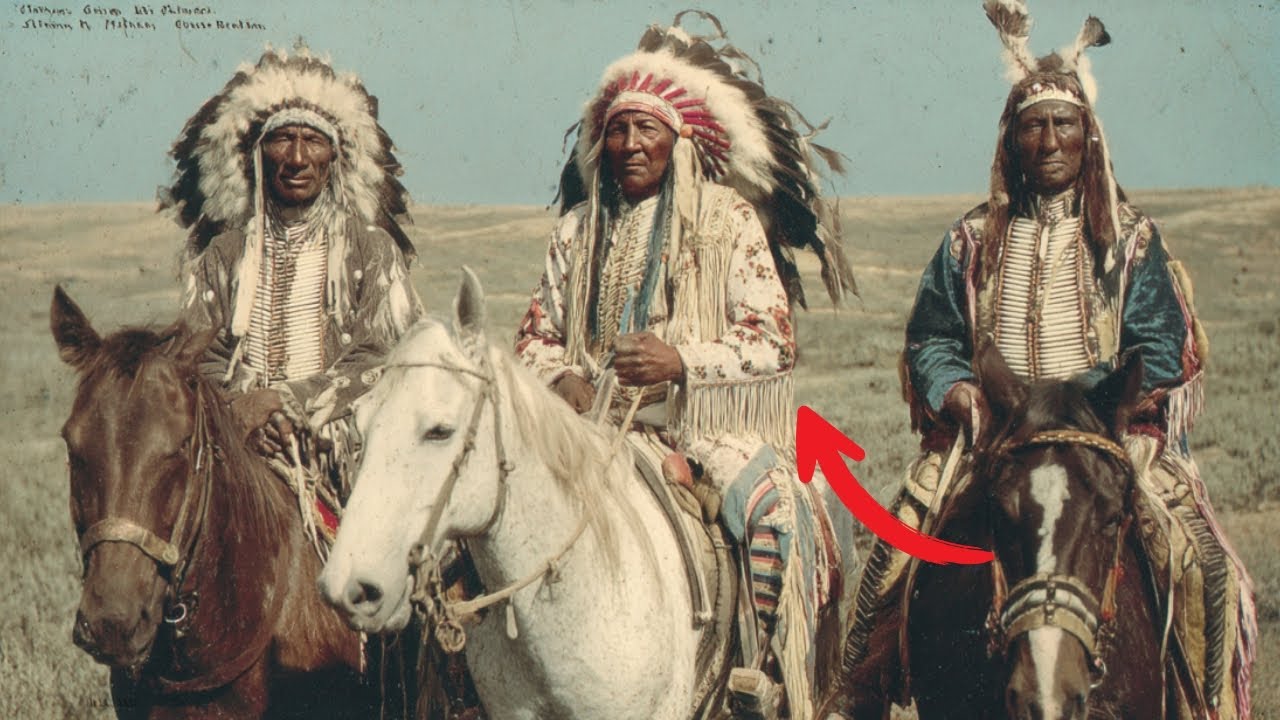
It was a violent flashpoint in a longer conflict, but the Kiowa people who fought that day were not newcomers to America or its frontier. They were a people whose rise had been tied for generations to the buffalo, the horse, and the plains they had fought hard to call their own. Long before they became known as masters of the southern plains, the Kiowa called the far north home. According to their oral tradition, they emerged from the hollow of a cottonwood tree in the northeastern Rocky Mountains.
Their creator gave them the land, the customs, and the skills they needed to hunt. In those early days they survived on small game, but over time they began following the bison herds, and the buffalo became the center of their existence. That shift likely allowed them to dominate a vast region that stretched across western Oklahoma, the Texas Panhandle, and northeastern New Mexico. The Kiowa did not begin as a plains power.
Their migration south brought them into territory already occupied by other groups, and they displaced the Apaches, Wichitas, and other communities as they moved into what is now Oklahoma and Texas. They first dwelt in the Black Hills alongside the Crow, and the two peoples formed strong familial bonds. For example, a prominent nineteenth-century Kiowa chief named Kicking Bird had Crow ancestry. But the Dakotas waged war against both groups for control of the land, forcing the Kiowa to push even further south.
It was there that they encountered the horse. Although a small horse species had once lived in North America during the Ice Age, the modern horse arrived with the Spanish. Nomadic tribes recognized the advantage immediately, and the Kiowa embraced it with remarkable skill. They raided into Mexico and Texas to acquire horses, targeting ranches and villages they opposed, while also engaging in trade.
The Kiowa quickly became known as exceptional equestrians, and the horse transformed their society. Combined with the buffalo, it gave rise to the powerful nomadic culture that later writers and filmmakers would romanticize as the quintessential plains Indian way of life. Like their close allies the Comanches, the Kiowa built their entire economy and spiritual world around these two animals. Their teepees were made from buffalo hides, as were their clothing and moccasins.
They ate buffalo meat as a dietary staple, and they made containers from buffalo bladders and stomachs. The buffalo was more than food and shelter; it held profound religious significance. During the sun dance, the most prominent of their ceremonies, a white buffalo calf was sacrificed, and priests used parts of the buffalo in prayers for healing and for invoking spiritual power. The Kiowa also tracked time using a calendar, a practice they shared with the Dakotas, making them among the few plains peoples to use such a system.
Their settlements reflected their mobility. The Kiowa lived in skin teepees that could be quickly disassembled and moved, yet were sturdy enough to endure the harsh prairie winters. In the cold months they erected grass barriers around their shelters for protection. They transported their belongings using travois sleds pulled by women, children, or dogs.
Women ran the daily life of the village, raising children, crafting clothing, setting up camp, preparing meals, processing jerky and pemmican, making cooking tools, and fetching water. Men gained prestige as warriors and hunters. Status often meant taking multiple wives, and marriage was simple: a man presented gifts to the bride’s father, and the couple lived with her family until the birth of their first child. After that, the man could establish his own household, though his wife typically remained with her mother, grandmother, sisters, and aunts to help raise the children.
Children were highly valued, and corporal punishment was rejected. The Kiowa also had a tradition of two-spirit individuals, people who embodied both male and female qualities. They were regarded as spiritual figures and played a significant role in the scalp dance, a ceremonial purification ritual held after successful raids. War was deeply woven into Kiowa culture.
They clashed with the Cheyenne, Dakotas, Pawnees, Utes, and Osages, and they often ambushed villages to capture prisoners and scouts. They understood that instilling fear in their enemies was an effective strategy, a tactic they later used against American settlers. Despite the relentless pressure of their enemies, the Kiowa formed important alliances. Their relationship with the Comanches was the strongest, but they also created kinship ties with groups they had once displaced.
The Wichita Confederacy traded crops for bison and participated in horse raids alongside them. The Kiowa also intermarried with the Apaches, producing a distinct group known as the Kiowa Apaches, who adopted Kiowa cultural practices. Not all tribes accepted them, however. The Caddos and Tonkawas, who were primarily agricultural, resented the Kiowa presence on their lands.
Contact with Europeans began early. The Kiowa traded furs with the Spanish and were familiar with the Mexicans by the eighteenth century. Their first significant interactions with Americans came in the early nineteenth century. Lewis and Clark did not meet the Kiowa directly during their 1804 to 1806 expedition, but they had heard of them.
In 1806, Zebulon Pike encountered both the Kiowa and the Comanche in present-day Oklahoma. The first extended interactions, however, occurred during the Stephen H. Long expedition in 1820. The expedition split into two groups.
Edwin James and Stephen Long explored the Red River Valley, while Captain John R. Bell covered the Arkansas region. Bell recorded in his journal that he twice witnessed Kiowa couples eloping, leaving their villages to begin new lives among relatives. He described the men as tall and robust, with braids over each ear and at the back, and the women as sturdy with long flowing hair.
Bell was well received by Kiowa leaders, who honored him with a horse, the highest tribute a Kiowa could offer. As American expansion pressed westward, the Kiowa were drawn into a bitter struggle to protect their lands and their way of life. Chief Satank, also known as Satangia, meaning Sitting Bear, was one of the most prominent Kiowa leaders of his generation. Born around 1810 in the Black Hills, he was both a chief and a medicine man, and he led the Koitsenko, the Ten Bravest, a warrior honor society.
He played a key role in negotiating peace between the Kiowa and the Cheyenne around 1840. In 1867, he was the first to sign the Medicine Lodge Treaty, but he did so reluctantly. After his son was killed by white men during a raid in Texas, Satank’s resistance hardened, and beginning in 1870 he led retaliatory attacks against settlers from the Fort Sill reservation in Oklahoma. The Salt Creek massacre of May 18, 1871, was the culmination of this violence.
Chief Satanta and the warrior Big Tree joined Satank in leading the raid. Henry Warren had been contracted to supply Fort Richardson, Fort Griffin, and Fort Concho, among other Texas forts. As his freight train traveled toward Jacksboro along the Belknap Road, it passed General William T. Sherman, who had earlier let Satanta and his warriors pass unhindered.
Less than an hour later, the Kiowa attacked. The teamsters formed a defensive circle, but twelve men were quickly overwhelmed. Seven were killed and mutilated, and five escaped. One man, Thomas Brazil, traveled nearly twenty miles to reach Fort Richardson.
Colonel Ranald S. Mackenzie immediately ordered pursuit, and General Sherman was sent to capture the responsible warriors. The three leaders, Satanta, Satank, and Big Tree, openly boasted of the raid at Fort Sill and were arrested by the military and ordered to Texas for trial. Satank, unwilling to be imprisoned, tore off his shackles, drew a hidden knife, and attacked a guard.
He was shot dead by soldiers and buried at the Fort Sill cemetery. Satanta and Big Tree were put on trial for murder and became some of the first Native American chiefs to be tried in a civil court. The Kiowa who survived this era found themselves confined to reservations, their buffalo economy destroyed and their power broken. One of the last great leaders to emerge from this time was Chief Apiatan.
Born around 1856 near Medicine Lodge, Kansas, he was the nephew of Lone Wolf and descended from respected Kiowa leaders. In 1890, as the Ghost Dance religion spread across the plains promising an end to European American dominance and the return of the buffalo, Apiatan was chosen to investigate. He visited the Pine Ridge Agency in South Dakota, where his Lakota kin welcomed him warmly, and he traveled to Fort Washakie seeking guidance from the northern Arapaho, who directed him to the Paiutes in Nevada to meet the prophet in Mason Valley. When he returned, a council was held in Anadarko with various tribes, and Apiatan shared his journey, concluding that the prophecy was false.
He was a member of the Native American Church, used peyote as a sacrament, and belonged to the Gourd Dance Society, composing songs for it and other tribal dances. In his later years he helped establish the Kiowa Indian Hospital in Lawton, Oklahoma, introduced a democratic tribal governance system, and strongly advocated for education among the Kiowa. He died on August 8, 1931, and was buried at Rainy Mountain Cemetery south of Mountain View, Oklahoma.