The camera has always been trusted to tell the truth, but some photographs have done the opposite. They have raised questions that outlasted the people in them. From ancient desert markings to figures appearing in family snapshots, these images share a common thread: they show something real, something unexplained, and something that refuses to be forgotten. The Nazca lines in Peru are among the most famous of these puzzles.
Etched into the desert floor nearly two thousand years ago by the Nazca civilization, the massive geoglyphs depict animals, plants, and geometric patterns that can only be fully appreciated from the air, a perspective the people who made them never had. Scientists have proposed religious purposes, astronomical calendars, or maps pointing to water sources, but no theory fully explains how the designs were created with such accuracy on such a scale. Some have even suggested alien involvement, though the true purpose remains unknown. A different kind of mystery emerged from the Soviet Union in the 1960s.
Nina Kulagina attracted attention for her alleged psychokinetic abilities. Under laboratory conditions at the USSR Academy of Sciences, she appeared to move objects with her mind, and her feats were documented on secret films. Skeptics argued she used tricks, but no one could reproduce her results. Due to Cold War secrecy, she never became internationally famous, but those who witnessed her demonstrations were left questioning the accepted limits of human ability.
In the jungles of Costa Rica, over three hundred perfectly round stone spheres lie scattered near the Diquís River. Some are small pebbles; others are more than two meters wide. They were carved from granodiorite, an extremely tough rock that is difficult to shape or break. How ancient people achieved such precision with the tools available to them remains an open question in archaeology.
Discovered in a 1900 shipwreck off the Greek island of Antikythera, the Antikythera mechanism is now regarded as the world’s first analog computer. Dating to around the second century BCE, the device consists of complex gears and inscriptions that could predict eclipses and track celestial movements. Its sophistication suggests a level of astronomical knowledge far beyond what was previously believed possible for that period, and the full extent of its functions is still not fully understood. In 1887, a photograph captured the Eiffel Tower under construction for the Paris Exposition.
Built in just over two years, the tower required eighteen thousand metal pieces held together by two and a half million rivets, all assembled by hand. When completed in 1889, it became the tallest man-made structure in the world, a title it held until 1930. The image shows the beginning of a landmark that still stands as a monument to engineering. The Ubaid lizard figurines, found at the site of Al Ubaid in Iraq, date to around 4500 BCE, long before the Sumerians.
The terracotta figures combine human and reptilian features: elongated heads, almond-shaped eyes, and scaly skin. Some depict lizard-like figures caring for babies or holding staffs, suggesting they may have represented leaders or deities. Their meaning and purpose remain unexplained. In the 1990s, a tourist visiting a cave in Ras Al Khaimah in the UAE took a photograph that unsettled all who saw it.
The image appeared to show an unusual creature partly hidden in the shadows. After the photo was taken, the group reportedly heard a boy’s scream from deep within the cave. Authorities searched and uncovered a body hidden in a recess. Who or what appeared in the photograph and its connection to the body has never been established.
The Dyatlov Pass incident of 1959 remains one of the most chilling unsolved mysteries of the twentieth century. Nine experienced hikers died under strange circumstances in the Ural Mountains. Photographs recovered from their cameras added to the unease, including one that shows a blurry figure in the trees, sometimes called the Yeti shot. The full truth of what happened to the group has never been determined.
In 1975, Diane and Peter Berilo visited the ruined church of Worstead in Norfolk, England to photograph its interior. When the film was developed, a white figure appeared seated in one of the pews. The couple insisted no one else was in the church, and the vicar confirmed there had been no trickery. Photography experts found no evidence of tampering.
Some believed the figure was the ghost of the White Lady, a spirit long associated with the twelfth-century church. The Patterson–Gimlin film of 1967 was shot in Northern California by Roger Patterson and Bob Gimlin. It shows a large, hairy creature walking through a clearing, believed by some to be Bigfoot. The footage has been studied endlessly, with skeptics arguing it shows someone in a costume and believers pointing to the creature’s movements and build as evidence of an unknown primate.
The debate has never been settled. In 1971, during the Apollo 14 mission, NASA released images showing glowing lights on the lunar horizon. The lights appeared to move between photographs. Astronauts Alan Shepard and Edgar Mitchell reported seeing them from miles away, ruling out lens reflections.
Theories involving sunlight on lunar minerals, electrostatic discharges, or outgassing have been proposed, but none fully explains the lights’ fixed positions and clear edges. In the Namib Desert, strange circular patches of bare ground surrounded by grass form a honeycomb pattern across the landscape. Known as fairy circles, they vary in size and cover large areas. Local legends attribute them to gods or divine footprints.
Scientists have suggested termites, plant competition, gas leaks, or radioactivity, but no single explanation has convinced the wider community. On March 13, 1997, thousands of people across Arizona observed a large, silent object moving slowly across the sky. The Phoenix Lights became one of the most widely reported UFO sightings in history. Arizona’s governor at the time, Fife Symington, said he saw it and later criticized the federal government for not taking the event seriously.
The US Air Force claimed the lights were flares from a training exercise, but many witnesses rejected that explanation. The Piri Reis map, created by the Ottoman admiral and cartographer in 1513, depicts parts of Europe, North Africa, the Atlantic, and the Americas, along with an astonishing representation of Antarctica. The map’s accuracy regarding South America is remarkable for a time when European knowledge of the New World was still emerging. Even more puzzling is the depiction of Antarctica free of ice, something believed to have occurred thousands of years before the map was made.
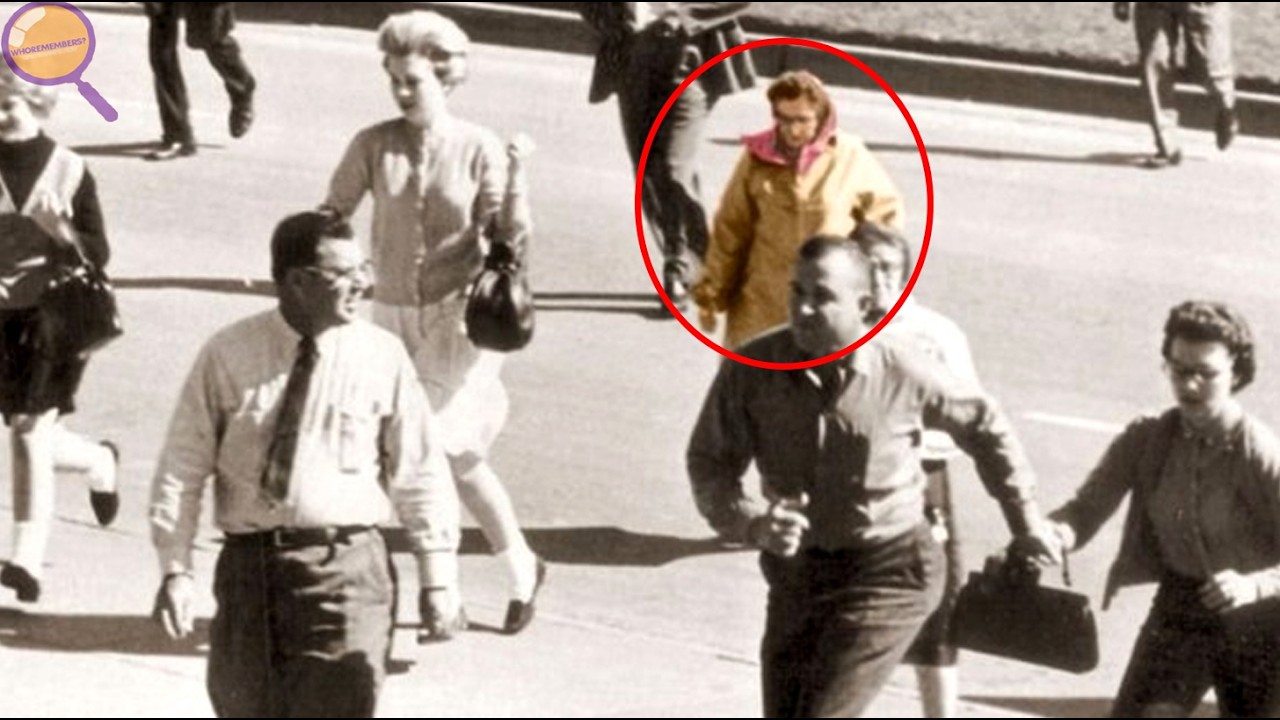
The babushka lady is a mysterious figure connected to the assassination of President John F. Kennedy in 1963. She appeared in several photographs near Dealey Plaza before and after the shooting, seemingly filming the motorcade while wearing a headscarf. Her identity was never discovered, and no film from her camera ever surfaced, fueling speculation about what might have been captured.
The Voynich manuscript, discovered in 1912 by the book dealer Wilfrid Voynich, is a fifteenth-century book written in a language no one has deciphered. It contains strange illustrations of plants, astronomical charts, and pharmaceutical preparations. Some depicted plants do not resemble any known species, and the star maps do not match anything modern astronomers recognize. Despite decades of attempts, no one has cracked the code.
In 1925, the crew of the SS Watertown passed through the Panama Canal when two deceased crew members, killed earlier that year by gas fumes while cleaning a cargo tank, appeared to rise from the water as ghostly faces. A fellow crew member photographed the phenomenon, and the Christian Science Monitor later confirmed the image had not been altered. Some considered it evidence of spirits returning; others called it a play of light. A tintype photograph purchased for just two dollars in 2010 was said to show Billy the Kid and his gang playing croquet.
If genuine, it would be only the second confirmed image of the outlaw and worth millions. Facial recognition software suggested a match, but historians raised doubts, pointing out that a croquet game seemed out of character for someone known for his criminal life. In 1964, a man named Robert Le Serrec photographed a massive creature resembling a giant tadpole in the shallows of Stonehaven Bay on Hook Island, Australia. Estimates placed its length at around twenty-five meters.
Some believed it was a surviving prehistoric creature; others thought it was a hoax, perhaps a weighted plastic sheet. The photograph became one of the enduring mysteries of cryptozoology. In 1864, during the American Civil War, six soldiers near Vicksburg claimed to have shot down an unknown creature. A photograph they took showed something resembling a pteranodon, a flying reptile from the Cretaceous period.
The authenticity and explanation have never been confirmed. In 1964, Jim Templeton was photographing his daughter in a field near Solway Firth in England when an unexpected figure appeared in the background, resembling a spaceman in white clothing and a helmet. Templeton swore no one else was present. Kodak and the police found no sign of tampering, though experts later suggested the figure was his wife overexposed in a blue dress.
The Black Knight satellite is said to be an object orbiting Earth and sending signals since the 1950s, possibly for over thirteen thousand years. The story began in 1899 with reports of strange signals from space, which Nikola Tesla claimed to have received. Mainstream science has not confirmed the satellite’s existence, yet the speculation continues. In 2003, CCTV cameras at Hampton Court Palace captured an unexplained ghostly figure walking through a corridor, the first documented photographic evidence from the palace’s long history of hauntings.
The technician who reviewed the footage ruled out tampering. Some skeptics suggested a glitch or light reflection, but the figure’s lifelike movements challenged those explanations. In 1959, Mabel Chinery took a photograph of her husband sitting in the front seat of their car during a visit to her late mother’s grave. When the film was developed, a figure appeared in the back seat.
Chinery believed it was her deceased mother. A photography expert examined the image and confirmed it had not been altered or double exposed. In 2008, archaeologists in Shangze County, China, opened a sealed tomb that had remained untouched for over four hundred years. Inside the coffin, they found a small wristwatch-like object with the time frozen at 10:06.
The word Swiss was engraved on the back. Whether it was a staged publicity stunt or evidence of something stranger, no one could say. Each of these photographs captured a moment that defied easy explanation. Some have been dismissed, some remain open questions, and a few have never been resolved at all.
What makes them endure is not the certainty they provide, but the uncertainty they leave behind.