In early 1976, a photographer named Ross Waby flew to the tiny Caribbean island of Mustique. He was working for the News of the World, and he had been given a tip about where Princess Margaret would be and who would be with her. He returned to London with photographs of the Queen’s sister sitting on a beach in swimwear beside a young man named Rody Llewellyn. On Sunday, 22 February, the newspaper ran the pictures across its front page, and the secret that a close circle of friends had guarded for two years became the shared property of the entire country.
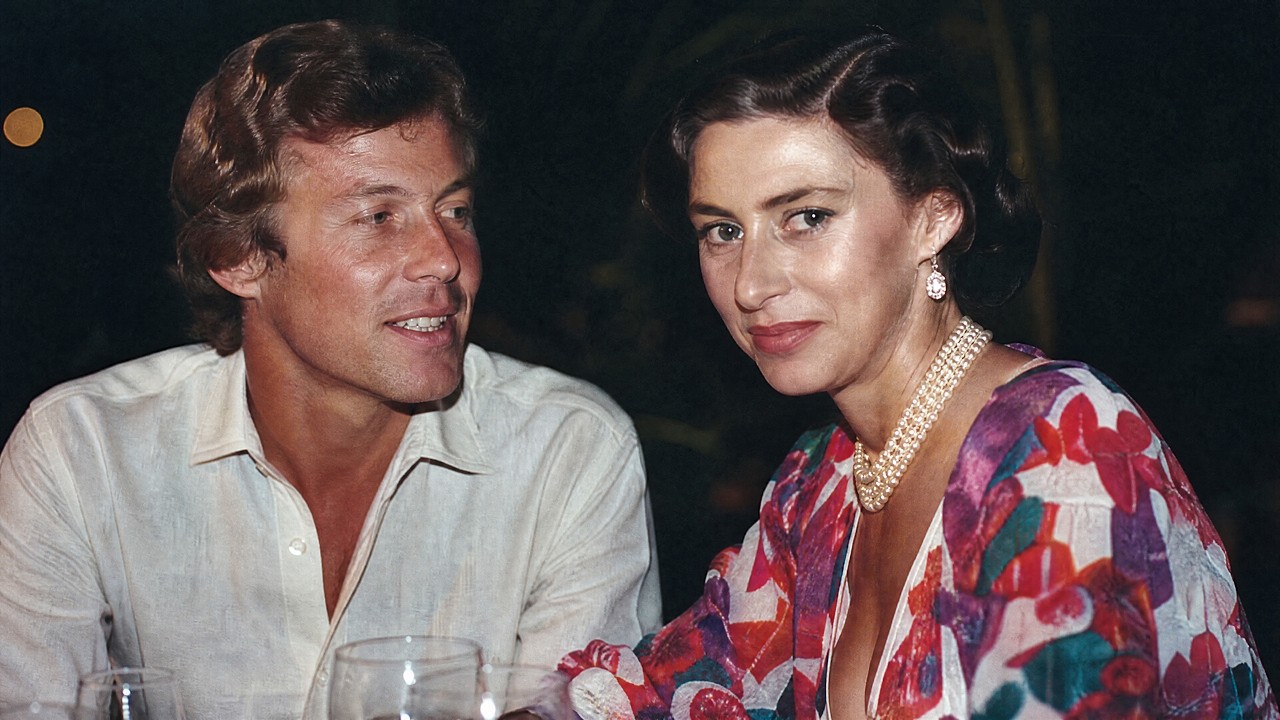
Margaret had come to this moment through a long and painful road. She was born at Glamis Castle in Scotland in 1930, the younger daughter of the Duke of York, a shy man with a stammer who never expected to be king. But in December 1936, her uncle, Edward VIII, abdicated in order to marry the divorced American Wallis Simpson, and her father became George VI. Margaret was six years old, and from that day she was the spare, the second child close enough to the throne to be watched, judged, and funded, but with no defined purpose of her own.
Her sister Elizabeth became queen in 1952, and Margaret, beautiful and quick-witted, became the most photographed young woman in Britain, dazzling a gray and rationed country with her glamour. Yet she held no official position and her private life was governed by the strict rules of the crown and the Church of England. In the early 1950s she fell in love with Group Captain Peter Townsend, a decorated Battle of Britain pilot who served as an equerry in her father’s household. He was divorced.
The church held that Christian marriage could not be dissolved, and the palace, still haunted by the abdication, would not permit the Queen’s sister to marry a divorced man. In October 1955, at the age of twenty-five, Margaret issued a public statement in which she chose duty over her own heart, mindful of the church’s teaching and conscious of her duty to the Commonwealth. The family, she said, mattered more than her own happiness. The country sympathized, and the story was told that her sacrifice would be rewarded.
In 1960 she married Anthony Armstrong-Jones, a dashing society photographer who was everything carefully managed court figures could not object to. The wedding at Westminster Abbey was the first royal wedding ever televised, watched by an estimated twenty million people in Britain and as many as three hundred million around the world. The Queen made her new brother-in-law Earl of Snowdon, and he was given a grand apartment at Kensington Palace, renovated at public expense. Their son was born in November 1961, their daughter in May 1964.
For a few years they seemed to be the most glamorous couple in London, hosting artists and actors and writers in a palace salon that outshone every older royal household. But the public marriage was not the private one. Snowdon was a talented man, a gifted photographer in his own right, and the designer of the celebrated aviary at London Zoo, but his charm was for the cameras. Inside the apartment, by the accounts of Margaret’s closest friends, he was cold and cruel.
He kept a separate studio in the basement and withdrew from family life, and he developed a habit that his biographer and Margaret’s lady-in-waiting, Lady Anne Glen-Cowne, later described in detail. He wrote her cruel notes and hid them where she would find them alone; inside books she was reading, folded among her handkerchiefs, left on her desk. Some were lists of the things he said he hated about her. The method was deliberate and cold, calculated to wound her when no one else was present.
Eventually, she could no longer bear to open her own chest of drawers. She asked her maid to do it, so that if another note was waiting, someone else’s hand would find it first. The marriage deteriorated into a mutual war. Both took lovers.
Margaret had a famous temper and could be cutting and imperious herself. But his cruelty was engineered in private, and the public never saw any of it. By the mid-1970s she was drinking and smoking heavily, suffering from depression in an age that offered little help and fewer kind words. Around this period she suffered a breakdown and was reported to have taken an overdose of sleeping pills.
The tabloids traded in rumors, while the country, in the midst of economic hardship, began to resent her as an expensive and purposeless royal, a symbol of a monarchy that took much and gave little. The MP Willie Hamilton made attacking her a career. In September 1973, at a house party in Scotland through the circle of her friend Colin Tennant, she met Rody Llewellyn. He was twenty-five, seventeen years her junior, the son of the Olympic show-jumper Sir Harry Llewellyn, and by profession a landscape gardener.
He was gentle where her husband was hard, admiring where Snowdon was contemptuous. She had built a house on Mustique, a ten-acre plot given to her as a wedding present, which became the one home she truly owned, and there Llewellyn designed and planted her garden. For two years the affair flourished in secret, protected by friends who understood that what happened on the island stayed on the island. That silence held until the News of the World broke it.
The exposure was devastating, and the press framed Margaret as a wanton and wasteful princess running off with a beach boy, while ordinary Britons struggled through a hard decade. Yet the photograph that was meant to ruin her had the opposite effect. After years of being wounded in private, the truth was finally out in the open, and once it was public, the performance could not continue. On 19 March 1976, the palace announced that the marriage had irretrievably broken down.
Margaret did not fight to preserve appearances. After sixteen years of absorbing and enduring for the good of the crown, she chose the truth. The divorce was finalized on 11 July 1978, making her the first senior royal in the direct line to divorce since the sixteenth century. The comparison to Henry VIII was drawn everywhere.
The institution she had sacrificed her first love to protect had now abandoned its own rule, not least because she had broken it. Within twenty years, three of the Queen’s four children would divorce, and royal marriage would never again be treated as indissoluble. She paid the price for opening that door. Snowdon remarried within months and his reputation never suffered.
Margaret remained unmarried. Rody Llewellyn, the beach boy of the headlines, also flourished. He married in 1981, raised three daughters, became a distinguished garden designer and writer, and in 2009 inherited the family baronetcy, becoming Sir Rody Llewellyn. He never sold his story.
Margaret’s late years were less kind. She had part of a lung removed in 1985, suffered a stroke at Mustique in 1998, badly scalded her feet there in 1999, and suffered further strokes. She gave up the house she loved. She died at King Edward VII’s Hospital in London on 9 February 2002, aged seventy-one.
She was cremated, an unusual choice for a senior royal, so that her ashes could rest beside her father in the small memorial chapel at Windsor, in the space that had held his coffin. The full account of the hidden notes reached the public only after her death, when Lady Glen-Cowne published her memoir in 2019. By then both Margaret and Snowdon, who died in January 2017, were beyond the telling. She had carried the truth of her marriage in silence, as she was raised to do, and left the telling to those who loved her.
Her life ran between two images: the hidden note folded among her handkerchiefs, and the photograph of a woman sitting in the sun, choosing her own happiness with nothing left to hide. The hidden note was her cage. The public photograph was her key.