The American Civil War, fought between 1861 and 1865, cost more than 600,000 lives and redefined the United States. At the center of that firestorm stood the generals who made split-second decisions that decided battles, campaigns, and ultimately the fate of the nation. Judged strictly by results, five men stand above the rest, drawn from both Union and Confederate sides, their records measured not by reputation but by what they actually accomplished on the field. Thomas Jonathan Jackson was a quirky Virginia Military Institute professor before the war, known for sucking on lemons and standing ramrod straight to align his organs.
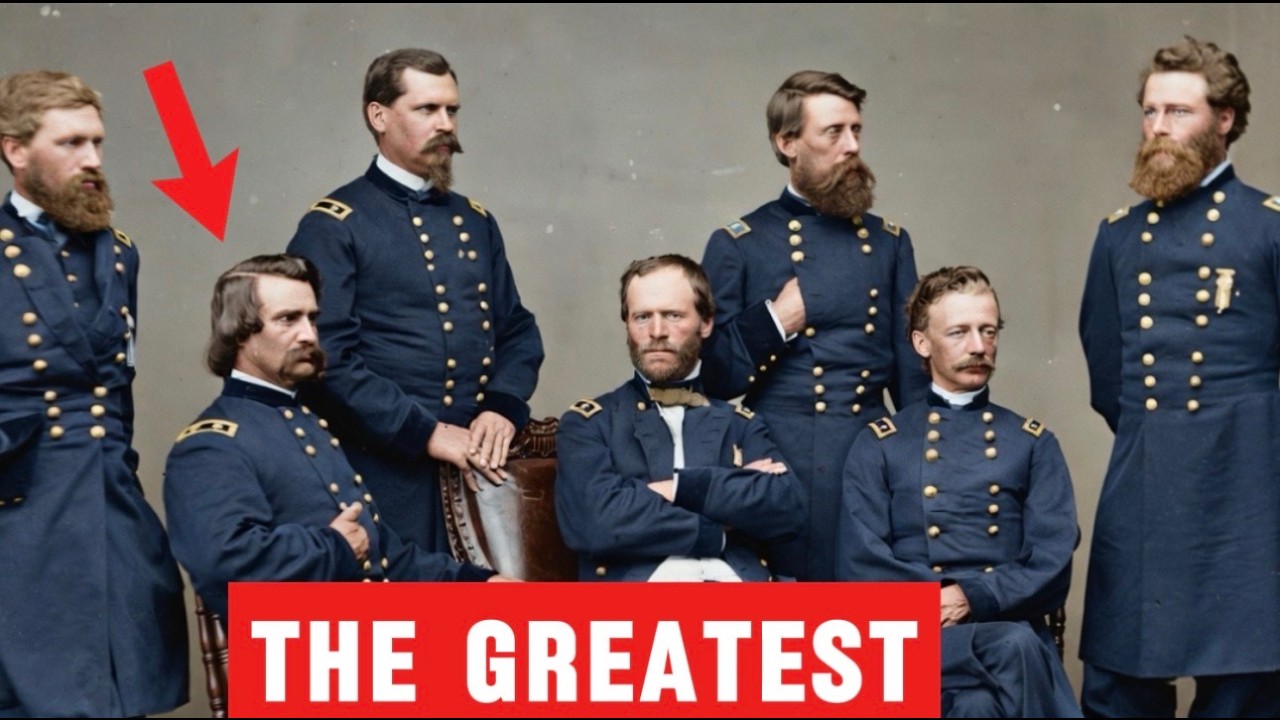
Born in 1824 in the hills of what is now West Virginia, he was orphaned young and clawed his way through West Point, finishing 17th in the class of 1846. He earned promotions during the Mexican-American War with gutsy charges at Chapultepec, where he manned a cannon under heavy fire. When secession came, Jackson chose Virginia and the Confederacy. His defining moment arrived at the First Battle of Bull Run in July 1861.
The Confederate line was crumbling under Union assault when Jackson’s brigade held a hill without flinching. General Barnard Bee, rallying his troops, shouted something like, “There stands Jackson like a stone wall. Rally behind the Virginians. ” Whether Bee meant it as praise or frustration remains unclear, but the nickname stuck, and the Confederates surged to their first major victory.
The Shenandoah Valley campaign in spring 1862 cemented Jackson’s genius. Facing three Union armies totaling over 60,000 men with just 17,000 of his own, he turned his soldiers into foot cavalry, marching them as much as thirty miles a day through mountains and mud. He struck isolated Union detachments repeatedly, at McDowell, Front Royal, and Winchester, capturing supplies and prisoners. In 48 days, his men marched 646 miles, fought five battles, and won four outright.
The result was decisive: he tied up Union troops that might otherwise have reinforced the push against Richmond, and the Confederate capital survived the Peninsula Campaign. Jackson kept delivering through the Seven Days Battles, Second Bull Run, and Fredericksburg. At Chancellorsville in May 1863, he led a twelve-mile flanking march through dense woods and smashed the Union right flank in a surprise assault that rolled up 11,000 Federals, producing the Confederacy’s greatest victory. That night, returning from scouting, he was mistaken for Union cavalry and shot by his own pickets.
His left arm was amputated, and pneumonia claimed him eight days later at age 39. Jackson fought about twenty major engagements, winning most with inferior numbers. His Valley Campaign alone delayed Union advances by months, but his early death limited his overall impact. William Tecumseh Sherman was the North’s unrelenting storm.
Born in 1820 in Lancaster, Ohio, he received his unusual name from the Shawnee leader Tecumseh. He graduated sixth from West Point in 1840 but missed combat in Mexico, serving in California instead. Civilian life brought failures in banking and law before he took a teaching post at a Louisiana military academy. When Louisiana seceded, he headed north.
Sherman started rocky. At First Bull Run his brigade fought well, but the Union rout shook him, and a Kentucky assignment brought a nervous breakdown that newspapers labeled insanity. His old West Point friend Ulysses Grant pulled him back, and at Shiloh in April 1862, Sherman’s division held the line after the surprise Confederate attack, earning Grant’s trust. He commanded a corps in the Vicksburg campaign that captured 30,000 rebels, then rose to command the Army of the Tennessee.
The 1864 Atlanta Campaign made Sherman’s reputation. With 100,000 Union troops against 60,000 Confederates, he avoided frontal assaults and used flanking moves instead. When John Hood replaced the cautious Joe Johnston and attacked recklessly at Peachtree Creek, Sherman repulsed him and besieged the city. Atlanta fell on September 2, 1864, a political bombshell that secured Lincoln’s re-election amid war weariness.
Then came the March to the Sea. Cutting supply lines, Sherman led 62,000 men from Atlanta to Savannah, covering 285 miles in five weeks. They lived off the land, twisting rails into “Sherman’s neckties,” burning factories, cotton gins, and anything useful to the war effort. Civilians were not targeted, but the psychological blow was massive.
“We can make war so terrible,” Sherman wrote, “that generations would pass away before they would again appeal to it. ” Savannah fell at Christmas 1864. In 1865, he swung north through the Carolinas, capturing Columbia and forcing Johnston’s surrender near Durham on April 26 after Appomattox. Sherman captured a key industrial hub, severed Confederate logistics, and shattered morale without endless slaughter, shortening the conflict.
Robert E. Lee was the marble man of the South. Born in 1807 at Stratford Hall, Virginia, to revolutionary hero Light Horse Harry Lee, he graduated second in the West Point class of 1829 with zero demerits. In Mexico he was Winfield Scott’s star engineer, and Scott later called him “the very best soldier I ever saw in the field.
” Lee led Marines capturing John Brown at Harpers Ferry, showing his Union loyalty until Virginia seceded. Lincoln offered him command of federal armies, but Lee could not fight his home. “I shall never bear arms against the Union,” he said, “but it may be necessary for me to carry a musket in the defense of my native state. ”
Taking the Army of Northern Virginia in June 1862, Lee found McClellan threatening Richmond with 100,000 men against his 85,000.
Aggressive counterattacks drove McClellan back despite 20,000 Confederate casualties, and Lee saved the capital. He followed with Second Bull Run, crushing Pope, then invaded Maryland. Antietam in September 1862 saw 23,000 casualties in a single day, a defensive hold that became a strategic loss, emboldening Lincoln’s Emancipation Proclamation. At Fredericksburg in December, Lee entrenched on heights and slaughtered Burnside’s charges, losing 5,000 against 13,000 Union dead.
“It is well that war is so terrible,” Lee mused, “or we should grow too fond of it. ”
Chancellorsville in May 1863 saw Lee outnumbered two to one, splitting his army and sending Jackson on the flanking march that won the day, though the victory cost Jackson’s life. Gettysburg in July 1863 proved the turning point. Lee invaded Pennsylvania seeking a decisive win, but Pickett’s charge on the third day failed disastrously, costing 15,000 casualties.
“It’s all my fault,” Lee told survivors. In 1864, against Grant’s Overland Campaign at the Wilderness, Spotsylvania, and Cold Harbor, Lee inflicted 55,000 Union losses against his own 32,000, but Grant kept coming. The Petersburg siege dragged nine months, and Lee surrendered at Appomattox on April 9, 1865. Against overwhelming odds, he won seven major battles, tied two, and lost three, keeping the Confederacy fighting for four years.
Strategic missteps like Gettysburg cost dear, but his defensive mastery was remarkable. George Henry Thomas was the unsung hero, a Virginian who chose the Union and paid for it. Born in 1816 in Southampton County, he witnessed Nat Turner’s Rebellion as a teen, hiding his family. He fought Seminoles and then Mexico, earning brevets at Monterey and Buena Vista.
When war came, Thomas stayed loyal while his sisters turned his portrait to the wall, disowning him. Starting in the West, he won the Union’s first big victory at Mill Springs, Kentucky, in January 1862. Then came Chickamauga in September 1863, the Union’s near disaster. Rosecrans’s army shattered and fled to Chattanooga, but Thomas, commanding the 14th Corps, held Snodgrass Hill against repeated assaults.
“We will hold this ground or die on it,” he said. His stand saved the army and earned him the nickname Rock of Chickamauga. Without him, the Western Theater might have collapsed. At Missionary Ridge in November 1863, his men charged without orders and broke Bragg’s line in a stunning upset.
In Sherman’s Atlanta Campaign, Thomas’s Army of the Cumberland was the backbone. The pinnacle came in the Franklin-Nashville Campaign of late 1864. John Hood invaded Tennessee with 40,000 men, and Thomas fortified Nashville, waiting for ice to melt despite Washington’s pressure. When Hood attacked, Thomas unleashed a two-day assault on December 15 and 16, shattering the Army of Tennessee, capturing 4,500, and scattering the rest.
It was the war’s only annihilation of a major army in open field. Undefeated in independent command, Thomas saved armies twice and destroyed a Confederate force utterly, achieving more with less fanfare than any general of the war. Ulysses S. Grant was the man who won it all.
Born Hiram Ulysses Grant in 1821 in Point Pleasant, Ohio, a clerical mix-up at West Point made him Ulysses Simpson. Shy and unassuming, he ranked 21st in 1843, excelling in horsemanship. He was fearless in Mexico, hauling a howitzer under fire at Chapultepec. Peacetime bored him, and rumors of drinking led to his 1854 resignation.
Civilian life brought failures in farming, real estate, and clerking. By 1860 he worked in his father’s Galena store. War called him back as a volunteer colonel. He captured Paducah without a fight, then took Forts Henry and Donelson in February 1862, where he besieged 15,000 Confederates in the cold.
Asked for terms, he replied, “No terms except unconditional and immediate surrender. ” He captured the entire force, the first major Union win, and became known as Unconditional Surrender Grant. At Shiloh in April 1862, a surprise attack nearly routed him, but he rallied and counterattacked with reinforcements, driving the Confederates off despite 23,000 total casualties. Vicksburg in 1863 was his epic.
Crossing the Mississippi, Grant cut loose from supplies in a risky live-off-the-land move, defeating Pemberton piecemeal at Port Gibson, Raymond, Jackson, and Champion Hill before besieging the city. Starvation did what assaults could not, and 30,000 surrendered on July 4, splitting the Confederacy. Lincoln said, “Grant is my man, and I am his the rest of the war. ”
Promoted to lieutenant general in March 1864, Grant commanded all Union armies.
The Overland Campaign from the Wilderness to Cold Harbor ground Lee down despite 55,000 Union losses. “I propose to fight it out on this line if it takes all summer,” he said. The Petersburg siege strangled Lee, and pursuing the Confederate breakout in April 1865, Grant cornered him at Appomattox. His surrender terms were generous: officers kept sidearms, and men took their horses home.
“The war is over,” Grant said. “The rebels are our countrymen again. ”
Grant captured three entire armies at Donelson, Vicksburg, and Appomattox, an unmatched record. His strategy overwhelmed the South by coordinating multiple fronts, and his tenacity turned stalemate into victory.
Flawed he was, but his results won the war.