Three days after the greatest victory of his military career, Major General George Meade received a letter from President Abraham Lincoln. It was not a congratulation. It was an accusation. Lincoln, frustrated and exhausted by the war, had drafted a furious message blaming Meade for nearly losing the entire conflict by allowing Robert E.
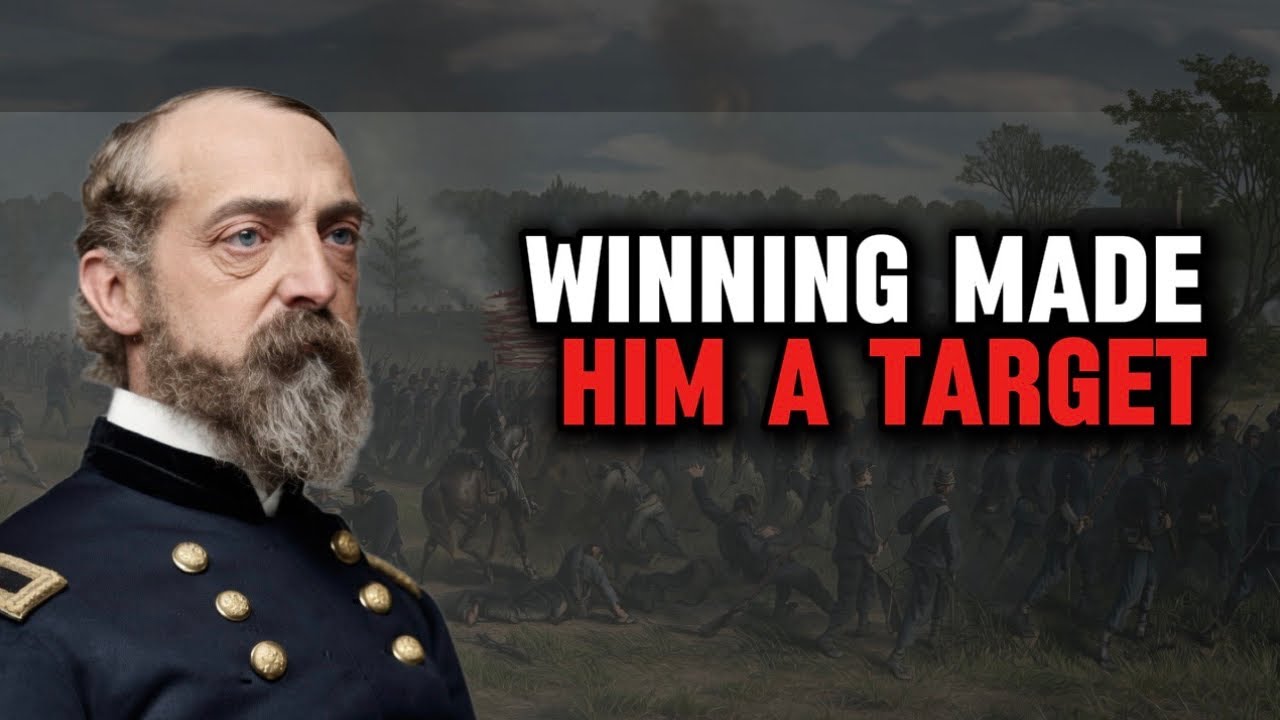
Lee’s defeated army to escape after Gettysburg. The president never sent the letter. He folded it away in a drawer, where it sat for years, surfacing publicly only after both men were dead. But the fact that Lincoln wrote it at all reveals how quickly the Union’s greatest battlefield triumph turned into a political ordeal for the man who had just won it.
Meade had taken command of the Army of the Potomac only three days before the battle began. A messenger arrived at his tent in the middle of the night on June 28, 1863, and Meade’s first reaction was to assume he was being placed under arrest. That instinct spoke volumes about the chaos inside the Union high command that summer. He had been handed an army of nearly one hundred thousand men he barely understood, in the middle of an invasion he had not planned for.
Within seventy-two hours, he was leading that army into the largest battle ever fought on American soil. Over three brutal days at Gettysburg, Meade held his lines against some of the most desperate Confederate assaults of the war. On July 3, Pickett’s Charge collapsed in the July heat, and Lee’s army began limping back toward Virginia. By every conventional measure, Meade should have become a national legend on par with Grant and Sherman.
Instead, something else happened almost immediately. Lee’s battered army retreated toward the Potomac River, but heavy rains had swollen the water so high that the Confederates could not cross. For nearly ten days, the Army of Northern Virginia sat trapped on the wrong side of the river, exposed, low on supplies, and vulnerable to a finishing blow. Lincoln understood the moment perfectly.
He believed with everything in him that a decisive strike could destroy Lee’s army completely and collapse the Confederacy’s ability to keep fighting. Meade did not strike. He hesitated, gathered intelligence, and second-guessed the strength of his own exhausted army. By the time he finally moved to attack, Lee’s engineers had built pontoon bridges and slipped the entire Confederate force back across the river into Virginia, alive and intact.
Lincoln’s fury was not exaggerated for dramatic effect. He reportedly told his secretary that he could have wept, that the war might have been ended, and yet nothing was done. The unsent letter accused Meade of allowing Lee to escape when victory was, in the president’s own words, easily within his grasp. What almost nobody mentioned at the time was the condition of the army Meade actually had to work with.
Gettysburg had gutted his forces just as badly as it had gutted Lee’s. Union casualties exceeded twenty-three thousand men killed, wounded, or missing in just three days of fighting. Entire regiments had been reduced to fractions of their original strength. Ammunition wagons were scattered across miles of Pennsylvania countryside, trying to resupply an army that had fired away nearly everything it carried.
The roads had turned into rivers of mud under the same rain that trapped Lee at the Potomac. Thousands of wounded soldiers still needed evacuation from a battlefield that had not even finished burying its dead. Asking that army to immediately launch an aggressive offensive campaign against an enemy still capable of inflicting serious damage was, in the judgment of many officers present, simply not realistic. Meade was not choosing caution out of timidity.
He was staring at exhausted men, broken supply lines, and a battered cavalry worn down by the pursuit. Washington demanded a knockout blow as though the army had emerged from the battle untouched. That gap between what Lincoln imagined was possible and what Meade’s officers actually reported on the ground rarely survives in popular retellings of the story. But it explains almost everything about the decision that followed.
The real hole in Meade’s history has nothing to do with pontoon bridges or swollen rivers. He was fighting a two-front war: one battlefield against Lee, and an entirely separate battlefield against his own government. Within weeks of the victory, a congressional committee began investigating his conduct, driven largely by political allies of a general Meade had removed from command during the retreat pursuit. Just months after delivering the most consequential Union victory of the war, Meade was hauled in front of politicians who treated him less like a savior and more like a suspect.
At the center of this campaign was Major General Daniel Sickles. On the second day of Gettysburg, Sickles had moved his corps forward into an exposed position at the Peach Orchard against direct orders, a decision that nearly shattered the entire Union line and cost him his leg to a cannonball. Rather than accept responsibility for a reckless maneuver that endangered the entire army, Sickles began quietly rewriting what had actually happened on that battlefield. He had every reason and every tool to make his version stick.
He was a former congressman with friends throughout Washington’s political machinery and a flare for public spectacle that Meade, a quiet, prickly professional soldier nicknamed Old Snapping Turtle, simply did not possess. While recovering from his amputation, Sickles reportedly kept his severed leg bones on display, inviting visitors to view them as a grim trophy of his sacrifice. It was propaganda dressed up as pity, and it worked. Sickles began feeding a narrative to sympathetic newspapers and eventually to Congress itself.
He painted his unauthorized advance not as recklessness but as the single decisive move that had actually won the battle. He framed Meade as a timid, indecisive commander who had wanted to retreat entirely and had to be talked into fighting at Gettysburg at all. It was a complete inversion of what happened on that field, yet it spread with startling speed. Meade, still commanding an army in the field, had neither the time nor the political instincts to fight a public relations war back home.
He assumed his record would speak for itself. That assumption proved to be one of the most costly miscalculations of his career. By early 1864, the campaign against Meade had grown too large to ignore. The Joint Committee on the Conduct of the War, a congressional body with a long history of scrutinizing and occasionally destroying the reputations of Union generals, summoned him to Washington.
What followed was closer to an ambush than a routine review. Sickles had already testified before Meade even arrived, laying out his version of events in vivid, self-serving detail. When Meade finally sat down before the committee, he walked into a room where the narrative had already been set against him. The most damaging accusation was not really about the battle itself.
It was about what happened after. Critics argued that after defeating Lee at Gettysburg, Meade had failed to pursue and destroy the retreating Confederate army when the Potomac River had trapped Lee’s forces for nearly ten days. In theory, a decisive aggressive strike during that window might have ended the war on the spot. In reality, Meade’s own army had just endured three of the bloodiest days in American military history, and asking it to immediately attack a still dangerous entrenched enemy force was not realistic.
Lincoln wanted annihilation. Meade delivered caution. And caution, however militarily sound, does not make for a satisfying story when a war-weary nation is hungry for a knockout blow. The psychological toll on Meade during this period was severe.
Correspondence from those months reveals a man increasingly bitter, increasingly withdrawn, and increasingly convinced that no matter what he accomplished on the battlefield, political operators in Washington would always find a way to diminish it. He wrote to his wife describing the hearings as a deliberate attempt at character assassination. He was not exaggerating. Sickles continued his campaign for years afterward, long after the war ended, using his influence to promote monuments, write articles, and shape early histories of Gettysburg that consistently minimized Meade’s role while inflating his own.
Some historians believe Sickles’ efforts to control the Gettysburg narrative continued for nearly three decades after the battle itself. Meade did not disappear quietly, at least not at first. He continued commanding the Army of the Potomac for the remainder of the war, technically still in charge even after Ulysses S. Grant arrived in 1864 to take overall command of Union forces and effectively began directing operations from alongside Meade’s own headquarters.
Newspapers increasingly credited victories to Grant, even when Meade’s army and Meade’s tactical decisions were doing much of the actual fighting. Meade essentially spent the final year of the war watching another man absorb the public glory for battles fought under his own command structure. By the time the Confederacy surrendered at Appomattox in 1865, the general who had stopped Lee’s invasion of the North stood in Grant’s shadow. After the war, Meade’s career quietly deteriorated.
He was assigned to a series of administrative military districts during Reconstruction, supervising Georgia, Alabama, and Florida. Grant ascended to the presidency in 1868. Sherman received parades and statues. Sheridan became a household name.
Meade, the man who had actually defeated Lee’s most dangerous invasion, found himself managing bureaucratic Reconstruction disputes in the Deep South. His son later wrote that his father rarely spoke about Gettysburg in his final years, not out of humility, but out of a quiet exhaustion with having to defend a victory that should never have needed defending in the first place. Meade’s health began failing in the early 1870s, worn down by old wounds, chronic illness, and what colleagues described as a persistent, gnawing sense of being permanently undervalued. He contracted pneumonia in the fall of 1872, complicated by lingering effects of an old combat injury sustained during the Peninsula campaign when a bullet had passed dangerously close to his spine.
He died on November 6, 1872, at only fifty-six years old. His funeral, while attended by respectful crowds, notably lacked the overwhelming national mourning that accompanied the deaths of other prominent Union commanders. Sickles astonishingly outlived Meade by nearly four decades, and he used every one of those years to keep reshaping the Gettysburg narrative in his own favor. He became a fixture at battlefield commemorations, an active voice in veterans organizations, and a relentless self-promoter.
He lobbied for monuments honoring his own controversial decisions. In one final act of audacity, he was later investigated for misusing funds meant for a Gettysburg memorial commission, funds that some accounts suggest were never fully accounted for. The man who had spent decades attacking Meade’s integrity ended his own career facing serious questions about his own. Modern historians examining the full record have increasingly reassessed Meade’s performance at Gettysburg with far more generosity than his contemporaries ever offered him.
Military analysts studying troop movements, supply constraints, and the genuine condition of his exhausted army have largely concluded that his cautious pursuit of Lee was not cowardice but sound, defensible military judgment. Some go further, suggesting that an aggressive, poorly supplied assault on Lee’s fortified position along the swollen Potomac could have easily turned into a catastrophic Union defeat, potentially undoing the victory at Gettysburg entirely. Meade’s caution, once treated as his greatest failure, is now viewed by many serious historians as one of his most underappreciated strengths. For decades, official battlefield markers, veterans reunion speeches, and even early textbooks leaned heavily on narratives shaped by Sickles and his allies.
Entire generations of Americans grew up learning a version of Gettysburg in which Sickles’ disobedience was quietly framed as brilliant improvisation rather than a violation of direct orders that had nearly collapsed the Union line. It took painstaking archival work by later historians, cross-referencing official reports, private letters, and the accounts of officers with no particular loyalty to either man, to slowly untangle fact from decades of self-serving embellishment. That process of correction did not meaningfully begin until roughly one hundred years after the actual battle. Meade won the battle that broke the momentum of the Confederacy’s most dangerous invasion of the North.
Then he spent the remaining decade of his life fighting not enemy soldiers but a relentless campaign to diminish everything he had accomplished. He died believing history would likely remember Sickles’ version of events over his own. For many decades afterward, he was largely correct.
Only in recent generations has Meade’s genuine contribution to that battle and to the Union’s ultimate survival finally begun receiving something closer to the recognition it always deserved.