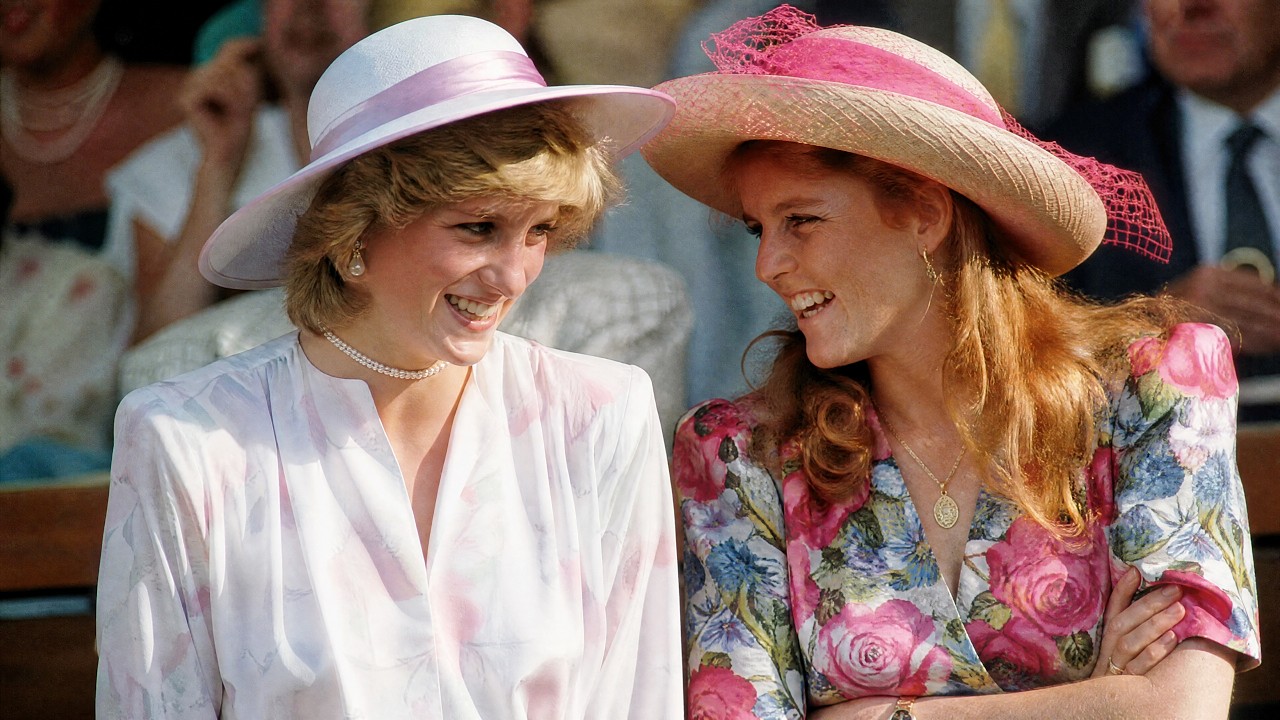
The world knew them as the Merry Wives of Windsor. Two young women who married into Britain’s oldest family and found in each other the one thing the palace could never provide—a friend who truly understood. They laughed together in the royal box. Their children played together.
When one felt suffocated inside that family, the other was the person she called. Yet when Diana died in a Paris tunnel in the summer of 1997, the two had not spoken for nearly a year. There were letters. There were apologies sent and never answered.
What ended the closest friendship either woman ever had was not a man, and not a betrayal of the kind one might expect. It was a paperback book and a joke about a pair of shoes. By the time Sarah Ferguson arrived, Diana had already spent five lonely years learning what this family did to the women who married into it. Diana Frances Spencer was born on July 1, 1961, at Park House on the royal estate at Sandringham.
The youngest daughter of an earl, she grew up almost in plain sight of the family she would one day join. Her childhood was aristocratic, and in its own way, solitary, spent in long silences inside a great country house. When she married Charles, Prince of Wales, at St. Paul’s Cathedral on July 29, 1981, she was twenty years old, and the whole world was watching.
The dress, the carriage, the kiss on the balcony, the crowds that filled the streets of London. It was sold to the public as a fairy tale, and the public believed every word of it. Within a year, she gave birth to Prince William. Two years after that came Prince Harry.
In theory, she had everything a young woman could be told to wish for. But the reality behind the palace walls was colder. Diana was the most photographed woman alive, and she was also, in the ways that truly mattered, alone. The marriage had been under strain almost from the beginning, and that strain had a shape and a name Diana understood long before the public did.
The world around her was ancient, formal, and rigid in its ways, run by courtiers who had served the Crown for decades and did not quite know how to handle a shy young princess who cried and did not hide her unhappiness. She was surrounded by people, attended to at every hour, yet almost no one understood her. The machine that made her famous was not interested in making her happy. It wanted her to smile, to wave, to produce heirs, and above all, not to show her own pain in the papers.
Sarah Margaret Ferguson was born on October 15, 1959, making her nearly two years older than Diana. Her father, Major Ronald Ferguson, managed Prince Charles’s polo interests. The Ferguson family had long moved in the same court circles. Sarah and Diana were distant relatives and had known each other socially long before either married into the family.
They came from the same small world of English country families, a world of horses, house parties, and shared acquaintances. What Diana saw in Sarah was something she desperately needed. Here was a young woman her own age, from her own background, who found the same things absurd and the same rules laughable, and who could make her laugh out loud. For a princess who had learned to guard every word, that was more than mere amusement.
It was a lifeline thrown from outside. Diana did not simply want a friend inside the family. She needed an ally who spoke her language, someone who understood the particular loneliness of being famous and besieged at once, and who was never afraid of her fame. In 1985, at Royal Ascot, Sarah and Prince Andrew, the Queen’s second son, reconnected.
On the surface, they were an unlikely couple. Sarah was warm, funny, spontaneous, a working woman who had made her own way. Andrew was a serving naval officer, handsome and confident, at the time one of the most eligible bachelors in the country. The courtship moved quickly.
On July 23, 1986, Sarah Ferguson married Prince Andrew in Westminster Abbey and became Duchess of York. She was twenty-six. The wedding was a major public occasion. For a moment, it seemed the monarchy had found a second young star to stand beside the first.
Two daughters came in quick succession: Princess Beatrice in August 1988 and Princess Eugenie in March 1990. On the surface, Sarah had walked into the same life Diana was living. The palaces, the titles, the cameras, the crowds. But Sarah had fallen into the same trap.
For a few bright years, they were the happiest story the monarchy had. The press gave them a nickname that stuck because it captured exactly what the country wanted to believe: the Merry Wives of Windsor. The phrase conjured a spirit of mischief and warmth. Photographs supported it fully.
Diana and Sarah were captured side by side at Royal Ascot, at polo matches, on ski slopes, in the royal box, exchanging private jokes the cameras caught but never heard. In those years, the friendship was real, and by all accounts, deeply rooted. Sarah said Diana was one of the cleverest people she ever knew, and that no one made her laugh the way Diana did. They leaned on each other through the strange pressures of royal life, the constant surveillance, the press at every door, the feeling of being outsiders inside a machine that understood almost nothing about them.
Their children grew up side by side. They spent holidays together with the children away from the cameras whenever they could. When one needed to talk at any hour, the other answered the phone. In a life where almost no one could be trusted, they trusted each other.
What almost no one saw behind the laughter was that both great royal marriages were already quietly rotting from within. Diana’s marriage to Charles had been tense almost from the wedding day. By every account, she felt unloved, unheard, and out of place. Sarah’s marriage was failing along a different path that led to the same bleak place.
Andrew was a serving naval officer, away at sea for long stretches. Sarah was left inside the royal machine without him, often alone and often struggling. The very qualities that had made her charming—her impulsiveness, her openness, her refusal to conform—were the ones the institution disliked, and the ones that made her an easy target. In March 1992, the palace announced that Sarah and Andrew would separate.
The fairy-tale wedding at the Abbey had lasted less than six years. For a woman never fully accepted by the institution in the first place, the separation was the beginning of a long exile. Then in August of that same year, the worst happened. The Daily Mirror published photographs of Sarah on holiday in the south of France with an American financial adviser named John Bryan.
In those images, he was kissing her toes while she lay in the sun. The ridicule that followed was merciless, total, and relentless. Sarah was humiliated on a national scale, transformed overnight from a duchess into a joke. In those same twelve months, Diana’s marriage was exploding publicly through Andrew Morton’s book about her life and through leaked private telephone conversations.
The Queen herself gave the year its enduring name: her annus horribilis, her horrible year. Three royal marriages in ruins, two young duchesses in public scandal, an ancient institution stripped of its mystique, all within a single year. Diana had secretly cooperated with Morton, keeping her hand hidden, because she had decided that the only way to fight a hostile palace was to put her own version of the truth before the world. It was a calculated and dangerous risk.
From that moment, Diana was at war with the institution she had married into, fighting through the newspapers. Sarah and Diana, once the brightest hopes of the family, had become its two greatest embarrassments. By the ordinary logic of friendship, this should have drawn them closer than ever. They were the only two people alive who knew exactly what the other was going through, having weathered the same storm at the same time.
And for a while, it did bring them closer. But shared disgrace is a strange and unstable glue, and the two women, so alike in circumstance, were about to be tested in a way that revealed how differently they were made inside. After the horror of 1992, the two women changed in opposite directions. Diana, locked in her long war with the palace, became harder, sharper, more guarded than ever.
She had learned that the press could be a weapon as much as a torment, and she taught herself to use it. She learned to control her image with total discipline, managing exactly how the world saw her. The shy girl who once cried behind the palace walls had become one of the most media-savvy figures on earth. But the armor changed the person who wore it.
Part of that hardening was a fierce new wariness of betrayal. People who knew Diana well described a woman who could be warm, funny, and generous beyond measure, and who could also cut someone off completely, without appeal. Her former servant Paul Burrell, who saw her domestic life from the inside, put it plainly in later years. Once Diana decided a relationship was over, it was over.
There was no room for argument, no gradual thawing of the ice, no second chance. The door was closed and stayed closed. Sarah took a completely different path. Where Diana became guarded, Sarah remained open, spontaneous, and warm, quick to make a public mistake and just as quick to try to fix it.
She was the type to apologize first and worry about the details later. She simply assumed that a friendship as deep as theirs could survive anything the world threw at it. She believed, without needing to say it, that there would always be time for everything. That difference in temperament is the axis on which this entire story turns.
One woman made her heart’s door a bolt that locked hard. The other could not believe that any door between two friends could truly close forever. In the beautiful years, this difference did not matter at all. Two people could love each other across that gap for a lifetime and never notice it existed.
It only shows when something goes very wrong, when a wound opens and one waits with an outstretched hand while the other simply turns and walks away without looking back. In the same years, among the wreckage of her marriage and her public humiliation, under the weight of enormous debts, Sarah was doing what many cast out by the palace had begun to do. She was preparing to tell her story in her own words and sell it to the world. After months of finalizing her divorce, Sarah told her story in a book.
It was 1996, the year both women finally freed themselves from the marriages that had imprisoned them, and both paid a price for that freedom. Sarah’s divorce from Prince Andrew was finalized that year. Diana’s divorce from Charles was finalized in August of the same year, ending the marriage that had begun with such splendor fifteen years earlier at St. Paul’s Cathedral.
Two duchesses, married into the royal family within five years of each other, were now divorced from it within months of each other. The strange parallel that had accompanied their entire friendship continued to the end. In November of that year, Sarah published her autobiography. Its title was Sarah: My Story, written with the American writer Jeff Coplon.
Somewhere in that book there was a passage about Diana, written with love, not malice. Sarah wrote about how close they had once been, close enough to share a wardrobe, and she resorted to a small, self-deprecating joke to prove the depth of that closeness. In a line that would be quoted for decades afterward, she wrote that when she lived in Clapham, south London, Diana had helped her by giving her all her shoes, and, less happily, her verrucas, the small foot growths also known as plantar warts. The shared shoes, once a private understanding between two friends, had finally made their way into print, offered as a warm and tiny symbol of how intimate the relationship had been.
For Sarah, it was pure affection. For Diana, it was a friend making her a laughingstock and getting paid for it. That line landed like a physical blow. And Diana, the one woman in this story who could close a door and never open it again, closed that door without hesitation.
The biographer Tina Brown, who wrote one of the most thorough accounts of Diana’s life in her 2007 book The Diana Chronicles, saw that small passage as fatal to the friendship. Her interpretation was as sharp as it was harsh. She wrote: “Goddesses do not get verrucas. ” In five words, she summarized the entire tragedy.
Diana had spent years building herself into something approaching a goddess in the public imagination—flawless, radiant, bright, seemingly above the small and ordinary indignities of the body. Then her closest friend, with a careless and loving joke, brought her back down to the level of foot warts and secondhand shoes in a book anyone could buy. Diana felt that Sarah had traded on their friendship, taken the privacy between them—the shared shoes, the closeness, the years of trust—and turned it into publication material, into pages for sale. Diana had done something remarkably similar herself, secretly cooperating with Morton’s book to tell her own story to the world.
She could forgive herself for publishing her story in the press because she owned the right to tell it, and because she was fighting for her survival against a family that had crushed her. What she could not forgive was being turned into a secondary character, material for mockery in someone else’s book, without controlling a single word of it. That discipline that had enabled her to survive a hostile palace and a cruel marriage, the fierce refusal to be a joke, the rigid instinct to close a door and never reopen it, was the very same quality that cost her the friend who had shared her worst moments. The armor that saved her life was also the thing that isolated her from the person who loved her most.
Sarah refused to accept the silence quietly. She wrote and she pleaded, but the letters simply ended up in a drawer that was never opened. According to Sarah’s account and the accounts of those around Diana, she could not bear the silence for a single moment. She wrote letters, more than one, over many months.
She tried to reach out again and again through every channel available to her. She apologized clearly and repeatedly. She believed, as she later expressed in her own words, that what had happened between them was not really important, and that they could surely settle it simply, as friends always did. Diana did not respond to any of it.
The letters arrived and went unanswered. The apologies hung in the air. The door Diana had bolted stayed shut month after month. Paul Burrell, who worked as Diana’s servant and knew the details of her life, later described the final period with careful words.
He said that during roughly the last six months of Diana’s life, the two women did not communicate at all, in any form. By the time Diana died, the two had not spoken for about a year. Burrell said that something had happened in their personal lives that they found impossible to get past. Every account of the rift traces back to the same source: the book and the line about the shoe.
On the last night of August 1997, the chance to make things right ran out in a road tunnel beside the Seine. On August 31, 1997, Diana, Princess of Wales, was killed in a car crash in the Pont de l’Alma tunnel in Paris. She was in the car with Dodi Fayed and their driver. She was thirty-six years old.
The most photographed woman in the world, the icon who had so fiercely protected her image at such great cost, was gone in moments inside a tunnel beside the river, chased to the very end by the same cameras that had tracked her throughout her adult life. The grief that followed was enormous and strange, a global outpouring unlike anything seen for a single person. But for Sarah Ferguson, the loss carried a second wound hidden inside the first. She had not only lost a princess the world loved, nor merely a sister-in-law.
She had lost the closest friend she had ever known, and she lost her in a silence that could now never be broken. There would be no phone call now, no reply to the letters, no laughter to laugh it off over a long lunch, no growing old together. The door Diana had closed was now closed forever, not by a final decision, but by an accident that erased every remaining chance at reconciliation. In the years and decades that followed Diana’s death, Sarah Ferguson returned to that loss again and again in her interviews and her own writings.
The tone was always the same: grief and regret, and a quiet, stubborn refusal to let the world reduce what they had shared to a trivial rivalry between two duchesses. She lost the person who was, in her own words, one of the quickest-witted people she had ever known, the friend who made her laugh as no one else on earth could. And she lost her without the reconciliation she had so desperately sought. In her 2011 memoir Finding Sarah, written about fifteen years after the book that caused the rift, she wrote about the estrangement with obvious pain.
She admitted that neither of them had spoken to the other for a year. She added that she never knew the real reason for it, except that if Diana got something into her head, it stayed there for a while and would not shift. She wrote about the letters she had sent, and about her belief that none of what had happened between them mattered in the end, and that they should simply have settled it and moved on. She has always insisted on one point above all others: they were never rivals.
When people suggest that jealousy or competition poisoned the friendship from within, she pushes back forcefully, saying people want to tear down something that was strong, and they cannot leave something good alone. Whatever finally spoiled the bond, in her account it was never a war between two women. It was a closeness, then a falling-out, then a terrible piece of timing that prevented them from healing. She has often spoken of her wish that they could have grown old together, become two old women sitting in the sun, finally laughing about that silly argument over a book and a pair of shoes.
That is the future that the tunnel in Paris took from her, and it is the future she seems to mourn most. The story of Diana and Sarah, in the end, is not really about the Crown at all. It is about pride and time, and about how the people who understand us best are the ones we cannot bear to lose over something that will not matter in a year. It is the oldest and most human of lessons, wrapped in a title and a crown and lit by a thousand camera flashes.
Pride is cheap. Time is not. And the door you leave closed today may be a door you never get the chance to open again. They were once the Merry Wives of Windsor, laughing together in the royal box, sharing a private joke the cameras caught but no one heard.
They were supposed to grow old together and laugh about all of it. They ran out of time by just a few days.