For most of the twentieth century, Oneida silverplate was the American wedding gift, a boxed set of engraved patterns like Coronation or Lady Hamilton, bought for what it promised: a home that followed the rules. The company earned that place deliberately, pricing its silverplate just below sterling and teaching young couples that a proper table required a separate fork for every course. The family that ran the business believed none of those manners, because they came from a place where almost nothing belonged to the person who used it. Their childhood home still stands in Madison County, New York, a brick complex whose small private bedrooms open onto common halls, so no arrival or departure goes unnoticed.
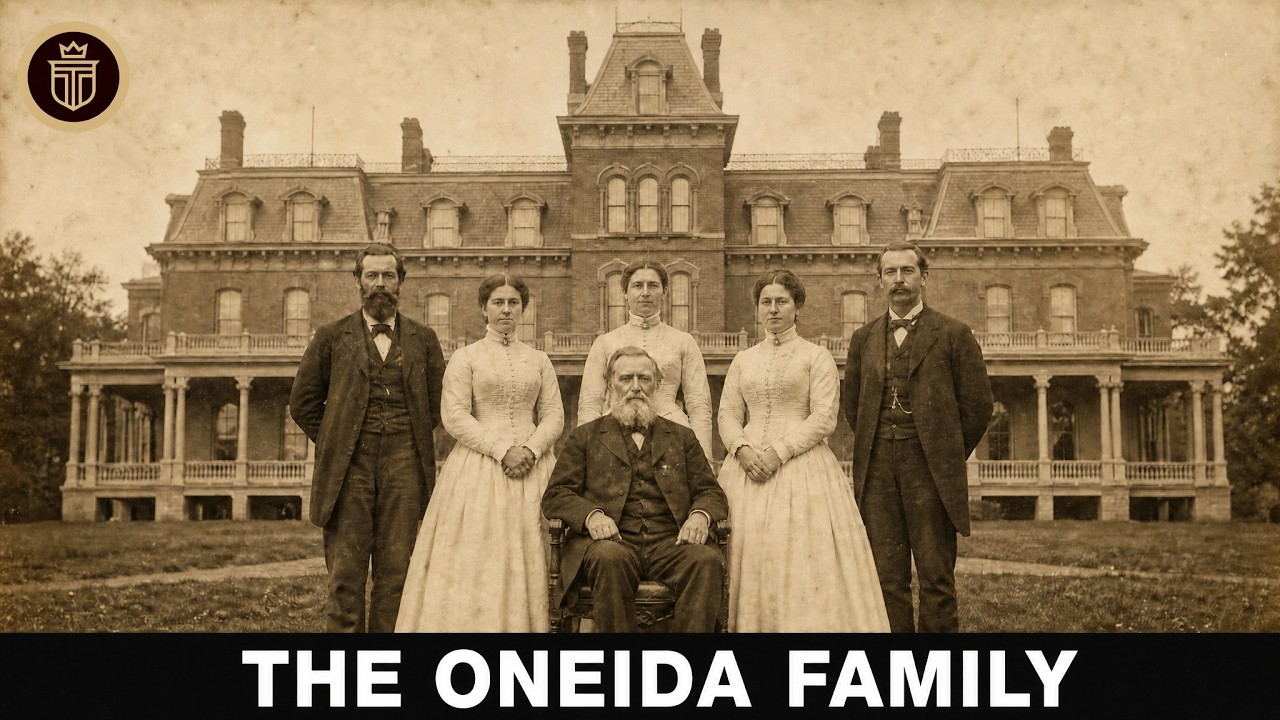
They called it the Mansion House, and between 1848 and 1880 it housed a religious community that abolished private marriage, routed sexual requests through designated intermediaries, and kept a written record of who asked for whom. That record no longer exists, burned in the Oneida landfill in 1947, one year before the company celebrated its centennial with a dance band and a silver crown. What remains of it sits in 72 linear feet at the Syracuse University archives: meeting minutes, health reports, and pledges signed by 53 women promising they did not own themselves. This is the story of how a community that made marriage collective and let its founder choose the parents became the company that sold America its most respectable dinner tables.
John Humphrey Noyes was born September 3, 1811, in Brattleboro, Vermont, into the American ruling class. His father sat in the U. S. House from 1815 to 1817, and his mother, Polly Hayes, was the aunt of Rutherford B.
Hayes, who reached the presidency while his cousin ran a cooperative under threat of prosecution. Noyes graduated Dartmouth in 1830 with little religious fervor until a revival wave swept New England in the fall of 1831 and carried him along. He entered Andover Theological Institute, moved to Yale, and in 1833 received a license to preach. His license lasted little more than a year.
In February 1834, he announced he had attained sinless perfection; the association withdrew its approval at once. He was said to have replied that they had revoked his license to preach while he revoked their license to sin. That retort is quoted more often than the argument behind it, and that argument is where the whole later history of the Oneida Community begins. Noyes concluded that the Second Coming had already occurred, at the end of the apostolic age just after the destruction of Jerusalem.
If Christ had already returned, the Kingdom was not a future reward but a present condition, and the standard of Christian character was not struggle against sin but its absence. A man who believes the Kingdom has already arrived is obliged to live by its laws. A society of people who had stopped sinning would need no law, no contracts, and no exclusive claims, and among those arrangements was marriage, which Noyes came to regard as a legal superstition that had survived only because ordinary Christians had failed to notice the shift in divine administration. He returned to Putney, Vermont, in 1836, gathered an evangelical school around his family, and began secretly working out what the abolition of exclusive attachment would look like in practice.
There was a wound beneath this theology, and the family archivists were the ones who identified it. Abigail Merwin was the first convert to his ideas in New Haven, and in 1835 she became engaged to another man and left the circle. Noyes afterward developed the idea that she remained his wife in spirit, regardless of what civil law recorded. A printed letter from January 1837, published without his consent in August of that year, declared that the institution of marriage does not exist in the Kingdom of Heaven.
The letter ended his standing among respectable reformers and marked him at twenty-five as a man whose theology had led him somewhere the churches could not follow. The letter also reached a wealthy young woman in Vermont who had already begun paying his debts. Harriet Holton settled eighty dollars of Noyes’s debts in 1837, and she wanted the arrangement to continue. In June 1838, he proposed, with the condition that neither would treat marriage as an exclusive right.
She agreed, and the marriage produced a series of pregnancies described as five births in which four infants were lost to premature delivery or early death. That series of deaths is the origin of the doctrine governing sexual relations at Oneida for the next four decades. Noyes concluded his wife had suffered repeatedly because of a physical act with a separate purpose, and he began teaching that intercourse could be performed without ejaculation, a practice he called male continence and published as doctrine in 1848. By 1843, his followers in Putney had formed what they called a partnership, pooling property.
In 1846, Noyes and his wife joined George and Mary Cragin and three other couples in a signed agreement renouncing all individual ownership, of persons or things, and naming Noyes as the father and overseer placed by the Holy Spirit over the family. Thus was born complex marriage, named later, as a principle of property rather than a sexual adventure. Its logic held that communism in things without communism in persons was incomplete surrender. Noyes connected the natural sciences of the age to theology with complete confidence.
The community, on this reading, operated like a battery, and a sufficient charge of divine current would eventually abolish death itself, which is why regulated sex was treated as sacred ritual. Putney did not appreciate the distinction. In October 1847, Noyes was arrested on charges of adultery and released on bail, and everyone around him advised that a trial would end the experiment. The group left Vermont and settled in central New York on land offered by a convert named Jonathan Burt at Oneida Creek, where the community was founded in 1848.
Around 1849, the community’s own writers began using a phrase that outlived everything else they produced. Noyes confirmed it in print two decades later, writing in the community paper on March 21, 1870, that the terrible mixture of two good ideas, free love and free love, had been used by Oneida writers for the first time about twenty-one years earlier. The rest of that article is a denial of the phrase he helped invent. He insisted that free love at Oneida did not mean freedom to love today and leave tomorrow, and he added that anyone tracing the community’s course would find no abandoned women or children along the way.
The historian Lawrence Foster reached the clearest judgment, noting that Noyes and his critics had somewhat misleadingly described the system as a form of free love. So he earned the term and then disowned it. The reason he disowned it is that his system was far more organized than the phrase suggests. To see how organized, you must enter the building he designed to make privacy structurally difficult.
Membership reached 87 in 1849, and the first dwelling built to hold them was a three-story wooden house, 60 by 35 feet, designed by Erastus Hamilton, an architect trained in Syracuse who joined the community and designed for it for thirty years. Growth was rapid and uneven, reaching about 170 by the mid-1850s and nearly 280 across the Oneida and Wallingford branches by 1870, peaking at 306 in 1878. The brick Mansion House opened February 20, 1862, followed by a dining hall and kitchen the next year and a large south wing in 1869. The structural report prepared for Syracuse University states that the arrangement of small private bedrooms opening onto common halls was a design plan developed in direct response to the needs of the complex marriage institution.
A system that considered exclusive attachment a sin required architecture in which that attachment could be observed. Hamilton provided that with sitting rooms positioned so that movement went back and forth through shared space. The community wrote its own testament to this arrangement: to love one another, not as couples as in the world, but as a group. The largest room, the Big Hall, held all members for nightly meetings, concerts, novel readings, and adult classes in Greek, physics, and chemistry from a library of five to six thousand volumes.
There was no tobacco, no alcohol, and the diet was chiefly fruit and vegetables, with meat, tea, and coffee as occasional luxuries. Women cut their hair short, abandoned corsets, and wore short dresses over trousers, which visitors found more shocking than anything they were told about sleeping arrangements. Members rose early, worked short shifts by the standards of the age, and met every evening in the big hall, where the same people in the same room discussed business, theology, and personal conduct. No member was left alone for long, and the building’s design did not allow it either.
Administration ran through committees, and the surviving records list dozens of standing committees and roughly forty-eight administrative departments. The instrument connecting all of it was mutual criticism, which Noyes drew from a secret society of missionary students at Andover and rebuilt as a system of discipline and governance. A member appeared before a rotating committee and sat while others described his or her faults in turn. The great sin under the criticism system was what the community called special love or sticky love, exclusive attachment of any kind.
Their stated rule held that the heart must be kept free to love all the true and worthy, and never be restricted by idolatry or selfish love in any form. By the mid-1870s, up to five thousand outsiders passed through the grounds annually, buying preserved fruit and looking for evidence of vice, finding instead a clean, industrious village that discussed chemistry after dinner. The vice they were looking for was indeed there, and it was organized with the same discipline the committees applied to the account books. Swinging is our word, not theirs, and no one at Oneida would have known what it meant.
Modern swinging is secular recreation, negotiated directly between adults, private, and contraceptive. Complex marriages inverted every one of those terms: they were sacred, mediated, governed by spiritual rank rather than personal attraction, documented and publicly criticized, and built on destroying exclusive attachment rather than preserving it with a primary partner. Birth control was doctrinal, not mechanical, and the mechanism was male continence, as published in the community paper in July 1866. Noyes taught the practice of intercourse without male ejaculation and rejected withdrawal entirely as a waste of seed.
By the community’s own accounting, the method succeeded with twelve unplanned births among roughly two hundred adults between 1848 and 1868, a record most Victorian couples could not approach. A man did not ask a woman for sex directly. Noyes decided in a home talk in 1852 that offers were best made through a third party, on the grounds that this prevented selfish privacy and made love a community matter. The intermediary was usually an older woman, and she conveyed the request, delivered the refusal or acceptance, and knew the answer before either party did.
The encounter itself was called an interview, and the rules specified that the sexes slept separately and met not to sleep but to elevate and enjoy, and that short interviews were best, since it is an excellent rule to leave the table while the appetite is still good. Who could ask whom was governed by a ladder called ascending fellowship, in which younger members were directed toward older, spiritually superior partners, while peer relationships or those toward the lower ranks were discouraged as a waste of spiritual advantage. In practice, young men were introduced to sex by women past childbearing age, and usually kept away from younger women until they reached twenty and mastered continence, while young women were introduced to sex by older men. The community published its own defense of consent, and it deserves quoting before being tested.
An 1867 pamphlet states that people should under no circumstances be forced to accept the attentions of those they do not desire, that the community abhors rape whether committed under the cover of marriage or anywhere else, and that every woman is free to refuse the attentions of any man. The contrary evidence lies in the manuscripts that survived the burning, and the most troubling element is in Noyes’s own hand. In a letter to his niece Tirzah Miller on April 6, 1869, he told her she had left him with the impression that her sexual nature had been abused by entering a sexual relationship without desire. Miller, a diarist whose journals were not opened to researchers until 1993, had recently been sleeping with men for whom she felt nothing, in what she described as a spirit of duty, and said the practice had taken all the romance out of life.
She did not realize she could refuse until Noyes told her so, a measure of how far the stated rule had sunk to the lower levels. Testimony gathered after the collapse points the same way. An 1884 study by a hostile physician, Eli Vanderwalker, quoted an anonymous informant who said a woman who refused a prominent member risked her respectable standing, since refusal was seen as a lack of modesty, and described the moral pressure on young women approached by men aged fifty to seventy. The historian Anthony Wonderley, a former curator of the Mansion House, put it in the most cautious terms available, writing that ascending fellowship carried the potential for exploitation, where some, especially young women, may have been pressured into relationships with partners they did not desire.
The ages are the hardest part of the records and must be reported as a dispute rather than a fixed number. Wonderley’s published estimate of the average age at which women in the community began sexual relations is fifteen. Mary Rieback, reworking Vanderwalker’s table and excluding the fourteen women in his sample who married before joining, calculated an average of about thirteen and three-quarters and a median of thirteen, with the youngest recorded case at age ten. Both calculations rest on the same limited survey.
The legal framework of the period also matters, given that the age of consent in New York was then ten or twelve, a low enough threshold that Rieback concluded most of the community’s older men would not have been charged with statutory rape under the law as it then existed. By 1869, Noyes moved from regulating sex to directing heredity. Stirpiculture comes from the Latin stirp, meaning stock or root, and Noyes chose it because it describes what stockbreeders do with their herds and what he intended to do with his congregation. He had been circling the idea for two decades.
The 1867 annual report argued that reproduction should not be left to blind chance or selfish passion but placed under scientific direction at least equal to what was applied to improving valuable animal breeds. Two years later, he asked his members to sign. Thirty-eight men put their names to a statement that they sincerely sympathized with his aims in regard to scientific propagation and offered themselves to form any combinations that he might deem desirable. Fifty-three women signed a stronger document declaring they had no rights or feelings in regard to reproduction that would oppose or embarrass him in any way, offering themselves as living sacrifices and calling themselves voluntary martyrs to science.
The full text declares that they did not own themselves in any way but belonged to God, and secondarily to Mr. Noyes as God’s true representative. Every later discussion of consent at Oneida collides with that sentence, voluntarily signed by fifty-three adult women who had spent years inside a system that treated hesitation as selfishness. Noyes had read Francis Galton on heredity, and his practical assumption was Lamarckian: he believed spiritual and intellectual gains acquired in life were passed to children.
That is why the first pairings were made on perceived spiritual rank, with Noyes choosing personally. From 1875, selection moved to a committee of six men and six women chaired by his son Theodore, a Yale-trained physician and religious skeptic, and the criteria shifted from spiritual rank toward physical health. Couples applied, and the committee approved, rejected, or proposed its own unions. Between January 1875 and April 1876, the committee handled fifty-one applications, rejecting nine.
Once a pairing was approved, the woman was bound to her assigned partner only until pregnancy occurred, while the man remained free to have relations with other women: temporary, one-sided monogamy inside a system that had abolished permanent monogamy. Pregnancy was announced at the evening meeting, and the couple was celebrated in a way resembling weddings in a community that had abolished weddings entirely. Fifty-eight children were born under the program between 1869 and 1879, though some counts say sixty-two. The gap likely reflects the difference between live births and all recorded births.
Noyes fathered at least nine of them, more than any other man in the community during a decade in which he aged from fifty-eight to sixty-eight. Across the whole group, fathers were on average twelve years older than mothers. Children left their mothers early, moving entirely to the children’s house by eighteen months and living there under nurses and teachers from age two to twelve. The community’s own expression was that children belonged to the community as a whole, and excessive maternal attachment had a clinical name, parenting instinct, and a penalty: mothers judged overly attached were separated from their children for set periods.
The 1849 annual report dismissed maternal distress as exaggerated and urged women to prefer freedom and education to sickly maternal tenderness, a sentence written thirty years before the program produced its last children. Victor Hawley wrote to Noyes in March 1876 asking, in six words, to have a child by Mary Jones, whom the committee considered too sick and too attached to be allowed to bear one. The couple was repeatedly rebuked, ordered separated for two months, and in 1877, after Mary bore a stillborn child, they left the community entirely, the only recorded path of escape from a eugenics committee decision. In his August 1878 report on children’s health, Theodore Noyes wrote that the community claimed no extraordinary knowledge, had only tried to prevent clearly unsuitable unions, and that their children were like children found among the general public had a little attention been paid to the obvious principles of stirpiculture.
The founder’s own son, running the program, was telling readers that little had been proven. Oneida did not invent eugenics. The peer-reviewed description of stirpiculture is that it was the first selective breeding experiment of the eugenic era, conceived almost two decades before Galton’s word entered common use. When two family archivists finally presented the data to eugenics specialists at a New York conference in September 1921, the paper attracted almost no interest.
Ellen Wayland-Smith’s explanation is that the conference was cool toward the stirpicults specifically because they were born outside marriage, meaning the American eugenics movement rejected Oneida for sexual impropriety rather than for its breeding logic. Anita Newcomb McGee, writing the first outside analysis in 1891, composed the epitaph: stirpiculture was meant to assure the future of church and community, but it destroyed both. Whatever the experiment settled about heredity, it was funded by animal traps, silk thread, and preserved fruit, and those three businesses were about to decide the community’s fate more than any pledge. The community had arrived in Madison County intending to feed itself from the land and turn the whole domain into a garden.
Climate and distant markets ended that plan, and by the mid-1850s gardening had been reduced to one production line among many, with the ideal of self-sufficiency formally abandoned in 1859. What replaced it was improvisation on a comic scale, the same people who discussed the resurrection after dinner spending their days making rustic furniture, leather suitcases, men’s canvas slippers, palm-leaf hats, hoes, wheel brakes, and mop handles. One project after another was tried and abandoned. Salvation came in the form of an animal trap.
Sewell Newhouse made steel traps before joining, and his design became the first product the community could sell faster than it could produce. Fruit and vegetable canning began around 1854, sewing and embroidery silk in 1866, and by 1870 the community had concentrated its activity into three departments: traps, silk thread, and preserved fruit. Profits reached $180,000 by 1867, and the land holding grew to nearly nine hundred acres by 1874. None of that money came from silverware because silverware did not exist as an idea yet.
What the three departments shared is that each converted repetitive labor and patience into a branded commodity, and each required more labor than the community contained. The problem was that the community could no longer supply its own workforce. Meeting orders meant hiring outsiders, and by 1870 about two hundred paid employees worked for a family whose founding documents considered wage labor a denial of God’s plan for the earth. Paid workers sometimes labored twelve-hour days while members worked about four, and the silk factory employed girls aged ten to sixteen because small fingers handled thread better.
Ellen Wayland-Smith puts the contradiction in the clearest possible terms: for about fifteen years before their dissolution, the Oneidans hired wage labor they had loudly declared to be both against communism and against God, so they had to live with that contradiction. Anthony Wonderley’s argument is the most precise diagnosis: once members stopped working side by side, the communal feeling itself began to fade. Members gradually moved toward supervision as payrolls grew, so the daily experience of the ordinary Oneidan increasingly involved directing work rather than performing it. A commune that supervises the work of others has already become an employer, no matter what it calls itself at the evening meeting.
Silverware came from the junior branch almost by accident. In Wallingford, Connecticut, in 1877, Charles Cragin watched a silverware factory working downstream on the Quinnipiac and suggested the community try the trade. The first production was tin spoons made by a religious commune that had never sold anything to a middle-class dining room. Within two years, the spoon and flatware work was moved from Wallingford toward Niagara Falls.
The pattern of these years is that community finance matured faster than its theology, and the men reading the ledgers were increasingly not the men reading the prophecies. Theodore Noyes took leadership in May 1877 and lasted seven to eight months before the succession experiment collapsed. His father resumed control by asserting an authority no vote had granted, telling the community that year that he had been president from the beginning, not by vote of the members but by the will of God. That claim was still standing when a Presbyterian professor at a nearby college began rallying central New York clergy into a campaign.
John Mears taught at Hamilton College, and from 1873 onward devoted much of his public life to ending the Oneida Community by law. On February 14, 1879, a Syracuse conference issued resolutions of denunciation and advised legal action. Mears took the case national on April 10 with a New York Times editorial attacking what he called a systematized slavery in the Oneida domains. The Comstock Act of 1873 had already made public discussion of birth control a criminal matter, and in 1878 the Supreme Court upheld the prohibition of polygamy in Utah Territory.
The legal climate had turned against experimental families across the country. Mears died in 1881, two years after the campaign achieved its goal. Inside the Mansion House, things were worse than the sermons outside. Frank Wayland-Smith recorded in 1879 that the young people were rapidly getting free from all sense of moral responsibility, and James Towner had rallied a faction openly challenging the founder’s authority.
Then, in June 1879, the Syracuse Standard reported that authorities were preparing to arrest the founder. Myron Kinsley carried the warning to Noyes. On the night of June 21, at age sixty-seven, Noyes left the community he had built and crossed into Canada, settling in Niagara Falls, Ontario. The distinction here matters more than the drama: he received warning of a warrant and left before it arrived.
No charge, warrant, or indictment against him from that summer appears in the records. The only documented prosecution of his life had come nearly three decades earlier, an adultery indictment filed in September 1851 and settled the following November for $350. Between June and August, the community tried to govern itself through an administrative council of ten men and nine women, an arrangement in which procedure had replaced the prophet and satisfied no one. From Canada, Noyes sent the instructions that ended the experiment.
On August 20, 1879, he proposed that the community abandon the practice of complex marriage out of respect for public sentiment while retaining common property. The general meeting approved the proposal on the twenty-sixth, and the practice itself ceased on the evening of the twenty-eighth at ten o’clock. Thirty-one years of doctrine ended in the time it takes to close a meeting. Members raised to regard exclusive attachment as a major sin were now expected to choose one person each and hold that choice for life.
What followed had the character of an evacuation. Thirty-eight couples married conventionally within four months, and more than seventy members were married within a year. Leadership arranged what marriages it could. Wayland-Smith’s summary is that some women got no husbands and ended up in a near-destitute state inside a community that had promised them everything belonged to everyone.
Noyes himself refused to abandon his larger project, writing on November 4 that ending complex marriage did not mean giving up the attempt to breed a superior race. He never returned to his home and died at Niagara Falls, Ontario, on April 13, 1886. Marriage had been restored, children were raised by identified parents, and the old sexual system was gone. Property was another matter, and three hundred people who had renounced all individual ownership now had to determine what each was owed.
The accounting began badly. On January 28, 1880, the business board voted to appropriate $288,000 for capital improvements, money the community did not have. Two days later, the board admitted the group had barely covered its costs for the previous five years. The community lacked, as its secretary wrote, a government worthy of the name; the board had failed; the young people were doing entirely as they pleased.
Their pointlessness explains the rest. Many members had stopped being industrious, seeing no point in toiling while others controlled the profits and returns. People who had abolished private property had rediscovered the free rider. The committee proposed a limited liability joint-stock company on August 20, drafted a division and organization agreement on September 1, adopted a revised agreement in November, and executed the transfer on the tenth with subscriptions at one-tenth of face value.
On January 1, 1881, the property and businesses moved to Oneida Community, Limited, with capital estimated at roughly $600,000 by one account and $550,000 by another, with no reliable source reconciling the two. The official account of the settlement, written from inside the company’s sphere of influence, is generous with itself, recording that adult members were compensated equally for past services, that those unable to contribute because of poor health received as much as those who contributed most, and that the elderly and infirm could accept a lifetime guarantee instead of working. According to this account, shares were distributed in proportion to years of service. The ledger tells a different story.
Myron Kinsley, a manager, received 1,241 shares. The architect Erastus Hamilton received 750, and the manager Alfred Barron 676. Harriet Worden, an unmarried mother of three community children, received 115 shares and spent the rest of her life working in the factory. Sewell Newhouse, whose trap had carried the community through its poorest decades, had never recorded his patent, voted against dissolution, and received nothing, while his daughter received 87 shares.
Kevin Caffrey’s reading of those columns is that the shares were distributed by calculations the committee alone determined, and that the limited liability structure deliberately protected the directors from personal responsibility for bank loans. The directors became the board and major shareholders of the new company. The formerly equal became wage workers, or salaried managers if their standing warranted it, and those who remained in the Mansion House paid rent proportional to the size of their rooms. The legal transformation completed a stratification that had begun years earlier.
The group shed any pretense of communism in favor of operating as a private capitalist enterprise. The legal cases over the settlement were still running in the New York Court of Appeals in 1892. The strangest part of the transition was not legal but sensory. Members who had lived their whole lives with common money had never handled cash, and some had grown up without ever seeing it.
Pierrepont Noyes, Harriet Worden’s son, remembered that it seemed really queer to see a boy own a sled and refuse to share it. After the founder’s death, the surviving elders used to consult him through séances for business guidance, which continued until the boy with the sled returned and put a stop to it. Pierrepont Burt Noyes took control of the company in 1895, with unusual qualifications for an American executive of that decade: he had been born under the selective breeding program, his mother had been left 115 shares, and he later wrote that being illegitimate meant he had to work twice as hard as those around him. He brought his fellow stirpicults back into the business, giving leadership positions to the group his father’s committee had arranged, and then he bet the whole company on spoons.
The silk and canning lines were scheduled to close by 1900, trap production was allowed to decline, and everything went toward silverplate at a time when the trade considered plating a poor cousin of sterling. The logic was commercial, not sentimental. Sterling was monopolized by established houses, while silverplate carried fussy Victorian engraving and cost little enough that buyers did not feel they were settling. Oneida improved the plating process to reduce metal wear, issued fashionable designs, and in 1899 launched the Community Plate line, aimed directly at young middle-class couples who wanted a respectable table without the price of sterling.
Selling that table required inventing the anxiety it cured. Burton Dunn, from a stirpicult family, became advertising manager in 1904 and photographed the flatware on antique lace borrowed from the Metropolitan Museum, lending an air of old-world refinement to a product made in a central New York factory. Coles Phillips came in 1911 and painted modern young women gazing into open Community Plate boxes, an image that Wayland-Smith describes as strongly resembling a woman opening the Ark of the Covenant. Maxwell Parrish and John Whitcomb followed.
Irene Castle and Bob Hope lent their names, and the patterns were named Coronation, Deauville, Noblesse, Duchess, Countess, and Lady Hamilton, commercializing an aristocracy in a republic that had abolished it. The core of the idea was to multiply the utensils required, convincing customers that using the same fork for salad and entrée was no longer acceptable in polite society. Wayland-Smith’s observation about her family is the detail that gives the campaign its force, because the people who wrote those advertisements did not believe a word of them. The company they were building treated its workers with a paternalism inherited directly from the commune.
Wages were above the local market, profits were shared, land and home loans were offered at low rates, a school, shopping district, and playing fields were established, and a cash bonus was paid to any employee who built a house. During recessions, managers cut their own salaries by twenty to thirty percent rather than lay off anyone, and the result was that a union organizer who visited in 1915 found workers uninterested in forming a union. About 150 stirpicults and their children moved into Mansion House apartments and then nearby homes, forming the village of Kenwood, marrying one another, and publishing a family newsletter in the spirit of the old community paper. Two wars turned the flatware factory into an arsenal, producing cartridge belts, gas shells, and combat knives in the first, and parachute equipment, surgical instruments, bayonets, bomb casings, engine bearings, and bomber propellers in the second.
In 1947, the family completed the other half of the project when George Wallingford Noyes’s accumulated diaries, letters, and his notebook recording sexual interviews were burned in the Oneida city dump. Wayland-Smith attributes the burning to postwar family-values anxiety and a wish to bury the memory of the community’s rebellious, mannish women. The following July, the company held its centennial celebration at the Mansion House with a silver queen and the Jimmy Dorsey orchestra, in the building where the destroyed papers had been written. Ella Florence Underwood, the last living person who had actually lived under complex marriage, died in June 1950, two years after a dance band played in the hall where the evening meetings once convened.
Executives viewed stainless steel as a downgrade and voted for it reluctantly in 1961, then made it well enough that Oneida produced nearly half of American flatware by the 1980s. Pierrepont Trowbridge Noyes retired as president in 1981, the last of the selective breeding lineage to run the company, while the outsiders who succeeded him kept selling metal flatware to airlines for another twenty years. The end of the American flatware business began in the sky rather than in showrooms. After the September 2001 attacks, American Airlines removed metal flatware from its planes, and the loss of that account and related trade cost Oneida roughly $157 million in sales.
The Buffalo China factory closed in 2003, and on March 22, 2005, the company sold the Sherrill factory that Pierrepont Noyes had built his village around. Oneida Limited filed for Chapter 11 on March 19, 2006, with its plan approved and exit financing of $170 million, all existing common and preferred stock canceled, and hedge funds and banks taking the new shares. Ellen Wayland-Smith says the restructuring disposed of workers’ pensions and retiree health benefits to satisfy creditors while executives kept retirement packages worth hundreds of thousands of dollars each. Ownership passed quickly, to Monomoy Capital Partners in 2011, a merger with Anchor Hocking creating EveryWare Global in 2012, and a second Chapter 11 filing in Delaware in April 2015.
The remaining corporate structure was renamed Oneida Group in 2017, then Anchor Hocking Holdings in July 2021, at which point the consumer brand was sold to Lenox, owned, like the seller, by Center Lane Partners. The name stamped on the back of the spoon became part of a private equity portfolio alongside Reed & Barton, Pyrex, and Instant Pot. The last flatware still made in the United States comes from a different company in the same building: Sherrill Manufacturing, founded in 2005 in the factory Oneida sold, which saw federal procurement officials pull twenty-two foreign-made flatware products from a government platform in June 2026 after pressure from the company. Back in Madison County, the building where it all began is preserved through fundraising.
The federal government designated the Mansion House a National Historic Landmark in 1965, and in 1987 the company transferred its management to a nonprofit museum, the way corporations dispose of a past they can no longer explain to shareholders. The museum’s public exhibits list traps, advertising art, and Jessie Kinsley’s handicrafts, a story of industry and innovation, and mention nothing about complex marriage or stirpiculture anywhere on the page. Museum staff have discussed the sexual system publicly in the press, and in 2025 the house hosted five temporary exhibits organized by Colgate University students in a course titled Curating Public History, Utopianism, Sex, and Silver. Both things are true at once, which is what usually happens when an institution has to live in the house it inherited.
The only thing the experiment did not consume was the balance sheet, which is why the children raised for an unrealized kingdom instead spent their careers selling flatware. The theologies faded and the archives burned, and the only part of the experiment that could be packed and shipped was the metal. A community that had forbidden its members to own anything, or anyone, ended as a brand in an investment portfolio, still teaching strangers that a proper table requires a separate fork for every course.