On the 10th of August 1997, a photograph of Dodi Fayed kissing Diana, Princess of Wales, on the deck of a yacht filled the front page of a British newspaper. Within forty-eight hours it had circled the planet, becoming the most lucrative image on earth. It was taken by an Italian photographer who claimed he simply happened to be in the area. No one has ever been able to prove who told him where to point his lens.
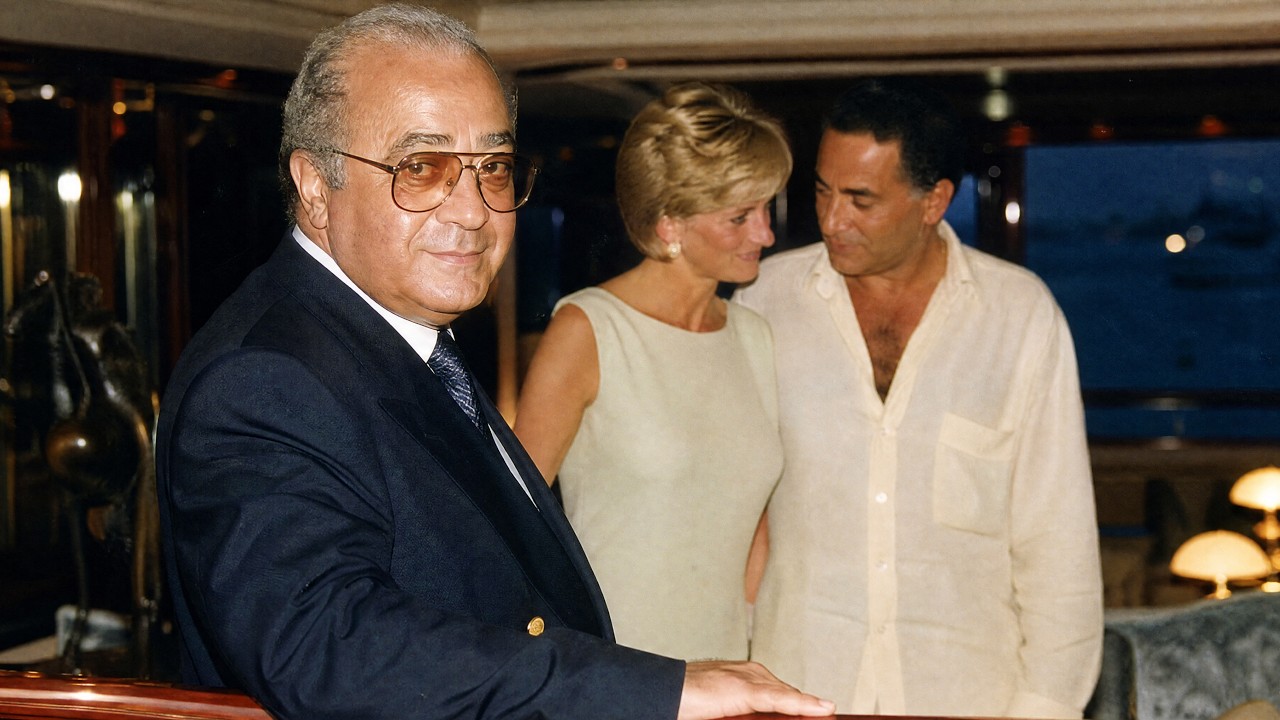
But the photograph set in motion the chain of events that would end in a Paris tunnel twenty days later. The man at the center of the summer had spent his entire life constructing the stage on which that photograph became possible. Born in Alexandria in 1929, Mohamed Al-Fayed had sold Coca-Cola on the streets as a young man before marrying into the Khashoggi family, one of the most powerful dynasties in Saudi Arabia. The marriage ended in 1956, and he was expelled from the family in disgrace, cast out while holding his infant son Dodi.
That humiliation shaped everything that followed. For the next seventy years he accumulated the trappings of British belonging—Harrods, the Ritz, a Surrey manor, a football club—while being refused the belonging itself. He applied for British citizenship repeatedly. He was refused in 1994, again in 1995, again in 1999.
He died an Egyptian citizen. In 1985, he and his brothers won a bitter takeover battle for the House of Fraser group, acquiring Harrods for 615 million pounds. By 1990, the British state had published a Department of Trade and Industry report finding that the Fayed brothers had dishonestly represented their origins, their wealth, and their resources. No charges were ever brought.
The takeover was never unwound. He kept the shop. But the report defined how Britain treated him for the rest of his life. Dodi Fayed was born in 1955, the son of the marriage that had ended in disgrace.
He was given everything and allowed to earn nothing. His father set up a film company and installed him as chief executive at twenty-four, with someone else hired to run it. The one credit that mattered was Chariots of Fire, which won the Academy Award for Best Picture in 1982. The real work was done by others.
The son was understood to be the checkbook. Unearned money arrived at a rate of 100,000 dollars a month, whether he worked or not. His father could cut off the flow with a telephone call, and did, publicly, when Dodi ran up hotel bills he could not pay. A Los Angeles hotel was told directly that the father would not be paying his son’s debts.
A colleague described the relationship as a choke chain: a little freedom, then a pull. Even in his forties, Dodi telephoned his father constantly to report in. His pattern with women was long and documented. He proposed to one model and married her in 1986, losing interest within eight months.
He bought another a penthouse, sued her when it ended, and attempted to take the property back. One of his friends said that Dodi bought far more for others than himself, and that this was part of his low self-esteem. In the summer of 1997, newly separated from the man she loved, and pursued by every camera in Europe, Diana needed a place no lens could reach. Mohamed Al-Fayed offered her a villa above Saint-Tropez with a private jetty.
It was built for privacy. The jetty pushed every moment of the family’s time out onto open water, where a man with a long lens and a fast boat could sit offshore and wait. The setting was built for exposure as well. While Diana was at the villa, the father summoned his son.
Dodi had been in the south of France already, for reasons that involved another woman. But when Diana arrived, he came as he always came when his father sent for him. The father had bought the yacht only weeks before the summer that made it famous. The Jonikal, nearly 64 meters long, had been purchased for around 15 million pounds.
The father assembled the stage piece by piece in the weeks before the play began. On a smaller boat, a few hundred meters away, another woman waited. Kelly Fisher was an American model who had been with Dodi for about a year. She said he had proposed, given her a sapphire and diamond ring valued at over 200,000 dollars, and bought a 7.
3-million-dollar house in Malibu on the 2nd of July for the life they would have together. He flew her to the south of France and left her on the smaller boat while he spent his days on the larger one with Diana and came back to her at night. She learned of the kiss from the newspapers. Four days later she announced she was suing for breach of contract.
She was still wearing the ring. The wedding, she said, had been set for the 9th of August. Nobody had told her it was off. A recording of a telephone call played years later at the inquest captured the exchange.
You even flew me to Saint-Tropez to sit on a boat, she told him, while you seduced Diana all day. His reply was three words: We broke up, Kelly. On the 30th of August, the couple flew up from Sardinia and spent the afternoon at the Villa Windsor, a mansion leased by Mohamed Al-Fayed. They arrived at the Ritz, the father’s hotel, at half past four.
In the early evening Dodi visited a jeweler on the Rue de la Paix and came away with a ring. The house had called the line Tell Me Yes. What the ring meant has been argued ever since. Two accounts of the ring exist.
The first belongs to the jeweler and to Mohamed Al-Fayed, who insisted it was an engagement ring chosen for a proposal that was hours away. The second was given under oath in a courtroom. A senior assistant to the president of the Ritz testified that the engagement story had been built after the fact, that the ring chosen was the cheapest of those presented, and that it was picked by Dodi alone in a last-minute decision. Paul Burrell, Diana’s butler, testified that she would not have gotten engaged, that she found the ring gaudy and lacking in taste, and that the romance had already passed its peak.
Late that night, a decision was made to slip the couple out of the back of the hotel. A decoy car was sent from the front to draw the photographers away. A few minutes after midnight, Diana and Dodi got into a black Mercedes. The driver was Henri Paul, the hotel’s acting head of security.
Not one of the four passengers wore a seatbelt. The decoy did not hold. Photographers on motorcycles gave chase. Minutes later, moving at more than 100 kilometers an hour on a road limited to fifty, the Mercedes entered the underpass beside the Pont de l’Alma, clipped a small white car, swerved, and struck the thirteenth pillar head-on.
Henri Paul and Dodi Fayed were killed instantly. Trevor Rees-Jones, the bodyguard, survived with severe injuries. Diana was alive when help reached her. She died at 4:00 in the morning at the Pitié-Salpêtrière Hospital.
She was 36. Dodi was 42. Blood tests showed Henri Paul had been drinking at around three and a half times the French legal limit and had taken prescription medication. The French investigation concluded the driver lost control at excessive speed while drunk.
Within days of burying his son in a brief service at the Central Mosque in Regent’s Park, Mohamed Al-Fayed began rebuilding the story. He insisted the couple had been engaged and that a wedding had been imminent. He built a memorial inside Harrods holding photographs, a wine glass from their last dinner, and the ring. Later he added a bronze statue of the couple dancing barefoot.
Then he went further, claiming the couple had been murdered by the British secret services on the orders of the royal family, because they could not bear the prospect of a Muslim marrying the Princess of Wales. He named Prince Philip directly. He claimed Diana had been pregnant. Every claim was tested.
A police inquiry running to 832 pages reviewed around 175 separate allegations of conspiracy and found no conspiracy to murder. Forensic examination found no evidence Diana had been pregnant. A formal inquest before a jury of eleven heard from around 250 witnesses. The judge directed the jury that there was not a shred of evidence to support the allegation that Prince Philip had ordered the death of the princess.
In the spring of 2008, the jury returned a verdict of unlawful killing, caused by the grossly negligent driving of the following vehicles and of the Mercedes itself, naming the impairment of the driver by drink and the failure to wear seatbelts. The jury made no finding that the couple had been engaged. The father’s response was to insist he was disappointed by the verdict rather than persuaded by it. In 2010, he sold Harrods to investors from Qatar for 1.
5 billion pounds. In 2018, the new owners cleared away the memorials to Diana and Dodi. The building he had bought to prove he belonged forgot him within a few years of his leaving it. Kelly Fisher, the woman on the other boat, married a Russian pilot, had a daughter, and built an ordinary private life.
She withdrew her lawsuit within days of Dodi’s death and has stayed quiet in the nearly thirty years since. Mohamed Al-Fayed died on the 30th of August, 2023, at the age of 94, one day before the twenty-sixth anniversary of the crash that took his son. He was buried near him on the private grounds of the Surrey estate. The love story he sold the world was the last and largest of his constructions.
The affection at its center, two lonely and hunted people finding a genuine ease in one another for a few weeks on a boat, was the one element of the whole summer he never had to buy, arrange, or invent. And it was the element his inventions finally buried.