On a Sunday morning in December 1983, a hotel worker in London found an elderly widow dead in her room near Paddington Station. She was 77 years old. A bottle of pink champagne stood among her few remaining luxuries. The woman had once been married to three millionaires in succession.
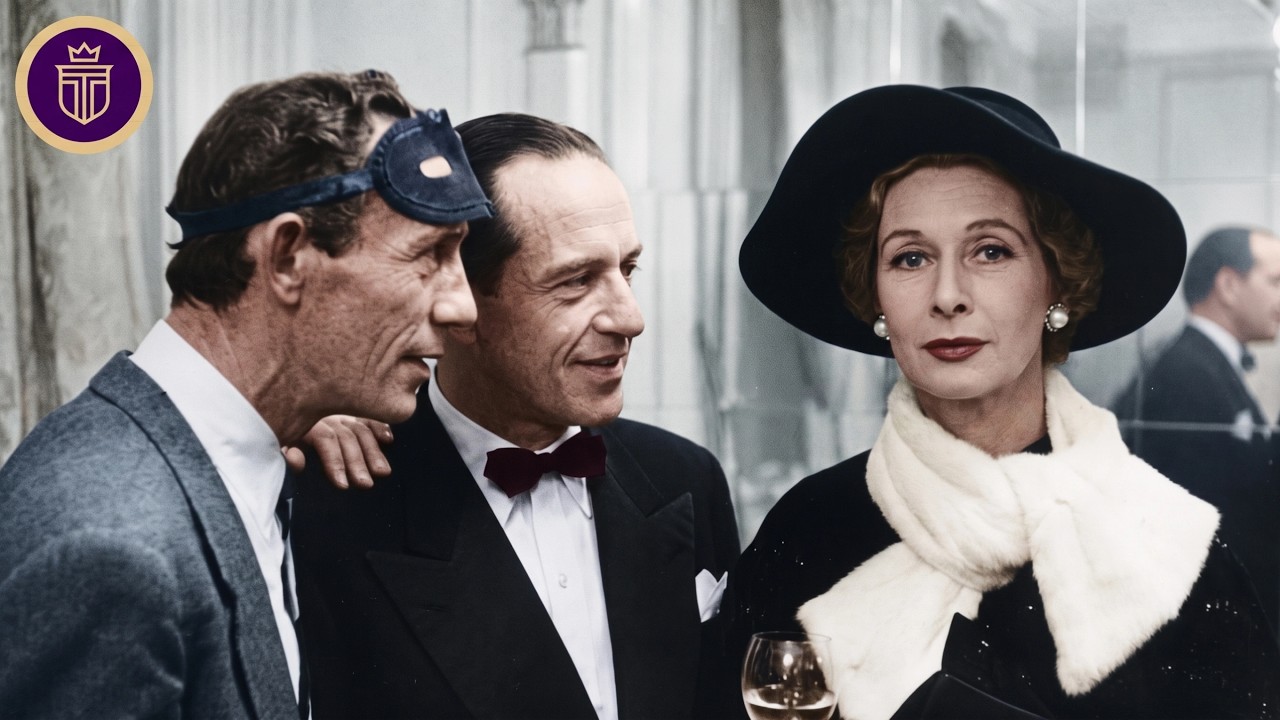
She had traveled through Europe in a gold-plated, zebra-fur-lined Daimler. She had quarreled with a reigning prince and been banished from an entire coastline because of it. She had been photographed, quoted, mocked, envied, and adored by a Britain still rationing sugar. And she had outlived not only her husbands but also her fortune, her yacht, her jewels, and the vast apparatus of attention she had built around herself with her own hands.
Her name was Norah Docker, and for roughly a decade she was about as famous as postwar Britain ever produced. Born above a butcher’s shop in Derby, she died in a rented hotel room beside a railway station. The distance between those two rooms, measured in gold leaf, champagne, and newspaper columns, was one of the strangest journeys any Englishwoman of her century ever made. Norah Royce Turner was born on June 23, 1906, in Derby, the second of four children.
Her father, Sydney Turner, was a self-made shopfitter who moved the family to Birmingham and opened a car showroom. For a decade the business flourished, and the children grew up in comfort on a good address with servants in the house. A girl accustomed early to the idea that money was something that arrived and stayed. When Norah was about sixteen, everything collapsed.
Her father suffered a nervous breakdown, spent time in a psychiatric institution, and then jumped from the ferry between Holyhead and Dublin into the sea. Norah was among the last of the family to see him alive. He had asked her shortly before his death whether she would take care of them all if something happened to him. The memory stayed with her for the rest of her life.
The comfortable existence vanished almost immediately. The showroom was sold, the staff dismissed, and her mother Amy invested what remained in a pub, then other businesses, each less successful than the last. Norah watched her mother’s small capital shrink with every move and learned a lesson about the fragility of money that a richer girl would never have needed to learn. She later described this brief taste of real poverty as the event that fixed her course, a determination never to be poor again that shaped every choice she made for the next sixty years.
At eighteen, Norah went to London to make something of herself. Her first ambition was the stage, but she soon found work as a dancer at Café de Paris, the basement club near Leicester Square then at the height of London fashion. It was a better education than any drama school could have offered. A dancer in that world was paid to be charming to men who had arrived with money and time, to make a stranger feel like the most interesting person in a crowded room, and to judge in seconds the difference between a man who could pay and a man only pretending he could.
Norah, one artificial blonde among thousands, learned to read wealth the way a jeweler learns to read a stone. She drifted through other jobs, returned to Birmingham, found she could not settle, and kept coming back to London as if pulled by a magnet. What she was really doing was serving an apprenticeship in the only trade that would ever hold her attention: the trade of being seen. In the club she met the first of the three men who would make her rich.
Clement Collingham was chairman of Henekey, the old wine and spirits merchant, a married man when their affair began. Norah moved in with him while his divorce was still in progress, and his wife named her in the proceedings. Norah became pregnant before they could marry, and the pregnancy was terminated, a fact that emerged during the divorce and later led to her being banned from the royal enclosure at Ascot. They married in 1938 at Chelsea Town Hall.
Norah, then thirty-two, settled into a country house in Berkshire with servants. In 1939 she bore Collingham a son, Lance, and in 1943 a daughter, Felicity, who died at nine months old. A private grief that remained quietly in the background. Collingham died in 1945 at the end of the war, leaving Norah, still under forty, a wealthy widow.
The amounts varied wildly in different accounts, but whatever the exact sum, it changed her life completely. The older, richer man she set her sights on was Sir William Collins, known as Wilkie, president of Fortnum and Mason. He was sixty-nine when they married in 1946, more than thirty years her senior. Norah had no sentiment about why she had done it.
He was sixty-nine, she said later, bluntly, and she married him for his money. As Lady Collins she took an apartment in Mayfair and entertained the fashionable elite of the West End. Collins died in 1948, about two years after the marriage, reportedly leaving her even richer. Twice widowed before she was forty-five, twice enriched, Norah had perfected a peculiar arithmetic: the arithmetic of a woman who married older men and buried them with genuine affection and considerable profit.
She met Sir Bernard Docker in 1948, the same year Collins died. Bernard was the only child of Frank Dudley Docker, the financier who had engineered the takeover that merged the Daimler Motor Company into the Birmingham Small Arms Combine. Bernard had inherited both the fortune and the chairmanships, heading BSA and Daimler, sitting on the boards of the Midland Bank and Thomas Cook. He was fifty-three and settled into bachelorhood when Norah arrived.
By her own astonishing admission, she proceeded with deliberate cunning, writing years later that she deserved an honorary degree from any marriage bureau. They married in February 1949 at Caxton Hall. This time the marriage was, at least at first, a genuine partnership that would last nearly thirty years until his death. What Bernard offered Norah was essentially different from what the wine merchant and the grocer had left her.
He offered her a stage. As chairman of a large manufacturing group, he controlled factories, budgets, motor shows, and a publicity apparatus. He had a wife who understood better than any advertising man that people do not fall in love with a balance sheet. They fall in love with a face and a story.
Norah had spent twenty-five years learning to make herself the most interesting person in the room. Now she had been handed a company and effectively told to make it interesting too. Between 1951 and 1955, the Docker Daimlers appeared one each year, unveiled at the Earls Court Motor Show in a Britain still bowed by austerity. Each Daimler was more extravagant than the last.
The first, in 1951, was the Gold Car, its body covered with 7,000 tiny gold stars, every part that would normally have been chrome plated in gold, the interior featuring a gold cocktail set and a gold tea service. A car reported to cost about £8,500 at a time when a modest house cost a fraction of that. Blue Clover followed in 1952 with lizard-skin trim, described by one motoring magazine as the most elegant object at Earls Court. Silver Flash arrived in 1953, repainted in metallic silver two days before the show on Norah’s whim.
Stardust appeared in 1954, royal blue and scattered with silver stars, with built-in cabinets of pale blue crocodile leather containing crystal decanters, silverware, and Wedgwood porcelain. In 1955 came the last and most notorious, the Golden Zebra, ivory and gold, with a golden zebra mascot and real zebra hide on the seats. When reporters asked about the zebra hide, Norah gave the answer she cherished above all: that zebra hide was the best skin because mink was too warm to sit on. She claimed the remark was quoted around the world and became her most famous saying.
Hidden beneath the spectacle, however, was a detail that would only emerge years later. The cars were not paid for by the Dockers themselves. They were built by Hooper and charged to the accounts of the Birmingham Small Arms Company as show cars and advertising vehicles. The shareholders of a company that produced motorcycles and munitions were, in effect, secretly financing a gold cocktail set and a set of crocodile leather suitcases.
For a few years the construction looked like a stroke of marketing genius, as queues stretched at Earls Court to see a Daimler and the name appeared on every front page in the country. But the men who owned the shares saw the same headlines as the public. Where the public saw glamour, more and more directors saw their dividends being spent on a woman’s wardrobe on wheels. Norah had become one of the most photographed and written-about women in Britain, and she had done it deliberately.
She understood decades before the words existed that fame could be manufactured rather than earned. Asked once why she had been elevated to the doubtful ranks of celebrity, she said she would thank a car. There had been earlier friction with Monaco. The Dockers had attended the wedding of Rainier and Grace Kelly in 1956, where they were told to leave their Daimler behind and travel to the cathedral by bus with the other guests, a humiliation Norah refused.
In April 1958 the Dockers went again to Monaco, this time for the christening of Prince Albert, the newborn son of Rainier and Grace. Norah brought her adult son Lance, since the trip coincided with his nineteenth birthday. Lance had not been personally invited to the reception, and palace officials refused him entry. Norah, humiliated and furious on her son’s behalf, refused to attend without him and went instead to lunch at the hotel.
On the table stood a small dish of flowers and a tiny Monegasque paper flag, no bigger than two inches by three. A decoration that appeared on every table in the room. She pulled out the flag, announced they would not be needing it, and made clear, in language the newsreels could not fully convey, what she thought of the Monegasques. Rainier’s response was neither small nor sentimental.
He banned the Dockers from Monaco and extended the ban over the entire French Riviera, closing off dozens of miles of coastline to a woman whose whole social geography had unfolded along that coast. Their christening gifts were returned by courier, icily, without a note. Norah declared herself at war with Rainier, said she would tear up the flag every time until he learned to behave, and refused a later chance to be readmitted in exchange for an apology she would not give. The deeper collapse was already underway, in a boardroom rather than on a terrace.
As early as 1953, the Midland Bank, on whose board Bernard had sat for a quarter century, had grown uneasy about the couple’s undignified publicity and quietly asked him to resign his directorship. By the mid-1950s the company was struggling. The direct scandal was a bill for a dress. Norah had worn an expensive gold and mink ensemble to the Paris Motor Show in 1956 and attempted to claim the cost as a tax deduction on the grounds that she had merely served as a model.
When the tax authorities refused and the matter reached the board, a figure of £7,910 for her Paris wardrobe landed on the table, and patience ran out. On May 30, 1956, the BSA board voted six to three to remove Sir Bernard as chairman and managing director, and then as director. A group of larger investors had first tried to offer him a dignified exit: a statement that he was stepping down for health reasons. It was returned within ten minutes with a single word written in red lipstick, a word not fit for publication.
Bernard owned only about 100,000 of the company’s nearly three million shares, hired a prominent lawyer, swore to fight, and lost. At a general meeting in August, the shareholders confirmed the board’s decision. The apparatus that had made Norah a star was dismantled piece by piece around her. She lost her directorship at Hooper.
The five Daimlers were recalled and stripped of their custom decorations. The Welsh castle was sold. Within four years, Daimler itself, weakened by the whole affair and by years of disappointing products, was sold to Jaguar. What followed was a slow decline lasting decades, the reverse of the ascent.
Without the chairmanships there was no income to offset the money spent, and one by one the possessions went. Jewelry sales reportedly began as early as 1958. The great yacht Shamara was offered for sale in 1965 at £600,000 and sold for less than half that, £290,000. The couple fought the buyer in court over alleged defects and won, a hollow victory in an ever-shrinking life.
They sold the Hampshire estate and left England to become tax exiles, first on Jersey, where Norah repaid the island’s hospitality by calling its inhabitants the most appallingly dull and dreadful people ever born, and then in Malta. The geographical scope of her life, once running from Mayfair to Monte Carlo by way of the Riviera, grew steadily smaller. Fame, once an engine, had become a habit that no longer paid. Bernard, ill and nearly blind, entered a nursing home in Bournemouth in the mid-1970s while Norah remained in Malta.
He died there on May 22, 1978, at the age of eighty-one. Norah flew from Malta to be with him in his final moments. She had married three men for security and outlived them all, and this time there was no third fortune waiting behind the grief. In 1969, in the middle of her long decline, Norah published her memoirs, titled bluntly Nora: The Autobiography of Lady Docker.
In them she performed the ultimate trick of the manufactured celebrity: seizing control of the story before anyone else could finish it. She admitted she had married one man for his money, that she had trapped the other on the way to the altar, that she had had an abortion and been turned away from Ascot. She wrote that she had walked down the red carpets of the world’s most sacred dynasties with delicate but audacious determination and had sometimes been thrown straight off them. She explained her fame not by talent or birth but by a machine, saying that if she had to name one reason for her elevation to the doubtful ranks of celebrity, she would thank a car.
After Bernard’s death, the decline took physical form, address after address, each smaller than the last. She returned to London, moving from a fine house near Claridge’s to a room in Claridge’s itself, and finally, when the money was truly gone, to the Great Western Royal Hotel at Paddington, a solid old railway hotel that had once known grandeur and was now merely functional. She kept up appearances as best she could, drinking her pink champagne almost to the end, a small symbol of her old character still fluttering above a much-shrunken landscape. Nearly all of her fortune was gone, not lost in a single disaster but steadily worn away by the cost of being Lady Docker.
She died there on December 11, 1983, a Sunday morning, found in her room at seventy-seven. No public cause of death was ever given beyond the simple fact that she had died peacefully in her sleep. She was buried in a churchyard in Berkshire beside the daughter she had lost as a baby. What she left behind was not a fortune, for all her fortune had been spent.
What she left behind was the personality itself, the template of a woman famous chiefly for being watched, a template that a later century would mass-produce without ever tracing it back to the butcher’s granddaughter from Derby who had first invented it. She had grown up in fear of the poverty that had struck her father, and she had answered that fear by acquiring, marrying, and displaying on a scale that left a ration-weary nation astonished. In the end she found rest in a rented room beside a railway line, having spent her life mistaking attention for wealth and spending the one in the belief that it could always be converted into the other, only to discover in a silent hotel above the platforms that when the attention finally stopped, there was nothing behind it to catch her.