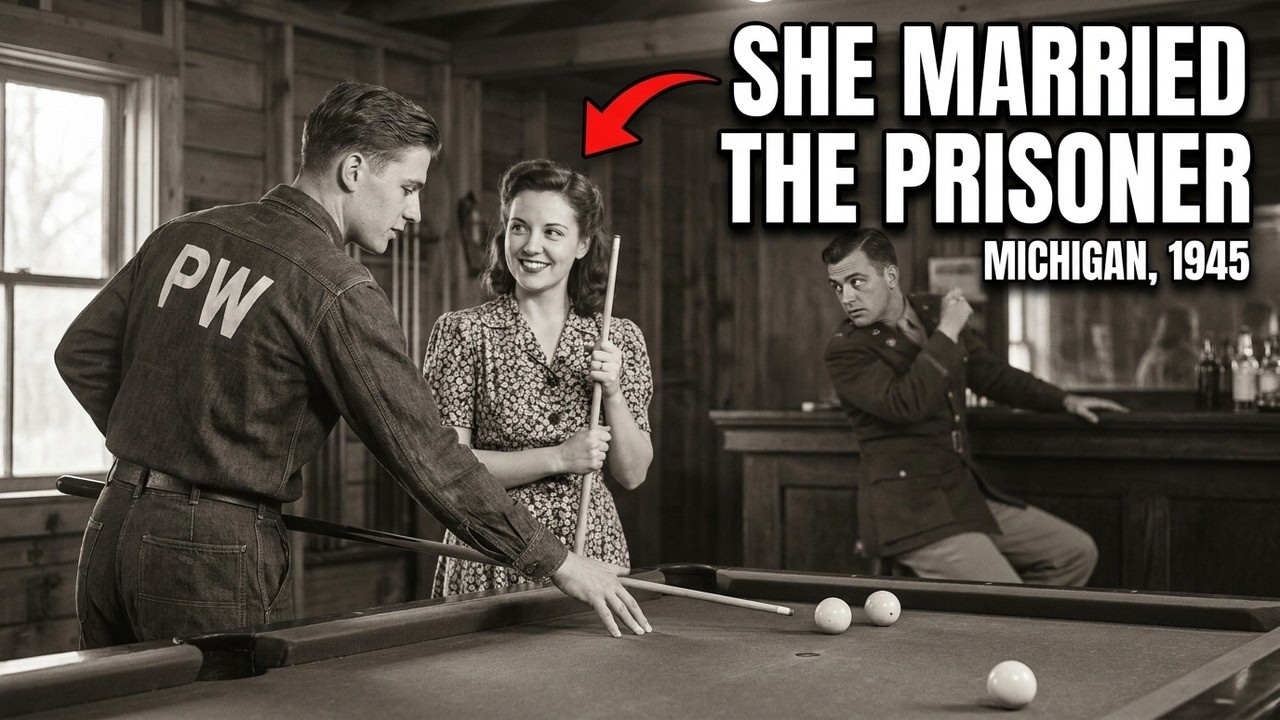
In 1945, the FBI detained a 21-year-old American woman for three days. She worked at a military airfield outside Detroit, and they suspected her of being a Nazi spy. What she had actually done was talk to a German prisoner of war who taught her how to play billiards. Four years later, she married him.
He was not the only one who found his way back. In 1946, the army shipped its German prisoners out of the country. Washington never counted how many of them returned. One former POW made his own estimate: roughly 5,000.
Out of more than 370,000, that is about one in every 75. Almost every one of them needed someone in America to say yes. Under the Geneva Convention, every prisoner had to be returned to his homeland. If a man still wanted America after that, he could come back the ordinary way, as an immigrant like anyone else.
But the requests were processed slowly. There was an annual quota for Germans, and the waiting line was long. Applications from American soldiers’ wives were handled first. A former enemy soldier needed someone in America to sign an affidavit guaranteeing that a job was waiting, that housing was available, and that he would never become a public burden.
So who would sign for a man who had worn the German uniform? Many Americans who did had one thing in common: they had worked alongside those men on their own land. In western Massachusetts, the Lankowski family had employed 15 German prisoners from Westover Field to pick potatoes on their farm from late 1944 into early 1946. The name Lankowski was Polish, and not every prisoner who came to that farm was friendly.
A later group of former SS men made no effort to hide their hatred of Poles. After the war, John Lankowski sponsored one of those prisoners anyway, a man named Wolfgang Lichtenberg. The State Department approved the visa. By signing, the Lankowskis took responsibility for him for five years.
John Lankowski remembered the paperwork the immigration service demanded. There was a great deal of it. In the winter of 1949, Wolfgang Lichtenberg returned to work for the family, this time at their farm in Homestead, Florida. In the West, a Wyoming rancher sponsored an entire family.
Julius Miesan was a factory worker from Hanover with a wife and a young son. The war sent him from the Normandy coast to Russia, where he was wounded, then to Sicily, then to Tunisia, where the Americans captured him. By November 1944, he was in Camp Douglas, Wyoming. For two seasons, he harvested potatoes on Alexander Cross’s farm.
At some point during those two seasons, the farmer and the prisoner became friends. After the war, Alexander Cross sponsored his return. Julius Miesan came back with his wife and children, and the family settled in Wyoming permanently. He died there, in Laramie, in 1986.
A farmer could take a chance on a man he had watched work for two seasons. For a young woman in Michigan, merely talking to a prisoner was enough to bring the FBI to her door. Her name was Stella Kohuth. She grew up on her family’s farm near Milan, Michigan, and during the war she worked for the War Department as a civilian at Romulus Army Airfield, in the procurement and contracting section.
In October 1944, her younger brother John, a 19-year-old private first class in the 88th Infantry Division, went missing during operations in northern Italy. His body was never found. In March 1945, 200 German prisoners were sent to the airfield. One of them, a young prisoner from Cuxhaven named Karl Hockbart, worked in the officers’ club.
He taught her to play French billiards with three balls. She later said, “Of course, there was a regulation against fraternization, but we kept talking. ” Then a Lutheran church in Detroit sent the prisoners packages of food and cigarettes with family names on them. Karl wrote thank-you letters and asked Stella to deliver them.
The day the FBI showed up, she was carrying a list of Detroit families. Every name on it was German. She said, “They thought they had caught some kind of Nazi spy. ” They held her for three days.
She said she was not worried, “because she was innocent. ” Her brother had been missing for five months when she met the German. After the war, Karl was shipped to England, where he spent another two years as a prisoner. Stella wrote to him there.
In August 1948, she was sent to Berlin as a secretary at the American occupation headquarters. The Soviets had cut off Berlin that summer, and American planes were flying in food around the clock. Karl had been there since March. They married in Berlin on June 18, 1949.
She said they paid for the wedding with cigarettes, canned milk, canned meat, and candy. Shortly afterward, Stella brought her husband home to Michigan. In East Texas, a prisoner came back for a woman. A German prisoner named Otto Reinkemeyer fell in love with a local woman named Amelia Kadel.
She was eight years older than he was. After the war, he came back from Germany and married her. Together they built an inn in San Augustine, the Kadel Inn. Horst Winge, a former prisoner from Florida camps, and his wife Hilda waited two years for their papers.
Years later, he still wondered whether the delay was because he had joined the prisoner strike at Belle Glade in April 1945. Their sponsor was Hilda’s aunt in New York. On November 24, 1952, the couple finally sailed from Bremerhaven to New York aboard the SS America. How many actually succeeded?
The immigration service never kept the number. When a historian asked in 1975, the answer was a letter stating that no figures existed. The closest thing to a statistic came from one of the prisoners themselves. John Schorr was a German naval officer who spent a year at Camp Montgomery, Alabama.
When he returned home, his father had died and everything was destroyed. He said, “I was twenty-one years old and had begun to love the American way of life. I suppose I was looking for adventure. ” He worked for the American military government, and by the time the German quota opened for him in 1951, he had several American sponsors.
A background check delayed him another year. He arrived in 1952, worked as a company auditor, and eventually became an executive in Los Angeles. His estimate of former prisoners who did the same was about 5,000. Alfred Mueller, the radio technician in the German Air Force who had been captured in Tunisia and returned to destroyed Berlin, was one of them.
He went back to Algona, the Iowa town where he had been imprisoned. He lived for a time in Minneapolis and retired in Faribault, Minnesota. In Tunisia, the Americans on the other side of the line had been the 34th Infantry Division. Years later, while living in America, Alfred Mueller attended one of their reunions.
Karl Hockbart, the prisoner who taught billiards in the officers’ club, worked at Ypsilanti State Hospital, a few miles from the airfield where he met Stella. He stayed there for 33 years. They were married for 51 years. Karl died in 2000 during a trip to Berlin.
Stella lived until 2020. They rest in Marble Park Cemetery in Milan, Michigan, the town where she grew up. In the same cemetery, a headstone bears the name of her brother. John never came home from Italy.
The girl the FBI once took for a spy brought the German home. For many of these men, the return began with accepting that the war was lost. In one Texas camp, it happened at breakfast, with a single sheet of paper on a bulletin board.
What the prisoners did next is this story.