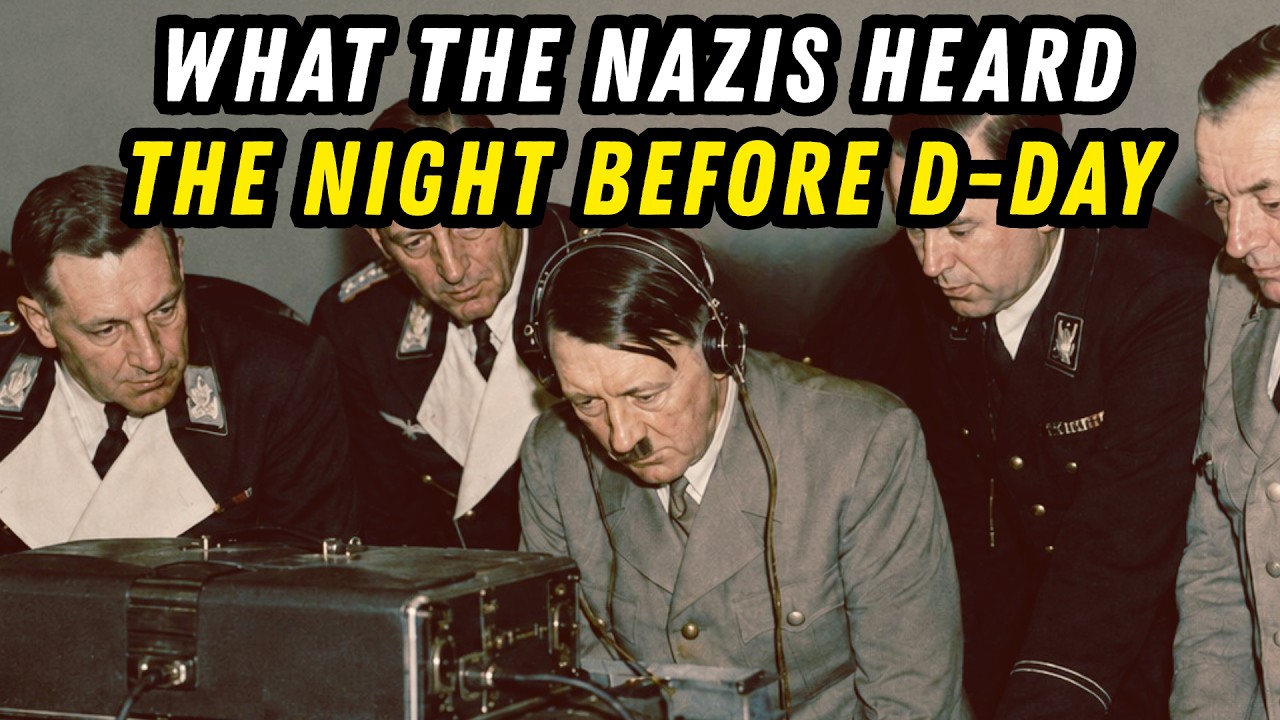
On the night of June 5th, 1944, a German radio intercept team in northern France picked up a coded BBC broadcast and knew immediately what it meant: the Allied invasion of Europe was coming within forty-eight hours. The warning was passed up the chain of command, and the entire 15th Army went on full alert. What no one realized at the time was that the army actually defending the Normandy coast would never receive that warning. On this single night, every layer of the German command structure failed at once.
Since the spring of 1944, the BBC had broadcast a nightly French-language program from London called *The French Speak to the French*. Run by Free French broadcasters who had escaped occupied France, it served as a direct counter to German-controlled Radio Paris. But Radio Londres, as the service was widely known, also carried coded operational messages to French resistance cells buried inside its regular programming. The messages were deliberately absurd-sounding personal notices—lines like “Jean has a long mustache” or “There is a fire at the insurance agency.
” To any casual listener they were meaningless, but each carried precise instructions for a specific resistance group that had been briefed in advance on its meaning. Those meanings were relayed by courier, never transmitted over the air. The Germans monitored the broadcasts constantly but could not keep up with the volume of coded traffic. One set of coded messages was different, because German intelligence already knew exactly what it signaled.
In January 1944, Admiral Wilhelm Canaris, head of German military intelligence, personally briefed Lieutenant Colonel Hellmuth Meyer, the 15th Army’s intelligence officer, on a pair of coded lines drawn from Paul Verlaine’s 1866 poem *Chanson d’Automne*. Canaris told Meyer that the poem’s opening line would alert certain resistance sabotage networks that the invasion of France was coming within roughly two weeks. The second half of the poem would mean action was to begin within forty-eight hours. On the night of June 1st, Meyer’s radio intercept team picked up the first line of the poem on the BBC broadcast.
Meyer informed his superiors, and the 15th Army’s chief of staff alerted the entire army. The message was aimed at Philippe de Vomécourt’s ventriloquist network based south of Orléans, ordering fighters to prepare for sabotage of communication routes within seven days. But everyone missed a crucial detail at the time: the 15th Army held the Pas de Calais coast, not Normandy. The 7th Army, under General Friedrich Dollmann, was the force actually defending the beaches where the Allies would land, and the 7th Army was never passed the warning.
Four days later, on the evening of June 5th, the BBC broadcast the second half of the Verlaine poem at around 9:15 p. m. Paris time, mixed in with hundreds of other coded messages on the same program. This second broadcast ordered resistance sabotage of French railways to begin immediately.
Today, a museum sits inside the concrete German bunker in Tourcoing, near Lille, where Meyer’s team intercepted that broadcast. The museum is named after the Verlaine message itself. German army intelligence informed General Alfred Jodl on the afternoon of June 5th that the second set of Verlaine lines had been detected. Jodl and his advisers took no action, because the coded lines themselves gave no indication of their meaning to anyone outside the original briefing chain.
Colonel General Hans von Salmuth, commanding the 15th Army, sensed something was wrong on his own initiative and ordered his forces onto standby that evening. The neighboring 7th Army, the one that would bear the full weight of the Normandy landing, did not. The reason the 7th Army stayed at ease had everything to do with what German meteorologists were saying. German forecasters had correctly identified a major storm moving into the English Channel, but the Luftwaffe’s chief meteorologist went further than the data supported, predicting that rough seas and gale-force winds would persist until mid-June.
It was a defensible assessment on its face, and German forecast maps from this period were ironically accurate, in large part because they were intercepting and incorporating Allied weather analysis. Allied meteorologist James Stagg, however, identified something the German forecasters missed entirely: a narrow thirty-six-hour window of calmer conditions opening on June 6th. General Dwight Eisenhower used that window to launch the largest amphibious invasion in history. German command, studying much of the same underlying weather data, concluded the Allies would never attempt a channel crossing in those conditions.
That confidence in the weather forecast led senior commanders to leave their posts across the board. Field Marshal Erwin Rommel, the architect of the Atlantic Wall coastal defenses, left his headquarters in France on June 5th and drove to Germany to celebrate his wife’s birthday and to press Hitler personally for additional panzer divisions. He was hundreds of miles from Normandy when the first Allied paratroopers began descending in the early hours of June 6th. General Dollmann, the 7th Army commander directly responsible for the Normandy coast, had scheduled a planning war game in Rennes for his division commanders—a tabletop exercise designed to test responses to a hypothetical Allied landing.
His officers were on the road to Rennes when the real invasion started and had to be recalled and scrambled back to their command posts. By one officer’s first-hand estimate, roughly fifty percent of division commanders and about twenty-five percent of regimental commanders were away from their units that night. Field Marshal Gerd von Rundstedt, commander-in-chief West, was at his headquarters in Paris, not at the front. Convinced by the Luftwaffe’s forecast of two more weeks of storms, Wehrmacht commanders across the sector had authorized leave for their men and sent their officers to the Rennes exercises as if there was nothing to worry about.
Nobody connected the Verlaine intercept to the empty command posts. While the German command structure was scattering itself across northern France and Germany, Allied electronic warfare was already working to ensure that whatever monitoring capability remained along the coast would see and hear exactly what the Allies wanted. In the weeks before D-Day, Allied bombers had systematically destroyed German radar installations along the Normandy coastline. Two independent accounts converge on nearly identical figures: ninety-two radar stations were targeted in the stretch from the tip of Barfleur to Le Havre, and seventy-four of them were knocked out.
By the morning of June 6th, the radar coverage that might have detected the approaching invasion fleet was largely gone before the fleet even entered the channel. But the Allies were just getting started. In the early hours of June 6th, RAF aircraft and naval ships began dropping massive quantities of metallic chaff—strips of aluminum foil cut to precise lengths matching German radar wavelengths. They formed clouds of reflective material that appeared as entire fleets on every surviving German radar screen.
Operation Taxable simulated a full invasion force heading for Cap d’Antifer, roughly eighty kilometers from the actual landing beaches. Operation Glimmer spoofed a separate fleet approaching Pas de Calais, reinforcing the German High Command’s pre-existing conviction that the main invasion would come there. A third deception, Big Drum, layered additional radar countermeasures along the real invasion fleet’s western flank to distort the true scale and direction of the Normandy assault. While all of this played out across the radar screens, something stranger was happening on the ground below.
In the hours before dawn, RAF aircraft dropped several hundred dummy parachutists over locations spread across Normandy. The dummies, code-named Paragons, were rigged with pyrotechnic noisemakers and small explosive charges designed to simulate a soldier burning his parachute after touching down. Small SAS teams who dropped alongside the dummies carried an American loudspeaker system nicknamed Bunsen Burner, playing thirty-minute pre-recorded loops of soldiers shouting orders, rifle fire, and mortar explosions into the pre-dawn darkness. The system could sustain the illusion of a full-scale firefight for up to six hours across the French countryside.
The German response showed how convincing it was. At 2:00 in the morning, German units reported paratroopers landing near Caen, Coutances, Valognes, and Saint-Lô, along with the sound of ships’ engines offshore. Seventh Army commanders raised their alert level, but General Hans Speidel lowered it again once patrols reported finding only dummies in the fields. By that point, the damage had already been done.
Field Marshal von Rundstedt had ordered the 12th SS Panzer Division to respond to what turned out to be a phantom airborne landing. An entire German infantry regiment spent the morning combing through the woods for a non-existent airborne division instead of moving toward the real invasion beaches at Omaha and Utah. Several SAS personnel who participated in the operation were killed in action or captured and later executed by the Germans. Then German state radio did something no one on the Allied side had anticipated.
At 6:33 a. m. London time, exactly forty-three minutes after the opening naval bombardment of the Normandy beaches, Berlin radio announced to the world that the Allied invasion had begun. Minutes later, the German news agency Transocean’s wire transmission was picked up by the Associated Press.
Germany had announced the invasion of its own occupied territory to the global press before the Allies had officially confirmed it was happening. American and British newsrooms treated the German broadcast with open suspicion for hours, precisely because they expected it might be a deliberate propaganda feint. And roughly half an hour after Berlin’s initial announcement, a spokesman on German-controlled Paris radio suggested the Allies had been given another month of grace before the real invasion would start. The choice to dismiss Normandy as a feint reached all the way to the top of the German chain of command, and the delay it caused proved devastating.
Hitler did not receive news of the landings until late morning because his staff were unwilling to wake him. When he was finally briefed, he dismissed the Normandy assault as a diversionary attack. Field Marshal von Rundstedt had requested the release of two reserve panzer divisions early that morning, but the Wehrmacht High Command hesitated, wondering whether the whole operation was a trap designed to pull reserves away from Pas de Calais. Only at a conference around 4:00 p.
m. on June 6th did Hitler finally authorize the 12th SS Panzer Division and Panzer Lehr Division for deployment to the Normandy coast. By that point, the Allies had been consolidating their beachheads for close to twelve hours. The night’s deceptions outlasted June 6th by weeks.
Operation Fortitude had convinced German command that Normandy was a diversion and that the real invasion was still coming at Pas de Calais. Elite panzer divisions and entire reserve formations stayed bottled up in the Calais region for weeks afterward, waiting for a second landing that never came. The signals were all there that night—the Verlaine intercept was correct, the weather data was sound, the radar contacts were real, even if the fleets behind them were not. But the Allies had built a deception so complete, and German command had committed so fully to the wrong forecast and the wrong coastline, that correct intelligence couldn’t break through.
A signal only matters if the system receiving it is still capable of acting on what it hears.