On August 25, 1942, a Sunderland flying boat emerged from low cloud over a barren Scottish hillside and struck the ground at full power. Fourteen men died. One man crawled from the tail of the wreckage and walked through the night, then spent the next 35 years refusing to say what he knew.
Among the dead was the brother of the King himself: Prince George, Duke of Kent, the fourth son of George V, and the man his family had spent two decades learning to hide.
The official inquiry blamed a dead pilot for deviating from his flight plan for reasons unknown. Then the file disappeared.
### The Fourth Son
Prince George was born on December 20, 1902, at York Cottage on the Sandringham estate in Norfolk. The house was so small that the servants outnumbered the usable rooms. He was the fourth of six children, born into a family that raised its children from a distance.
The nursery consisted of two small rooms at the end of a corridor behind a swing door. Two future kings, three other princes, and a princess grew up in those two rooms.
His father, the future George V, had little interest in intellectuals. The children were raised by staff. The boys’ tutor and a servant, in the words of his brother Edward, “brought up my three brothers and myself until we went one by one to school.”
The King’s guidance was remote at best.
At birth, George was fifth in line to the throne. When his father became King in 1910, he became fourth, where he remained for most of his life. Under the Civil List Act of 1910, each son of the King who was not the heir received £10,000 a year at age 21, and an additional £15,000 upon marriage.
That was all he was given. No job. No task.
No purpose.
The family’s treatment of an unusable child is best illustrated by the fate of his younger brother, Prince John. Born in 1905, John developed epilepsy. In 1916, he was moved to Wood Farm on the same estate, cared for by the head nurse.
He died there in January 1919 at age 13. His mother called his death “a great relief” for his troubled spirit. His father called it “the greatest mercy possible.”
Edward, who later wrote 400 pages about his childhood, mentioned John exactly once: on the page listing births. The family did not punish the unwanted child. They simply placed him where the light did not reach and stopped writing about him.
### The Navy Years
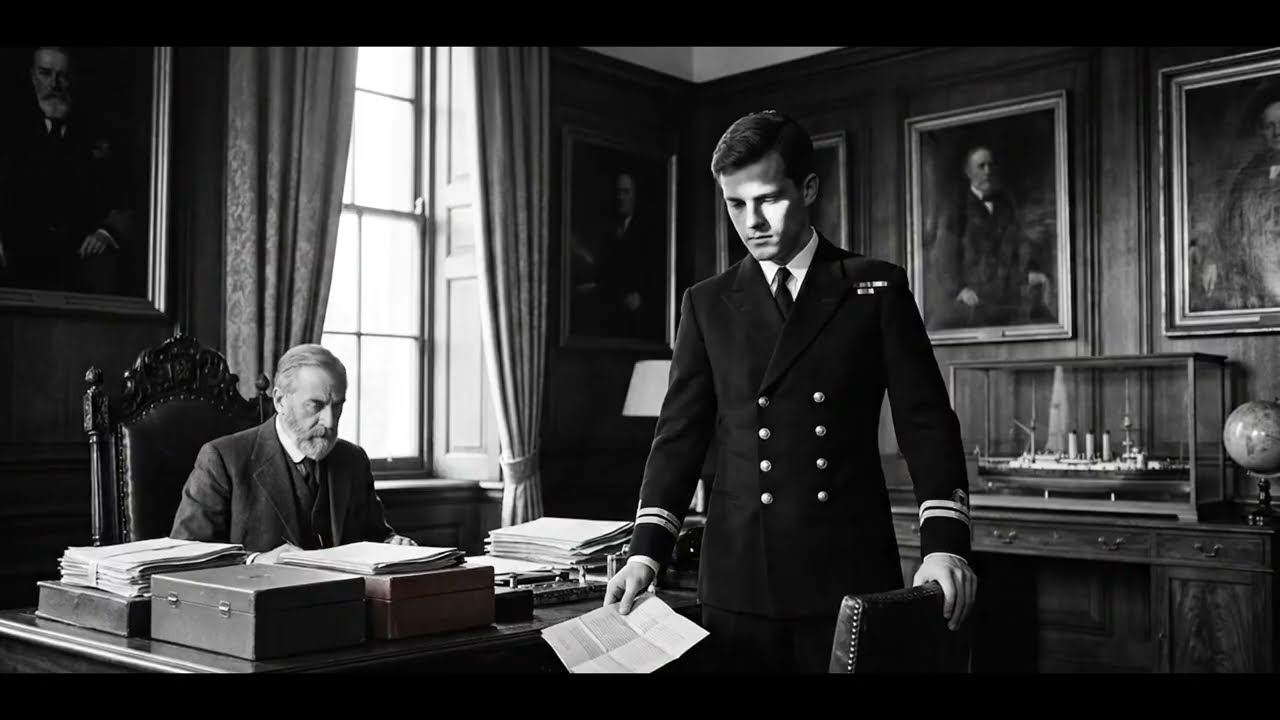
George was sent to the naval college at age 13. He was sick for much of the time, though no one in the family spoke of it aloud. His documented naval career shows he was a sub-lieutenant in February 1924 and a lieutenant exactly two years later.
But his service record is thin. The only well-documented appointment was aboard HMS Durban in 1928, stationed in Bermuda, where he stood watch duties as a lieutenant.
He hated it. Or perhaps he did not, depending on which account you believe. His brother Edward’s version was tidy: George was “somewhat Bohemian” and found naval life constraining, but was happy to take on more public duties.
The biographer Christopher Warwick’s version was medical: George was physically unsuited for naval training, suffering from seasickness, insomnia, and digestive problems. He pressed his father directly and the King eventually relented.
Both accounts cannot be true. Edward, writing more than 20 years later and crafting his own legend, had every reason to make his brother’s exit look respectable. George left active service in March 1929.
The navy kept promoting him on paper for years afterward, but he never returned to sea.
There was something else the navy years cost him. Her name was Helen “Bobby” Baring. She was clever, fashionable, and had already been rejected once by this same family.
In 1921, his brother Albert had proposed to her, and Queen Mary made the marriage impossible. A few years later, George wanted her for himself. His father objected on the grounds that she was unsuitable, and that was the end of it.
The rejection came in the winter of 1924–25, when George was 22 and a serving naval officer.
In April 1928, while still a lieutenant, he joined the Freemasons. He fit in perfectly. Eleven years later, he became Grand Master of the United Grand Lodge of England, a position he held until his death.
It was a society with rules, rituals, and ranks, where a man could earn a position he had actually achieved. He was hungry for that.
### The Wedding
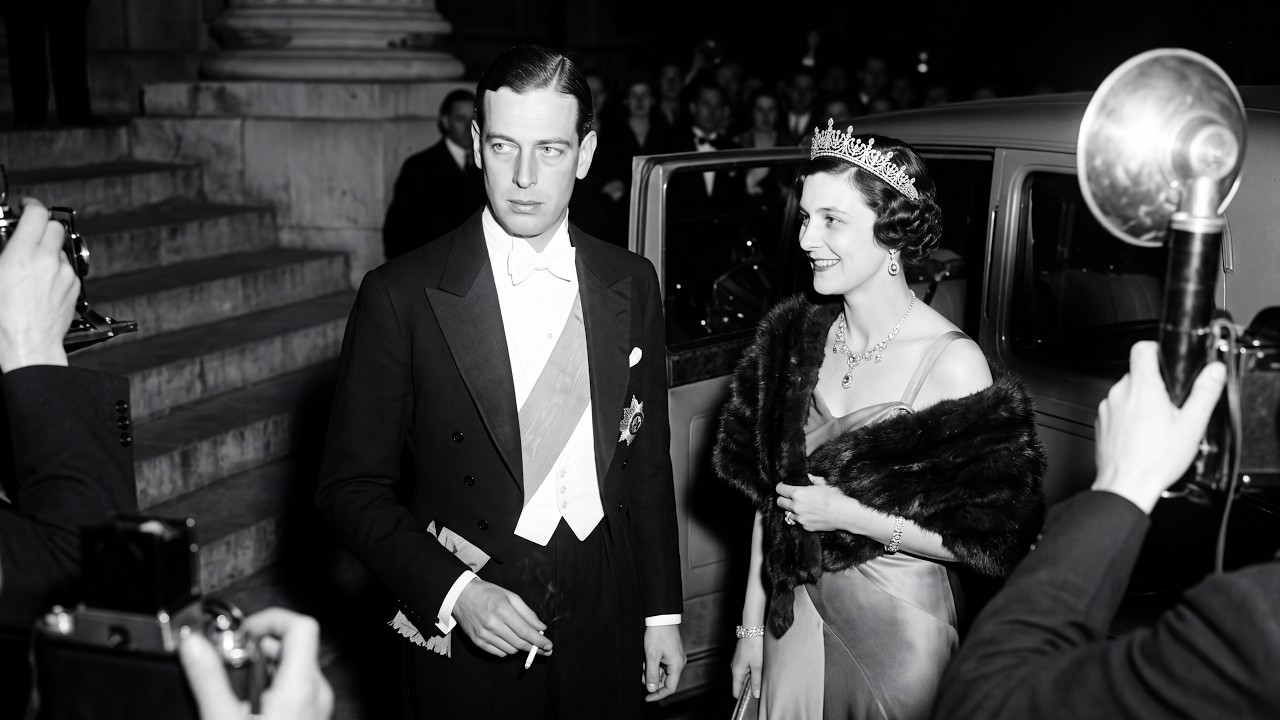
In November 1934, he married Princess Marina of Greece and Denmark, one of the most admired women in Europe. She was four years younger, tall, dark, and striking, an icon of elegance so influential that a shade of green was named after her. The engagement was announced in August 1934.
The ring was platinum with a square Kashmiri sapphire of seven carats between two baguette diamonds.
On October 9, 1934, patents were issued granting him the titles Duke of Kent, Earl of St Andrews, and Baron Downpatrick. The wedding took place on November 29, 1934, at Westminster Abbey. It was the first royal wedding ever broadcast live, with a microphone placed under the Tomb of the Unknown Warrior.
Some 1,500 guests filled the abbey. Hitler sent congratulations. The bride wore a dress by Edward Molyneux with a 15-foot train.
She was the first British royal bride to marry wearing a tiara.
His allowance increased from £10,000 to £25,000 a year on the day of the wedding. There was no vote on it. A Member of Parliament asked when the House would discuss the increase.
The answer was: never. By the end of 1934, he had a dukedom, a duchess, a house in Belgrave Square, £25,000 a year, and the affection of an empire. He still had nothing to do.
### The American with the Silver Syringe
Her friends called her “the girl with the silver syringe.” Her name was Alice “Kiki” Preston. Born in New York, she married twice, first to Horace Allen in 1919, then to investment banker Jerome Preston in 1925.
She and Preston built a house called “Mond” on the shores of Lake Naivasha in Kenya, placing her at the center of the “Happy Valley set,” a community of wealthy white settlers with money, distance, and little oversight.
Evelyn Waugh met her in early 1931 and wrote a single line in his diary that summed her up: “Kiki Preston the beautiful American who never gets up before dinner.” His biographer described her more bluntly as “the beautiful, amusing, cocaine-addicted American.” The nickname “the girl with the silver syringe” was not invented later by a biographer seeking a catchy phrase.
It was what people who actually knew her called her at the time.
She met Prince George sometime in the mid-1920s. No one can pinpoint exactly where or when. The most authoritative source on the Duke of Kent’s addiction is the official biography of Edward VIII by Philip Ziegler, published in 1990.
Ziegler had full access to the Royal Archives and two private sources no one else had used. His statement is unambiguous: Prince George “fell into the clutches of an attractive American called Kiki Preston, who introduced him to drugs.”
Ziegler does not specify the drug. The details everyone repeats come from later writers. Hugo Vickers describes her as addicted to heroin, cocaine, and morphine, and says she soon made Prince George an addict too.
Andrew Morton mentions heroin by name. These are careful authors with credible claims, but they remain claims, not documents.
What is certain is that by the summer of 1929, George was seriously addicted. His brother Edward, the Prince of Wales, had spent months trying to persuade both of them to stop, without success.
### The Treatment
In the summer of 1929, Edward cancelled his holiday, shut his brother in a country house, and stayed there until it was over. In Ziegler’s words, he “intervened vigorously.” He forced Kiki Preston to leave the country and extracted a written promise from her to live abroad permanently.
Then he turned to his brother. Ziegler says he “virtually imprisoned him in the country” and took personal charge of his recovery.
What George went through was never documented by anyone. But what Edward went through was recorded moment by moment in letters to the woman he loved, Freda Dudley Ward. He told her he was doing “the work of doctor, gaoler, and detective” all at once.
He apologised for the lost holiday. After about a month, he still could not leave. He wrote that the treatment had reached “a very delicate and critical stage.”
Then came the detail that stops you cold. To steady his nerves, while sitting for long hours in his brother’s sickroom, the Prince of Wales took up embroidery. He told Freda himself: “This will make you laugh, and perhaps cry a little too.”
Imagine the room. The heir to the British throne, sitting beside his younger brother’s bed, doing embroidery to keep his hands steady while his brother withdrew from drug addiction. No nurse is mentioned in any account.
No doctor. Only him.
By the end of 1929, the worst was over. In mid-January 1930, Edward wrote to his father that he felt more optimistic about the future. He told the King: “It is really a terrible and ghastly thing for anyone, and far worse when it happens to one’s own brother.”
The King wrote back with the only warm sentence ever recorded from him to his eldest son: “Your care of him during all these months must have been a great burden to you. I think everything you did for him was wonderful.”
In 1932, George met Kiki Preston by chance in Cannes. He had to be almost forcibly removed. Sir John Aird was there and recorded it in his diary: “I felt very sorry for His Royal Highness as he took it very much to heart.”
But this was a meeting broken off, not a relapse. No biographer has found evidence of drug use after that.
Kiki Preston’s story ends grimly. On December 23, 1946, at the Stanhope Hotel in Manhattan, she went to a fifth-floor window and jumped. She was about 50 years old.
Her son had been killed serving with the Royal Canadian Air Force in Normandy in June 1944. She outlived Prince George by four years, and no one in England noticed.
### The Child Born in Bern
A child was born in Switzerland in August 1926 and registered under a surname belonging to no one in his family. The date was August 20. The place was Bern.
The name on the register was Anthony Carse Lycett. He was adopted as an infant by an American publisher named Cass Canfield and his wife, and grew up as Michael Temple Canfield.
He lived a full life. He worked as a diplomatic assistant for the United States and later as an editor at Harper & Row in New York. In April 1953, he married Lee Bouvier, whose sister Jacqueline would marry a President of the United States.
That marriage ended in 1958. He died of a heart attack on a plane between New York and London in December 1969, aged 43.
For most of his adult life, people in certain circles in London believed he was the son of the Duke of Kent. There are two conflicting accounts of his birth. The popular story says his mother was Kiki Preston.
This version first appeared in 1961 in the memoirs of Loelia, Duchess of Westminster, who said Edward VIII believed it. From there, biographer after biographer recycled it for 40 years.
But the strongest evidence comes from the woman who married him. Laura Charteris, later Duchess of Marlborough, published memoirs in 1980. She recorded what the Duke of Windsor told her when she raised the subject of her husband’s parentage.
His answer was decisive: “I am sure your husband is my nephew’s son.” That is direct testimony from a man who spent five years under the same roof as the father in question.
The second account of the mother appeared much later, supported by official papers. In July 2013, royal writer Christopher Wilson presented a different version: the mother was a young woman named Violet Evans, daughter of a Canadian coal merchant, who met Prince George at a naval dance in Dartmouth. She became pregnant, was quietly sent to Switzerland to give birth, and never publicly connected to him again.

She killed herself with gas in 1951. Genealogists have since assembled a documentary trail supporting this account: a Swiss birth certificate, an English adoption certificate, and a passenger record for a ship called Minnetonka in September 1927 listing an infant named Anthony Carse Lycett traveling to New York under the care of a nurse.
So why does everyone believe the other story? Perhaps because of a coincidence too perfect to resist. “Carse Lycett,” the surname the child was registered under, was also Kiki Preston’s middle name.
She was born Alice Carse Lycett Gwynne. Two women, one child, a shared name, and 65 years of retelling did the rest.
### The Crash
On August 25, 1942, a Short Sunderland Mark III flying boat, serial number W4026, took off from Cromarty Firth at 1:05 p. m. , bound for Iceland.
The crew of 15 included the Duke of Kent, who was travelling to inspect Royal Air Force units stationed there. The pilot was Flight Lieutenant Frank McKenzie Gwynne, an Australian serving in the RAF. Also aboard, listed as first pilot, was Wing Commander Thomas Lortton Mosley, the squadron commander.
The plan was simple. Fly northeast, staying over water roughly parallel to the east coast of Scotland until reaching Duncan Head at the northern tip. Then turn northwest toward Iceland.
Over water the whole way. There was nothing to hit.
The aircraft did not do that. At some point after takeoff, it turned inland over the hills of Caithness. No one has ever established why.
The inquiry used three words that have kept this story alive for 84 years: “for reasons unknown.”
In the rear turret, 21-year-old Andrew Jack felt what was happening. He testified under oath four days later: “As we were going along, the clouds became denser. I felt the aircraft losing height after about 20 minutes.
The pilot was apparently trying to get below the base of the cloud.” That is the crux of it, an entirely ordinary decision. In thick cloud with a base at 500 feet above what you think is open sea, you descend to regain visibility.
It only kills you if you are not where you think you are.
They descended from about 2,000 feet. Below them, invisibly, was ground rising toward a hill called Eagle’s Rock, about four miles southwest of the village of Dunbeath. The aircraft struck at 1:42 p.
m. , 37 minutes after leaving the water, at an elevation between 650 and 700 feet above sea level.
All four engines were running at full power at the moment of impact. This was proven later by the propellers. No engine failure.
No fuel exhaustion. Nothing wrong with the machine. The aircraft exploded.
Two thousand five hundred gallons of fuel ignited at once, and the wreckage slid down the slope upside down and burned.
A farmer named David Morrison and his son Hugh heard the plane pass low overhead, then heard the explosion. When they reached the site, Morrison said simply: “The aircraft caught fire when it crashed, and one part was still burning when we arrived.” Fourteen of the 15 men aboard were dead.
The rear turret had separated from the aircraft.
### The Survivor
Andrew Jack woke up with burns to his face and back and a head injury, alone in the mist on open moorland, with 14 dead men behind him. He began to walk. He walked through the night, covering several miles across peat bogs and heather in dense fog, crossing footbridges in the dark with no idea where he was going.
The next day, August 26, he was found by a farming family named Sutherland on their remote property at Rinsary. He was in a state of complete exhaustion. The local doctor was astonished he had walked so far in that condition.
He was taken to Wick hospital, where two senior RAF officers came to visit him in his bed. He is said to have been forced to sign the Official Secrets Act. No document supports this, but the visit is widely documented.
Three days later, on August 29, he gave evidence to the inquiry. His statement was short. He said they took off at about 1:00 p.
m. , cloud base about 500 feet. He was in the rear turret.
He felt the aircraft lose height after about 20 minutes. He remembered nothing after that. When asked who was navigating, he said he did not know.
When asked who was in the second pilot’s seat, he said he did not know that either.
He went on to a normal career and unusual silence. He was commissioned as a pilot officer in January 1945, remained in the RAF until 1964, and retired as a flight lieutenant. He died in Brighton on March 22, 1978, aged 56.
Throughout those years, he said almost nothing in public about August 25, 1942. He confided that he did not accept the verdict, that Gwynne could not be held responsible for any serious error of judgment in flying the aircraft. Then he fell silent.
Whatever he thought he knew, he took with him to Brighton and kept it there for 35 years.
### The Inquiry That Vanished
The court of inquiry convened on August 28, sat in full on August 29, and concluded its work on September 1. On October 7, 1942, the Secretary of State for Air, Sir Archibald Sinclair, published the findings in a written answer to a Member of Parliament. There were five points: the accident occurred because the aircraft flew on a course other than that laid down in the flight plan given to the pilot, at a height too low to clear the high ground on the route; responsibility for this serious error of navigation lay with the captain; the weather encountered would not have presented difficulties to an experienced pilot; examination of the propellers showed the engines were running at full power when the aircraft struck the ground; and all passengers were on service at the time.
A more detailed version adds the most important phrase: the captain changed the flight plan for reasons unknown and descended through cloud without making sure he was over water. The official answer is navigational error followed by descent below safe altitude. In modern terms, a serviceable aircraft was flown into a hill.
The verdict does not explain why the course was changed. It does not explain why the descent was made. It does not explain who was actually holding the controls.
It does not explain who was navigating. The entire judgment rests on three words admitting that the central question was never answered.
Then the paperwork disappeared. The court of inquiry report cannot be found in British public records. A journalist was told by the Public Record Office in 1990 that it was missing.
A suggestion that it had been moved to the Royal Archives at Windsor was denied by the Royal Archives themselves. When retired investigator Michael Morgan published a full investigation in 2024, he stated the report could not be found in the United Kingdom at all. He obtained a copy from the Australian archives, from the casualty file of the Australian second pilot.
The witness statements, technical assessments, photographs, weather data, and post-mortem reports vanished with it. So did the original flight plan.
### The Theories
Four theories have filled the vacuum. The first is the extra body. A niece of Andrew Jack said years later that her uncle told her father there was one person too many aboard.
Separately, a man described as an air force researcher claimed he found a woman’s body at the site and was told to remove it and tell no one. Both accounts rest on a single witness and emerged decades later. Against them stand 14 names, each registered as a death in the district of Lunn, all buried in known graves.
The second theory involves Swedish money. The claim is that a bag strapped to the Duke’s wrist contained 100-kronor notes, worthless in Iceland, proving the real destination was Sweden. No police inventory was ever produced.
No photograph. No named person who found it. The farmer who reached the wreckage described the scene in detail and mentioned nothing of the sort.
The third theory is a peace mission. The most famous version claims the flight was to carry Rudolf Hess to neutral Sweden for talks. The background is not fiction.
The Duke had documented pre-war contacts with Ribbentrop, Alfred Rosenberg, and Princess Stephanie von Hohenlohe. In July 1939, he raised the idea of direct negotiations with Hitler with his brother the King. But this theory dies on one fact: Rudolf Hess was held at Maindiff Court in Abergavenny in Monmouth from June 26, 1942, until he was moved to Nuremberg.
On August 25, 1942, he was in documented custody in South Wales.
The fourth theory is sabotage. There is a claim of a German report received in December 1942 alleging internal sabotage. It is cited without any supporting archive, and even on its face it is mere German rumour.
The physical evidence refutes it anyway. Four engines at full power, controls intact. An aircraft flying normally for 37 minutes, then hitting a hill, is not a mechanism of sabotage.
The most technically credible commentator, Roy Conyers Nesbit, a former RAF navigator, argued in 1990 that a fault in a new gyromagnetic compass caused the course error. Michael Morgan reached the same conclusion from a different direction, pointing to the variation setting corrector, the device that calibrates the compass for local magnetic variation. A compass reading incorrectly, a crew believing they were over the sea, a descent below a 500-foot cloud base exactly as they were trained.
This explanation accounts for every physical finding and requires no cover-up at all.
There remains another question unrelated to conspiracy theories. Wing Commander Thomas Mosley, the squadron commander, was aboard and listed as first pilot. He was senior to Gwynne but less experienced on that type of Sunderland.
Researchers have wondered whether Gwynne was effectively forced into the second seat while his commander flew. If so, the blame was placed on the wrong man. Morgan called it a travesty of justice: an Australian pilot carrying the blame for 84 years for a change of course no one can explain, based on words in a report no one can find.
### The Duke Who Was Invented Twice
For 40 years, Prince George was a brave prince who died on active service. Then he suddenly became something else entirely.
Marina was 35 when he died. Prince Edward was six and became the second Duke of Kent the moment his father hit the hillside. Alexandra was five.
Michael was seven and a half weeks old. Civil list payments that had supported the family simply stopped the day he died. She visited the crash site herself.
She visited the families of the other men who died. She went to see Andrew Jack more than once, trying to find out what actually happened up there. He never established what she said to him, if anything.
In 1947, she sold his collection. The sale at Christie’s ran over four days in March and raised £92,541. The attendance was a record for the house.
His possessions sold for three times what he had paid for them. Of everything ever said about the Duke of Kent, this is the only claim anyone has tested, and it proved true. That eye was real.
She trained as a nurse and served for the rest of the war. She remained in royal service for 26 years. She never remarried.
She died of a brain tumour at Kensington Palace on August 27, 1968, aged 61. Two days later, she was taken from the vault at Windsor and moved to the royal burial ground at Frogmore to lie beside him, after 26 years of widowhood.
The second thing that happened to him was the invention of a different man. From 1979 to 2007, a handful of popular books and one newspaper article assembled the opposite figure: the addict, the blackmailed prince, the cross-dresser arrested on the street. That version was also manufactured by repetition, a single unsourced sentence in one book becoming, through repeated copying, a fact everyone knows.
Both were inventions. The evidence supports a third man, sadder than either. He was intelligent and no one used it.
He had an eye that outperformed experts at auction. He was the only one of his brothers who did anything resembling ordinary work, walking through British factories for the Home Office to see how people earned their living. He was weak and charming, and his brother’s letters prove he was loved.
He got involved in something that nearly killed him at 26, and a family that discussed nothing spent months quietly pulling him out of it. In the end, during the war, at 39, he found real work and threw himself into it until it killed him.
The Viscount Cranborne, who watched him do it, said the truest sentence ever spoken about him. He told the House of Lords that the Duke’s main preoccupation was that he could not do more.
There are two stones on that hillside, placed by the Office of Works in 1946. The first is a granite cross bearing his name, his ranks, the names of his companions, and the phrase “on special service.” Someone carved the word “special” incorrectly, and no one has ever corrected it.
The second stone stands further north, deliberately placed out of sight of the first, marking the exact spot where they found his body. Out of sight. That is where this family has always put the parts it cannot use.