In the spring of 1943, one of the most respected field commanders of the Second World War put pen to paper and wrote something that startled his own high command. Erwin Rommel, the Desert Fox who had run circles around the British across thousands of miles of North African sand, was writing about an army that had just been routed in its first major clash with German troops. He was warning his superiors that this same army would eventually destroy them. That army was the United States military, and the reason for Rommel’s alarm reveals a great deal about how wars are actually won.
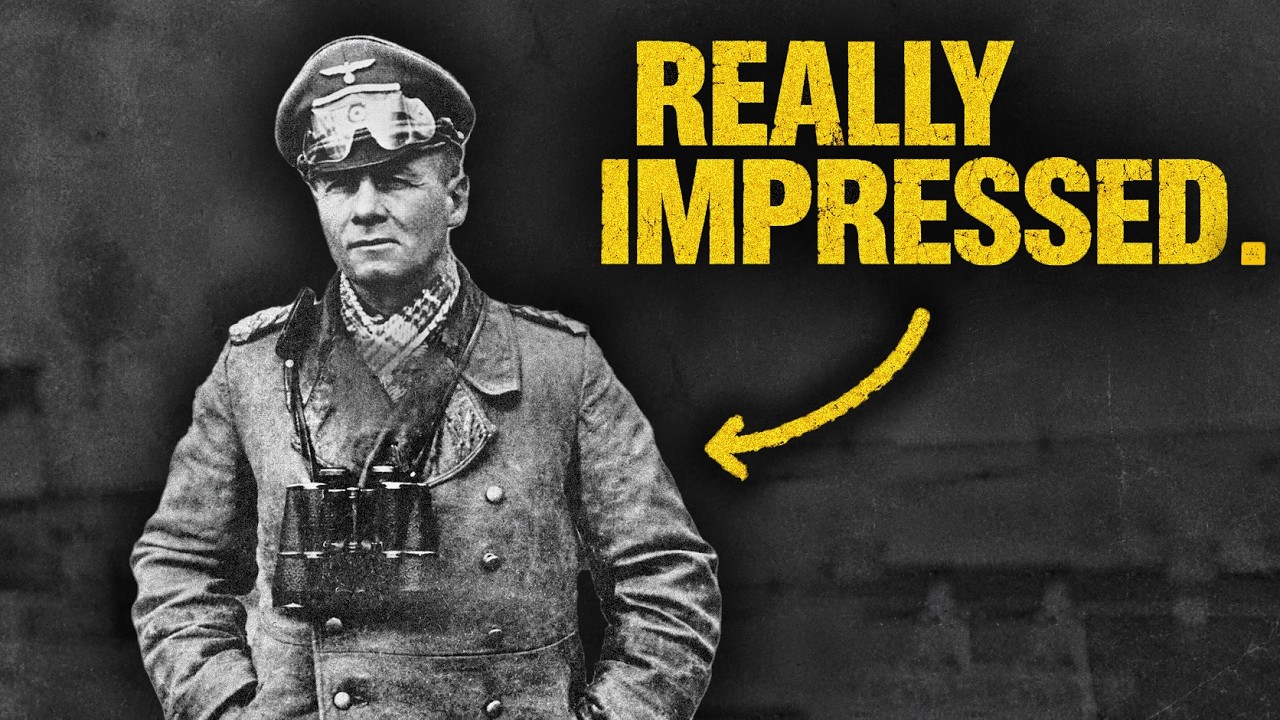
Rommel’s reputation had been built on audacity and speed. In France in 1940, and later in Libya and Egypt, he had outmaneuvered numerically superior British forces with rapid movement, deception, and a relentless focus on supply lines. His enemies respected him. In 1942, Winston Churchill told the British Parliament that Britain faced “a very daring and skillful opponent against us, and may I say, across the havoc of war, a great general.
” Rommel was no propaganda creation. He led from the front, shared hardship with his men, and was studied carefully by his opponents. When American ground forces first met the Germans in major combat at Kasserine Pass in Tunisia in February 1943, the encounter went badly for the Americans. Major General Lloyd Fredendall’s units were spread too thin, coordination between infantry, armor, and artillery was poor, and the command post sat far from the fighting.
Rommel exploited every weakness, pushing the Americans back with heavy losses in men and equipment over several days. It was a humiliating first impression. But the response came quickly, and that response is the real story. Within days, Dwight Eisenhower relieved Fredendall and replaced him with George S.
Patton. Patton imposed strict discipline, demanded proper uniform standards even in combat zones, and forced a genuine overhaul of how infantry, tanks, and artillery worked together. Working with officers like Omar Bradley, the Americans rebuilt their combined arms doctrine under fire. In March 1943, at the Battle of El Guettar, American forces inflicted the first defeat on German ground troops in North Africa, using far better coordination between artillery barrages and infantry advances than they had managed only weeks earlier.
A commander like Rommel might have taken comfort from that early clumsiness. Instead, he was alarmed. The speed of the American correction proved something more dangerous than raw skill: it proved flexibility. The American military had the internal culture to identify a failure, diagnose it honestly, and implement a fix without months of bureaucratic paralysis.
Germany, increasingly strangled by Hitler’s personal interference in operational decisions, could not match that kind of rapid self-correction. Rommel understood exactly what that imbalance meant over a long war. Tactical improvement was only part of what Rommel saw. He was obsessed with logistics, having long argued that battles are often decided by quartermasters before the first shot is fired.
That background made him uniquely qualified to recognize what American industry was doing. The M4 Sherman tank was not superior to the best German heavy armor in a one-on-one duel, but it was produced in such numbers that the comparison became almost irrelevant. Germany might build a handful of Tiger tanks, but the United States could field dozens of Shermans for each one, supported by a supply network that kept them fueled, armed, and repaired far more reliably than the Wehrmacht could manage. The trucks mattered just as much.
The American two-and-a-half-ton cargo truck, nicknamed the deuce and a half, gave U. S. forces a level of mobility that German forces could not match. A large portion of the Wehrmacht still relied on horse-drawn transport for supplies, a detail that runs against the popular image of a sleekly mechanized German army.
American artillery doctrine added yet another layer, allowing multiple batteries to coordinate devastating fire onto a single target within minutes of a request from the front line. Rommel understood that this was not a difference in individual weapons. It was a difference in an entire industrial and logistical philosophy, one that meant even flawless German tactics would eventually be ground down by sheer weight of production. Machines alone do not win battles, and Rommel knew it.
The final element of the story is the individual American soldier. Many of the GIs who panicked and retreated at Kasserine Pass were the same men who would later hold their ground in the hedgerows of Normandy against determined German counterattacks. The difference was combat experience purchased at a brutal cost. When Rommel took command of Army Group B in early 1944 to prepare the defense of occupied France, he was no longer facing the disorganized force from Tunisia.
He was facing battle-tested divisions supported by overwhelming naval gunfire and air power, fighting through some of the most difficult terrain in Western Europe. The Norman countryside, with its dense hedgerows and sunken lanes, turned every field into a potential ambush. American infantry adapted their small-unit tactics on the fly, developing new methods to breach the hedgerows using improvised attachments on their tanks and coordinating closely with supporting armor. German officers serving under Rommel noted with real concern that these were no longer green troops freezing under pressure.
They were soldiers who absorbed devastating losses, kept advancing, and displayed a tenacity that matched anything the Wehrmacht could produce. For a general who had long believed that superior training and experience would always give German soldiers the edge in close combat, this realization struck at something fundamental about how the war would be decided. Rommel’s private correspondence, later compiled into the Rommel Papers, shows a man repeatedly trying to warn the German High Command that the war in the west could not be won through tactical brilliance alone. He argued that Germany needed either to negotiate a political settlement or drastically reorganize its defenses before the full weight of American industrial and manpower resources arrived in Europe.
Hitler dismissed these warnings in favor of rigid no-retreat orders that ignored the realities Rommel was observing firsthand. Rommel was not a man prone to defeatism. He had built his career on winning against superior numbers. That this particular enemy pushed him toward such blunt warnings shows how seriously he took the threat.
Rommel’s respect for the American military was never really about individual heroism, though that heroism was real. It was about something more structural. An army that can honestly confront its own failures, correct them under pressure, and back that correction with an industrial capacity capable of outproducing its enemies holds a decisive advantage that raw tactical genius cannot overcome on its own. Rommel was, in many ways, the last great practitioner of a style of warfare based on maneuver and individual command brilliance.
He found himself facing an opponent that beat him not by matching his genius, but by making genius progressively less relevant through sheer adaptability and production. That uncomfortable lesson is the real reason his private writings took the American military so seriously.