On the morning of July 5th, 1965, a silver Ferrari 250 GT cabriolet traveling west through the Bois de Boulogne clipped a parked car, locked its steering, crossed the pavement, and struck a horse chestnut tree head-on. The driver had fitted the car with a wooden racing steering wheel, the kind used in competition, and it shattered on impact. The steering column drove into his chest. He was 56 years old, and the night before he had won the Coupe de France, the polo championship of France.
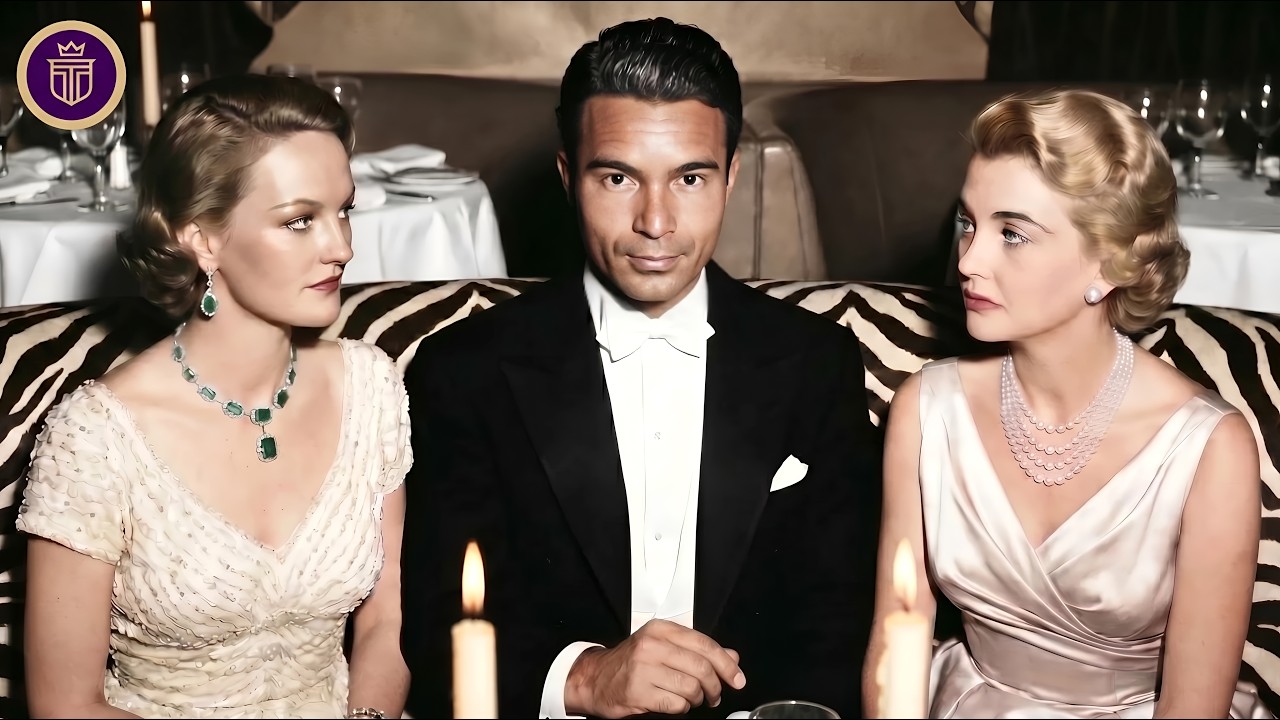
He had been celebrating at Jimmy’s nightclub in Montparnasse until after 6:00 in the morning. A passing ambulance found him at the roadside and took him toward the hospital, but he died before reaching it. A French newspaper offered his permanent epitaph: “Had he been wearing his seatbelt, nothing would have happened to him. ” But if he had put on his belt, he would not have been Porfirio Rubirosa.
Rubirosa was the most celebrated international playboy of the 20th century: a Dominican diplomat who married the two richest women in the world in consecutive marriages, served a murderous dictator for 30 years, raced Ferraris at Le Mans, played polo into his mid-50s, and died behind the wheel of a sports car with nothing left in his estate but personal effects and a name that Parisian waiters still use for the largest pepper mill on the table. He was born on January 22nd, 1909, in San Francisco de Macorís, a provincial city in the agricultural heartland of the Dominican Republic. His father, Don Pedro, was a general of a government-backed militia and a notable womanizer, a man whose political ambition and predatory charm his son watched with awe. When Porfirio was six, the family moved to Paris, where Don Pedro served at the Dominican embassy.
For the next 11 years, the boy was formed entirely by the most seductive city in the world. He was educated in French schools, absorbed the manners of the French upper bourgeoisie, and developed fluency in five languages. He learned to ride, to box, to ski, and developed a passion for polo on the fields outside the city. In 1926, at 17, his father sent him back to the Dominican Republic to study law.
The experiment failed. Rubirosa enlisted in the military, rising to captain by 20 and securing the title of captain of the national polo team. Polo brought him face to face with the man who would determine his entire adult existence. In 1931, at a polo match, the young army captain caught the eye of Rafael Trujillo, the military strongman who had seized control of the country the previous year.
Trujillo saw himself in the young man immediately. “He is good at his job,” Trujillo would later say, “because women like him and he is a wonderful liar. ” The next morning, Rubirosa was promoted to lieutenant of the presidential guard. One of his first assignments was to receive Trujillo’s daughter, Flor de Oro, at the airport from studies in France.
Rubirosa greeted her in French, monopolized every dance with her at the presidential ball, and was exiled from the capital for his presumption. She reached him with a message, they met in secret, she proposed, and he accepted. Trujillo banned the match, but Flor de Oro launched a hunger strike, and the dictator relented. They married on December 2nd, 1932, in a ceremony declared a national holiday.
The marriage lasted five years, marked by Rubirosa’s spectacular infidelities during a diplomatic posting to Berlin, where he attended the 1936 Olympics and moved through Nazi high society. After Flor de Oro filed for divorce, Trujillo offered his former son-in-law any posting in the world rather than lose him as an operative. Rubirosa chose Buenos Aires, the polo capital of the world, and was appointed ambassador to Argentina. Behind every diplomatic posting lay a second unofficial career.
In 1935, a Dominican exile organizing opposition to Trujillo in New York was shot dead, and a grand jury indicted Rubirosa’s cousin for the murder. Testimony established that Rubirosa himself had been in New York in the weeks before the killing, departing just before the shooting. He was never charged. When Trujillo’s assassination stripped Rubirosa of diplomatic immunity in 1961, Manhattan District Attorney Frank Hogan announced his intention to question Rubirosa about that killing and about the 1956 disappearance of Jesús de Galíndez, a Columbia University professor who had written a dissertation denouncing the regime and vanished after entering a New York subway station.
Rubirosa was questioned in January 1962, denied involvement, and never charged. His wartime years in occupied Paris added further layers of moral complexity. He sold Dominican visas to Jewish refugees, pocketing the payments, an enterprise that saved lives as a byproduct of profit. He was interned by the Vichy government for five months under circumstances never fully clarified, and was involved in a jewel affair in which valuable gems entrusted to him went missing, a loss he attributed to an armed robbery that investigators noted had left not a single bullet hole in his car.
His second wife was Danielle Darrieux, the defining face of French cinema. They married in September 1942 in the middle of the German occupation. In 1944, as liberation approached, the resistance ambushed them near their Paris apartment, firing on their open car. Rubirosa threw himself across Darrieux’s body and absorbed three bullets near his kidneys.
He survived. The couple went into hiding at her farm, narrowly evading capture when German soldiers searched the property. When Paris was liberated, they emerged and made their way to Rome. It was there, in 1947, that a tall American heiress arrived to interview Darrieux for Harper’s Bazaar and found herself staring at Darrieux’s husband.
Her name was Doris Duke, the richest woman in the world. Duke was 34 and, her biographers agree, desperately lonely. Rubirosa was 38. Within days they were inseparable.
The State Department itself became involved in drafting the prenuptial agreement, and when Rubirosa was presented with the full accounting of Duke’s net worth, he reportedly fainted. They married on September 1st, 1947, in a ceremony surrounded by what one attendant described as “a battery of legal talent. ” The marriage lasted 14 months. His infidelities were serial and public, including a resumed affair with his first wife, Flor de Oro, which Duke discovered in the most direct way possible.
The divorce, finalized in October 1948, produced an extraordinary settlement: $25,000 per year in alimony until he remarried, a commercial fishing fleet off West Africa, multiple sports cars, a converted B-25 bomber, and a 17th-century townhouse on the Rue de Bellechasse in Paris. Barbara Woolworth Hutton was born exactly eight days before Doris Duke, to the Woolworth five-and-dime fortune. The press dubbed her the “poor little rich girl. ” By 1953, she had been married four times.
Rubirosa courted her in his most theatrical style, serenading her with a full band outside her hotel window. There was a complication: he was simultaneously entangled with Zsa Zsa Gabor, who had expected to marry him. The wedding took place on December 30th, 1953, in a 10-minute civil ceremony. Before it, Rubirosa told reporters: “In my country, her wealth is hers and mine is mine.
I do not require her fortune. I possess my own. ” A statement universally admired for its audacity and universally disbelieved. The marriage lasted less than three months.
The settlement was more spectacular than Duke’s: a coffee plantation, a second B-25 bomber, eight polo ponies, $2. 5 million in cash, and a wardrobe of 40 suits and 20 pairs of shoes. The years between the Hutton divorce and his fifth marriage represent Rubirosa at the absolute peak of his public mythology. His polo team competed seriously throughout Europe, and he was no dilettante; he had trained since childhood and competed at a high level into his mid-50s.
He raced Ferraris at Le Mans, competed at Sebring, and drove the Carrera Panamericana across thousands of miles of Mexican highway. His friends adored him. “He made each woman feel that she was the most important thing in the world,” one friend said, and the observation captured what made him simultaneously irresistible and destructive. The attention was real while it lasted, and it never lasted.
In 1956, Rubirosa met Odile Rodin, a 19-year-old drama student. He was 46, and his friends had never witnessed anything like it. Genuinely, involuntarily, in love. “All my life I have controlled women,” he told at least one interviewer.
“Every woman I have ever met except this one. She is under my skin. ” They married on October 27th, 1956, and settled into a 17-room country house at Marnes-la-Coquette. The marriage outlasted his four previous marriages combined.
For nine years, Odile was there when he returned. The assassination of Trujillo on May 30th, 1961, was a sentence for Rubirosa. His diplomatic title, his immunity, his unique position as inspector of embassies — all derived from a single source that had just been extinguished. He lobbied the Kennedy administration to recognize the new government and failed.
By November of 1961, the Trujillo family had been pressured into exile. In January of 1962, Rubirosa’s diplomatic appointment was terminated. The alimony from Duke had ended when he remarried. The Hutton settlement had been spent.
The fishing fleet had been sold. What remained was the house, the cars, the horses, and the social architecture of a world that was beginning to find his kind of man anachronistic. Some friends detected a flatness in his final months, a slight withdrawal of the famous total attention. Cassini later questioned whether the crash that killed him was entirely accidental.
The question has never been settled. On the afternoon of July 4th, 1965, Rubirosa’s team, Cibao La Pampa, won the Coupe de France at the Bagatelle Polo Club in the Bois de Boulogne. It was the pinnacle of his sporting life, earned over decades of serious play by a team he had founded and captained. He was 56.
The celebration moved from the club to dinner, then to Jimmy’s nightclub in Montparnasse, and continued through the night. He walked out into the morning sometime after 6:00. He drove his silver Ferrari west through the 15th arrondissement toward the park, heading for the road home. At approximately 8:00, the Ferrari clipped a parked car.
The impact jammed the steering, and with the wheel locked, the car struck a horse chestnut tree head-on. He died in the ambulance before reaching the hospital. He was buried at the Cimetière de Marnes-la-Coquette. He left no children and almost no money.
The house on the Rue de Bellechasse had been sold years before. He had consumed everything as he went, converting inherited patronage and extracted wealth into a life that produced no durable assets, no institutions, no endowments. The life itself was the product. When the supply stopped, the existence built on consumption had the structural integrity of smoke.
Odile was left with the house and the memory of nine years with a man whose friends described as the most charming human being they had ever encountered. The cultural afterlife of Porfirio Rubirosa is larger and stranger than the man himself. Ian Fleming died 11 months before Rubirosa’s crash at the same age and never confirmed whether Rubirosa inspired James Bond; the circumstantial case is compelling. Harold Robbins’ 1966 novel The Adventurers featured a Latin American diplomat playboy universally understood to be a version of Rubirosa.
Ralph Lauren launched his Polo line in 1967, naming the brand after a world of effortless masculine elegance, and scholars have argued that the polo player on horseback carries in spirit the ghost of a Caribbean man of color whose aesthetic became one of the most commercially successful brand identities in American fashion history, with his identity thoroughly laundered in the process. And the pepper mill remains. At Maxim’s, the largest pepper mill on the table is still called a Rubirosa, the most intimate and absurd cultural remnant of a life lived at a velocity that the wooden racing steering wheel of a silver Ferrari was not built to sustain.