In November 1944, the Allied high command was in a celebratory mood. The beaches of Normandy were five months behind them. Paris had been liberated.
German prisoners were streaming into holding pens by the thousands, many of them old men and boys. Intelligence reports described a German war machine that was exhausted, disorganized, and incapable of anything but a slow, painful collapse. Officers were writing letters home, promising their families they would be back by Christmas.
Inside the headquarters of the U. S. Third Army, the mood was different.
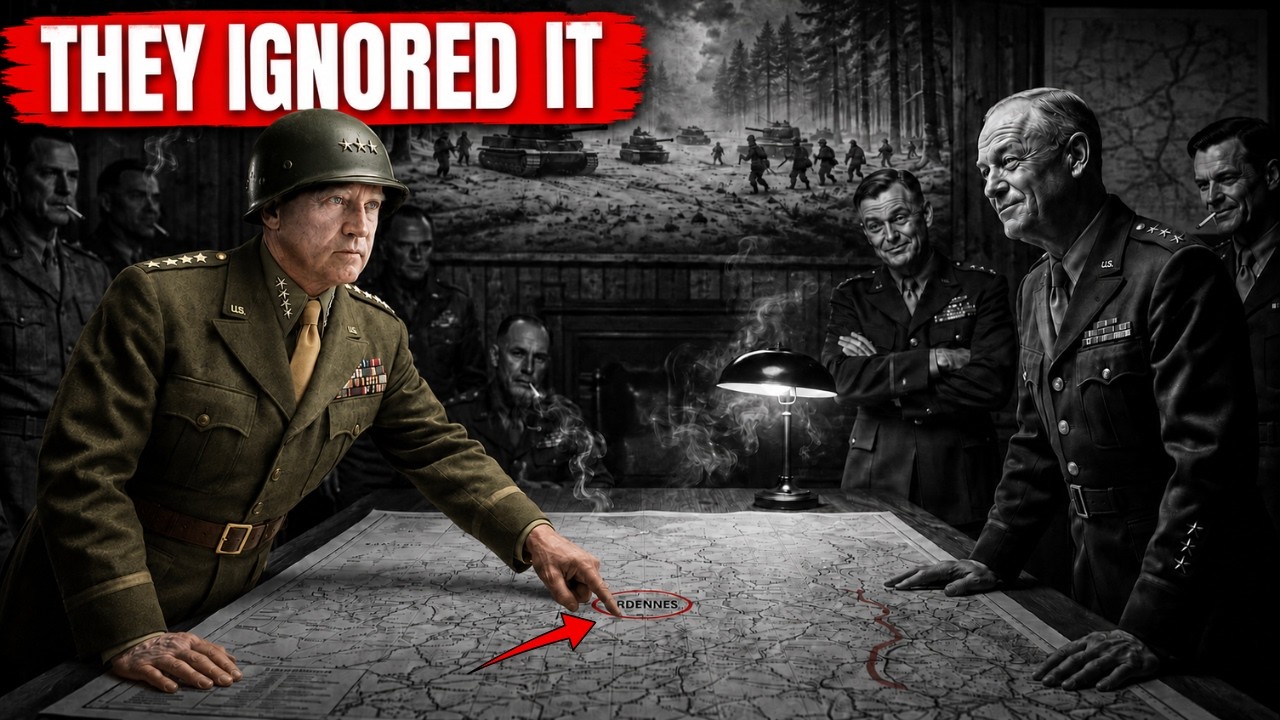
There was no champagne. General George S. Patton stood over a map spread across a wooden table, walking back and forth with his hands clasped behind his back.
He was not celebrating. He was listening to the same intelligence reports as everyone else, and he did not believe a word of them.
Patton was not looking at what the reports said. He was looking at what they did not say.
To understand why Patton felt growing dread while surrounded by evidence of victory, you have to understand who he really was. The public image was a reckless cavalry officer, a crude instrument who won through sheer audacity. That image was largely a performance.
Behind it was a man who had spent his entire life obsessively studying the history and theory of war. He struggled with dyslexia, but he had built one of the most extensive private military libraries of any American officer. He studied the campaigns of Hannibal and the writings of Roman military theorists.
Most importantly, he had studied the German officers who rebuilt their army after World War I.
Patton had read translated German field manuals and studied the doctrine of rapid, concentrated armored warfare. He did not just learn what the Germans did on the battlefield. He learned how their commanders were trained to think.
The German military tradition distrusted static defense. When forced to retreat, doctrine called for something far more aggressive: concentrating dispersed strength into one overwhelming point, striking the enemy’s weakest spot, and encircling everything on the other side.
While young officers across the Allied lines saw a defeated army preparing to surrender, Patton saw an army built on a doctrine that required exactly this kind of counterattack.
He was not alone in his suspicions. Colonel Oscar Koch, the quiet and precise head of Third Army intelligence, was bent over the same maps night after night. While Allied intelligence suffered from a dangerous narrowness of vision, Koch and Patton looked for anything that contradicted the comfortable story.
Koch noticed that many of the most experienced German panzer divisions had simply stopped appearing in Allied reports. The prevailing assumption was that they had been crushed or destroyed. Patton was not convinced.
Entire armored divisions with their tanks, fuel, and trained crews do not simply evaporate. They go somewhere. They fall silent for a reason.
Then came the radio traffic, or rather, the absence of it. Along certain sectors of the front, German communications went almost completely silent. Other Allied officers interpreted this as evidence of collapse.
Patton read it differently. Strict radio discipline and forced silence across an entire sector was not the sound of an army falling apart. It was the sound of an army trying not to be heard before it moved.
Standing over his map, Patton began asking himself a question no one else in the Allied high command seemed to be asking. If he were commanding the German side, exhausted and outnumbered and running out of time, where would he strike? His finger kept returning to the same place: a dense, hilly forest stretching across the border between Belgium and Luxembourg.
It was so heavily wooded and difficult to move through that Allied planners considered it almost impossible for a major armored attack. They called it the Ghost Front, a quiet sector where exhausted divisions were sent to rest and new, untested troops gained experience away from actual fighting.
For Patton, that quiet was the highest warning sign on the entire map.
He had seen this before. Four years earlier, French and British commanders had looked at the same tangled forest and concluded that no modern army could push a serious armored force through it. They had been catastrophically wrong.
German divisions had swept through those same hills and woods in the spring of 1940, bypassing France’s strongest defenses entirely. Within six weeks, one of the most powerful nations in Europe had collapsed. Patton had studied that campaign in exhaustive detail.
Now he found himself staring at the same quiet forest, wondering if history was about to repeat itself.
There was another detail bothering him. Weather reports predicted a wave of dense winter cloud cover moving over the region within days, thick enough to keep Allied planes on the ground. For months, Allied air superiority had been one of the few advantages no German commander could counter.
A desperate German commander launching a major offensive would need exactly this kind of weather to have any real chance of success.
For Patton, every piece was lining up into one uncomfortable pattern. Missing divisions. Silent radios.
A quiet, unprotected forest that history had already proven was not as impassable as everyone assumed. Incoming weather that would neutralize the Allies’ only unbeatable advantage. Separately, any intelligence officer could explain any of these details away.
Together, they looked like a plan.
Patton kept these doubts mostly to himself within the Allied high command. His fellow generals considered him reckless and difficult. If he raised the alarm and nothing happened, it would confirm what his critics already believed.
But inside his own headquarters, with Koch beside him and the map spread between them, he stopped wondering whether the Germans were planning something. He wondered how much time remained before they moved.
By the second week of December, Patton stopped treating his suspicions as mere theory. He summoned his operations officer, Colonel Halsey Maddox, and issued an order that seemed completely illogical. The Third Army was in the middle of its own offensive, pushing east toward the Saar region.
Yet Patton asked Maddox to quietly begin drafting contingency plans for something almost unthinkable: a sudden halt and a complete turn of the army’s axis away from the east and toward the north, directly into the region everyone considered the quietest and safest sector of the front.
Maddox did not fully understand why, and he did not ask twice. Patton did not fully explain himself. He simply said that if the Germans struck through the Ardennes, he wanted the Third Army ready to move within hours, not weeks.
Three separate plans were quietly drawn up, each built around the same core idea: shifting several divisions north to hit the flank of any German force that broke through the Ardennes.
Then came the waiting. December 9 passed. December 12 passed.
Daily intelligence summaries continued to describe a defeated, retreating German army. Patton’s private diary entries from those days read less like the journal of a confident commander and more like the record of a man watching a fuse burn without knowing exactly when it would reach the charge. He was certain something was coming.
He just did not know if he would arrive in time for his preparations to matter.
On the German side of the line, the plan Patton could only partially see had a name and a sense of desperation. Adolf Hitler, watching Germany’s position collapse on every front, personally pushed his generals toward one final, enormous gamble in the west. The goal was a rapid armored thrust through the Ardennes, across the Meuse River, and on to the port city of Antwerp, splitting the American and British armies.
Hitler hoped this would force the Western Allies into a negotiated peace, freeing Germany to concentrate all its strength against the Soviet advance in the east. Many of Hitler’s senior commanders considered the plan reckless and undersupplied. Their opinions were overruled.
Then, in the darkness before dawn on December 16, 1944, the silence broke. Along an 80-mile stretch of the Ardennes front, the ground itself seemed to shake. German artillery, more than a thousand guns, opened fire almost simultaneously.
A wall of high explosives fell from the darkness onto American positions that moments before had been among the quietest in the entire war. Soldiers who had been told this sector was a rest area found themselves buried under bombardment.
Behind the artillery curtain came the force Patton had spent weeks warning about. Nearly 200,000 German soldiers, organized into two full panzer armies with supporting infantry, surged out of the mist and snow. General Hasso von Manteuffel drove the Fifth Panzer Army through the center.
To the north, the Sixth Panzer Army under Sepp Dietrich, built around some of the most heavily equipped units Germany still possessed, headed for the Meuse. The weather arrived exactly as Patton had feared. Thick, low clouds settled over the region, grounding the fighter-bombers that had spent months destroying German movements in daylight.
For the first time in months, German columns could move on open roads without fear from the sky.
For the young American soldiers holding that sector, many of them fresh from transport ships and fighting for the first time, the attack came as pure chaos. Entire companies of the inexperienced 106th Infantry Division found themselves surrounded within hours. Regiments were forced to surrender within the first two days after their supply lines were cut and ammunition ran out.
It was one of the largest mass surrenders of American troops in the entire European campaign.
Reports reaching Allied headquarters were fragmentary and contradictory. Some senior officers initially dismissed them as local skirmishes. It took hours, in some cases a full day, for the true scale of the attack to sink in.
By then, the German advance had punched deep into Allied lines, creating a bulge in the map that would give the battle its name.
The northern spearhead of Dietrich’s attack was led by a heavily armed battle group under a young, ruthless Waffen-SS colonel named Joachim Peiper. He was tasked with advancing at maximum speed toward the Meuse before the Americans could organize their defenses. Peiper’s column tore through the rear areas of American forces with terrifying speed, capturing fuel depots intact, since the entire German plan depended on seizing American fuel to continue the advance.
Then came news that turned fear into something like rage. Near a small crossroads in Malmedy, a column of American prisoners, artillery observers who had already surrendered and laid down their arms, was led into a snow-covered field by soldiers from Peiper’s advancing column. Without warning, machine guns opened fire on the unarmed men.
Dozens were killed where they stood or as they tried to flee across open ground. A few survived by playing dead for hours in freezing temperatures before crawling to safety after the German column departed.
Word of what happened at Malmedy spread among American ranks within days. For soldiers along the line, many of them exhausted, frozen, and shocked by the surprise of the German attack, the news landed like a thunderbolt. The war had become personal in a way that rarely happens in combat.
Fear also became a weapon in a different way. Word reached command of a secret operation led by German commando Otto Skorzeny, who had assembled a small battalion of English-speaking soldiers wearing captured American uniforms and driving captured American jeeps. Their orders were to infiltrate behind Allied lines, spread misinformation, cut communication lines, and seize key bridges over the Meuse.
Only a few of these infiltrators were actually captured. But the psychological effect of their mission far exceeded their numbers. Suddenly, no uniform could be trusted.
Military police at checkpoints began interrogating soldiers, including officers, with questions only a real American would know: state capitals, baseball team managers, popular song lyrics.
During the first week alone, American casualties in killed, wounded, captured, and missing exceeded tens of thousands. For an Allied command that had spent the previous month planning victory parades rather than emergency defenses, the scale of the loss was almost impossible to absorb. Eisenhower, the Supreme Allied Commander, moved quickly when the scale of the crisis became clear, ordering the two airborne divisions that were resting near Reims, the 82nd and 101st, to move immediately toward the collapsing front.
In the middle of this chaos lay a small, unremarkable crossroads town in Belgium called Bastogne. On any ordinary map, it would barely attract attention. But seven separate roads converged there, passing through terrain that offered few reliable routes for heavy vehicles.
Any army that controlled those roads controlled the ability to move large numbers of tanks and trucks quickly through the region. Both sides realized this within hours of the attack beginning.
The 101st Airborne Division arrived in Bastogne by truck. Many of the paratroopers lacked winter clothing, ammunition, and adequate medical supplies. They were thrown into positions alongside scattered survivors of other units who had been fighting desperate defensive battles for days.
Within days, German forces had bypassed Bastogne and surrounded it from multiple sides. Inside the encirclement, about 18,000 American soldiers found themselves cut off from supplies, surrounded by German armor, and facing brutal winter conditions with dwindling ammunition, food, and medical supplies. Temperatures dropped far below zero.
The wounded froze where they fell before medics could reach them.
A German air raid struck the building being used as the main aid station, wounding and killing patients and staff alike and destroying most of the division’s remaining medical supplies. Surgeons continued operating with what little equipment remained, working by lantern light in freezing rooms while the number of wounded needing care grew every hour. Local Belgian civilians trapped inside the surrounded town took in wounded soldiers and shared what food they had left.
On December 22, a small group of German officers approached the American lines under a white flag carrying a written ultimatum. It warned that the town was completely surrounded, that further resistance was futile, and that the only way to avoid the annihilation of the trapped American forces was immediate surrender. With a two-hour deadline to consider the terms, the American commander inside the perimeter, Brigadier General Anthony McAuliffe, read the request, thought about it briefly, and sent back a written reply consisting of a single word: “Nuts.”
The German officers, confused by the American slang, had to consult their interpreters before realizing it was as absolute a rejection as was intended.
On December 23, the German attack lost its most dangerous spearhead. Joachim Peiper’s armored column ran out of fuel. The American depots its advance depended on never materialized in the quantities the plan required.
With his troops abandoning tanks for lack of fuel and no open road toward the Meuse, the survivors of his battle group were forced to destroy their remaining vehicles and flee on foot toward German lines.
On December 26, the leading elements of the 4th Armored Division broke through the German ring around Bastogne, opening a narrow corridor into the town to relieve the exhausted, frozen defenders who had held out for more than a week against everything the German army threw at them. Trucks loaded with ammunition, medical supplies, and food flowed through the corridor within hours, and the wounded who had been treated for days in freezing, overcrowded aid stations were finally evacuated to proper hospitals behind the lines.
The fighting was not over. It took weeks more of brutal winter combat to eliminate the bulge in the Allied line entirely and push German forces back to their original positions. But the moment of maximum danger, the window in which the German attack had any realistic chance of reaching the Meuse and splitting the Allied armies, had closed.
The last major German offensive in the west was broken, and Germany would never again be able to mount an attack of similar size for the rest of the war.
The cost was enormous on both sides. Tens of thousands of American soldiers were killed, wounded, captured, or missing in the weeks of fighting that followed December 16, making it the most costly battle the United States Army fought in the entire war. German losses in men and equipment were so severe that Hitler’s army effectively exhausted its last effective reserves of manpower and armor in the west, reserves that would have been desperately needed when the final Allied advance into Germany began just a few months later.
Most people today remember General George S. Patton for his ivory-handled pistols, his theatrical profanity, and his ferocious aggression. But the story of December 1944 reveals a different weapon entirely, one far less visible and far more decisive.
While young officers across the Allied lines looked at the map and saw a defeated enemy staggering toward surrender, Patton looked at the same map and saw a military doctrine he had spent 20 years studying, ready to strike exactly where history had shown it would strike before.
He did not just react faster than everyone else once the German attack began. He had already positioned his army to respond before the attack started, based on nothing more than missing divisions, silent radios, and a stubborn refusal to accept the comfortable version of events everyone around him wanted to believe. It was not recklessness that saved the tens of thousands of trapped soldiers inside that collapsing perimeter that winter.
It was a lifetime spent reading the enemy’s doctrine closely enough to know what it would demand of them, and a willingness to act on that knowledge before anyone else was ready to believe it.