John Nicholas Ringling had spent decades building an empire of canvas and steel. By 1929, he was the last surviving son of a German saddle maker, the sole remaining brother of seven who had turned a penny show on an Iowa riverbank into the greatest circus in America. That year, he paid $1. 7 million for the American Circus Corporation, acquiring the Sells-Floto, Hagenbeck-Wallace, John Robinson, Sparks, and G.
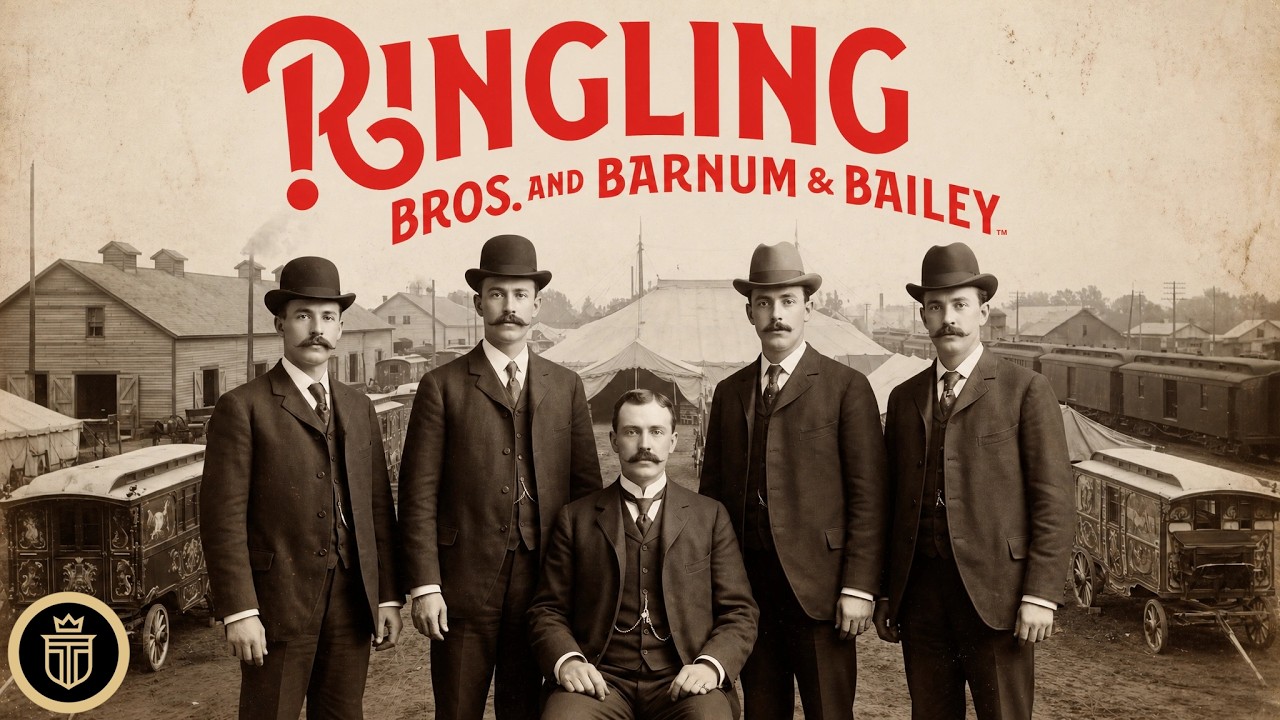
Barnes circuses in a single stroke. There was only one circus in the country larger than his own, and now he owned that one too. The purchase did not expand his audience; it eliminated any chance that someone else might compete for it. He controlled the combined Ringling Brothers and Barnum & Bailey, which billed itself as the Greatest Show on Earth.
His personal fortune was estimated at $50 million. He owned railroads in five states, oil interests in Oklahoma, and enough Florida real estate to incorporate his own property company. He was vice president of Madison Square Garden and president of its sporting corporation. He had never finished high school, spending his youth instead negotiating lot rentals and ticket prices in small towns along the circus route.
By the time he was sixty-three, the winter quarters sat on Sarasota Bay, beside a fifty-six-room Venetian Gothic mansion called Ca’d’Zan, a Venetian dialect phrase meaning “John’s house,” completed three years earlier at a cost of $1. 65 million. Next door, on land reclaimed from a swamp, he was finishing a museum to hold the paintings he had bought across Europe while scouting for acrobats, including four enormous Peter Paul Rubens canvases designed as tapestry patterns. Seven years later, he died in a New York apartment with $311 in his bank account.
His nephew recorded the figure plainly in the family records, not as a guess but as a fact. The estate that accompanied that bank balance was appraised at approximately $23. 5 million. The Internal Revenue Service claimed $13 million of it, mortgages encumbered most of the physical assets, and a line of Sarasota merchants held unpaid bills for sums of only a few dollars.
Five days before he died, a federal court in Tampa had scheduled the sale of Ca’d’Zan at public auction to settle a judgment. Only the timing of his final illness prevented the sale. The will he left granted his home, his museum, and his entire art collection to the State of Florida, on condition that the museum bear his name and that of his first wife forever. It left his second wife one dollar.
A handwritten codicil, dashed off as he hurried from his New York apartment to catch a train, cut both of his nephews out of the inheritance entirely and reduced his sister’s income to $5,000 a year for life, with the words “no more” written into the document. The two nephews he disinherited were the executors and trustees named in the will he had just amended against them. A dying man in a hurry had laid a trap for himself, handing the largest art bequest in Florida history to the two men he was trying to punish. For a decade, the mansion stood empty in the Florida humidity.
The museum opened on an irregular schedule without a director. The endowment for maintenance was managed by no one in particular. The circus that had built the wealth left family hands, returned, and left again. The family name stayed attached to the show for eighty years before the final performance in a hockey arena on Long Island.
The distance between a boat landing on the Mississippi River and the courthouse steps in Sarasota measured sixty-six years, seven brothers, one sister, two wives, two nephews, one handwritten page, and a state government that had to obtain legislative permission to accept a gift. The wealth was real, the collapse was documented under oath, and the settlement was decided by a divided court in the state capital four hundred miles away. Every dollar traced back to a single morning on an Iowa riverbank when five boys watched a boat unload animals and one of them asked the others a question the family would repeat long after it stopped being a joke. August Frederick Ringling, a saddle maker from Hanover, had married Marie Salomé Julia from Alsace in Milwaukee in 1852, simplified the family name to Ringling, and produced eight children along a series of Mississippi river towns.
The founding scene, as the family told it, occurred in 1870, when the boys woke early to watch a showboat unload animals and wagons at the McGregor landing. Their first attempt charged one cent admission and collected $8. 37. Two years later they formed the Ringling Brothers Classic and Comic Concert Company.
By 1884, in Baraboo, Wisconsin, they presented their first actual circus under a name that stretched to twenty-two words on the posters. They bought their first elephant in 1888, the acquisition that separated a variety troupe from a circus, because an elephant had to be fed, housed, insured, and transported whether anyone bought a ticket or not. In 1889 they moved from horse-drawn wagons to railroad cars, changing the economics entirely, allowing a circus to reach a new town every morning and abandon a bad market by nightfall. What set the Ringling brothers apart from hundreds of other American shows was a division of labor so strict it functioned as a constitution.
Albert managed the equestrian acts. Otto controlled the money with such absolute authority the family called him “the King. ” Alfred ran publicity. Charles drove the circus train and served as general manager.
Augustus joined as advertising manager. John took what the profession called the advance, traveling ahead to negotiate lots and prices, making him the only man who knew what every town in America was worth in any given week. He summed up the arrangement in one sentence the family quoted for decades: they divided the work but remained united. After the deaths of the other brothers between 1907 and 1919, John and Charles were left to run the enterprise.
In 1927, John moved the winter quarters to Sarasota, turning it into a paid tourist attraction. He had already begun buying art on a scale that exceeded any home’s capacity, purchasing Old Master paintings and Baroque canvases while searching for acrobats. He was buying two things on the same European trips: the acts that filled the tent and the paintings that could never be shown in it. Only one of those purchases produced income.
The 1929 purchase of the American Circus Corporation cost $1. 7 million, but John Ringling did not have $1. 7 million in cash. According to his own testimony under oath in a Brooklyn federal court in 1933, he met a man named William M.
Greve at a boxing match that year. Greve lent Ringling $1. 7 million, secured by half of Ringling’s circus stock. The Great Depression followed immediately, meaning the loan was secured by the ability of traveling entertainment to profit at the exact historical moment American families stopped buying tickets to it.
When Ringling later fell behind on an interest payment of roughly $18,000, Greve threatened to seize the circus revenues on the spot. Ringling was suffering from a fever of 104 degrees, was moved to a wheelchair, and signed papers that transferred most of what he owned to Greve’s company. He learned afterward that Greve had created one voting trust for the circus stock and a second to hold a selection of the Titian, Rembrandt, Hals, and Rubens paintings from the Sarasota collection. Ringling was told he would recover his assets if he could repay the loan.
He never could. By 1932, the board of the company he had built with his brothers voted to take control from him. A man named Sam Gumpertz was appointed general manager and reportedly went so far as to prevent Ringling from entering the circus lot entirely. The last Ringling brother was barred from the winter quarters his own money had built.
He was sixty-nine, unable to enter his own winter headquarters, owning a museum he could not open, a home threatened with foreclosure, and an art collection legally owned in part by a trust created by a real estate lender. An angry, frightened man with a pen and a train ticket is the most dangerous author a will can have. The codicil he wrote in that lobby consisted of only two paragraphs, but it moved more money than most legislatures do in a session. It disinherited the nephews and reduced his sister to an annuity.
What he had not accounted for was that inheritance and office are legally distinct things, and that cancelling one does not touch the other unless explicitly stated. The appointments of the disinherited nephews as executors and trustees were among the provisions the codicil confirmed. When John Nicholas Ringling died on December 2, 1936, at age seventy, his estate’s legal battle consumed Florida’s legislature, the lower courts, and the divided Florida Supreme Court for the next ten years. The nephews, stripped of their inheritance but confirmed in their authority, managed the estate.
The state legislature passed a law accepting the gift. The courts ruled that the codicil’s punishment shifted nearly the entire remaining estate to the State of Florida. The mansion stayed empty and closed from 1936 until 1946. The endowment of $1.
2 million grew to just $2 million over more than fifty years. In 2000, the Florida legislature transferred the entire bequest to Florida State University. Under university management, Ca’d’Zan underwent a $15 million restoration, about nine times the original construction cost. The collection John Ringling assembled while searching for circus performers is now ranked the sixteenth largest art collection in the United States.
The state that spent ten years in court to obtain it finally received exactly what the will described: a museum bearing two names no one is permitted to change. The circus itself received no such protection. John Ringling North assumed the presidency in 1937, a year after his uncle tried to erase him from the will. He held the presidency until 1967, managing the institution’s long decline.
In July 1944, the big top caught fire in Hartford, Connecticut, killing at least 167 people. The company was convicted of negligence, and its officers served prison sentences. In 1956, the circus performed its last show under the big top, moving to permanent venues. In 1967, the Ringling heirs sold the company for $8 million.
The circus finally closed forever in 2017. The name remains on a building in Sarasota where it is legally impossible to remove it, above a collection no one is permitted to sell. John Ringling paid $1. 7 million in 1929 to ensure that no competing tent in America could outlast his.
The only bidder left standing in the end was the state that took his house.