Gladys Deacon spent her childhood in the shadow of a scandal that exploded around her in the most violent way imaginable. Born in Paris in 1881 to wealthy American expatriates, she seemed destined for a life of privileged normalcy among the fashionable community of Bellevue, France. Her father was a prosperous Boston textile manufacturer; her mother was the daughter of an admiral. But in February 1892, when Gladys was eleven, her father discovered that his wife was conducting a passionate affair with a French lover.
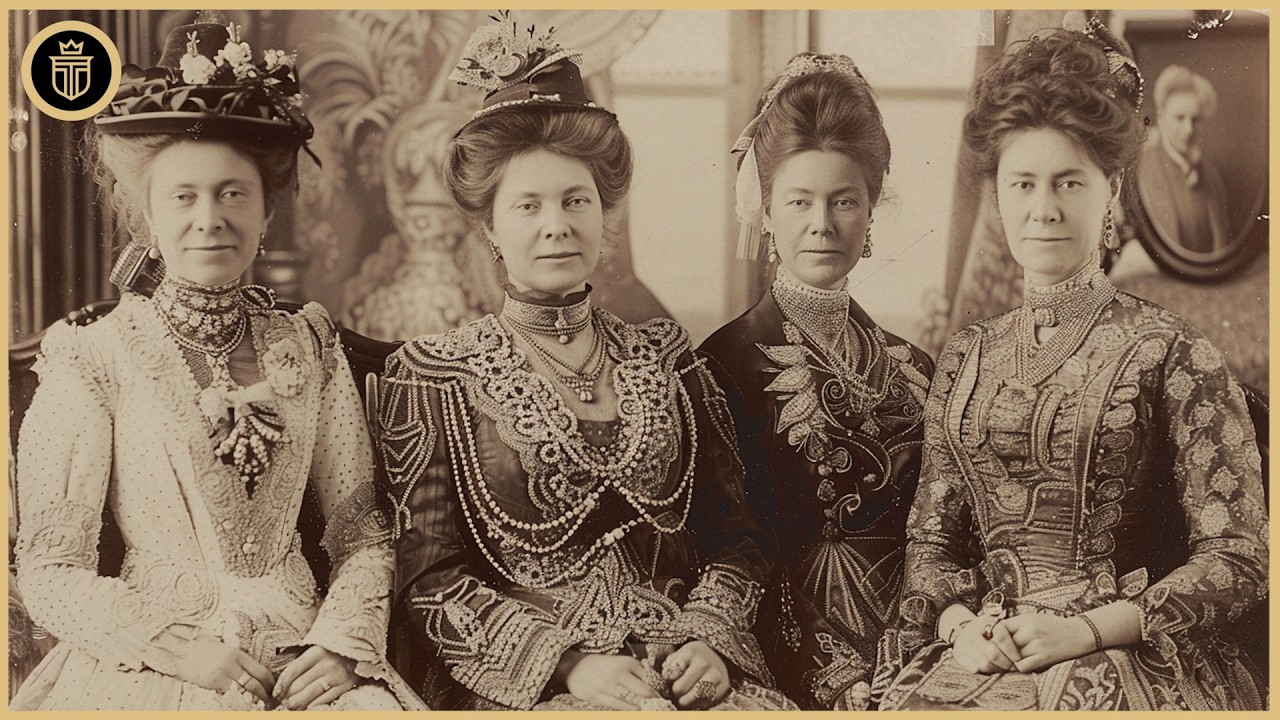
Armed with a revolver and consumed by rage, Edward Parker Deacon broke down the door of his wife’s apartments at the Hotel Splendid in Cannes, found the cowering Frenchman hiding behind a sofa, and fired three shots, killing him instantly. The murder dominated European newspapers for months. Edward was arrested, charged with murder, and eventually had the charge reduced to manslaughter, serving less than four months in prison. The scandal destroyed the family’s reputation and left Gladys traumatized by the violent end of her parents’ marriage.
Her parents divorced in 1893, and after a bitter custody battle that included her mother kidnapping her, Gladys was taken to the United States and settled in Newport, Rhode Island. She received an excellent education and was tutored in seven languages. But the trauma of her father’s crime continued to haunt the family as his mental health deteriorated. By 1899, Edward was committed to a hospital for the insane in Massachusetts, where he died in 1901.
The institutionalization and death of her father left a profound mark on Gladys, who would spend the rest of her life terrified of inheriting his mental instability. Returning to Europe as a wealthy orphan with a scandalous past, Gladys proved irresistible to the cultural elite of Paris, London, and Rome. She possessed what contemporaries described as radiant beauty, with striking blue-green eyes that became her most famous feature. Marcel Proust was completely enchanted by her, writing with obvious infatuation that he had never seen a girl with such beauty, magnificent intelligence, and charm.
The art critic Bernard Berenson became so enamored that he seriously considered marrying her. She became the ultimate artist’s muse, considered the most painted woman of her time, posing for Giovanni Boldini, whose celebrated 1908 portrait now hangs in the Metropolitan Museum of Art, and for the sculptor Jacob Epstein. Auguste Rodin presented her with one of his works as a token of admiration. She was courted by dukes and princes, including the Crown Prince of Prussia, who gave her a ring that Kaiser Wilhelm II later demanded be returned.
But at the height of her beauty and social success, Gladys made a decision that would haunt her for the rest of her life. At age twenty-two, she became obsessed with what she perceived as a minor imperfection: a slight indentation between the bridge of her nose and her forehead. She spent hours studying the proportions of classical Greek statues in Roman museums, measuring the distances between eyes and noses to understand the parameters of perfect faces. Inspired by classical proportions, she decided to undergo a primitive cosmetic procedure involving the injection of paraffin wax into her nose to create what she believed would be the perfect Greek profile.
The procedure, performed when plastic surgery was in its absolute infancy, proved catastrophic. The wax began to migrate and melt over time, gradually moving from its original position and creating increasingly distorted facial features. What had been intended to enhance her legendary beauty instead transformed her into a grotesque caricature of her former self, as the migrating wax eventually settled in her jaw and cheeks. But Gladys had spent too many years plotting a social conquest to let facial disfigurement stop her.
For fifteen years, she had conducted the most patient and ruthless romantic campaign in European high society. Her obsession had begun when she was just fourteen, after reading about the Duke of Marlborough’s 1895 marriage to American heiress Consuelo Vanderbilt. She wrote in her diary, “Oh dear, if only I was a little older, I might catch him yet. ” Her strategy was both patient and ruthless.
She befriended Consuelo and became a regular guest at Blenheim Palace, where she could observe the unhappy marriage firsthand. By 1912, she had successfully become the Duke’s mistress, beginning an affair that would last nearly twenty years and essentially make her the unofficial mistress of Blenheim Palace. After years of legal maneuvering, the Duke and Consuelo were finally granted a divorce in 1921, clearing the path for Gladys to achieve her ultimate ambition. On June 25, 1921, at the age of forty, Gladys finally married Charles Spencer-Churchill, the 9th Duke of Marlborough, in a ceremony in Paris.
She wore a gown of gold tissue with a veil that strategically concealed her increasingly disfigured features. But the reality of married life at Blenheim Palace proved nothing like the fairy tale she had imagined. The couple were fundamentally incompatible, and the Duke was increasingly repelled by his wife’s deteriorating appearance and erratic behavior. Gladys’s conduct became progressively disturbing, including shocking comments at social gatherings and once placing a revolver on the dinner table while threatening to shoot her husband.
She kept a revolver in her bedroom to prevent the Duke from entering. One of the most damaging aspects of her tenure as Duchess was her obsession with breeding Blenheim spaniels, which she allowed to overrun the palace and cause extensive damage to the recently restored interiors. The dogs ruined carpets, furniture, and priceless artwork. By the early 1930s, the Duke had reached the limit of his patience.
He moved out, leaving Gladis alone in the vast mansion, but eventually returned with legal authority to force her complete removal. She was forced to leave behind most of her possessions, banished from the palace that had been her home for over a decade. The Duke died in 1934, just one year after evicting her. Gladys retreated from society entirely, moving to a farm in Oxfordshire, where she lived under the assumed name Mrs.
Spencer. She became a complete recluse, living in increasingly squalid conditions surrounded by her dogs. Local children, convinced she was a witch, threw stones at her house. When a conservative MP encountered her in a Bond Street jewelry shop in 1943, he barely recognized her, describing a frightening figure that looked like a marionette.
When he attempted to introduce himself, Gladys looked at him with vacant eyes and muttered “Je m’appelle personne” before fleeing. By 1962, her behavior had become so erratic that authorities committed her to St. Andrews Hospital in Northampton, a psychiatric facility where she would spend the final fifteen years of her life. During her years there, young Hugo Vickers became her only regular visitor.
When he asked her, “Where is Gladys Deacon? ” she replied slowly and sadly, “Gladys Deacon. She never existed. ” On October 13, 1977, at the age of ninety-six, Gladys Deacon died alone in the hospital.
The sphinxes at Blenheim Palace preserve her features in stone, monuments to the danger of mistaking appearance for identity. Evelyn Walsh McLean’s story followed a different path but reached a similar destination. Born in 1886, she was the daughter of Thomas Walsh, an Irish immigrant who struck gold in Colorado’s San Juan Mountains with the Camp Bird Mine, one of the most profitable discoveries of the era. The family relocated to Washington, DC, where Evelyn met Edward “Ned” McLean, heir to the Washington Post publishing empire.
Their 1908 wedding combined the Walsh mining fortune with the McLean publishing empire; each set of parents gave the couple $100,000 to purchase their own wedding presents. In 1910, while the McLeans were staying at their Paris hotel, the jeweler Pierre Cartier arranged a meeting to show them an extraordinary gem: the Hope Diamond, a 45. 52-carat deep blue stone with a documented history of royal ownership. It had been part of the French crown jewels until the French Revolution, after which it disappeared for decades, resurfacing in England in the 1830s when it was acquired by Henry Philip Hope.
After months of negotiations, the McLeans purchased the diamond for $180,000. Evelyn integrated it into her life with a casualness that contrasted sharply with its royal history, at one point allowing her great dane to wear the stone. She laughed at tales of the ancient curse, declaring herself immune to its dark history. Within decades, the curse seemed to find her.
In 1919, her nine-year-old son Vincent was struck by a car and killed. Ned’s behavior became increasingly erratic, marked by problems with alcohol and gambling. In 1927, Evelyn separated from her husband. The stock market crash of 1929 brought financial challenges, and Evelyn temporarily pawned the diamond.
In 1933, Ned was declared legally insane and committed to a mental hospital; that same year, the Washington Post was sold as part of the settlement of his estate. Ned died in 1941 in the hospital where he had spent his final years. Evelyn passed away in 1947 at the age of sixty, having outlived her ex-husband and two of her children. After her death, the diamond was sold to Harry Winston, who displayed it for the next decade before donating it to the Smithsonian Institution in 1958, where it remains today.
Barbara Hutton’s fortune was built on retail, not diamonds. Born November 14, 1912, in New York City, she was the sole child of Edna Woolworth of the retail empire and Franklin Laws Hutton, a founder of the EF Hutton investment firm. When her grandmother Jenny Kraton Woolworth died in 1924, Barbara was left a staggering inheritance of $26 million, which would inflate to $42 million by the time she reached twenty-one, crowning her one of the richest women in the world during the Great Depression. But wealth defined her birthright while emotional neglect shaped her life.
Her father, notorious for his infidelities, was a distant figure; her mother, lonely and unhappy, sought comfort in an affair. At age five, Barbara discovered her mother lifeless after her death in 1917, officially attributed to complications from mastoiditis, though whispers of suicide persisted. She was shuffled among relatives, spending time at her maternal grandparents’ sixty-room mansion, where material excess was abundant but emotional warmth was scarce. Her entrance into society was spectacular.
On a November evening in 1930, as the Great Depression ravaged the nation, New York’s elite gathered at the Ritz-Carlton Hotel for her eighteenth birthday. Four orchestras played, 2,000 bottles of champagne were served by 200 waiters, and each guest received a small jewelry case filled with unmounted diamonds, emeralds, rubies, and sapphires. The celebration reportedly cost $60,000, equivalent to over one million dollars today. That night marked Barbara Hutton’s transformation into a public figure, the “poor little rich girl,” a nickname that would cling to her through varied fortunes.
Her quest for love was as heartbreaking as it was storied. At twenty, she married Prince Alexis Mdivani, a self-proclaimed Georgian prince and notorious social climber, in a grand ceremony in Paris. The marriage dissolved in March 1935, after Mdivani spent her inheritance on a luxurious home, polo ponies, and lavish attire. Her second marriage in May 1935 to Count Curt von Haugwitz-Reventlow brought her only child, Lance.
That marriage crumbled by 1941. Her third marriage to Hollywood icon Cary Grant in 1942 was highly publicized, with the couple dubbed “Cash and Cary,” but it ended in divorce, with Hutton later remarking that Grant was primarily interested in growing his star power. Her fourth marriage to Prince Igor Troubetzkoy ended by 1951; her fifth to a Dominican diplomat dissolved after only 53 days; her sixth to German tennis star Baron Gottfried von Cramm ended in 1959. Her final marriage, to a prince of the former royal family of Laos, concluded in 1966.
By the 1940s through the 1960s, her fortune dissolved under the weight of extravagant spending, financial mismanagement, hefty divorce settlements, and husbands accused of siphoning her wealth. Her health declined sharply, marked by addiction to barbiturates, near-fatal overdoses, a coma, near blindness, a hip injury causing chronic pain, and severe anorexia. The death of her only son, Lance, in a 1972 plane crash plunged her into profound despair. She retreated into seclusion in a Beverly Hills hotel, dependent on staff for care.
By the time of her death on May 11, 1979, from a heart attack at age sixty-six, it was reported that she had only $3,500 to her name. Her funeral was subdued, attended by only a close circle of family and friends, a muted affair far removed from the lavish gatherings she once hosted. Dorothy Arnold’s story ended in a mystery that was never resolved. Born July 1, 1885, she was the second of four children of Francis R.
Arnold, who had built his fortune importing perfumes. The family mansion at 108 East 79th Street stood as a monument to their ascension, and the Arnolds could trace their blood back to the Mayflower. Dorothy studied at the Veltin School for Girls and at Bryn Mawr, where she began to write, pouring her soul onto paper. But her stories returned with rejection letters, and her family’s amusement cut deep.
She began spending time alone, making mysterious trips downtown, her father refusing to let her move to Greenwich Village. Secretly, she corresponded with George Griscom Jr. of Boston, a man her father disapproved of. On the morning of December 12, 1910, Dorothy emerged from the family mansion wearing a tailored blue suit and a black velvet hat adorned with silk roses.
In her purse lay $25 and a letter bearing a Boston postmark. At Park and Tilford she purchased a box of chocolates; at Brentano’s bookstore she selected a copy of “Engaged Girl Sketches. ” She merged with the crowd of holiday shoppers and moved toward Central Park. She was never seen again.
For six weeks, the family remained silent, conducting discreet inquiries through their lawyer. When they finally broke their silence on January 25, 1911, the press descended. Francis Arnold offered $1,000 for information, a sum that seemed paltry against the $100,000 he would eventually spend chasing shadows. Reported sightings bloomed across the nation, all false.
Ransom notes arrived, all fraudulent. A confession proved to be the fabrication of a desperate mind. In Dorothy’s room lay her evening clothes, her jewelry, her diary filled with secrets about Griscom, and a half-finished manuscript forever waiting for an ending. In the decades that followed, theories flourished.
Some whispered of suicide, citing rejected manuscripts and the weight of expectations. Griscom spoke of her despondency over failed literary ambitions. Others imagined elopement, fueled by her secret Boston rendezvous and her family’s iron-fisted control. But no body was ever found in Central Park, and no unidentified woman matched her description in any Manhattan morgue.
Francis Arnold went to his grave in 1922 believing his daughter had ended her own life. Mary Martha Arnold followed in 1928, her final years marked by the daily ritual of watching her front door, waiting for a return that never came. Dorothy Arnold’s disappearance continues to whisper through time, a reminder that even in an age when wealth could buy almost anything, some questions remained forever beyond purchase.