Eight square miles of volcanic rock, no fresh water, no cover, no beach worth the name, and 22,000 Japanese soldiers who had spent eight months digging seventeen miles of tunnels into the island’s bones, waiting. On February 19, 1945, the United States Marine Corps landed 70,000 men on Iwo Jima. What followed was 36 days of combat so dense and so costly that the Marines took more casualties on that single island than they had in the entire four years of the First World War. When it was over, Japanese commanders in Tokyo sat in silence, trying to understand how it had happened.
They had built what they believed was an impenetrable fortress. Every gun, every tunnel, every fighting position had been arranged to make the cost of taking the island prohibitive. They believed the Marines would break. To understand why Japanese commanders could not explain what happened, you have to understand what they believed they had built.
Lieutenant General Tadamichi Kuribayashi arrived on Iwo Jima in June 1944 and immediately recognized that the island could not be held in the conventional sense. He had served as a military attaché in Washington in the 1930s, driven across the American interior, visited Ford’s factories in Detroit, and studied American industrial capacity firsthand. He knew, with a clarity that very few Japanese officers possessed, what the United States could produce and deliver to a battlefield. He knew a conventional surface defense, the kind used on Tarawa, Peleliu, and Saipan, would be destroyed by American naval gunfire and air bombardment before the Marines ever came ashore.
So he abandoned doctrine. He told his commanders they would not meet the Americans on the beaches. They would not waste men in banzai charges that looked heroic on paper and accomplished nothing in practice. Instead, Kuribayashi ordered his engineers to dig.
For eight months, around the clock in shifts, 22,000 Japanese soldiers excavated the volcanic rock of Iwo Jima with hand tools, pneumatic drills, and explosives. They built seventeen miles of tunnels connecting hundreds of reinforced bunkers, artillery positions, and fighting caves. They built hospitals underground. They built command posts forty feet below the surface.
They built ammunition magazines sealed into the rock with steel doors. Every weapon was positioned to create overlapping fields of fire across every possible approach to the island. The beaches were not defended because the beaches were a trap. The real defense began 200 yards inland, where the tunnels emerged into firing positions that no amount of naval gunfire could destroy without physically blasting open every square yard of volcanic rock on an eight-square-mile island.
Kuribayashi told his men they would each kill ten Americans before they died. He did not tell them they would live. His plan was designed to make taking Iwo Jima so costly that the American public would demand a negotiated peace before the invasion of the Japanese home islands could begin. The American commanders who planned the invasion knew it would be difficult.
They did not know it would be what it was. The pre-invasion naval bombardment was the heaviest laid down on any target in the Pacific War up to that point. For three days, American battleships, cruisers, and destroyers fired approximately 22,000 shells into an island eight miles long and four miles wide. American aircraft dropped thousands of tons of bombs.
The ground shook so continuously that observers on the ships reported seeing the entire island vibrate with each salvo. Marine commanders watching from the transports believed the bombardment must have destroyed or suppressed a substantial fraction of the Japanese defenses. They had learned that lesson in blood across a dozen islands in the Pacific, but even they, the men who had survived the nightmare of Tarawa’s beaches and the grinding horror of Peleliu’s ridges, could not fully anticipate what Kuribayashi had built. When the first waves of Marines hit the beaches on the morning of February 19, the first thing they noticed was the silence.
There was no Japanese fire. The beach was almost quiet. Men looked at each other across the black volcanic sand and began to move inland. For approximately thirty minutes, the landing was almost unopposed.
Some Marines later said they thought the bombardment had actually worked. Then Kuribayashi gave the order. Every gun on the island opened simultaneously. The Marines on the beach, pinned between the water and the rising volcanic terraces, had nowhere to go and no cover that could stop what was falling on them.
The battle had not begun gradually. It had sprung fully formed from the earth. The black volcanic sand of Iwo Jima was unlike anything the Marines had encountered on any previous island. It was loose volcanic ash and pumice, ground fine over centuries, that shifted and collapsed under weight like wet gravel.
Marines trying to dig a fighting hole watched the walls cave in before they could get below the surface. Men running for cover found their legs sinking into the ground with each stride, as if the island were trying to swallow them. Tanks that made it off the landing craft immediately bogged down, treads spinning uselessly in the collapsing material. The terrain Kuribayashi had chosen to defend was not just fortified.
It was actively hostile to the men trying to take it. Steam vented from cracks in the ground. The soil in places was hot enough to cook food. There was no fresh water anywhere on the island.
Every drop the Marines consumed had to be brought ashore from the ships. In the first days of the battle, under constant fire, with the landing beaches clogged with men, equipment, and the dead and wounded, the simple act of moving 200 yards inland took the better part of a day and cost dozens of casualties. The Japanese had understood all of this when they chose Iwo Jima as the place to make their stand. The terrain was not an obstacle to their defense.
It was part of their defense. The feature of Iwo Jima’s defense that most confounded American commanders, both during the battle and afterward, was the tunnel network. On every previous island the pattern had been recognizable. Marines who fought their way through a bunker complex, killing every defender they could find, would advance 100 yards and then come under fire from positions they had already passed.
Japanese soldiers who had retreated through the tunnel system reoccupied positions the Marines believed were cleared. This happened on the first day. It happened on the tenth day. It happened on the thirtieth day.
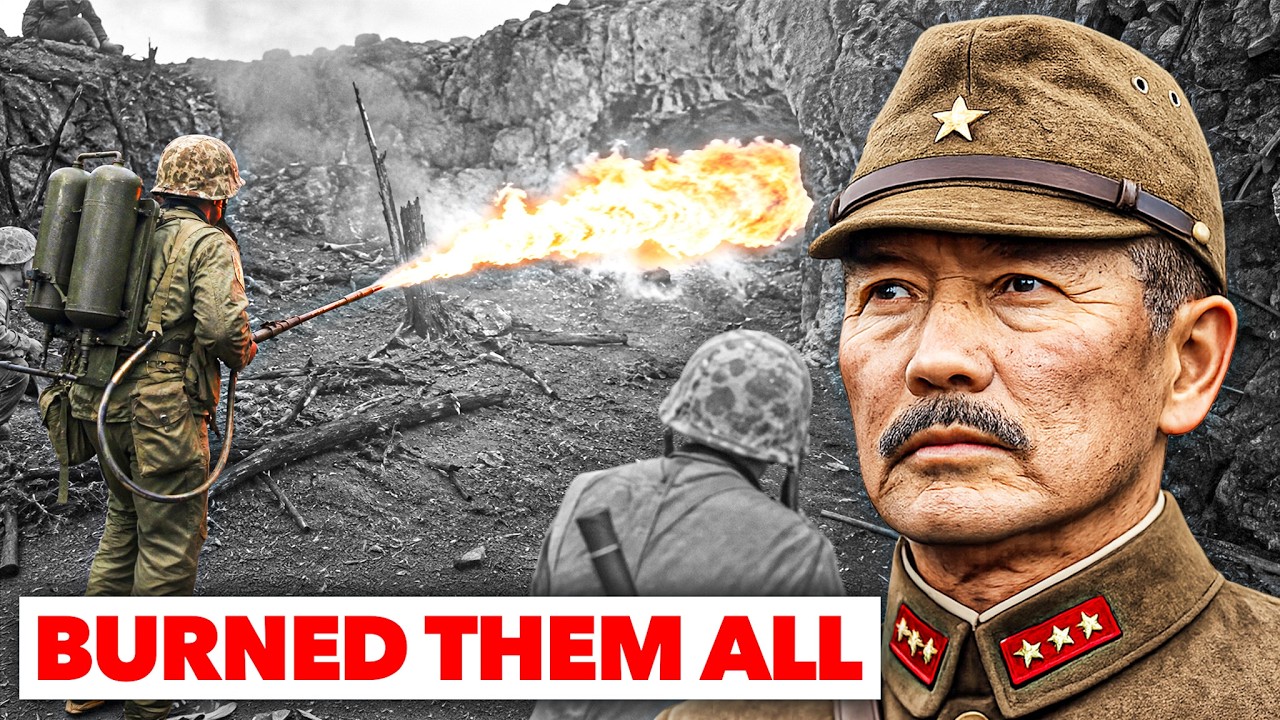
American engineers eventually developed a systematic approach: flamethrower teams sealed the entrances with fire, and demolition teams packed explosives into every opening they could find and collapsed the passages. But the tunnels were deep, extensive, and numerous. For every passage the Marines destroyed, there were others they had not yet found. Kuribayashi had built a fortress that existed in three dimensions, and the Marines were fighting in two.
On the fifth day of the battle, Marines of the 28th Regiment reached the summit of Mount Suribachi, the extinct volcanic cone that dominated the southern end of the island, and raised an American flag. A photograph of the second flag raised that morning became the most reproduced photograph in the history of American journalism. What the photograph did not convey is that raising the flag on Suribachi was not the end of the fight. It was the end of the beginning.
Suribachi represented approximately ten percent of the island’s land mass. The remaining ninety percent, including the bulk of Kuribayashi’s tunnel network, all three airfields, and the vast majority of his 22,000 defenders, lay to the north. The flag went up on day five. The battle lasted thirty-one more days after that.
What followed was 22 miles of terrain that Kuribayashi had converted into an interlocking system of killing ground so dense that in some sectors the Marines gained ground measured in yards per day. Senior Marine commanders described a quality of Japanese resistance unlike anything they had encountered previously. This was not the suicidal banzai charge of the early Pacific war, which had been terrifying but ultimately wasteful of Japanese lives and ultimately beatable. This was more methodical, more patient, more coldly rational.
Kuribayashi’s men were not dying for the emperor in the old way. They were dying for every square yard of rock, one at a time, taking as many Marines with them as terrain, position, and remaining ammunition would allow. The element of the Marine assault that most confounded Japanese defenders was the speed at which the Americans regenerated. Japanese tactical planning had been built around attrition, which had worked in China and Southeast Asia in the early years of the war.
But it had not accounted for the logistical system the American military had built to sustain combat across the Pacific. When a Marine rifle company took fifty percent casualties in a single day, which happened repeatedly, replacements arrived the following morning. Not raw recruits, but trained Marines who had been moving forward through the supply chain specifically to feed into units that needed them. Artillery was brought ashore continuously through the surf, the volcanic sand, and the Japanese fire, and it kept firing.
The medical system evacuated the wounded back to hospital ships offshore and returned men to the line within days of minor wounds, keeping effective strength higher than any calculation of the violence they were absorbing would have suggested possible. Kuribayashi wrote in his dispatches to Tokyo in the second week of the battle that the Americans were not behaving the way doctrine said they should. They were taking losses that should have broken a force of their size, and they were continuing to attack. He reported this not with alarm but with a kind of professional admiration for an enemy that was refusing to function according to the rules his training had taught him to expect.
The weapon that ultimately broke the tunnel system was not artillery. It was not naval gunfire. It was not the explosive charges Marine engineers spent the battle packing into every cave entrance. It was fire.
The M4 Sherman tank modified to carry a flamethrower, known to the Marines as the Ronson or the Zippo, was the single most effective weapon system in the campaign, and the Japanese had no answer for it. The tank flamethrower could project burning fuel sixty yards and sustain the flame long enough to fill an enclosed space completely. For a bunker or a cave system, this was a death sentence for everyone inside, regardless of how deep the tunnel went, regardless of how many turns it made. The heat, the oxygen deprivation, and the burning fuel followed the tunnels.
Japanese soldiers who survived described the arrival of the flame tanks as the single most psychologically devastating experience of the campaign. They could hear the tanks above them. They could feel the ground shake. Then the fire came down the tunnel entrance, and there was nothing to be done.
Regular rifle platoons had learned through brutal trial and error in the first week that assaulting a bunker with infantry meant losses the unit could not sustain. A single Japanese machine gun position in a reinforced cave could hold off a platoon for hours and kill a third of it. The flame tank changed the calculation entirely. Marine infantry moved to protect the tank and suppress the positions that could destroy it, while the tank did the actual work of clearing the position.
It was slower than a conventional assault and required intense coordination under fire, but it worked. And the Japanese, for all of Kuribayashi’s genius for adaptation, had no countermove. The battle lasted 36 days. When the island was declared secure on March 26, 1945, the cost on both sides was nearly incomprehensible.
Of the approximately 70,000 Marines who participated, nearly 27,000 were killed or wounded. 6,821 Americans died. It remains the bloodiest battle in the history of the United States Marine Corps. Of the 22,000 Japanese defenders, fewer than 220 survived to be taken prisoner.
The rest died in the tunnels, the bunkers, the caves, and the ruins of Kuribayashi’s underground fortress, exactly as he had told them they would. Kuribayashi himself sent his final radio message to Tokyo on March 17, nine days before the battle officially ended, reporting that his forces were reduced to a remnant and organized resistance would shortly cease. His body was never found. The island that had cost all of this was, by any conventional measure of military real estate, worthless.
Eight square miles of volcanic rock with no agricultural value, no mineral wealth, no population, no strategic depth. What it had was location. Iwo Jima sat almost exactly halfway between the Mariana Islands, where the B-29 bomber bases were located, and the Japanese home islands. American fighter aircraft flying from Iwo Jima could escort the B-29s to Japan and back.
Crippled bombers that could not make it back to the Marianas could land on Iwo Jima’s airfields. In the months between the capture of the island and the end of the war, approximately 2,400 B-29 sorties made emergency landings on Iwo Jima. At a standard crew of eleven men per aircraft, that is a potential 26,400 American airmen who were alive at the end of the war because there was an airfield on Iwo Jima to land on. In the weeks after the battle, a consensus emerged about what Kuribayashi had accomplished and why it had ultimately failed.
He had built the most sophisticated static defensive system the Imperial Japanese Army ever deployed in the Pacific. He had discarded the suicidal banzai doctrine that had wasted Japanese lives on a dozen previous islands. He had understood that the Americans could not be beaten in a stand-up fight and had designed a defense intended not to win, but to make winning so expensive that American political will would erode before the invasion of Japan. He was right about almost everything except one thing.
He had been right that conventional surface defenses would be swept away. He had been right that banzai charges were tactically useless. He had been right that the tunnel system would force the Marines to fight for every yard. What he had not correctly accounted for was the institution he was fighting.
The United States Marine Corps had been built over decades and across the entire Pacific campaign specifically to do what it did on Iwo Jima, to assault fortified positions across open ground under fire and keep moving regardless of casualties. It was not that the Marines were individually more capable than Kuribayashi’s defenders, who fought with a discipline and ferocity that earned the genuine respect of the men who killed them. It was that the Marine Corps as an institution had been optimized for exactly this kind of battle, and Kuribayashi’s defense, for all its ingenuity, was ultimately a problem the institution had been designed to solve. The Marines took 36 days.
Kuribayashi had hoped for months. The difference in the end was not firepower. It was not technology. It was what the Marine Corps had built itself to be over forty years of preparation for exactly this moment.
The Japanese commanders in Tokyo who read Kuribayashi’s final dispatches understood what had happened but not why. They never fully understood why.