Early in the making of the Andy Griffith Show, Andy Griffith faced a choice that would define the series. He was the proven star, the name above the title. The natural arrangement was obvious: Griffith would deliver the jokes and the actors around him would provide support. Then Don Knotts entered as Deputy Barney Fife—nervous, proud, underqualified, and gloriously certain that nobody could see his fear.
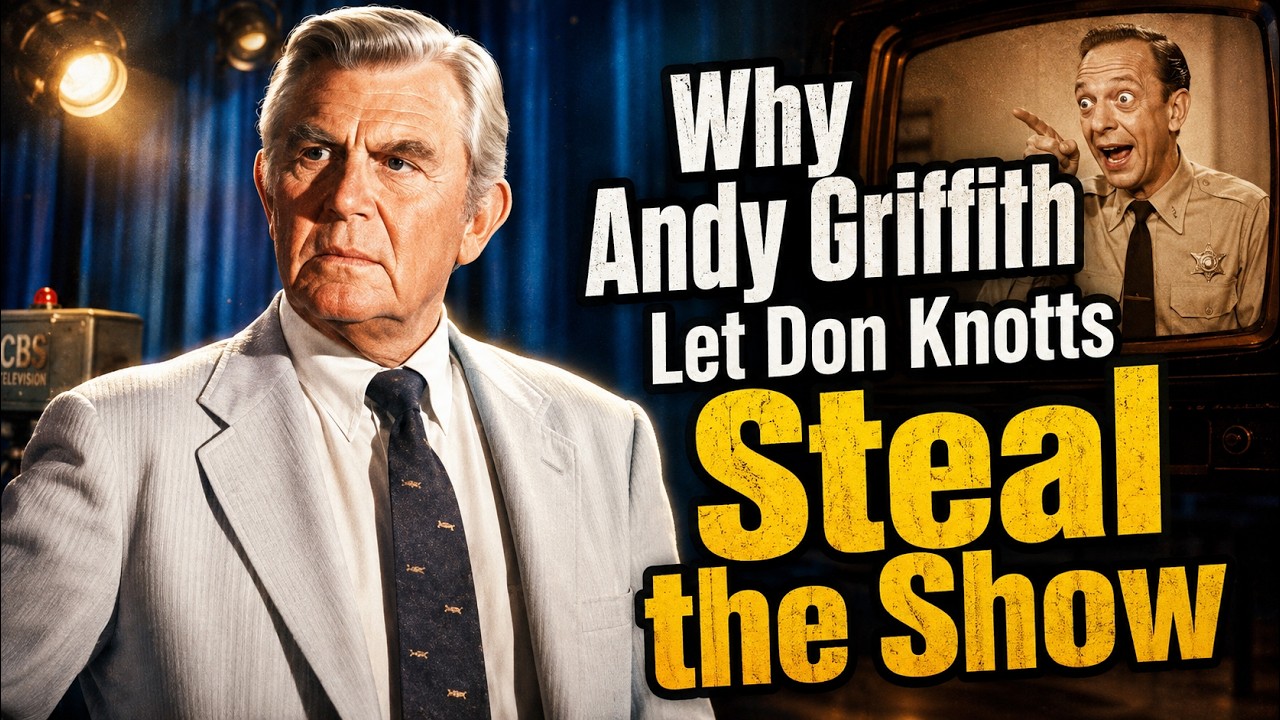
Every stiffened shoulder, narrowed eye, and sudden claim of courage betrayed the panic underneath. Griffith watched. By the second episode, he understood what the series needed. He later recalled: “Don should be the comic, and I should play straight for him.
” It was a surrender of the loudest laugh, but not of authority. Griffith stepped back so the scene could grow larger than the star. That choice made Barney Fife possible. It made Mayberry possible.
And it revealed something essential about the man who would spend the rest of his career moving between the need to command and the wisdom to listen. Andy Samuel Griffith was born on June 1, 1926, in Mount Airy, North Carolina, an only child in a modest household. His father Carl worked with his hands; his mother Geneva held the family together. Griffith grew up alert to how a voice could identify class and region before the words themselves were fully heard.
He remembered himself as shy and self-conscious. Music gave him a way into a room. A trombone placed him inside a group where timing, discipline, and listening mattered as much as volume. At Grace Moravian Church, the Reverend Ed Mickey encouraged him and helped develop his musical ability.
The boy who felt watched discovered that performance could reverse the direction of attention. At the University of North Carolina at Chapel Hill, he initially considered the ministry. But music, drama, and performance became the language through which he understood work and himself. He changed course and earned a degree in music in 1949.
One of the most important experiences came on Roanoke Island, where he performed in The Lost Colony, the long-running outdoor drama about the vanished English settlement. The production demanded projection and endurance—a performance had to reach the back rows without losing human shape. It also brought Barbara Edwards into his life; they married in 1949. Griffith taught at Goldsboro High School, and the classroom refined a manner he would later use on television: calm explanation, patient questioning, instruction that did not feel like command.
Yet ambition exceeded the classroom. He and Barbara developed a traveling act mixing music and comedy. His most effective material began with a narrator who did not understand the modern world. The misunderstanding was not random stupidity but a method—by refusing familiar names, the narrator stripped an ordinary event of its accepted meaning.
At a luncheon in Chapel Hill, publisher Orville Campbell heard Griffith perform a monologue about a country preacher wandering into a football game. Campbell recognized what local audiences already knew. Colonial Records released “What It Was Was Football” in November 1953. The narrator described the game without its accepted vocabulary.
The record sold hundreds of thousands of copies in its first year and transformed Griffith’s working life. The success led to No Time for Sergeants, first as a television play, then on Broadway. Griffith played Will Stockdale, an innocent Georgia farm boy drafted into the Air Force. The role brought a Tony Award nomination and placed him beside Don Knotts, who played a tense military evaluator whose composure broke under Will’s guileless answers.
Their styles were different but compatible; both understood that comic partnership depended on attention. Broadway success did not satisfy Griffith’s desire to be taken seriously. In 1957, director Elia Kazan gave him that chance in A Face in the Crowd. Griffith played Larry “Lonesome” Rhodes, a drifter discovered in an Arkansas jail and transformed by broadcasting into a national force.
The character used the same materials that had made Griffith popular: southern speech, music, laughter, informality. The film turned those materials inside out. Rhodes’s intimacy became manipulation, his friendliness became appetite. For viewers who knew Griffith mainly as Andy Taylor, the performance can still feel startling.
But it did not immediately give him the film career he expected. By the end of the 1950s, Griffith had proven he could sing, act, carry comedy, hold a theater, and terrify a film audience. Yet Hollywood had not found a durable place for him. Television, still dismissed by some film actors, began to look less like retreat and more like a medium in which he might shape the work himself.
A guest spot on the Danny Thomas Show gave him the outline of a small-town sheriff. After the pilot sold, Don Knotts called Griffith and asked whether the sheriff might need a deputy. The question sounded casual. Its answer changed the series, Griffith’s career, and the memory of American television.
The Andy Griffith Show premiered in October 1960. A widowed sheriff named Andy Taylor lived with his son Opie and Aunt Bee in the fictional town of Mayberry. Barney Fife served as deputy. The earliest episodes still carried traces of Griffith’s established comic persona—rustic, excitable, hungry for the joke.
But Barney arrived with a more precise comic engine. He wanted authority and feared what authority might require. He guarded his dignity so urgently that he revealed every weakness he hoped to hide. Griffith saw that two men competing for the comic center would exhaust the scene.
If Andy Taylor became calmer, Barney could become more extreme without turning the program into noise. The sheriff’s stillness would give the deputy scale. The decision improved more than a partnership. Once Andy stopped demanding every laugh, Floyd the Barber, Otis, Ernest T.
Bass, Gomer, Goober, Aunt Bee, and the rest of Mayberry could enter with rhythms of their own. Mayberry became the star—a phrase Griffith himself used. He also worked closely on scripts, without regular writing credit, caring about language and the moral temperature of a scene. A joke that treated a character as merely stupid could damage the town.
The best comedy made weakness visible without asking viewers to withdraw affection. Andy Taylor’s authority worked because he tried to understand the person before solving the problem. He rarely needed to declare victory. He could allow Barney to retain a fragment of pride after the mistake was clear.
That mercy became one of the program’s most recognizable qualities. Ron Howard was still a child when he began playing Opie. Griffith did not speak down to him; he expected him to listen, react, and work as an actor. The relationship between Andy and Opie gave the series its emotional spine—not through grief turned into a weekly device, but through the daily labor of fatherhood: explaining unfairness, correcting selfishness, admitting uncertainty.
Stories like “Opie, the Birdman” joined a moral lesson to work and care rather than detached speech. “Mr. McBeevee” placed Andy between adult evidence and his son’s word, and he chose to trust the child’s honesty. Authority became most meaningful when it accepted the risk of faith in another person.
During the black-and-white seasons, the show became one of television’s most dependable successes. Don Knotts won repeated Emmys for Barney Fife. The recognition made the unusual arrangement at the center of the program visible: the supporting actor often received the largest comic moments. Griffith did not respond by reclaiming them.
He kept refining the straight role, making his face an instrument of reception. He remained the star, deeply involved in scripts and tone, but he had changed the level on which he exercised control. The weekly production was neither casual nor quaint. Producer Aaron Rubin and executive producer Sheldon Leonard helped create the discipline of the early seasons.
Leonard later identified Griffith’s willingness to subdue his own comedy as central to the show’s success. Most stars were expected to intensify the qualities that made them marketable. Griffith did the opposite. The country comic who had sold records and filled theaters reduced the visible machinery until viewers experienced Andy Taylor’s calm rather than Andy Griffith’s technique.
Music remained essential. Griffith played guitar and sang, sometimes alone, sometimes with guests. The songs connected Andy Taylor to the church, school, and local performance traditions that had shaped Griffith himself. The partnership with Knotts extended beyond performance.
They had known each other before Hollywood, on Broadway. Don had understood the series might last only five years; when he began planning a film career, Griffith decided to continue. Knotts left as a regular after the fifth season, though he returned for guest appearances. Without Barney in the courthouse, Andy Taylor had fewer scenes built around the old duet.
The series moved into color, remained popular, but its central comic pressure had shifted. After eight seasons, Griffith chose to leave. The final original episode aired in 1968, and the show ended its final season at number one. Leaving at that height looked like freedom, but it also removed the structure that had organized his working life.
Headmaster and The New Andy Griffith Show both failed to find the balance Mayberry had achieved. Viewers who had welcomed the sheriff into their homes did not easily accept a replacement identity. Griffith was also trapped by the success of Andy Taylor. The energy of Lonesome Rhodes had not disappeared from his range; it simply had fewer chances to surface.
He took roles in television movies and dramatic productions that used his familiar authority in darker ways, playing lawmen, fathers, and judges whose standing concealed danger or moral weakness. His private life carried its own costs. Andy and Barbara, married in 1949, divorced in 1972. In 1973, Griffith married Greek actress Solica Casuto; the marriage lasted until 1981.
He formed Andy Griffith Enterprises in 1972 and worked steadily, but none of the projects restored a continuing world. Syndication created a strange double existence: somewhere in America, the young sheriff appeared every day, unchanged, while the older actor waited for current work. North Carolina offered continuity that Hollywood did not. He returned more often to Roanoke Island, to the landscape connected to youth and music.
Cindy Knight met him during this unsettled period. She was an actress working in The Lost Colony, the production that had shaped his early life. They married in April 1983. Not long after, a health crisis overtook him.
What first appeared like influenza developed into severe pain and difficulty controlling his feet. He was eventually diagnosed with Guillain-Barré syndrome—relatively limited paralysis, but intense and persistent pain. Cindy became a caregiver; Griffith became dependent at a moment when his professional independence already felt uncertain. A physician friend, Leonard Rosengarden, saw beyond his effort to appear stoic and arranged admission to a rehabilitation hospital.
The illness left lasting pain in his feet. Financial fear compounded it. Griffith later wrote that a former manager told him and Cindy they were nearly broke. They considered selling the Los Angeles house and returning permanently to North Carolina.
The house did not sell. Cindy read the situation differently: leaving Los Angeles, she believed, might turn a temporary professional retreat into disappearance. Her advice was direct: “What we need to do is stay here and stoke the fire. ” Together they began going to the William Morris Agency at lunchtime and sitting in the lobby—one of the most familiar faces in television history placing himself where agents and executives would have to confront the fact that Andy Griffith was alive, available, and wanted to work.
The campaign worked gradually. New television movie roles followed. Most importantly, the renewed activity included Return to Mayberry and the pilot that became Matlock. Return to Mayberry aired in 1986.
Don Knotts, Ron Howard, and other familiar performers came back. The reunion did not pretend the years had vanished, but it allowed the old relationships to acknowledge time without surrendering affection. Matlock offered Griffith a different solution to being remembered as Andy Taylor. Ben Matlock was southern, observant, morally centered, and underestimated.
He was not a sheriff maintaining a stable town; he was a defense lawyer who took apart a lie. Griffith worked on language, logic, and character consistency, sometimes revising material so Matlock’s reasoning felt genuine. Matlock premiered in 1986 and ran for nine seasons, first on NBC, later on ABC. Don Knotts later appeared repeatedly as Les Calhoun, carrying a history the script did not need to explain.
The comeback was not a gift delivered by nostalgia. It followed failed series, scattered roles, illness, financial fear, physical rehabilitation, and an organized effort to be seen again. In 1996, Griffith released I Love to Tell the Story, a collection of hymns. The album won a Grammy Award the following year.
The hymns returned him to a language older than celebrity. In the same period came private grief: his son Sam died in 1996 at age 38. Griffith did not turn the loss into a public performance. In 2000, he suffered a heart attack and underwent quadruple bypass surgery.
In 2005, President George W. Bush awarded him the Presidential Medal of Freedom. Don Knotts died in February 2006. Griffith lost the partner whose arrival had transformed his most important work.
Griffith spent much of his later life with Cindy on Roanoke Island. He died at his home on July 3, 2012, at age 86—a heart attack with long-standing coronary disease. He was buried privately in the Griffith family cemetery. The speed and privacy of the burial surprised some people; familiarity was not ownership, and Griffith had maintained that boundary at the final moment.
Cindy described him as her love, partner, and best friend. The career cannot be reduced to the man whose name appeared above the title. Griffith’s gift was inseparable from his response to other people. He was often most original when he recognized what a partner, child actor, writer, musician, or an entire fictional town could do if the star left enough room.
Room was never the same as absence. He watched closely, adjusted language, protected pace and tone. For viewers, that vigilance disappeared into ease. They saw Andy Taylor lower his voice, a father take a child seriously, a sheriff let a nervous deputy keep the last piece of dignity available to him, a town in which embarrassment did not automatically end belonging.
Early in the series, Griffith understood that Don should be the comic and that he should play straight for him. What looked like a smaller role became the center of a larger achievement. The loudest laugh went to Barney.
The lasting rhythm belonged to both men, and the star whose name stood above the title became unforgettable by knowing when not to stand alone.