On October 20, 1968, on a rain-soaked Greek island, in a small chapel that held perhaps thirty people, Jacqueline Bouvier Kennedy married Aristotle Onassis. The bride was thirty-nine. The groom was sixty-two, a shipping magnate roughly five inches shorter than she was. The Greek Orthodox ceremony lasted about ten minutes.
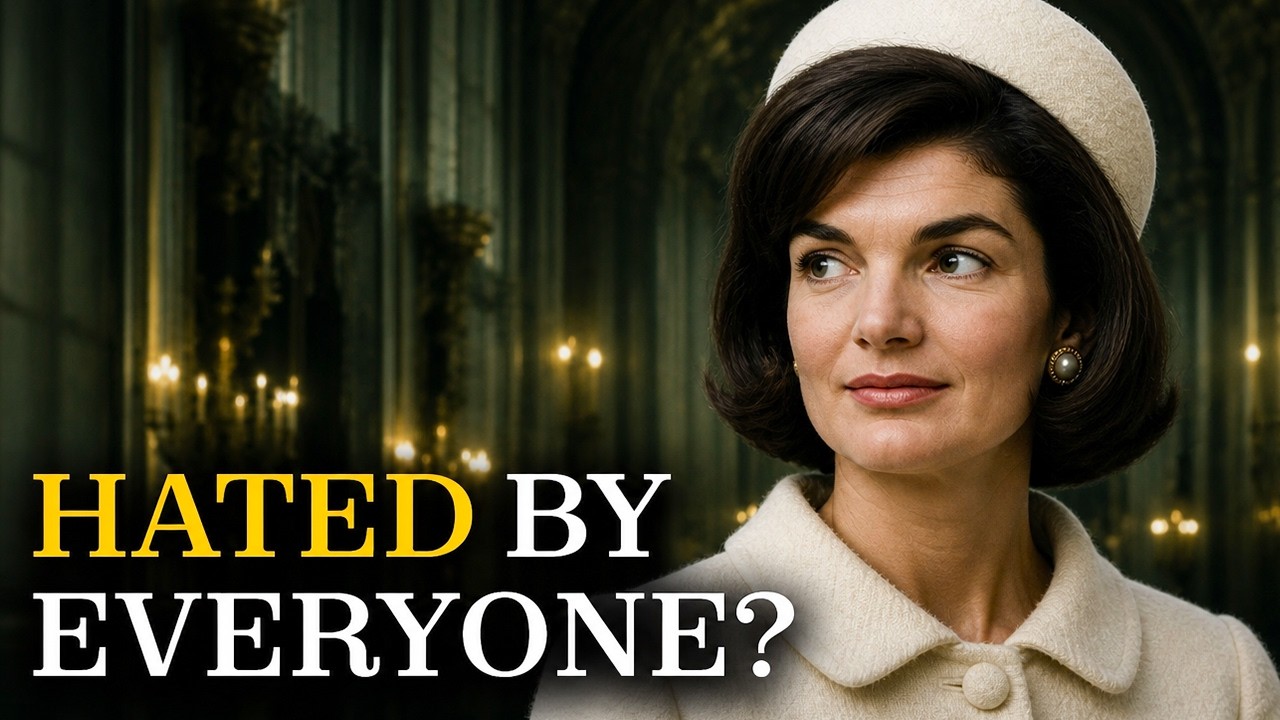
The press had been kept off Scorpios by Onassis’s security and a ring of boats, so the photographs the world saw the next morning were long-lens, gray, and faintly furtive. Within hours, the most admired woman in the world became the most despised. A Swedish paper asked, “Jackie, how could you? ” A German front page announced that America had lost a saint.
The Vatican’s weekly newspaper described her as a public sinner, because Onassis was divorced, until the church quietly walked the statement back. American columnists who had spent five years praising her dignity discovered overnight that she had always been a gold digger. Almost no Kennedys attended, but the correction is more interesting than the myth. Ted Kennedy was there, along with Pat Lawford and Jean Smith.
Caroline, aged ten, and John, not quite eight, stood holding candles. Rose Kennedy did not come. Ethel did not come. Ted had not flown to Greece as a sentimental brother-in-law.
He had gone earlier that year to sit down with Onassis and negotiate terms. Whatever else the Scorpios wedding was, it was a transaction with lawyers attached, and the Kennedy family sent a senator to handle the paperwork. There were practical prices as well. By marrying a foreign national, Jackie forfeited her federal widow’s pension, roughly ten thousand dollars a year, and she gave up her Secret Service protection.
The protection mattered more than the money. Five months earlier, her brother-in-law Robert Kennedy had been shot to death in a hotel kitchen in Los Angeles. She had told friends, in lines repeated by several of them afterward, that they were killing Kennedys and that her children were targets because of the name. Her solution was to acquire a man with his own island, his own airline, his own security, and no interest whatsoever in American politics.
The hatred directed at her, though, was not a single reaction. It came in waves. The first lasted a decade and came from inside Washington, from other political wives, from congressmen, from reporters who covered the Hill, and it had nothing to do with Onassis. It had to do with the fact that she would not do the job.
The second wave was short and came from political professionals who thought she was costing Jack Kennedy votes. The third, in 1968, was global and hysterical, and in a strange way the most honest, because by then the public genuinely believed it owned her. She had learned early how much of a marriage is performance, and exactly what happens to a woman who does not have her own money. Her father taught her both lessons, mostly by failing at them.
John Vernou Bouvier III, called Blackjack, was a stockbroker with a seat on the exchange, a deep tan he maintained year-round, and a habit of pursuing women in front of his wife. In 1936, when Jackie was seven, the separation reached the newspapers, and the New York tabloids covered a society broker’s marital collapse with enthusiasm. The evidence of his affairs was laid out for public consumption. Before she was ten, she had watched the press turn a marriage into content.
Janet Lee remarried in 1942, to Hugh D. Auchincloss Jr. , a man with Standard Oil money and two large houses: Merrywood in Virginia and Hammersmith Farm in Newport, Rhode Island, with twenty-eight rooms and a view of the bay. Jackie and her sister Lee moved into serious wealth.
They did not inherit any of it. Auchincloss was generous and decent, but the Bouvier girls were stepdaughters, living in an establishment that would never legally belong to them. Meanwhile their actual father was drinking, losing money, and sending letters that alternated between adoration and self-pity. She grew up in beautiful rooms she did not own, understanding that affection was unreliable and that money was the thing that kept you in the house.
She was also genuinely gifted. In 1951, she entered Vogue’s Prix de Paris, a writing contest with over a thousand entrants that year. She named three men from history she wished she had known: Diaghilev, Baudelaire, Oscar Wilde. She described herself with a cool, unsparing accuracy.
She won first place. The prize was a year working for Vogue, six months of it in Paris. She did not take it. Her mother generally gets the credit for that; the reasoning was practical and unremarkable for 1951.
A twenty-two-year-old woman already too intellectual needed to come home and marry. So she came home and took a job at the Washington Times-Herald as the inquiring camera girl, earning $42. 50 a week, stopping strangers on the street with a camera and a notebook and a question. She spent a year learning how to get people to say revealing things quickly, how to frame a picture, and how a quote looks in print once an editor has finished with it.
She was trained in press management before she was twenty-three. She was also briefly engaged to John Husted, a New York investment banker. The engagement was announced in January 1952 and over by spring. Several accounts put the cause at least partly on money.
He was making something like seventeen thousand a year, and Janet Auchincloss thought her daughter could do considerably better. Jackie gave the ring back at the airport. She had already run the arithmetic. At a dinner party at Charles and Martha Bartlett’s house in Georgetown in May 1951, she finally met Congressman John F.
Kennedy. Jackie later described it in her own understated way: he leaned across the asparagus and asked her for a date. The courtship that followed was barely a courtship. He was running for the Senate against Henry Cabot Lodge Jr.
through most of 1952. The relationship ran largely on long-distance telephone calls and postcards. He wasn’t the kind of man who wrote letters. She was twenty-three.
He was thirty-six, a war hero with a gravely compromised spine, an endocrine disorder his family denied publicly for years, and a sexual reputation so established that it was a standing joke among the reporters who covered him. She knew. Her friends knew. This was not hidden information in Washington in 1952.
The sequencing of their engagement was not sloppy. On June 13, 1953, the Saturday Evening Post published a profile titled “Jack Kennedy: The Senate’s Gay Young Bachelor. ” Twelve days later, the engagement was announced. Joseph P.
Kennedy wanted the bachelor piece to run first, because a bachelor senator is charming at thirty-six and suspicious at forty. Then he wanted the engagement. Joe was the real architect of the match, and his criteria were not romantic. She was Catholic, which the Boston archdiocese would notice.
She was photogenic in a way that made the Kennedys look less like recent arrivals. She spoke French, Spanish, and Italian. And socially, Bouvier and Auchincloss outranked Kennedy. The grandson of an East Boston saloon keeper was buying a daughter of Newport.
Jackie understood the transaction perfectly well. She had grown up with a father who did exactly what Jack Kennedy did, and she had watched her mother’s response: leave, then remarry upward. She said yes anyway, not blindly. She said yes to a man she found genuinely fascinating, to the only life available to a woman with her tastes and no money of her own, and to a family that had already decided she was an asset.
The wedding took place on September 12, 1953, in Newport. Janet Auchincloss had wanted something restrained. She lost that argument comprehensively. Joe Kennedy wanted a national event, and he got a mass at St.
Mary’s Church with something like eight hundred inside and three thousand spectators outside, who broke through the police line and nearly crushed the bride on the church steps. The reception at Hammersmith Farm was for twelve hundred. Two things went wrong that day, and both got tidied out of the record. Her father, Blackjack Bouvier, came to Newport to give his daughter away and did not appear at the church.
The family account repeated for decades was that he was ill. What actually happened, according to multiple people present, was that he had been drinking in his room at the Viking Hotel, and the Auchinclosses decided he would not be walking anyone down any aisle. Hugh Auchincloss did it instead. Jackie found out shortly before the ceremony.
She is smiling in every one of the wedding photographs. She had been doing that particular kind of smiling since she was seven. The gown was ivory silk taffeta with a portrait neckline, a huge circular skirt, and wax-flower detailing, made by Ann Lowe, a Black designer in New York who had dressed Auchinclosses, Roosevelts, Du Ponts, and Rockefellers for years. Ten days before the wedding, a pipe burst in her Lexington Avenue workroom and destroyed ten of the fifteen dresses, including the bride’s.
Lowe and her staff rebuilt everything in eight days. She had quoted the job at seven hundred dollars, and by her own later account, the disaster cost her around twenty-two hundred out of pocket. She absorbed it and said nothing. When she arrived in Newport to deliver the gowns, she was directed to the service entrance.
She refused and went in the front. The press described the dress in loving detail. It did not name her. The most photographed dress in twentieth-century America was made by a woman the story left out.
After the honeymoon in Acapulco, the marriage began, and the first thing she discovered was that she had not married a man. She had married an operation. There was no house. For the first year, they moved between hotels, her mother’s places, and a rented house in Georgetown.
Jack was in the Senate, traveling constantly, and when he was home, the home was frequently Hyannis Port, where the actual power sat. The compound functioned like a small corporation with a beach. Jackie was by temperament none of it. She read.
She drew caricatures. She rode. She had a habit, documented in the recollections of nearly everyone who spent time there, of mimicking people with lethal accuracy once they had left the room. The sisters found her affected.
She found them relentless. Her only real ally in the family was Joe. The father-in-law who had bought her and installed her was also the one person who talked to her like an adult, defended her spending, and told his son to leave her alone about it. She adored him.
Then came the thing that nearly ended it. In 1956, Jack lost the vice presidential nomination at the Chicago convention, and the loss was what made him a national figure. Instead of going home with his wife, who was eight months pregnant and had already had a miscarriage two years earlier, he flew to the south of France and boarded a chartered yacht in the Mediterranean with his brother Ted and Senator George Smathers of Florida. On August 23, at Newport, Jackie hemorrhaged and underwent an emergency cesarean.
The baby, a daughter, was stillborn. Jackie later gave her the name Arabella. The child was not named at the time. She woke up, and her husband was not in the country.
Bobby Kennedy was the one at the hospital. Jack was reached by ship-to-shore radio. He did not immediately come back. The most cited account has Smathers telling him bluntly that if he wanted to be president, he had better get on a plane, because the voters would not forgive a man who stayed on a yacht.
The dialogue is unreliable; Smathers was telling a good story about himself thirty years after the fact. What is not in dispute is the timeline. Jack stayed several days and came home on August 26. That was the moment the marriage should have ended, and the moment you have to understand why it did not.
Jackie had no money. Her stepfather’s fortune was not hers. Her father was broke and would be dead within a year. She was Catholic in a Catholic family, in 1956, when divorce would have ended her standing entirely and his career outright.
And the family was already building a presidential campaign around a Catholic candidate whose entire electability depended on being unimpeachably wholesome. She stayed. The marriage changed shape. What replaced romance was an arrangement, and she began negotiating within it rather than against it.
Caroline was born in November 1957, healthy. That helped. It also locked the door. Then the presidency arrived and made everything public.
During the 1960 campaign, she was pregnant with John, and pregnancy became her negotiating instrument. She didn’t do the whistle stops or the endless coffee mornings. What she did instead was write a syndicated column called Campaign Wife, give interviews in Spanish when it was useful, and appear on television. She also produced the two lines that started the first war.
Asked about her clothing budget, she reportedly said she couldn’t spend that much unless she wore sable underwear. Asked about the campaign, there was the widely reported remark that if her husband lost, she’d be relieved and they’d travel. Some of these quotes were mangled. Some were invented outright by columnists.
It didn’t matter. The template had been set: rich, foreign-seeming, bored by American politics, faintly contemptuous. Once she got to the White House, the country loved her, and Washington did not. The country got the restoration, and it was a genuine achievement.
She assembled a fine arts committee, created the White House Historical Association, got the place designated a museum so furniture couldn’t walk out with departing administrations, and sold guidebooks to pay for it. On February 14, 1962, CBS and NBC carried her televised tour of the house. Fifty-six million Americans watched. She won an Emmy.
Washington got something else: she skipped things. She skipped teas, receptions, congressional wives’ luncheons, the whole apparatus of small obligations that first ladies had performed since forever. Lady Bird Johnson substituted for her constantly and did it without complaint, which was noticed and remembered. Cabinet wives found her cold.
Congressmen’s wives found her worse. And the spending was real. In 1961, her personal expenditures, clothing, entertaining, decorating, ran past $105,000. The president’s salary was $100,000.
He found out and, according to multiple staff accounts, was furious, then paid it. In April 1963, she announced she was pregnant. No first lady had given birth in office since Frances Cleveland in the 1890s. She canceled her official schedule for the rest of the year.
All of it. She went to Hyannis Port for the summer. On August 7, five and a half weeks early, she went into labor at Otis Air Force Base on Cape Cod. The baby was a boy, four pounds ten ounces, with hyaline membrane disease, respiratory distress syndrome, the killer of premature infants in an era before surfactant therapy and modern ventilation.
They named him Patrick Bouvier Kennedy, using her father’s name. Jack came. That is the sentence that matters, because in 1956 he hadn’t. He flew up from Washington.
He was there, and he stayed with the baby through the transfer to Children’s Hospital in Boston and into the hyperbaric chamber. Patrick lived thirty-nine hours. The president was in a room down the hall when he died on the morning of August 9. Dave Powers, who was with him, said afterward that he had never seen him cry like that.
Jackie was still at Otis, too weak to travel, and had not been with the baby when he died. When Jack came back to her hospital room, those present said he sat on the bed and they held on to each other. Something shifted after that. Multiple witnesses, Secret Service agents, White House staff, Charles Bartlett, Ben Bradlee, all independently described the same change in the months that followed: a president who was physically demonstrative with his wife in a way he had never been in public before, holding her hand, an arm around her at Hyannis Port, sitting with her rather than working through the evening.
The most careful biographers treat the fall of 1963 as the closest thing to genuine repair the marriage ever produced. Whether it would have lasted, nobody can say. It had eleven weeks to run. After Patrick died, her sister Lee, by then close to Aristotle Onassis, arranged for Jackie to recuperate aboard Onassis’s yacht, the Christina, in the Aegean.
Jackie accepted. The president tried to stop it. Onassis in 1963 was not a socially neutral figure. He had been indicted by a federal grand jury in 1954 over surplus ship purchases and had settled with the United States government for seven million dollars.
He was a foreign national with ongoing business before American agencies. He was radioactive. Jack asked her not to have Onassis on board. Onassis offered to stay off his own yacht, then decided he couldn’t be a poor host and came anyway.
The first lady spent two weeks in October 1963 cruising the Aegean and the Turkish coast on the boat of a man who had paid a $7 million settlement to her husband’s government. The photographs came back. She looked spectacular, and she looked like she was having a wonderful time a few weeks after burying a child. The cost in political terms was small but real.
She knew it, and she offered him something in exchange: she agreed to go to Texas. That is not an inference. It is in her own account and in the accounts of the people around them both. She came back from Greece in mid-October and told him she would campaign with him, which she had essentially refused to do since 1960.
Some accounts have her saying she would campaign with him anywhere he wanted in 1964. A woman who had spent three years skipping Red Cross luncheons volunteered for a two-day political swing through a state the campaign was worried about, immediately after a trip that had embarrassed her husband. She was settling an account. That was how this marriage worked, and by then she was fluent in it.
On November 21, she flew to Texas. It was her first domestic political trip as first lady. On the morning of November 22, in Fort Worth, the president joked to a crowd about how nobody cared what he and Lyndon wore. A few hours later in Dallas, she was sitting beside him in an open car in a pink wool suit with navy trim.
What followed shaped the rest of her public life. During the ninety-nine hours after the assassination, she refused to change her clothes. Lady Bird Johnson offered to help her change before the swearing-in. She said no.
She stood in the cabin of Air Force One beside Lyndon Johnson while he took the oath, in a suit that was visibly ruined. When someone suggested she clean up before landing, she said she wanted them to see what they had done. The suit, incidentally, was not Chanel. It was a licensed Chez Ninon copy made in America, because a first lady wearing Paris couture in an election cycle was a political problem.
She stayed in that suit for nearly twelve hours. Then, over the following three days, she personally designed the funeral. She sent for material on Lincoln’s. She had the East Room draped to match the 1865 photographs.
She insisted on the procession on foot from the White House to St. Matthew’s, heads of state included, over the strenuous objections of every security professional in Washington, including a Secret Service that had lost a president seventy-two hours earlier. Charles de Gaulle walked. Haile Selassie walked.
She walked with Robert and Edward Kennedy. She chose the eternal flame at Arlington, and had it lit on the day of the burial, which gave the engineers about a day to build it. She had her two dead children, Patrick and the daughter from 1956, moved to lie beside their father. Five days after the funeral, on November 29, she summoned Theodore H.
White, the author of The Making of the President, to Hyannis Port. She sat with him for nearly four hours and did not talk about policy or the Cold War. She talked about the record she was worried about. She said she was afraid the historians would get him, that bitter old men would write history.
And she told White that at night Jack had liked to play a record before bed, the Lerner and Loewe cast album, and that the lines he loved were the last ones: “Don’t let it be forgot, that once there was a spot, for one brief shining moment, that was known as Camelot. ” Then she said the thing that became the entire American memory of the Kennedy administration: there would be great presidents again, but there would never be another Camelot. White did not think much of it as journalism. He wrote later that it was a misreading of history, that the Kennedy White House had been nothing like an idyll.
He wrote the piece anyway. While he typed, Life’s editors were on the phone from New York, holding the presses, arguing for cuts. Jacqueline Kennedy stood in the doorway and listened to his end of the call. When the editors pushed back on the Camelot material, she made it clear it stayed.
The essay ran in Life dated December 6, 1963, one week after the funeral. White’s handwritten interview notes, released in 1995, confirm all of it. His own annotation is that she wanted Camelot in and that he yielded to what she wanted. The most enduring political myth in modern American history was authored by a thirty-four-year-old widow on deadline, with the presses held, five days after she buried her husband.
She was not preserving the record. She was writing it. She kept going. In 1964, she sat with Arthur Schlesinger Jr.
for over eight hours of oral history interviews, then had them sealed for a generation. Her daughter released them in 2011. They are startling. She is sharp, funny about Lyndon Johnson, contemptuous of Charles de Gaulle and Indira Gandhi, dismissive of Martin Luther King Jr.
based on what Bobby had told her about FBI surveillance, and she describes herself as having no political opinions independent of her husband’s. That performance of wifely deference sits inside eight hours of a woman demonstrating she had read everything and judged everyone. She knew that tape would outlive the people in it. That’s why she locked it up.
In the same period, she authorized a book, and that decision turned into the ugliest public fight of her life. She and Bobby chose the writer themselves in early 1964, specifically to prevent someone else from doing it. Jim Bishop was already at work on a book about the assassination. They chose William Manchester, a Wesleyan academic who had written an admiring book about Kennedy in 1962 and who was, they assumed, safe.
The agreement gave the family the right to review the manuscript. Manchester spent two years on it, interviewed a thousand people, and in 1964 recorded roughly ten hours with Jackie herself, much of it late at night, much of it about the two days in Dallas, in a level of detail she had never given anyone and would never give again. Then he wrote it down, and she read what she had said. The fight that started in 1966 was not really about politics, though that’s how it was covered.
Look magazine had paid $665,000 for serialization, a record. Jackie sent Richard Goodwin and others to demand cuts. When that failed, she sued in December 1966 to stop publication. She lost control of the story instantly.
The press treated it as the widow attempting censorship, which it was, and her approval ratings took their first real damage. The suit settled in January 1967. Manchester agreed to cut roughly sixteen hundred words from the serialization and about seven pages from the book. What got cut was not state secrets.
It was domestic material: her account of Jack’s habits, the private texture of the marriage, moments from the plane, and a portrait of Lyndon Johnson so hostile that publishing it would have detonated the Democratic Party while Bobby was preparing to run. She had given a writer the intimate marriage and then spent a year and a fortune in legal fees getting it back. Manchester never recovered from it professionally or emotionally. The transcripts of her interviews were placed under a restriction that has kept them closed to this day.
She had learned that her own words, accurately recorded, were the most dangerous material in existence. She never sat for an interview like that again, not once, for twenty-seven years. Then June 1968 happened, and the calculation changed entirely. Robert Kennedy had been the person who told her about the 1956 baby, who was at the hospital when Patrick died, who walked with her behind the caisson after Dallas.
He was the last structural support she had. He was shot in Los Angeles on June 5 and died on June 6. She flew out. She was at the hospital.
She helped arrange another funeral. Several people who spoke to her that week reported the same thing afterward: that she said they were killing Kennedys, that her children were targets because of the name, and that she wanted to get out of the country. The most frequently quoted version comes to us through secondhand recollection, so the exact phrasing should be treated carefully. The behavior is not ambiguous.
Within four months, she had married a foreign national with a private island, a private airline, and a private security force. Aristotle Onassis had been in her life for five years by then. The negotiation was real and conducted by professionals. Ted Kennedy flew to Scorpios in August 1968 to talk terms.
The reported outcome was a settlement in the low millions, plus provisions for the children, a fraction of what Onassis was worth and a fortune by any normal measure. The exact figures have never been verified. What is established is that there was a prenuptial agreement, that a United States senator negotiated it, and that it was designed around Greek inheritance law, which reserves a fixed share of an estate for a widow, a provision Onassis spent the next several years trying to write around. Cushing, the same cardinal who had married her in 1953 and buried her husband in 1963, defended her publicly and took such a beating for it that he moved up his retirement.
That was the price she cost the people who stood by her. And America reacted as if it had been personally cheated. Not disappointed. Cheated.
She had never promised anyone perpetual widowhood. But the country had spent five years using her as the vessel for its own unfinished grief, and she had invited that deliberately when she handed Theodore White a lyric from a Broadway musical. She built the shrine. Then she walked out of it.
People do not forgive that. The marriage to Onassis was not a happy one and lasted six and a half years. He traveled constantly. She was in New York with the children much of the time.
His daughter Christina despised her, and his son Alexander was killed in a plane crash in 1973, after which Onassis deteriorated badly. He was reportedly consulting lawyers about a divorce when he died in Paris in March 1975. Christina fought the widow’s claim hard, and the two sides settled in 1977 for a reported $26 million, with Jackie surrendering her claim to the estate. That number is why the gold-digger version of her life persists.
It is also, if you follow the arithmetic from 1953, the end of a completely coherent forty-year project. She grew up in beautiful houses she did not own, watching a charming man who could not hold on to money. She was never going to be in that position again. The rest of her life is not what the caricature predicts.
In 1969, she went to court against Ron Galella, the photographer who had been trailing her and her children relentlessly. A 1972 federal ruling ordered him to stay a set distance from her and a greater distance from the children. He violated it. She took him back to court in 1981, and he eventually agreed to stop photographing her entirely.
The inquiring camera girl, who had once stopped strangers on the street with a lens, spent a decade establishing the legal boundary between a public figure and a private one. In 1975, she took a job as consulting editor at Viking, four days a week. She left in 1977 after Viking published a thriller involving a plot to assassinate Ted Kennedy; a Times piece implied she had been involved with the book, and she resigned rather than argue about it. Then Doubleday, where she worked for the last sixteen years of her life and acquired somewhere around a hundred books.
Editors who worked with her describe a real professional who came to meetings, read manuscripts, and fought for her authors. She never published a memoir. She was offered sums that would have been historic. She never wrote a word about her marriage for public consumption.
Every other participant in that administration wrote a book. She held the center of the story and said nothing, and because she said nothing, everyone else had to write around the hole where she was. Silence is not passivity when you are the only person who can confirm anything. She died in May 1994 at sixty-four, in her apartment on Fifth Avenue.
She was buried at Arlington beside John Kennedy, beside Patrick, and beside the daughter from 1956. Her funeral mass was at St. Ignatius Loyola, the church where she had been baptized and confirmed. Her son read from Isaiah and told reporters afterward that his mother had died surrounded by her books and the people she loved.
The papers gave her the sainthood back, twenty-six years after “Jackie, how could you? ” The obituaries were unanimous and adoring, and the Onassis marriage was handled in a paragraph. The year after she died, the Kennedy Library opened Theodore White’s Camelot notes. In 2011, her daughter released the Schlesinger tapes.
The estate sale at Sotheby’s in 1996 brought in $34 million, and the country queued around the block to look at her furniture. The Manchester transcripts stayed shut. She had been sorting that material her whole adult life: what opens, what stays closed, what opens only when everyone in it is dead. So why was she hated?
Because for ten years she wouldn’t do the small, dull, obligatory work of being a political wife, and the women who did it noticed. Because she spent more than her husband earned and made no apology. Because she traveled without him, skipped the luncheons, and was photographed on a Greek yacht in the fall of an election year. And then in 1968, because she declined the role the country had assigned her, permanent mourner, national widow, the woman in the ruined pink suit, and took the exit that was available to her, which happened to be a sixty-two-year-old shipping magnate with a security detail.
The hatred was the invoice. She had run the numbers before she signed. That wedding gown is in the Kennedy Library in Boston, laid flat in a climate-controlled case. It has been reproduced on magazine covers for seventy years as the founding image of a great American love story.
The woman who made it was Ann Lowe. She rebuilt it in eight days after a flood destroyed the original, lost money doing it, was directed toward the service entrance when she delivered it, and was described in the coverage as a colored dressmaker. She died in 1981, and it took another forty years for museums to start putting her name on the labels. Both women understood the same thing about American mythmaking, from opposite ends of it.
One of them spent her career being erased from a story she had literally sewn together. The other spent hers deciding what the country got to see. Jackie wore Ann Lowe’s dress for one afternoon.
She kept the keys to the archive for forty-one years.