On April 30, 1945, deep beneath the Reich Chancellery Gardens in Berlin, Adolf Hitler took his own life in a concrete bunker thick with diesel fumes and despair. In the rooms next to his, the men who had sworn to die protecting him heard the gunshot. Their oath was suddenly void. Their purpose was erased.
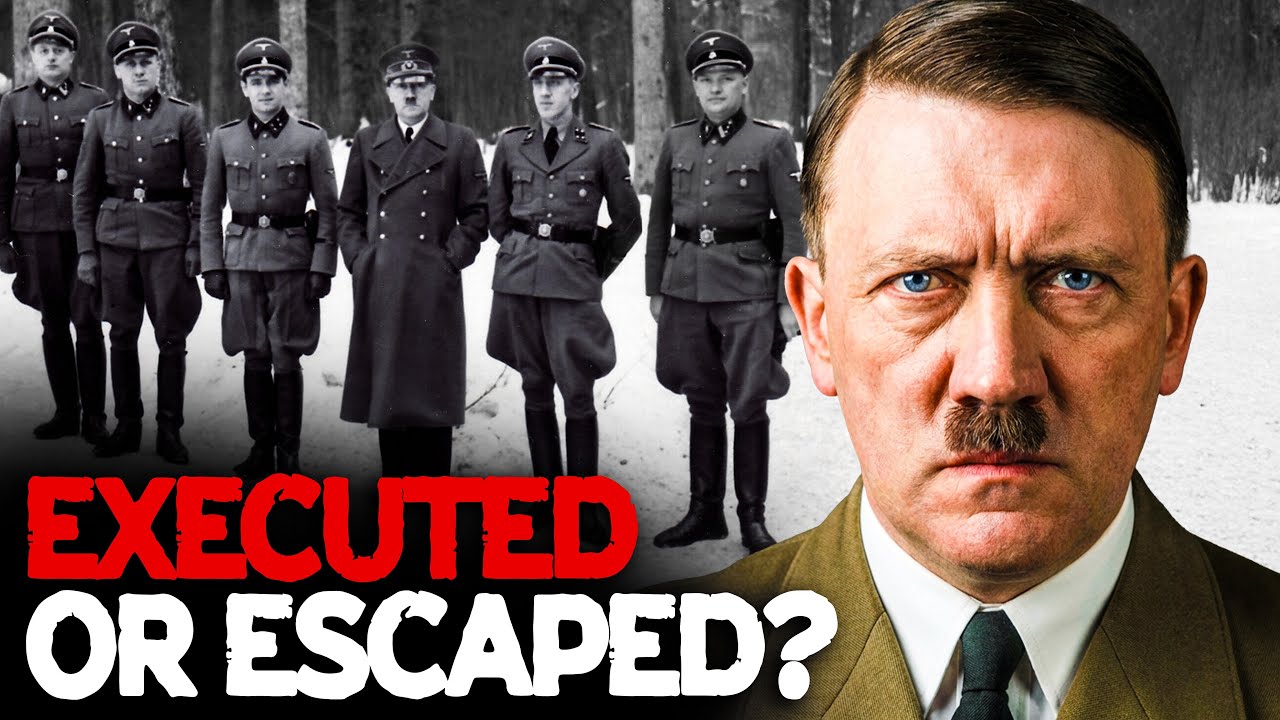
Within hours, these bodyguards abandoned the bunker and scattered into the ruined city, joining thousands of SS men desperately trying to disappear before the Soviet noose closed completely. Hitler’s personal security had been built in layers. The innermost circle, the Führerbegleitkommando, or FBK, was a unit of thirty to fifty men who guarded him constantly, securing his residences, screening visitors, and providing armed presence at public appearances and private meetings. Selection demanded not just physical fitness but a proven, fanatical loyalty verified through extensive background investigation.
Beyond the FBK stood the Leibstandarte SS Adolf Hitler, an entire division that had begun as Hitler’s personal guard in 1933 and had evolved into a frontline Waffen-SS combat formation while still maintaining ceremonial and protective duties at his headquarters. Its commander, SS-Oberstgruppenführer Josef Dietrich, had direct access to Hitler and oversaw both combat operations and security protocols. Another layer, the Reichssicherheitsdienst, or RSD, was a plainclothes security service staffed by criminal police and SS personnel. RSD officers worked alongside the FBK but operated with more autonomy, focusing on intelligence gathering and threat assessment rather than physical protection.
By April 1945, that apparatus had been destroyed. The Soviet army had encircled Berlin, and most of Hitler’s bodyguards were dead, killed in combat as Germany’s defensive lines collapsed. The Leibstandarte was scattered across multiple fronts, its remaining elements fighting desperate rear-guard actions. Only a small contingent of FBK members, a handful of RSD officers, and a few SS aides remained with Hitler in the bunker.
Once Hitler was dead, the men in the bunker faced an immediate and brutal choice: stay in Berlin and face Soviet capture, or try to break through the collapsing front lines. Most chose flight. Small groups of SS men, including former bodyguards, moved through sewers, ruins, and forests toward American or British lines. Many never made it.
Soviet forces, enraged by German atrocities and determined to capture high-ranking Nazis, shot SS men on sight or sent them to prisoner-of-war camps in the Soviet Union. Those camps, particularly in Siberia and Kazakhstan, became death traps. Harsh conditions, inadequate food, forced labor, and brutal treatment killed tens of thousands of German prisoners in the years after the war. Former bodyguards received especially harsh treatment once their affiliations were discovered.
Those who reached Western Allied lines faced different but still serious consequences. American, British, and French forces screened surrendering German personnel with particular attention to SS members. The distinctive blood-type tattoo on the inner arm made concealment difficult. Many former bodyguards destroyed their papers or removed the tattoos through crude self-surgery and burning.
They claimed to have been regular Wehrmacht soldiers or even civilians. Captured SS men were sent to detention camps such as Dachau, Ludwigsburg, and Nuremberg, where Allied intelligence officers interrogated them about war crimes, Nazi leadership, and the regime’s final days. Hitler’s bodyguards possessed valuable intelligence; they had witnessed conferences, overheard conversations, and observed decision-making at the highest levels of Nazi power. Several high-ranking members of the security apparatus faced immediate prosecution.
Josef Dietrich was tried by American military courts for the massacre of American prisoners during the Battle of the Bulge. Though he had not personally committed the murders, he was held responsible as commanding officer. Convicted in 1946, he received a twenty-five-year sentence and was released in 1955. Later, German courts tried him again for his role in the Night of the Long Knives in 1934, resulting in additional imprisonment.
Bruno Gesche, one of Hitler’s longest-serving bodyguards, who had been with him since the 1920s, disappeared into the chaos of postwar Germany. He had witnessed countless private moments and knew intimate details of Hitler’s routines and relationships, but he avoided prosecution and lived quietly in Bavaria under false identity papers until his death in the 1980s. He never publicly discussed his service. Rochus Misch, one of the last bodyguards in the bunker, surrendered to Soviet forces in May 1945 and spent nine years in Soviet prisoner-of-war camps, enduring interrogations about Hitler’s final days and the bunker’s layout.
Released in 1954, he returned to Germany and lived quietly for decades. Unlike many former Nazis, Misch eventually agreed to interviews in his later years, providing detailed accounts of daily life in Hitler’s headquarters. His memoir, published in 2008, offered insights into the mundane routines and bizarre atmosphere surrounding Hitler. Misch maintained until his death in 2013 that he had simply been a soldier doing his duty, a claim many historians found deeply problematic.
Hans Baur, Hitler’s personal pilot, who also commanded elements of his security escort, was captured by Soviet forces trying to escape Berlin. He was imprisoned for ten years and repeatedly interrogated about Hitler’s possible escape or survival. Released in 1955, Baur returned to Germany and wrote a memoir defending his service and portraying Hitler in sympathetic terms. His book generated controversy for its unapologetic tone and lack of moral reflection.
Most lower-ranking bodyguards simply vanished into civilian life. Some adopted new identities and moved to other regions of Germany or emigrated abroad. Argentina, Brazil, Spain, and Egypt became destinations for fleeing SS men, including former members of Hitler’s security units. In Argentina, many found work in German-owned businesses or security firms; some became bodyguards for wealthy industrialists, their experience protecting Hitler translating into marketable skills in a new context.
They integrated into German expatriate communities in Buenos Aires and Bariloche and maintained careful silence about their wartime service. The escape networks that helped them operated with surprising efficiency. Informal systems of mutual aid among former SS members, sometimes called comradeship organizations, provided false papers, safe houses, and employment opportunities. The Catholic Church’s role in facilitating escapes remains controversial; some priests and bishops, motivated by anti-communism or misguided mercy, helped former Nazis reach South America through what became known as rat lines.
Monasteries in Austria and Italy served as temporary refuges, and sympathetic clergy provided documentation that allowed fugitives to obtain Red Cross travel papers under false identities. West Germany’s approach to former Nazi personnel complicated accountability. During the 1950s and 1960s, the government, focused on economic recovery and Cold War positioning, showed limited enthusiasm for prosecuting lower-ranking Nazi functionaries. Unless individuals were linked to specific atrocities, they often faced no legal consequences.
Former bodyguards who had not personally committed murders or participated in documented war crimes fell into this category. They lived as ordinary citizens, their past service known only to family members and old comrades. The 1960s brought renewed pressure for accountability through the Frankfurt Auschwitz trials and other proceedings, but by then many former bodyguards were elderly. Unless prosecutors could prove participation in specific crimes, merely having served in Hitler’s security apparatus was not sufficient grounds for conviction under German law.
East Germany took a different approach, enthusiastically prosecuting former Nazis, though often with selective targeting based on political considerations. Several former bodyguards who ended up in East German territory faced trials in the 1950s and 1960s; the proceedings served propaganda purposes, allowing the East German state to present itself as more thoroughly denazified than West Germany. The psychological impact of their postwar experiences varied dramatically. Some exhibited symptoms consistent with what would now be recognized as post-traumatic stress disorder, suffering nightmares about the war’s final days and the collapse of everything they had believed in.
Others adapted to civilian life with remarkable ease. Family dynamics presented unique challenges. Many former bodyguards chose silence about their service to Hitler, creating households of unspoken secrets. Children who eventually discovered their fathers’ pasts reported feelings of shock, betrayal, and confusion.
Some relationships survived, others fractured irreparably. The generational transmission of guilt affected families for decades. Neighbors who suspected or knew about their pasts often chose not to report them, viewing such revelations as unnecessarily disruptive to community harmony. Allied intelligence agencies sometimes recruited former Hitler bodyguards as informants.
The Cold War created strange alliances, and men with intimate knowledge of Nazi security procedures or connections to underground Nazi networks possessed intelligence value. Through programs like Operation Paperclip, American and British intelligence recruited numerous former Nazis for anti-communist purposes. The Israeli intelligence service, Mossad, took a different approach. Dedicated to hunting Nazi war criminals, Mossad agents tracked former bodyguards who had been present during key decisions or who might provide testimony about other fugitives.
The capture of Adolf Eichmann in Argentina in 1960 demonstrated Mossad’s reach. Several former bodyguards lived in perpetual fear that they might be next, changing residences frequently, using multiple aliases, and avoiding photography. Documentary evidence emerging decades later provided new leads. When Soviet archives opened in the 1990s following the USSR’s collapse, researchers discovered interrogation records of Hitler’s bodyguards captured in 1945.
These documents revealed names, aliases, and biographical details that enabled investigators to trace individuals who had successfully hidden for fifty years. By then, most were dead or extremely elderly, but a few cases resulted in renewed prosecution efforts in the 1990s and early 2000s. As the 21st century began, the last surviving members of Hitler’s bodyguard detail entered their final years. Organizations dedicated to Holocaust remembrance raced to record testimony before these witnesses died.
The interviews that resulted are historically valuable but often frustrating, revealing men who remained defensive, minimized their roles, or selectively remembered events. Even in extreme old age, few expressed unconditional remorse or fully acknowledged the implications of having devoted years to protecting a genocidal dictator. Estimates suggest that approximately 150 men served in the innermost security circle, the Führerbegleitkommando, during the Nazi regime’s twelve years. Of these, perhaps forty to fifty were still alive in May 1945.
Tracking the postwar fates of each individual has proven impossible given incomplete records, successful identity changes, and the passage of time. What is certain is that the majority escaped any meaningful accountability, living out their lives as the regime they served became history’s most universally condemned government. Their postwar trajectories, whether they involved evasion, prosecution, silence, or belated testimony, demonstrate how thoroughly those who enabled Nazi crimes could vanish into the postwar world, and how incomplete the process of accountability remained even decades after the Reich’s collapse.