In the summer of 1940, France collapsed. German troops marched into Paris, Mussolini’s Italy had entered the war, and Switzerland suddenly found itself nearly surrounded by Axis power. Swiss soldiers guarded the frontiers while German officers studied invasion plans. Yet the attack never came.
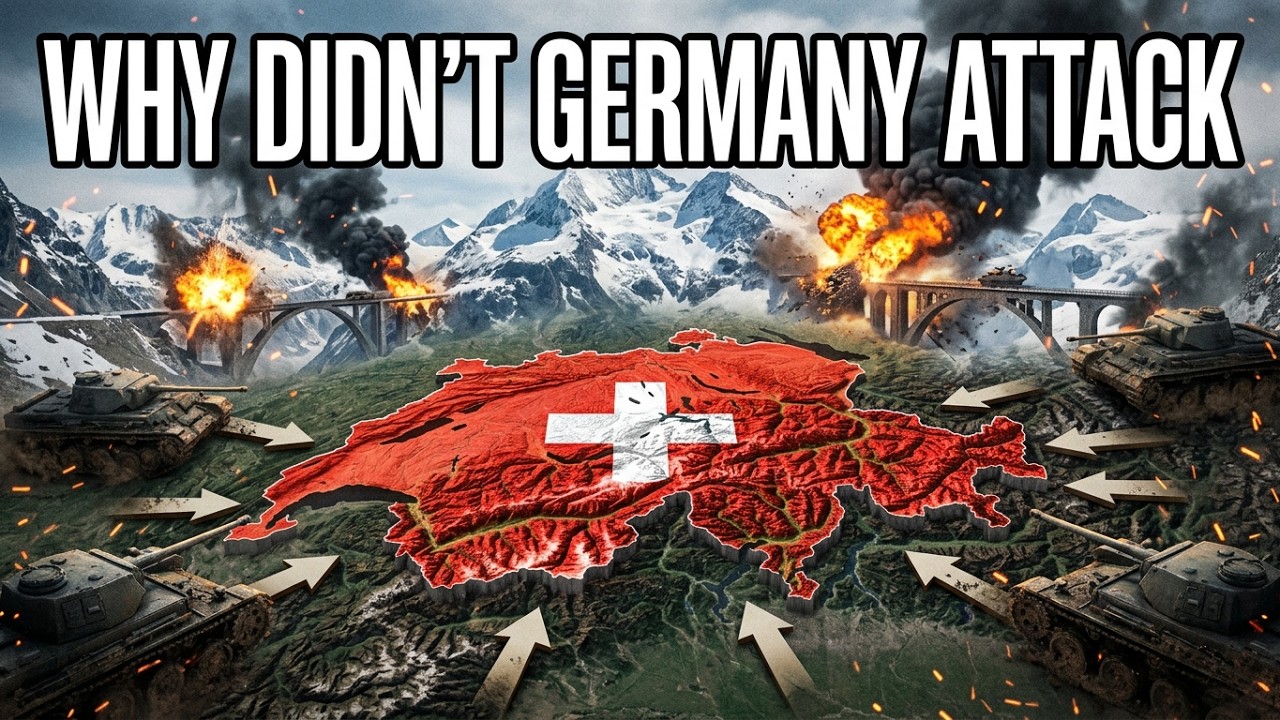
Switzerland kept its government, its army, and its independence. The explanation runs through mountain fortresses, railway tunnels, factories, banks, and decisions made far beyond the Swiss border. It also raises a harder question: what did surviving the war require, and who paid the price? The word most often used to explain Switzerland is neutrality.
The European powers formally recognized Swiss neutrality in 1815, after the Napoleonic Wars. Switzerland would remain outside wars between other states while defending its territory against their armies. That position offered a small country surrounded by larger neighbors a way to preserve its independence. But a declaration on paper depended on what other governments chose to do.
Europe in 1940 showed how quickly an aggressor could tear up such an agreement. Belgium and the Netherlands had tried to remain neutral, and German forces invaded both. Norway and Denmark had also been attacked. International recognition could never provide an automatic military shield.
If Germany decided to occupy Switzerland, its leaders would need more than a diplomatic protest. The country therefore practiced armed neutrality. Its willingness to stay out of the conflict existed alongside a willingness to fight anyone who brought war across the border. The challenge was making that promise convincing to an army that had just conquered France.
When war began in September 1939, Switzerland called up hundreds of thousands of men. Soldiers dug positions, laid obstacles, and guarded the approaches an invading force might use. The Rhine formed a natural barrier along parts of the northern frontier, but rivers required defending; bridges could become entry points. Switzerland’s militia system allowed a small country to mobilize a substantial force, but the men under arms were also workers, farmers, shopkeepers, and fathers whose absence affected the economy.
Every month of readiness carried a cost, even when no battle followed. Initially, Swiss commanders worried that German forces might cross their territory to get around French defenses. France’s defeat transformed that problem. Switzerland could no longer look west toward an intact major power resisting Germany on land.
German control extended along much of the west as well as the north, while fascist Italy stood to the south. If France could fall so quickly, how long could the Swiss army hold out? General Henri Guisan became the public face of Swiss resistance. On the 25th of July 1940, he gathered senior commanders at the Rütli Meadow beside Lake Lucerne, a location closely associated with Swiss independence.
The meeting sent a message that the army intended to fight. Guisan explained a defensive strategy built around the Alps, known in English as the National Redoubt. Its purpose was to preserve the ability to resist even if an enemy overran important parts of the country. Survival would depend on choosing where the army could sustain a defense.
The Alps contain steep slopes, narrow valleys, and routes that channel movement into limited corridors. An army advancing through that landscape faces a different problem from one crossing open ground. Vehicles need roads, supplies need reliable access, and heavy equipment must get through passes and tunnels. Defenders can concentrate on the places an attacker has to use.
Swiss planners intended to take advantage of those constraints, building on existing fortifications and expanding their preparations. There was a severe weakness at the heart of the strategy. Much of Switzerland’s population and industry lay outside the high alpine refuge. A withdrawal into the mountains could leave major towns, homes, and factories exposed to occupation.
For civilians on the plateau, the redoubt was hardly a promise that danger would never reach them. It represented a choice made under desperate circumstances: preserve an organized army capable of prolonged resistance, even if the defense of every community became impossible. The plan could make conquest expensive without making Switzerland invulnerable. The redoubt also protected something Germany and Italy valued: transport across the Alps.
Railway connections through Switzerland helped link the two Axis countries. Those routes depended on infrastructure that could be damaged far more quickly than it could be rebuilt. Swiss preparations included the demolition of important bridges and tunnels in the event of attack. This created a practical threat.
An invasion might give the Axis control of Swiss territory while destroying part of what made that territory useful. Germany could seize a tunnel entrance and still inherit a blocked passage. Guisan understood the importance of making resistance look credible. His public image was carefully managed, and his movements and photographs were subject to restrictions.
He also communicated Swiss intentions to foreign representatives. What an adversary believes can matter almost as much as the weapons available. An expectation of quick surrender produces a different calculation from the prospect of costly occupation and damaged transport links. Swiss leaders could not control the decision in Berlin, but they could influence the assumptions behind it.
The invasion threat was real enough to produce military plans. The best known became Operation Tannenbaum. German planning after the fall of France considered attacks on Switzerland, with Italian participation envisaged from the south. The Swiss army on the plateau would face powerful forces before a mountain defense could fully develop.
These plans demonstrate that neutrality did not place Switzerland beyond Nazi ambitions. They also require careful interpretation. Military staffs prepare options that are never executed, and a map covered with arrows is different from an order to begin a campaign. Tannenbaum tells us that an invasion was contemplated, but it does not by itself reveal one final explanation for why the German leadership never launched it.
The wider war is essential to that explanation. After France’s defeat, Britain remained in the fight. Germany devoted attention and resources to the struggle against it, while Hitler’s ambitions increasingly focused on the Soviet Union. The invasion of the Soviet Union in June 1941 opened an immense campaign in the east.
Fighting elsewhere also demanded troops, aircraft, equipment, and fuel. Invading Switzerland would have created another task, followed by the continuing demands of occupation. Germany’s decisions were made across an entire war with objectives that competed for the same resources. A small neutral country could remain threatened while repeatedly falling below other priorities.
Being within reach of an army was not the same as becoming its next objective. Switzerland also faced a threat that required no invasion at all. It depended heavily on supplies from abroad. Coal, fuel, industrial materials, and food had to move through a Europe dominated by war.
A mountain position could defend a road junction, but it could not manufacture an unlimited supply of everything a modern country needed. The Axis powers controlled crucial access routes and could apply pressure through trade. For Swiss officials, maintaining imports was a matter of keeping factories operating, transport moving, and households supplied. Their bargaining position was constrained by geography.
The same borders that could be defended with soldiers could also be closed to shipments on which civilian life depended. Inside the country, rationing made the pressure visible. Families needed coupons to buy staple goods, and officials worked to distribute limited supplies. A ration card provided permission to purchase an item; people still needed the money to pay for it.
The system reached deep into everyday routines, turning shopping and meal planning into exercises in careful accounting. Agricultural production was expanded and essential goods were stockpiled. These measures reduced vulnerability without eliminating dependence on the outside world. Swiss industry remained part of the European economy.
Companies produced machinery, tools, precision instruments, chemicals, and other goods that trading partners wanted. Germany was an important customer, and Swiss exports to the Axis included weapons and ammunition. These relationships provided employment and helped secure imports, but they also supplied a regime fighting a war of conquest. The legal position of private trade under neutrality was complicated, and Switzerland’s actions did not always remain within its obligations.
Economic survival, commercial opportunity, and political concession overlapped. It would be inaccurate to describe every factory order as freely chosen under comfortable conditions; it would be equally inaccurate to pretend that pressure removed every possibility of choice. Then there was gold. During the war, the Swiss National Bank conducted substantial transactions with Germany’s Reichsbank.
Gold could be exchanged for internationally useful currency, helping Germany pay for goods abroad. The problem was the origin of part of that gold. The Nazi state had plundered reserves from occupied countries, and Swiss purchases included looted assets. This was a documented part of wartime finance with consequences that continued long after the fighting ended.
In its later examination of the period, the Swiss National Bank acknowledged serious failures in how its wartime leadership assessed and responded to the issue. The transactions belong in any honest account of Swiss neutrality because they connected Swiss institutions directly to the economic machinery of Nazi power. Economic dealings were only one form of contact across the lines. Switzerland also performed diplomatic work for governments that had broken relations with one another.
As a protecting power, it could represent foreign interests and provide channels of communication that belligerents could no longer maintain directly. That work gave neutral territory a practical role in an increasingly divided world. Such usefulness contributed to the broader environment in which the country survived. It would be too simple to treat diplomatic services as a guarantee of safety, but they help explain why a neutral state could matter to several competing powers at once.
The same environment attracted intelligence services. Switzerland became a place where information could move through diplomatic contacts, personal relationships, and secret networks. Allen Dulles led an American intelligence operation there for the Office of Strategic Services, the wartime organization that preceded the CIA. Germany was close enough to investigate while Switzerland offered a base outside direct German occupation.
Other countries also operated intelligence networks on Swiss soil. Neutrality therefore coexisted with a hidden struggle over information. Nor did the border keep the air war away. Aircraft crossed Swiss territory, sometimes deliberately and sometimes through navigational error or damage.
Swiss pilots intercepted intruders, and clashes with German aircraft occurred during the fighting in 1940. These encounters created a dangerous problem for the leadership: defending sovereignty could escalate a confrontation with the much stronger neighbor surrounding the country. Later, the expanding Allied bombing campaign brought further incursions and emergency landings. Each incident required decisions about enforcement, rescue, and diplomatic protest.
On the 1st of April 1944, American bombers mistakenly attacked Schaffhausen. Forty people were killed. Buildings were damaged, families lost homes, and part of the town’s museum collection was destroyed. Weather and navigation failures had carried the aircraft away from their intended target area.
The United States acknowledged the error, and compensation followed. The bombing remains a stark reminder of what the phrase “staying out of the war” can hide. Switzerland escaped military occupation, yet its civilians could still die beneath the aircraft of a power fighting Nazi Germany. Foreign servicemen who reached Swiss territory faced another consequence of neutrality.
Under the rules governing neutral states, troops crossing into the country could be interned so they could not simply return to combat. That included soldiers escaping defeat and airmen whose damaged aircraft landed in Switzerland. Internment could provide safety from the battlefield, but conditions varied, and serious abuses occurred. The notorious detention camp at Wauwilermoos became a particular source of controversy.
For an Allied airman, surviving a dangerous flight and reaching Switzerland did not necessarily mean immediate freedom. For civilians fleeing persecution, reaching the border carried even greater stakes. Switzerland admitted many refugees during the Nazi era, including Jewish people whose lives were saved by finding safety there. It also refused entry to many others.
In 1942, Swiss authorities denied that racial persecution alone qualified a person for political asylum. Decisions made at border posts could determine whether a person escaped or was sent back toward persecution. Officials cited shortages, security, and the country’s capacity to absorb arrivals. Those explanations must be examined alongside the knowledge available to them and the consequences for the people they excluded.
There were Swiss people who chose to help despite official restrictions. Paul Grüninger, a police commander in St. Gallen, helped Jewish refugees find safety by falsifying documents. He lost his position and was prosecuted.
His story shows how a rule enforced by the state could be challenged by an individual who understood what its enforcement meant for human beings. In Budapest, Swiss diplomat Carl Lutz and others used protective papers and sheltered buildings to help Jews threatened by persecution and deportation. Their efforts saved lives on a large scale. As the war changed, Switzerland’s room for maneuver changed with it.
German defeats reduced the prospect of a quick Axis victory, while Allied pressure on Swiss economic relations became stronger. American and British officials pressed for restrictions on exports that supported the German war effort, and Switzerland reduced important categories of trade as the conflict approached its end. The shift illustrates how neutrality operated within changing power relationships. Policies presented as essential under one set of circumstances could be revised when those circumstances changed.
Germany’s defeat in 1945 ended the immediate invasion threat. Switzerland remained independent, but the end of the war opened difficult questions. The Allies sought the return of looted assets, and disputes over gold and German property brought Switzerland into difficult negotiations. Later, renewed attention focused on dormant bank accounts, the treatment of Holocaust survivors and their heirs, and refugee policy.
The Independent Commission of Experts, chaired by historian Jean-François Bergier, investigated Switzerland’s wartime conduct and published its final report in 2002. Its work brought together evidence about finance, industry, persecution, and official decision-making. The record was more difficult than a national success story. Military preparedness and humanitarian action existed alongside transactions and policies that deserved serious criticism.
So why did Hitler never invade Switzerland? The answer brings several explanations together while acknowledging that their relative importance remains debated. The Swiss prepared to make an attack costly. Alpine geography and threatened demolition complicated the possible rewards.
Germany pursued larger military objectives elsewhere. Economic and diplomatic relationships gave neutral Switzerland practical value. Swiss leaders also made concessions under pressure, sometimes with consequences that remain deeply troubling. No surviving document turns all of this into a neat equation.
What history can show is how those factors interacted across six years of danger, adaptation, and changing priorities. In 1940, the people guarding bridges could not know that the invasion plans would remain on paper. The families managing ration cards could not know when normal life would return. Refugees approaching a border could not know what answer they would receive.
Switzerland’s story holds courage, calculation, sacrifice, profit, rescue, and exclusion together. The mountains explain part of its defense. The decisions made around them explain the rest.