In a city where a wrong word could end a life, Rome perfected a stranger punishment: the destruction of a man’s entire existence, long after his heart stopped beating. The killing was only the beginning. The state could erase your family, your property, your legal identity, your reputation, your right to burial, and your right to be remembered as a Roman at all. This was a fate designed not merely to end a life but to unmake it completely.
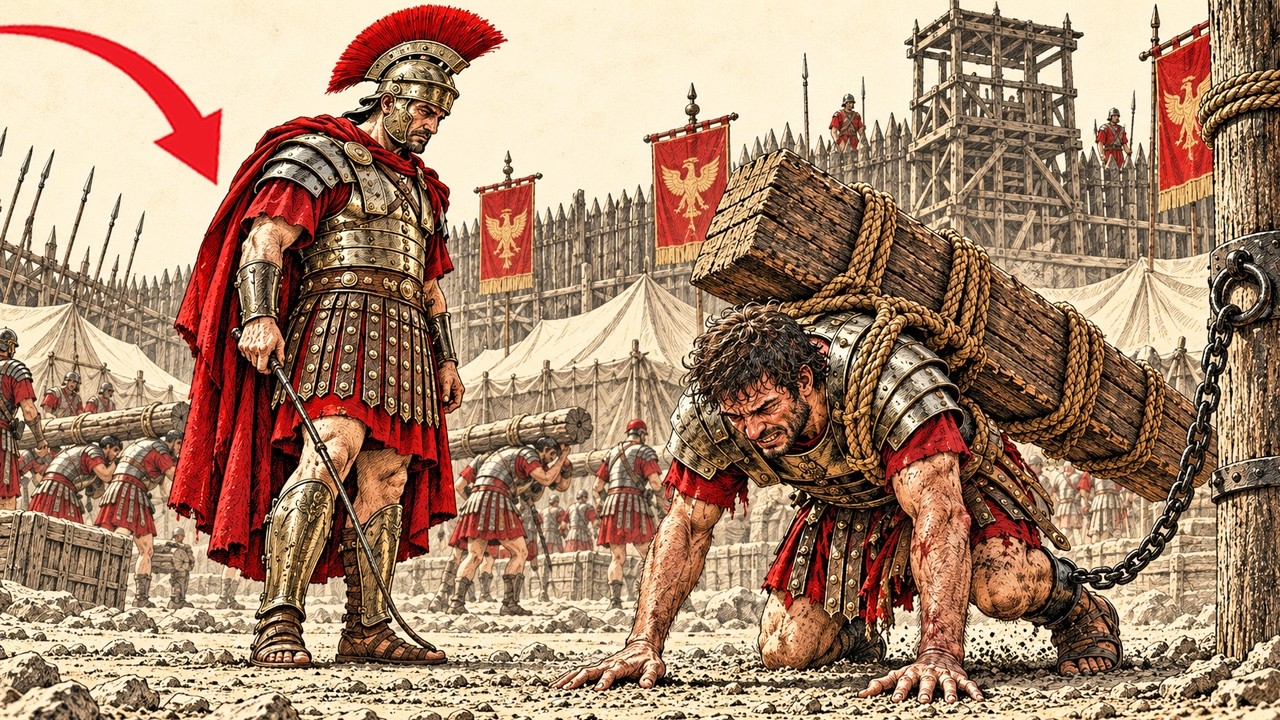
The foundations of this system lay in Rome’s earliest laws. In the mid-fifth century BC, the Twelve Tables, the founding legal code of the Republic, declared contact with an enemy a major crime. The charge was called perduellio, hostility toward the state, and it carried a brutal penalty. A convicted man was flogged and then hanged from a tree the Romans called the “unlucky tree,” a phrase laden with ritual pollution.
The death was a form of purification, not simple execution. Another ancient punishment involved hurling traitors from the Tarpeian Rock on the Capitoline Hill, turning the city’s own geography into an instrument of death. But the most distinctive early Roman punishment was a formula: aquae et ignis interdictio, the prohibition of water and fire. A condemned man was forbidden any water or flame within Roman territory.
Any Roman who provided them committed a crime, and any Roman who killed him was innocent. The man walked out of the city alive, but to the legal system he was already dead. His property was seized, his marriage dissolved, his children disinherited. Rome had discovered how to kill a man while his heart still beat.
This machinery evolved with the empire. The crime of maiestas, which originally meant the majesty and dignity of the Roman people, shifted under Augustus until the emperor’s dignity and the state’s were one and the same. Under Tiberius, insulting the emperor was treason. Rumors about his health, mutilating his statue, even carrying a coin bearing his image into a latrine could be treason.
The law expanded to cover any place a Roman might speak, write, or dream. It was enforced by the delatores, professional informers who were allowed to keep a share of any convicted man’s property. The system essentially placed a bounty on every wealthy Roman. The informer who dined at your table tonight could denounce you in the Senate tomorrow and own your villa by sunset.
In October of 31 AD, Tiberius, ruling from his villa on Capri, decided to destroy his most powerful servant, Lucius Aelius Sejanus. Sejanus commanded the Praetorian Guard and was, by every appearance, the second most powerful man in the empire. He controlled the soldiers in Rome itself, so a public arrest order might have sparked civil war. A trial would require evidence that might incriminate the emperor himself.
Tiberius wrote instead a single, deliberately ambiguous letter. Its tone shifted so subtly from praise to complaint to veiled accusation that no listener could tell whether it was leading toward reward or ruin. When the letter was read to the Senate in the Temple of Apollo, senators initially whispered congratulations to Sejanus. As the reading dragged on for hours, the mood changed incrementally.
By the time the final paragraph ordered his arrest, no one moved to defend him. The crowds that had gathered that morning to celebrate him watched him led away under guard by replacement troops. The man of the morning had become the enemy of the evening. Within hours, the Senate condemned him, and by nightfall he was dead, likely strangled in the Tullianum, the small stone prison beneath the Capitoline Hill.
But his death was only the first step. In the following days, Rome destroyed him with surgical precision. His corpse was dragged down the Gemonian Stairs to the Forum, where the same crowds that had cheered him that morning mutilated the body. It was then thrown into the Tiber River.
Roman law and religion held that proper burial, funeral rites, and the spoken name of the dead were essential to a person’s status in the afterlife and in the memory of the living. Being cast into the river without burial meant none of that. No funeral. No urn of ashes.
No name spoken at the family altar. His statues were toppled and their faces smashed. The Senate ordered his name erased from public records, inscriptions, and the official lists of magistrates. Modern archaeologists can still see the scars on surviving stone where his name was chiseled out.
His property was confiscated, and his family was destroyed. His son was killed. His young daughter, because Roman custom held that a virgin could not be executed, was violated by the executioner before her death. This is not legend; Tacitus records it with barely suppressed horror.
No member of the family remained to remember him favorably, and no property remained for his descendants to build upon. Beneath this elaborate machinery lay one of Rome’s strangest rituals. Around 91 AD, the emperor Domitian presided over a court of priests that condemned Cornelia, the senior Vestal Virgin, for breaking her vow of chastity. The Vestals were six priestesses entrusted with keeping Rome’s sacred flame burning; their purity was believed to guarantee the city’s survival.
A violation was treated not as a personal sin but as a public danger. The men accused with her were beaten to death in public. Cornelia’s punishment was different. Near the Colline Gate, at the edge of the city’s sacred boundary, lay the Campus Sceleratus, the Field of the Wicked.
There, a small underground chamber was excavated, containing a bed, a burning lamp, bread, water, milk, and oil. This was not mercy; it was theology. Roman religious law forbade burying anyone alive inside the city. By providing the condemned woman the basics of life, the state could claim it had not killed her.
She was carried there in a covered litter, sealed so tightly that passersby could not see, touch, or speak to her. She descended the short steps into the chamber. The high priest, in this case Domitian himself, raised his hands in prayer. The entrance was sealed shut, and earth was heaped over it.
The image, a lamp burning underground beside a living woman, in a city built around a different flame that must never go out, was the purest expression of Roman religious punishment. The city above saved its sacred fire by burying one beneath the ground. This multi-layered process of destruction was not unique to Sejanus. In 65 AD, after the Pisonian conspiracy against Nero, the jurist Gaius Cassius Longinus was condemned because he kept in his family’s ancestral hall the wax mask of his ancestor, Gaius Cassius, one of the men who had murdered Julius Caesar more than a century earlier.
A face from five generations past became political evidence against a living man. The pattern of killing the man, erasing the family, and smashing the statues was also applied to those whose only crime was their blood. Lucius Junius Silanus Torquatus, a young man descended from Augustus himself, was ordered to die simply because his lineage placed him near the throne. The same systematic damnation was applied in 205 AD to Gaius Fulvius Plautianus, another fallen commander of the Praetorian Guard.
His property was confiscated, his inscriptions were altered, and fragments of his statues still exist today in museums, their faces deliberately disfigured by the same chisel, the same project, the same seven-step erasure applied two centuries after Sejanus. The procedure had become institutionalized. The modern term for this cruelty is damnatio memoriae, damnation of memory. But the Romans did not call it that; they simply did it, stroke by stroke of the chisel, one shattered statue at a time, one erased line at a time.
The news of these events traveled through Rome in the specific, visible way the state had learned to make its violence travel. The Forum was the news. The physical fact of a statue standing one morning and gone the next, the empty space in a stone still standing in a public portico, was the message. The news that reached Rome in the days after Sejanus’s death was that the empire’s second most powerful man had been destroyed between breakfast and sleep.
His children were killed. His name was erased. His face was hammered off every stone that carried it. The message to anyone who might imagine themselves safe at the top of the pyramid was that there was no safety, only the emperor’s attention for a time.
And when that attention turned away, everything else turned away with it. There is one detail most people misunderstand about damnatio memoriae. It did not actually erase memory. The hammer marks on a statue tell you, two thousand years later, that someone powerful enough to deserve destruction once stood there.
The void left by the chisel where a name should be is itself a record, a signature left by the state. Sejanus’s name disappeared from the stones, but every scar tells us he was there. The empire did not erase him; it carved him deeper. The modern term for Roman cruelty is itself a monument to the thing it was meant to end.
The scar was always the message. Think of the chamber beneath the Colline Gate, the bed, the lamp, the bread, that careful little legal fiction performed over sealed stone. The Roman state did not kill that woman. The Roman state only built her a room.
That was the particular genius and the particular cruelty of what Rome designed: not to end a life, but to take it apart piece by piece, long after breathing had stopped. For a Roman, the cruelest punishment was never the one that ended in death. It was the one that never ended.