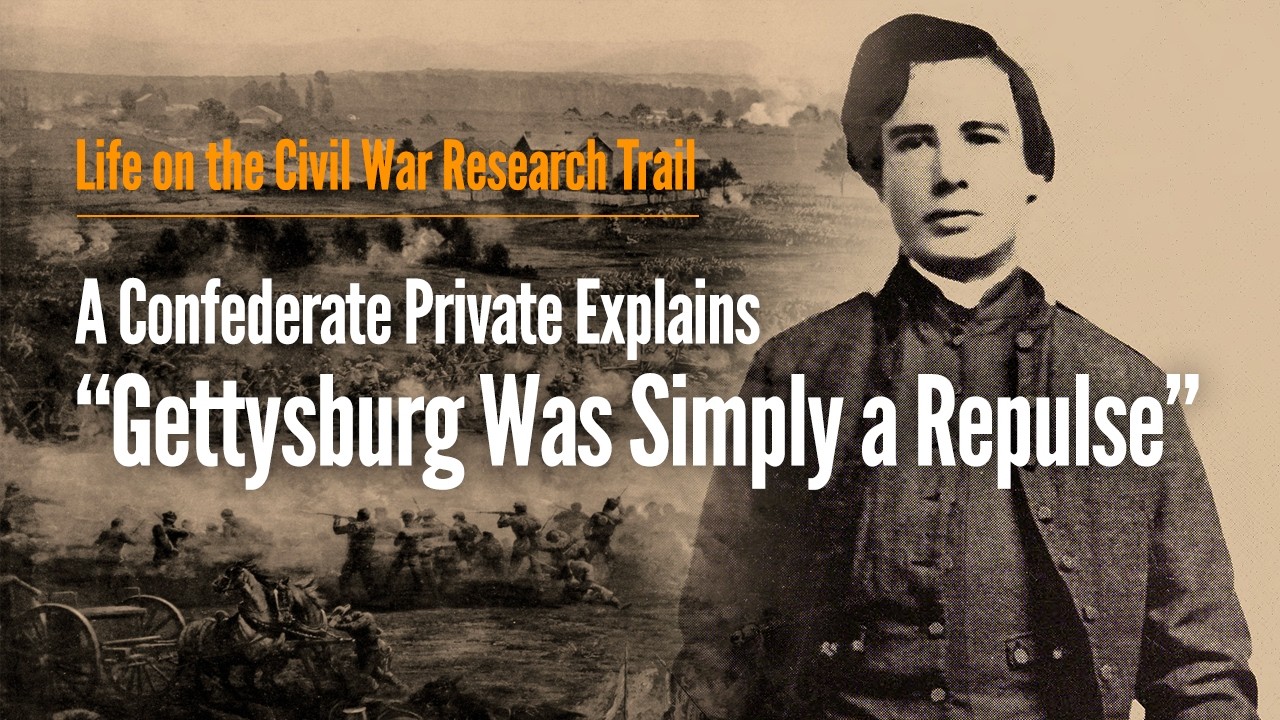
In the early twentieth century, as the last veterans of the Civil War faced their own mortality, a quiet but forceful voice emerged from the ranks to challenge the dominant memory of the war’s greatest battle. John Joseph Bowen, known to his friends as Joe, had served more than three years in the first company of the Richmond Howitzers, Virginia Light Artillery, from the Western Virginia campaign of 1861 to the fighting along the lines of Petersburg and Richmond in 1864. After his death in 1912, his short work, The Strategy of Robert E. Lee, was published, offering a perspective rarely heard in the flood of memoirs written by senior commanders.
It was the view of an enlisted man, one who had followed orders on the front lines, and he used that vantage point to argue aggressively that Gettysburg was neither the decisive turning point of the war nor the Confederacy’s best or last chance at independence. Bowen’s argument ran directly counter to the popular interpretation that the crossroads town in Pennsylvania marked the high watermark of the Confederacy. He contended that the books written by Lee’s general staff and biographers had created a false impression. According to Bowen, these works made it appear that Lee had planned the Gettysburg campaign to conquer Confederate independence on that field and that such independence was possible there.
Because Lee did not accomplish that alleged object, historians who relied on those books naturally concluded that Gettysburg was the fatal failure and the grand decisive battle of the war. Bowen rejected this narrative outright. He insisted that beyond employing his usual strategy, which was designed to limit the Army of the Potomac to the defense of Washington, Lee had no plan to conquer independence at Gettysburg. In Bowen’s view, the campaign was not a failure, and the battle was not decisive.
He called it a mere accidental incident of a successful campaign. Bowen supported his argument with a cold comparison of strategic realities. Lee, with seventy thousand men in the North, did not conquer Confederate independence in July 1863. But neither did Lincoln subdue the Confederacy with seventy thousand men in the South at the same time.
It took nearly two more years and nearly a million men to accomplish that. For Bowen, the exaggerated importance of Gettysburg rested on a mistaken view. Lee’s victories had been brilliant, but they were gained on the most conspicuous field, the one between Washington and Richmond, and that prominence obscured federal successes elsewhere. By the time of Gettysburg, the Federals had taken Norfolk and New Orleans, held the Mississippi from its source to its mouth except at Vicksburg, and controlled Kentucky and Missouri.
Grant’s operations and the navy on the Tennessee River had made Tennessee almost untenable for the Confederacy. Fort Pulaski had fallen, and with it, practically Savannah. The North possessed the largest navy afloat while the South had none worthy of the name. The Northern navy held Southern ports in an almost complete blockade, dominated the coast to the Rio Grande, and controlled all the rivers.
The fortunes of the Confederacy had waned everywhere from the first, except in Virginia. For Bowen, the true turning point came not at Gettysburg but in the Wilderness, when Lee found himself so comparatively weak that he was compelled to renounce his aggressive posture and act entirely on the defensive. That condition was decisive, and Bowen argued it would have existed just the same if Lee had defeated Meade at Gettysburg or if Gettysburg had never occurred at all. To emphasize his point, Bowen compared Gettysburg to the simultaneous disaster at Vicksburg.
Gettysburg, he said, was simply a repulse. Vicksburg was the loss of an army, complete with artillery and infantry arms so precious to the Confederacy, and the loss of a valuable strategic point. General Joe Johnston commanded the geographical department embracing Vicksburg and was empowered to use the entire resources at his command to save it. On the fifteenth of June, Johnston telegraphed the war department from Jackson, Mississippi, that saving Vicksburg was hopeless.
The secretary of war replied with alarm, declaring that Vicksburg must not be lost at least without a struggle. The interest and honor of the Confederacy forbade it. He relied on Johnston to avert the loss and urged him to hazard an attack if no better resource offered, possibly in concert with the garrison, but otherwise without, by day or night, as he thought best. On the twenty-first, the secretary wired again, expressing his conviction of almost imperative necessity for action.
He admitted great deference for Johnston’s judgment and military genius but felt it right to share, if need be, to take the responsibility and leave Johnston free to follow the most desperate course the occasion might demand. The eyes and hopes of the whole Confederacy were upon him, the secretary wrote, with the sentiment that it were better to fall nobly daring than through prudence even to be inactive. Bowen noted pointedly that there was never such anxiety over Gettysburg. Bowen then turned to Lee’s own words to establish the actual object of the Gettysburg campaign.
In a letter to Secretary of War Seddon, dated Culpeper Courthouse, June 8, 1863, Lee stated explicitly that there was nothing to be gained by the army remaining quietly on the defensive, unless it could be reinforced. He acknowledged the difficulty and hazard of taking the aggressive with so large an army in his front, entrenched behind a river where it could not be advantageously attacked. Unless the enemy could be drawn out into a position to be assailed, it would take its own time to prepare and strengthen itself, renew its advance upon Richmond, and force Lee’s army back within the entrenchments of that city. That might be the result in any event, Lee admitted, but he thought it worth the trial to prevent such a catastrophe.
If the department thought it better to remain on the defensive, guard all avenues of approach, and await the enemy, Lee was ready to adopt that course. He needed only to be informed. For Bowen, this letter proved that Lee did not expect to conquer independence at Gettysburg and was not even sure he could avoid being forced within the entrenchments at Richmond. The forward movement was ordered to avert that catastrophe, not to win the war on a single field.
Bowen also cited General Hunt, who observed that Lee’s operations indicated either a contempt for his opponents or a belief that the chronic terror of the war department for the safety of Washington could be safely relied upon to paralyze the enemy’s movements, or both. On no other hypothesis, Hunt argued, could one account for Lee stretching his army from Fredericksburg to Williamsport while his enemy was concentrated on one flank and on the shortest road to Richmond. In the end, Bowen’s voice was one of many in an era when old veterans sought to reunify the country as it healed from four years of strife. His defense of Lee supported the rising Lost Cause narrative of the war, but it came not from a commanding general protecting his legacy.
It came from a gunner in the ranks, a man who carried his own memories of the front lines and who insisted that the true history of the war should not be reduced to a single accidental afternoon in Pennsylvania. For Bowen, the Confederacy’s fate had been sealed long before, in the Wilderness, by the vast weight of Northern resources that no tactical victory could overcome. Gettysburg, in his telling, was not the moment the war was lost.
It was merely one repulse in a war that had already been decided by the slow, grinding power of an enemy the South could never match.