On the morning of July 14, 1978, five-year-old Ruth Voss drew her father a picture of a horse. Gerald Voss folded it carefully, slipped it into his shirt pocket, and told his wife he had an errand after work. He would be home before dark. He never was.
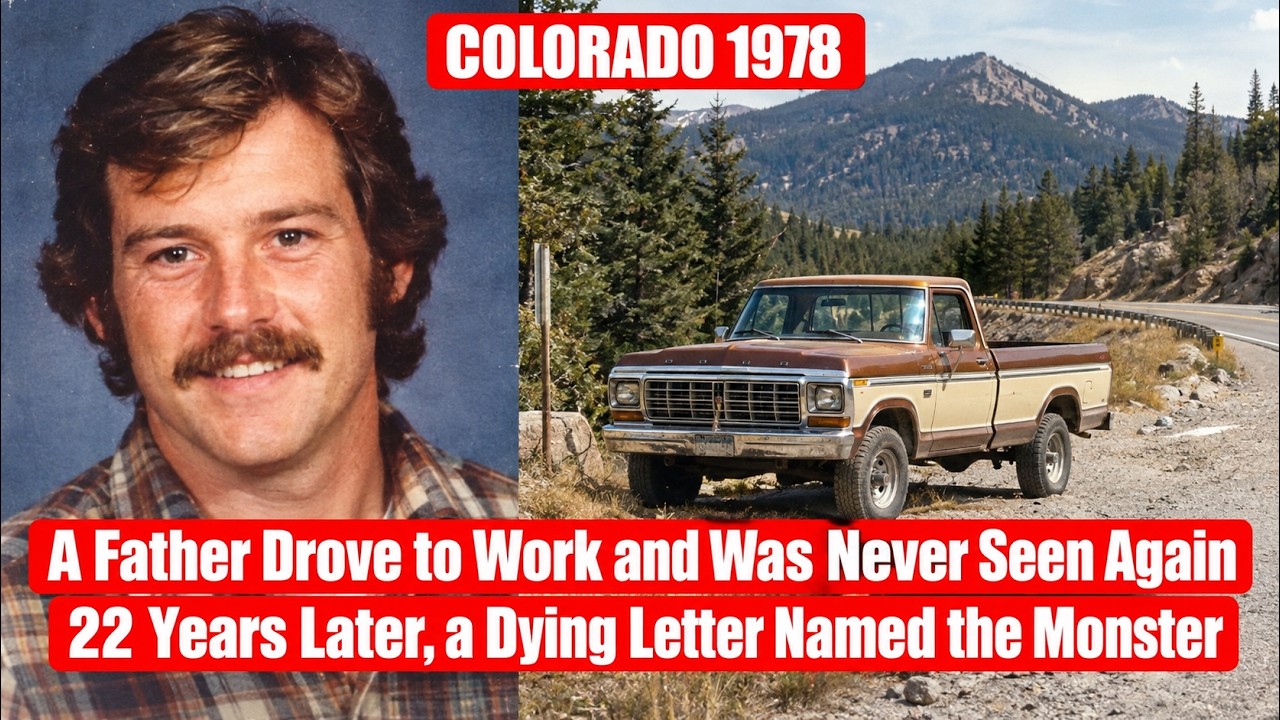
Voss was thirty-four years old, a Vietnam veteran, a father of three, and a foreman at the Creekide Timber Yard in the small mountain town of Ridgemont, Colorado. He had never missed a day of work. At 4:38 in the afternoon, he clocked out, said good night to his crew, and drove north on Highway 9 in his 1972 Ford F100. Two witnesses saw him leave.
That was the last confirmed sighting of Gerald Voss alive. When he did not return home by 7:15 that evening, his wife Diane drove the route he might have taken. At 7:40, she found his truck parked at a pulloff near the Gosh Creek Bridge, about four miles north of the timber yard. The driver’s door was unlocked.
His wallet, with his identification and twelve dollars in cash, sat in the glove compartment. His keys were on the seat. His hard hat was in the truck bed. The seat showed no sign of a struggle.
A CB radio mounted to the dash was switched on, but silent. Diane called the Mesa County Sheriff’s Office from the pay phone at the Ridgemont gas station at 7:53 p. m. Deputies arrived by 8:20.
The following morning, roughly thirty volunteers from the community searched a two-mile radius around the pulloff. They found nothing. There was one detail that never made it into the initial report. Bert Callaway, the owner of the gas station at the end of Garnet Road, told Diane the following week that he had seen Gerald’s truck pass the station heading north.
Behind it, close, was a dark sedan he did not recognize, a vehicle that did not belong to Ridgemont. Callaway said he had told the deputies too. The detail does not appear in the 1978 case file. The investigation was handled by Detective Ronald Puit of the Mesa County Sheriff’s Office, a cautious man who had spent most of his career working property crimes.
He interviewed twenty-three people in the first week. He took statements from everyone at the timber yard. He ran background checks on two co-workers, one with a prior assault charge and another who had recently argued with Gerald over a shift schedule. Both were interviewed twice.
Puit could not disprove either man’s account. By the end of August 1978, six weeks after Gerald vanished, Puit filed a three-page preliminary report. It noted the absence of evidence of foul play and raised the possibility of voluntary departure. There was no known life insurance policy, no evidence of marital trouble, no sign of criminal activity in Gerald’s background.
The case was quietly closed. Diane Voss was forty-seven words into the report when she put it down. She called her sister and said her husband had not left his family. Men who leave their families, she said, do not carry a child’s drawing in their shirt pocket.
The community responded the way small mountain towns do, with casseroles first and then with distance. The search parties dissolved. Conversation at Pette’s Diner shifted back to elk season, the school board vote, the price of diesel. People were not unkind.
They simply could not sustain an emergency that refused to resolve itself. Diane filed a missing person report. She contacted the FBI field office in Denver. She wrote letters to the Colorado Bureau of Investigation.
The responses were polite and non-committal. She kept a journal of every call and every reply. By the end of 1979, it had thirty-eight entries. Not one contained new information.
Puit retired in 1983. The case was transferred to a storage room where cold cases were kept in manila folders behind a shelf of decommissioned radio equipment. Nobody assigned to the case after Puit ever interviewed a new witness. Nobody submitted the CB radio or the truck’s interior for forensic review.
The file sat in its box, and the years accumulated. By 1985, Karen, the oldest daughter, was seventeen. She had no memories of the investigation, only of its absence, of her mother’s phone calls, of the way the house felt every July 14th. By 1990, all three daughters had left Ridgemont.
Karen was married in Denver. Linda lived in Albuquerque. Ruth, the youngest, the one who drew the horse, was finishing her degree at the University of Colorado. Diane stayed in the house on Garnet Road.
She aged the way grief ages people, steadily, settling deeper into her face and hands each year. She kept Gerald’s coffee mug on the left side of the cabinet. She kept the faded reward poster pinned to the bulletin board at Pette’s Diner. Nobody took it down.
Bert Callaway closed his gas station in 1989 when his wife’s health declined, and moved to Grand Junction. He had told exactly one person about the dark sedan, Diane, and one investigator who wrote nothing down. He never stopped thinking about it. Then, in the spring of 2000, a letter arrived at the Mesa County Sheriff’s Office, postmarked from a hospice facility outside Grand Junction.
It was written in the shaking hand of a dying man named Albert Norris, seventy-one years old, diagnosed with lung cancer four months earlier and given six weeks to live. The letter was addressed to the Cold Case Division by name. Detective Sandra Fitch, twelve years with the department, had inherited a portion of the cold case backlog and was working through it methodically. She read the first page of Norris’s letter standing at her desk.
She sat down for the second. Norris wrote that in the late 1970s he had worked as a contract laborer doing earthwork for a land development company owned by a man named Douglas Harl, a developer out of Montrose. Harl had been in a prolonged dispute with Gerald Voss over a land access easement along the northern boundary of the Creekide timber property. Voss, as foreman, had been the point of contact for the timber yard’s legal team and had filed a formal objection to Harl’s construction permit the previous spring.
The objection had cost Harl his construction timeline and a significant financial penalty. In July 1978, Norris wrote, Harl paid him and another man named Cleat Warshaw to follow Voss after his shift and confront him. What began as a confrontation did not end as one. Voss was struck, fell, and did not rise.
Norris and Warshaw carried his body into the treeline above Gosh Creek and buried him under a shelf of shale. Norris described the location in detail, including a distinctive double-trunked ponderosa pine visible from the road. He included a hand-drawn map. He included Harl’s full name and last known address.
He wrote that he had lived with this for twenty-two years and could not die with it. Detective Fitch called the coroner’s office before she called her supervisor. The search team reached the location on the morning of March 16, 2000. The double-trunked ponderosa pine was still there, older and wider, but unmistakable.
Beneath eight inches of accumulated soil and a shelf of shale that had partially collapsed over two decades, they found the remains of Gerald Voss. He was still wearing the clothes his wife had described in her original 1978 report. In his shirt pocket, beneath a corroded snap button, was a folded piece of paper that had survived in the dry shale. The ink was gone.
The crayon had not. Ruth’s horse, faded almost to nothing, was still there. Douglas Harl was located in Tucson, Arizona, where he had been living under his own name since 1989. He was seventy-four.
He was arrested on March 22, 2000, on charges of first-degree murder. Cleat Warshaw had died of a stroke in 1994 and could not be charged. Harl was extradited to Colorado in May. Albert Norris died in the hospice facility in Grand Junction nine days after mailing his letter, before he knew Gerald had been found.
Detective Fitch later confirmed the letter arrived on the same day Norris passed away. He had written it on the last morning he was well enough to hold a pen. Douglas Harl pleaded guilty in November 2000 to first-degree murder and was sentenced to life in prison without the possibility of parole. He made no statement at sentencing.
He looked at no one. Diane Voss was sixty-three when she received the call from Detective Fitch. Karen drove through the night from Denver. Linda flew from Albuquerque.
Ruth drove from Boulder. The four of them sat together in the house on Garnet Road and waited for whatever would come next. Gerald was buried in the Ridgemont Community Cemetery, beside the plot Diane had held for herself since 1979. She had bought it the year after he disappeared because she had decided that wherever she ended up, she wanted to be next to him.
The only accounting Douglas Harl ever gave the world was a guilty plea that lasted four minutes in a Montrose County courtroom attended by Diane and all three of her daughters, by Detective Fitch, and by Bert Callaway, seventy-four years old, who had driven four hours from Grand Junction to be present. He had told someone about the dark sedan in 1978, and nobody had written it down, and he had never forgiven himself for not doing more. Gerald Voss was thirty-four years old on the morning he drove north on Highway 9 and did not come home. He had survived Vietnam.
He had built a house with his hands. He had checked on his daughters every night he was home. He had a wife who spent twenty-two years refusing to let the world forget his name. He had a daughter who drew him a horse, and he had put it in his pocket, and it was still there.
The man who took all of that lived freely for twenty-two years. He spent the rest of his life in a Colorado correctional facility. He never explained himself. He never expressed regret.
What Diane Voss carried for those twenty-two years was not rage or bitterness. It was the simple insistence that her husband was real, that his life had mattered, and that the truth about what happened to him had not disappeared just because the people responsible wanted it to. That insistence is the only reason Gerald came home.