The last week of August 1971 had been one of those Iowa summers that settled into the land like something permanent, the kind of heat that did not lift at night and turned the cornfields along Route 18 into walls of dark green. The town of Calverton had been celebrating its centennial all summer, with banners on the lamp posts and a photograph of the original Main Street in the hardware store window. The Labor Day picnic was three days away, and Meredith Ann Folger had already written her name in the sign-up book at Harlan’s Hardware: Meredith Folger. Potato salad.
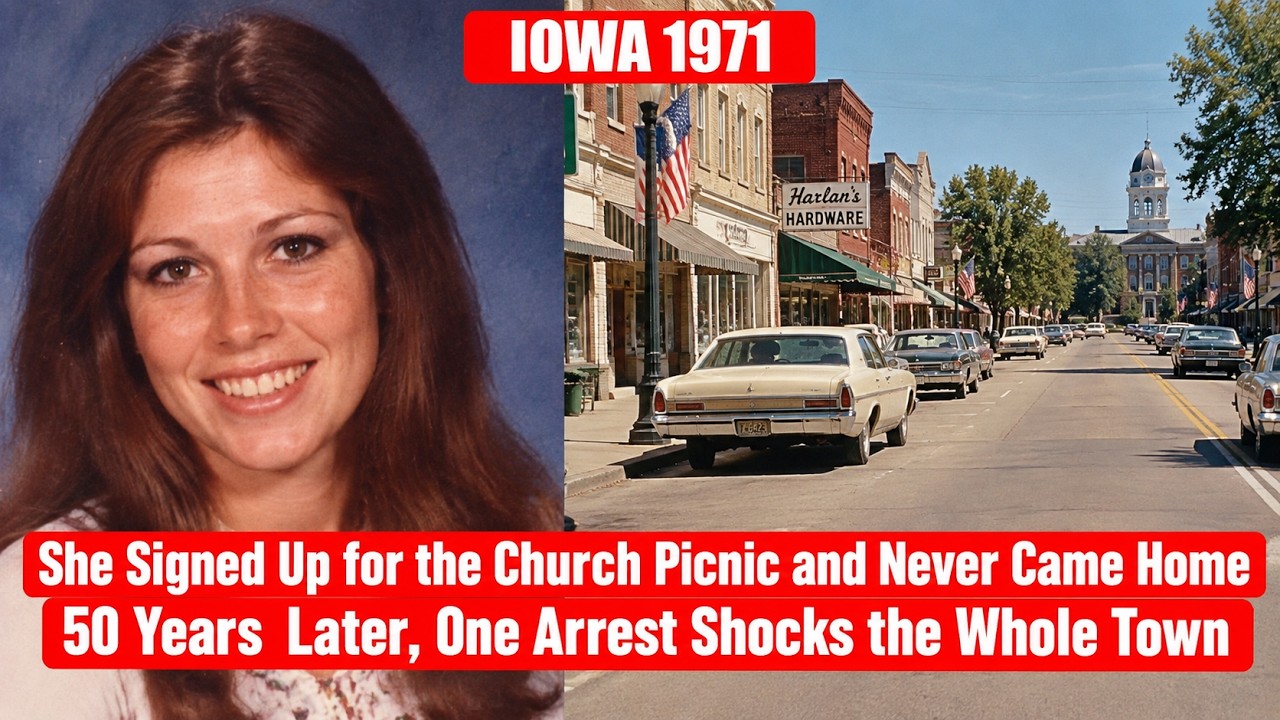
The mustard and celery seed version her mother had taught her, which had won the church auxiliary competition two years running. She was 28 years old, had taught third grade at Calverton Elementary for four years, and drove a 1968 Ford Fairlane the color of cream. She kept animal crackers in the glove compartment because she believed a small treat could fix most of what a school day broke. On the evening of August 28th, 1971, Meredith drove to the Calverton Consolidated School to pick up a box of art supplies she had left in her classroom: construction paper, paste, and a new set of safety scissors for the fall semester that started in six days.
A neighbor, Earl Pitts, saw her Fairlane pull into the school parking lot just after seven in the evening. He noted it because the school was empty in August, and Meredith waved at him from the driver’s side window the way she always waved at everyone, like it was something she meant. He waved back. He went inside for supper.
He was the last person in Calverton to see Meredith Folger alive. Meredith had grown up in Calverton, one of three daughters raised by Glenn and Norma Folger on a farm at the north end of the county. She was the middle child, steady, her mother always said, the one you could count on to be exactly where she said she’d be at exactly the time she said she’d be there. She had attended Calverton Elementary herself, gone four years to the University of Northern Iowa, and come back to her hometown not because she lacked options, but because she had considered them and decided that what she wanted was here: a classroom, a community she knew.
She lived in a small house on Birch Avenue rented from a widow named Opal Crest, who called Meredith the best tenant she had ever had. She had a cat named Almanac and a vegetable garden along the south fence. She had a standing Friday evening arrangement with her two closest friends involving pot roast and gin rummy, uninterrupted for two years. That spring she had applied to become the Calverton Elementary Curriculum Coordinator, and the superintendent, Harold Voss, had told her privately that she was the strongest candidate.
The appointment was scheduled to be formalized in September. In six days, her third graders were going to walk into room 7 and find construction paper and safety scissors and a teacher who knew all their names before they sat down, because Meredith memorized her class lists every August and practiced the names until they were automatic. None of that happened. When Meredith hadn’t called her mother by nine that Saturday night, Norma Folger began calling the house on Birch Avenue.
By ten-thirty, Glenn Folger was driving toward town. By midnight, Calverton Police Chief Bud Raymer had been reached at home, and by one in the morning, two officers were at the elementary school with flashlights. The cream-colored Fairlane was still in the parking lot. The box of art supplies was on the passenger seat.
The driver’s side door was unlocked. On the asphalt beside the rear bumper, one of Meredith’s shoes, a tan flat, the left one, lay on its side as if it had simply fallen off. Her body was found at 7:40 the following morning in the drainage ditch behind the school’s maintenance shed. She had been strangled.
The time of death was estimated between 7:30 and 9:00 the previous evening. The murder hit Calverton, a town of two thousand, not just with grief but with a specific bewildered fury at the violation of a world people had believed was safe. The school was on the main road. Somebody had done this within a few hundred yards of houses where people were eating supper, and nobody had heard anything, and nobody had seen anything except Earl Pitts, who had seen nothing at all except a wave.
The investigation was led by Chief Bud Raymer, a deliberate man in his late forties who had grown up in Calverton and took the murder as close to personal as a law enforcement officer could take something. He brought in the Iowa Division of Criminal Investigation within 48 hours. Agent Roy Stillman arrived from Des Moines, reviewed the scene, and began the systematic work of interviewing everyone connected to the school. There was physical evidence: a partial boot print in the soft earth near the maintenance shed, a torn piece of denim fabric caught on the chain-link fence behind the building, dark blue and consistent with work pants, and a single blonde hair, not belonging to Meredith, recovered from her coat collar.
Then there was what Stillman found when he began working through the list of people with keys to Calverton Elementary. The list was short. The principal had a key. The two custodians had keys.
The superintendent had a key. The night custodian, a man named Carl Veeder, who had worked at the school for eight years, had a key. He had no alibi for the window between seven and nine that evening. When interviewed on September 1st, 1971, he gave an account of his movements he could not support with any witness.
He said he had been home alone. He said he didn’t go out that night. He said he didn’t know anything about it. Carl Veeder was 41 years old, a quiet man known primarily by his function: the one who mopped the floors, changed the light bulbs, and got the boiler running every October.
He had a prior misdemeanor from 1964 for a bar altercation, nothing more serious. He drove a dark blue pickup truck. He wore dark blue work pants. He was interviewed three times and never changed his account.
Agent Stillman wrote in his case notes that he believed Veeder knew more than he was saying, that the absence of an alibi was troubling, that the truck and the pants were consistent with the physical evidence, and that the key gave him means and the empty school gave him opportunity. What he lacked was a thread that tied it all together tightly enough to take to a prosecutor. He never found that thread. Not in 1971.
Not when he checked back in 1977. Not when the Iowa DCI reviewed the file in 1984. Carl Veeder continued working at Calverton Elementary until he retired in 1989. He attended the retirement party held in his honor in the school gymnasium.
The principal gave a short speech about his years of service. There was cake. People shook his hand. Norma Folger, still living on the farm at the north end of the county, did not attend.
Over the years, Meredith’s youngest sister, Barbara Folger Cade, took over the responsibility of following up on the case after her mother’s health declined. She wrote to the Calverton Police Department every year on August 28th, the anniversary, asking if there was anything new. The answers were polite and offered nothing. She wrote to the Iowa DCI in 1993 and again in 1998, receiving the same polite nothing.
Norma Folger died in 1997 without knowing who had killed her daughter. Glenn Folger had died in 1988. Between them, they had lived with the question for a combined 34 years. By 2001, thirty years after the murder, the denim fabric from the fence and the hair from Meredith’s coat were still in the evidence room at the Calverton Police Department.
A new chief, Dennis Foley, reorganized the storage in 2003 and made sure the Folger evidence was properly documented and preserved. He had been five years old when Meredith Folger was murdered and had heard about it his whole life, the way children in small towns hear about the things that happened before they understood what things like that meant. By 2005, Carl Veeder was 75 years old, retired for 16 years, and still living in Calverton. He had outlived Agent Roy Stillman, who died in 2002, and Chief Bud Raymer, who died in 1999.
He had been to both of their funerals. He was still the only person who knew exactly what had happened in the parking lot of Calverton Elementary on the evening of August 28th, 1971. The case had been cold for exactly 50 years when the Iowa Cold Case Unit opened Meredith Folger’s file in the summer of 2021. The partial boot print was analyzed but too degraded to yield new information.
The hair recovered from Meredith’s coat, however, had been stored in a sealed evidence envelope in conditions that had, by luck and Dennis Foley’s 2003 reorganization, kept it intact. In August of 2021, it was submitted to the Iowa Division of Criminal Investigation Laboratory for mitochondrial DNA analysis, a technique that extracts genetic material from the shaft of a hair when the root is absent, reading a specific inherited sequence that can be matched to maternal relatives. The profile generated from the hair could not produce an individual identification on its own, but it was uploaded to genealogical databases. It flagged potential maternal line relatives in Iowa and Illinois.
The genealogist assigned to the case worked for eleven weeks building family trees from those matches. In November of 2021, she arrived at a cluster of relatives that converged consistently on a single maternal line rooted in eastern Iowa. The line led to a man who was 91 years old and had lived in Calverton, Iowa, for his entire life. Cross-referencing the name against the original case file, she found Roy Stillman’s 1971 interview notes, the three transcripts, and his notation: Veeder, no alibi, consistent physical profile, unable to establish evidentiary link.
In January of 2022, a buccal swab was collected from Carl Veeder during a routine wellness visit at the Calverton Medical Clinic, coordinated through the clinic with legal authorization the subject was not informed of. The mitochondrial DNA profile extracted from the swab matched the hair recovered from Meredith Folger’s coat to a degree the laboratory described as conclusive within the limits of mitochondrial analysis. A family member, interviewed after the arrest, confirmed that Veeder’s mother, deceased, had been the source of the mitochondrial line. The arrest took place on a Thursday morning in March of 2022, 50 years and seven months after Meredith Folger’s murder, on the front porch of the house Veeder had lived in for most of his adult life.
He was 91 years old and used a walker. Special Agent Lena Marsh and two Calverton officers approached him while he sat in his porch chair in the early morning. The Calverton Elementary School was visible from where he sat, as it had been for 50 years. When Agent Marsh identified herself and read him the charge, Carl Veeder looked at her for a long moment, looked at the school down the street, and looked back.
He did not ask how they had found him. He did not deny anything. He said, in a voice that had gone thin with age but was steady, “I’ve been looking at that school for 50 years. ” He said nothing else.
The DNA evidence was presented to the Wapello County District Attorney, who filed charges of first-degree murder. The denim fabric from the fence, subjected to updated fiber analysis, was confirmed consistent with work pants of the type Veeder had worn during his employment. The response in Calverton was not the shock of a stranger’s guilt, but the specific, layered devastation of a community realizing that the answer had been among them the entire time: at the school gymnasium retirement party, at the funerals of the men who had investigated the crime, on the porch of a house visible from the school parking lot where it had happened. Carl Veeder had waved at people from that porch.
They had waved back. Barbara Folger Cade, 73 years old and living in Cedar Rapids, received the call from Agent Marsh on the morning of the arrest. She had written her annual letter to the Calverton Police Department seven months earlier on August 28th, 2021, the 50th anniversary, and had received the usual polite reply. She sat down when Marsh told her the name.
She had thought about Carl Veeder across the years. Her parents had thought about him. But she had told herself it was unfair to believe something without proof. She had spent 50 years being fair.
Carl Veeder was deemed competent to stand trial after a judicial evaluation. His attorney negotiated a plea agreement in the fall of 2022. He pled guilty to murder in the second degree and was sentenced to life in prison. He died in the Iowa Medical and Classification Center 11 months after his sentencing at the age of 92.
He never explained why. He never said what had happened in that parking lot on the last evening of August 1971. He left no statement, no letter, nothing that could answer the question Barbara Folger Cade had carried for 50 years, the question her parents had carried until they died. He took the reason with him, and Calverton was left with the fact of it instead.
Meredith Ann Folger was 28 years old. She memorized her class lists every August so she knew all 30 names before the children sat down on the first day. She kept animal crackers in her glove compartment. She grew oversized zucchini she didn’t entirely know what to do with and gave most of it away to her neighbors.
She had written her name in the sign-up book for the Labor Day picnic with the particular care of someone who took small commitments seriously, because she understood that communities were built from the accumulation of those small commitments, one potato salad at a time. She did not make it to the picnic. The sign-up sheet still had her name on it when they took it down. The man who killed her attended the retirement party in his honor in her school gymnasium.
He ate the cake. He shook the hands. He drove home and went to bed and got up the next morning and the morning after that, for 33 more years, while her parents wrote letters and Barbara waited for answers and the evidence room held a single blonde hair in a sealed envelope through three decades of everything. That hair outlasted him by 11 months.
What the case answers definitively is the thing Barbara Folger Cade had refused to give up on: not the why, not the full weight of accountability, but the who. After 50 years, the name. After 50 years, the end of the question that had outlived her parents and consumed five decades of August anniversaries and gone unanswered through every polite letter and every polite reply. Justice found Meredith Folger after 50 years.
These stories exist because someone kept asking, and because the science eventually caught up with what the asking deserved.