On the night of October 27–28, 1864, a twenty-one-year-old lieutenant crouched at the stern of a thirty-foot wooden boat, one hand on the tiller, the other resting on a rope that would, within minutes, either end the greatest naval threat on the Carolina coast or end his life. The darkness was absolute. The boat carried fourteen men and an experimental explosive charge eight miles up an enemy river. William Barker Cushing had been expelled from the Naval Academy three years earlier.
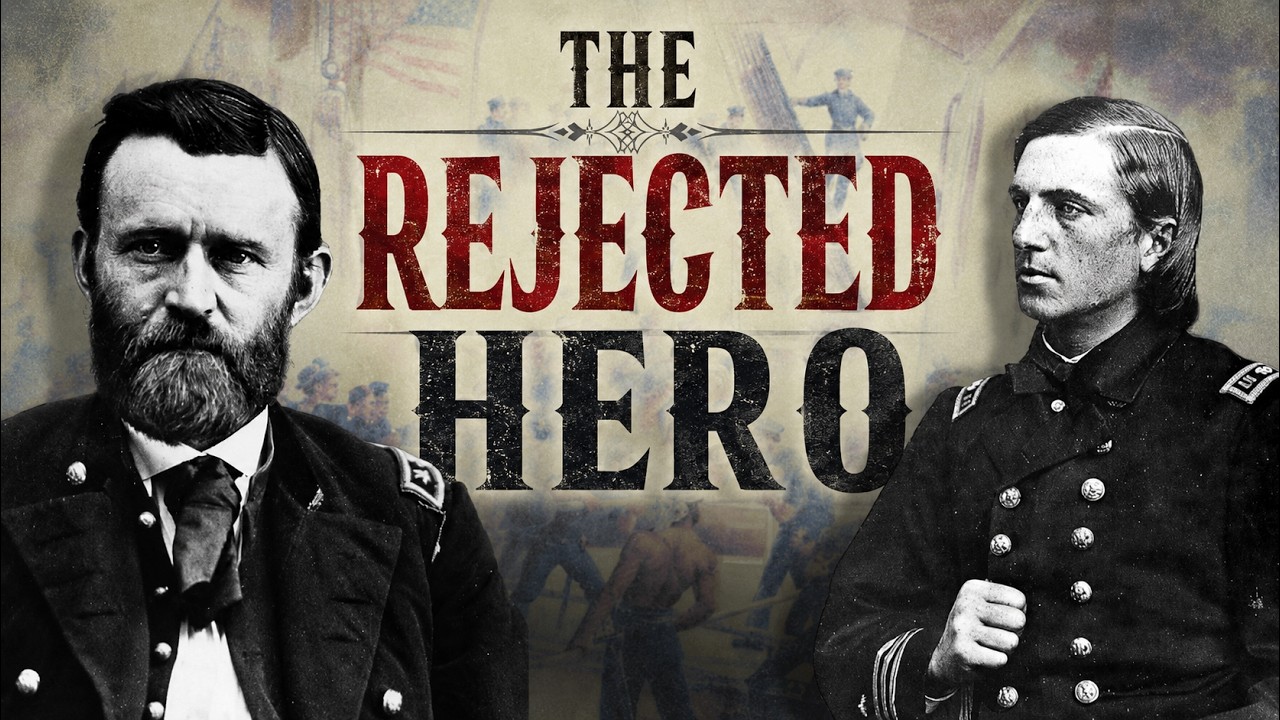
Tonight he intended to prove the institution catastrophically wrong about what he could do. Somewhere ahead, invisible in the black water, lay the CSS Albemarle, an armored Confederate ram so formidable that its mere presence had reshaped the entire region’s war. Surrounded by defensive chains, logs, barriers, and watchers, the ironclad had defied every conventional attempt to destroy it. While Grant ground down Lee’s army at Petersburg, this single ship had stalled Union strategy in North Carolina.
A young man in a wooden boat with an experimental torpedo was about to attempt what traditional strategy could not achieve. He had already decided that survival for the next half hour did not matter. The path to this moment began in Fredonia, New York, in 1847, when Cushing’s father died, leaving his widow Mary with four sons, two daughters, and little income. She moved the family east to Fredonia, where relatives could help.
The two eldest sons responded to the loss in opposite ways. Alonzo, the older surviving son, channeled his grief into discipline, destined to become a soldier who stood firm because institution and cause demanded it. William chose a different kind of duty, more restless, more questioning, more determined to chart his own course rather than have it drawn for him. Both answered the call of duty, but in fundamentally different languages.
Even as a boy, William refused to engage with things the way schools demanded. Teachers agreed he was exceptionally intelligent, reading everything available, but he simply rejected learning on anyone else’s terms. In 1857, at age fourteen, he received an appointment to the United States Naval Academy at Annapolis. What most boys would have called the opportunity of a lifetime, Cushing treated as a larger stage with more people to resist.
He excelled at navigation, reading winds and currents instinctively, but formal lectures bored him physically. And in William Cushing, boredom quickly became rebellion. In his fourth year, during a monotonous lecture, Cushing opened his notebook and drew a sharp caricature of Professor Edward Roger with unmistakable donkey ears. He did not hide it.
By the time the drawing reached three rows, half the class was suppressing laughter. The caricature itself was not the remarkable part. The remarkably bold part was doing it openly, with near-exhibitionist disregard for consequences, as if the true goal was forcing the institution to admit it could not actually control him. For four years he had walked the edge of the two-hundred-demerit line, always retreating moments before automatic dismissal.
This was different. This was a young man testing precisely how much rope the institution would give him before hanging him with it. In March 1861, the academy’s formal verdict arrived. The record read: methodical, dutiful, poor in Spanish, irregular study habits, generally bad conduct, not well prepared for naval service.
Cushing resigned under institutional pressure months before graduation, dismissed not for any single incident but for a pattern: four years of friction, chronic behavioral problems, and a final institutional judgment that he was fundamentally unfit to be a subordinate naval officer. He returned home to Fredonia with nothing but a reputation as a brilliant troublemaker. For most men, that would have been the quiet end of the story. William Cushing came home to wait.
Six weeks later, on April 12, 1861, Confederate guns opened fire on Fort Sumter in Charleston Harbor. The navy that had just expelled one of its most naturally gifted sailors was suddenly desperate for every trained officer it could find. Cushing saw his opportunity immediately. He wrote directly to Secretary of the Navy Gideon Welles.
The letter was not an apology. It simply stated facts: he was unquestionably a sailor of exceptional innate ability, the Union was in desperate need of exactly such sailors, and whatever his documented failures at Annapolis, the nation now faced a war in which those failures no longer mattered. It was an extraordinary gamble for a twenty-year-old with a history of institutional friction, betting everything on the idea that a nation fighting for survival would value his talent far more than his tendency to clash with authority. Welles agreed.
Cushing was reinstated as a master’s mate aboard the USS Minnesota and sent immediately to active service. The war had a brutal talent for finding men no peacetime institution could use and transforming them, almost overnight, into men that institution could not survive without. For Cushing, the transformation began immediately. He was present at Hampton Roads in March 1862, the epic duel between the ironclads USS Monitor and CSS Virginia, when wooden warships suddenly became obsolete before his eyes.
By July 1862, he was promoted to lieutenant at the astonishing age of nineteen. While the academy had punished his restlessness at every turn, the wartime navy, desperate and understaffed along thousands of miles of southern coastline, began rewarding it instead. He was given small ships and released along the rivers, sounds, and inlets of North Carolina. In August 1862, he wrote to his mother about his ambitions to serve under Lieutenant Commander Charles Flusser, whom he called a fighter of the sounds, bold to death and full of fighting spirit.
Flusser was everything Cushing wanted to become, not just brave but operationally creative, willing to risk everything to accomplish the mission. By the summer of 1863, Cushing understood something about North Carolina’s rivers that traditional naval thought had not yet grasped. They were not obstacles to be overcome by force but systems to be understood and analyzed. In July 1863, commanding a small gunboat near Plymouth, Cushing faced a Confederate artillery battery at a narrow bend in the river.
A textbook impossible situation: larger guns, fortified position, advantage of stationary position. Instead of attacking head-on, Cushing studied the river itself, noting the current, water depth, and the angle of fire the Confederate guns could actually achieve given their elevated position on the bank. Then he did something unconventional. He deliberately steered his boat closer to the position, not to attack it directly, but to move into the precise point where the angle of the enemy’s guns made them incapable of targeting him due to the river’s geometry and the bank’s height.
He held that position while his own guns, with superior firing angle, pounded the site until the enemy abandoned it. It was not courage that decided the battle. It was clear vision of how physical systems actually worked. Cushing was not becoming more aggressive.
He was becoming more precise. He had already failed spectacularly and survived. In November 1862, commanding the small gunboat USS Ellis, Cushing penetrated the New River Inlet with an ambitious plan: clear the river of enemy ships, capture a town, gather intelligence. The raid succeeded in almost everything it sought, but it cost him his ship.
Trapped by pursuing Confederate forces with no escape by water, Cushing made his decision about surrender. When enemy forces demanded the Ellis be handed over intact, that option was of course impossible. Instead, he fired her guns at the attackers in one final defiant shot before sinking her, then escaped overland with his crew, leaving the Confederates only burning wreckage. It was a costly failure.
The ship was lost, the mission only partially completed. But instead of accusations of negligence, Commander Flusser and others quietly praised Cushing’s calm in crisis, his priority on crew safety, and his refusal to accept defeat on Confederate terms. They understood that in a war built on improvisation and desperation, the very qualities that had gotten him expelled were exactly what the navy needed. On July 3, 1863, at Gettysburg, the war became personal for William Cushing in the most final way possible.
His older brother, Lieutenant Alonzo Cushing, commanded Battery A of the 4th U. S. Artillery at a low stone wall on Cemetery Ridge called the Angle, directly in the path of the largest infantry assault ever mounted on the North American continent. Through the long brutal morning, Alonzo’s battery endured what may have been the war’s heaviest artillery bombardment.
When Confederate infantry finally came, the cost was catastrophic and immediate. Gun after gun was disabled. Nearly all the horses were killed. The twenty-two-year-old lieutenant was hit twice by shell fragments, once in the shoulder, then a far more serious wound to the abdomen, so grave that a senior officer personally begged him to withdraw for treatment.
Alonzo refused. Bleeding heavily and unable to stand, he asked to be propped against his last working gun and continued directing fire himself at the advancing Confederate ranks closing within yards. He fired his final round of canister, turning his gun into a massive shotgun blasting directly into the advancing wall of soldiers. Moments later, a bullet struck his head, and Alonzo Cushing died instantly at his post, at the point where Pickett’s Charge finally broke.
One hundred fifty-one years passed before the United States government formally recognized what Alonzo Cushing did that field. In 2014, President Barack Obama posthumously awarded him the Medal of Honor. But in July 1863, William had only a telegram and the grim fact that his disciplined, handsome older brother, who had done everything right, was dead in a Pennsylvania field. The loss revealed something that would shape every choice William made afterward.
The war would demand a certain kind of will: the willingness to hold your position when holding it might mean death, the willingness to volunteer for the impossible, the refusal to accept surrender as an option. By the fall of 1864, that position was the Roanoke River. The Confederacy had built its nemesis by hand from scrap iron and sheer desperation. The CSS Albemarle was a 152-foot armored ram, shallow-drafted, built specifically for narrow winding rivers, armed with heavy rifled guns.
By any reasonable engineering standard, it should not have worked. The Confederacy in 1864 had no real industrial capacity to build a proper warship. Yet on April 19, 1864, she steamed down the Roanoke toward Plymouth, North Carolina, and did exactly what she was built to do. She rammed and sank the Union gunboat USS Southfield within minutes.
In the same engagement, she killed Commander Charles Flusser, the Union officer Cushing personally knew and deeply respected. The details of Flusser’s death revealed the terrible logic of armored warfare. Commanding the USS Miami, Flusser fired a massive nine-inch shell at point-blank range, no more than ten feet, at the Albemarle’s sloped armor. The shell struck the sloping iron at exactly the wrong angle and rebounded directly onto the Miami’s deck, tearing Flusser apart in front of his entire crew, killed not by a direct enemy strike but by his own ricocheting shell.
Conventional courage would not defeat the Albemarle. Conventional weapons would not defeat her. Only something unconventional could. For the rest of that spring and summer, the Albemarle did not need to fight constantly to remain a strategic destroyer.
She only had to exist somewhere upriver, out of sight, to reshape the behavior of every force around her. Admiral David Dixon Porter, newly commanding the North Atlantic Blockading Squadron, understood the political and military reality with stark clarity. As long as the Albemarle existed, the entire Union position in that region of North Carolina remained fragile and collapsible. What the navy truly needed was not a bigger or better-armored ship.
It needed something small enough to approach unnoticed, fast enough to strike before the enemy could respond, and cheap enough that losing it meant nothing compared to what would be gained by destroying the Albemarle. In short, it needed a weapon shaped like a young, reckless officer willing to risk everything in one night. Porter had read the submitted plan for exactly this kind of mission: a bold scheme to sneak a small boat fitted with an experimental torpedo up the heavily fortified Roanoke River and detonate the charge directly beneath the ironclad’s hull. He had little confidence in ultimate success, but one name kept recurring as the only officer in the fleet with the nerve and operational skill to actually attempt it: Lieutenant William B.
Cushing. The plan was mechanically dangerous, and everyone involved knew it. Cushing’s proposal called for a small steam launch, Picket Boat No. 1, about thirty feet long, fitted with a spar from which hung a torpedo, an explosive charge densely packed with black powder.
The launch would also tow a second, smaller boat carrying additional sailors whose specific mission was crucial: they would approach the wreck of the USS Southfield and prevent the firing of any warning rocket. If Southfield’s guards fired a signal rocket, every Confederate position on the river would receive minutes of warning. The element of surprise would vanish. To actually use the main weapon, the boat first had to approach directly alongside the Albemarle, lower the boom into the water, guide the torpedo beneath the ironclad’s exposed hull, then detonate it by pulling a manual lanyard.
All while the crew sat fully exposed in an open wooden boat at close range, under the ship’s guns and Confederate riflemen on shore. There was no armor protecting the boat. There was no realistic chance of retreat once the final approach began. If the torpedo failed to detonate or detonated prematurely, the crew would likely die instantly.
Even if it worked as planned, they would have to survive the shockwave at close range, then escape eight miles down a heavily patrolled river. Porter approved the plan anyway, because the practical alternative, leaving the Albemarle in place, meant a slower but more certain strategic defeat for the entire region. On October 17, 1864, Rear Admiral Samuel P. Lee officially dispatched Cushing with Picket Boat No.
1 toward Plymouth. The mission was official. The chain of command was clear. All that remained was the river itself, eight full miles of the Roanoke lined with Confederate lookout posts.
Cushing assembled a crew of thirteen volunteers, most deliberately chosen from other ships already serving in the fleet. Men who fully understood what they were volunteering for and chose to go anyway. Before an hour of boarding the river in pitch darkness, Cushing gathered them briefly in the last calm before departure. Someone commented on the danger ahead.
Cushing laughed genuinely, a laugh that made the men around him relax for a moment. It was the last time most of them would laugh together. They had names. Acting Master’s Mate John Woodman, Fireman Richard Higgins, Fireman William H.
Howorth. Others survive only in official reports. They were not famous. They were volunteers.
At ten-thirty on the night of October 27, 1864, disaster nearly ended the operation before it properly began. Cushing’s boat, picking its way carefully through black water with all lights extinguished, struck an invisible sandbar hard. The boat was stuck fast, exposed in water so shallow that any Confederate guard standing on the bank could have waded out to reach them. For any other commander, that alone would have been enough for a quiet end to the operation.
Cushing did not seriously consider that option. The boat remained stuck and exposed for hours while the crew worked in near silence to free it, fully aware that one alert guard could end the mission and their lives together. Only around two in the morning did the tide finally rise enough to lift the hull off the sand. Cushing continued upriver, hours behind schedule, with far less darkness remaining than originally planned.
The river narrowed steadily, its banks lined with Confederate lookout posts. For nearly eight miles the plan worked. The boat slipped past Confederate observation points in the dark, moving unmolested through the narrow river, approaching the target. Then around three in the morning of October 28, everything changed in an instant.
As the boat approached the Southfield wreck, a sharp challenge suddenly rang out from the darkness ahead. A vigilant Confederate guard demanding immediate identification. There was no answer that could satisfy him. Within moments, heavy gunfire erupted directly from the wreck itself.
Somewhere nearby on the bank, a pre-prepared fire was quickly ignited, a deliberate signal fire designed specifically to illuminate the river and reveal whatever was creeping silently through it. In one moment, the operation’s greatest tactical advantage, the unbroken darkness, vanished completely. Suddenly Cushing’s boat was lit as if standing on a stage, fully visible to every Confederate rifle and cannon in range, still hundreds of yards from the target. Most commanders would have reversed course and withdrawn immediately.
The element of surprise, the entire tactical foundation of the mission, had been stripped away in seconds. Cushing did not change course. He immediately ordered maximum speed ahead, ordered his crew to cut the towline to the small boat completely so the main launch could move faster, and steered directly toward the burning signal fire and the unmistakable dark shape rising steadily behind it. He had not come all this way to turn back now.
What Cushing saw clearly in the light of the fire immediately changed the tactical calculations of the mission, and decisively not in his favor. The Confederates defending the Albemarle had anticipated exactly this kind of attack. Lieutenant Alexander F. Warley, the ironclad’s commander, had doubled the watch that night, not from routine caution but from specific expectation that a Union torpedo boat would eventually attempt exactly what Cushing was now attempting.
Correctly anticipating that a Union boat might strike below the ironclad’s exposed hull, they had surrounded the ship with a floating barrier of heavy logs bound tightly together, extending outward from her sides as a physical barrier specifically designed to prevent any small Union boat from approaching close enough to plant a torpedo directly against her armor plates. But defenses are only as strong as their execution, and execution in the chaos and darkness of the Roanoke River was about to fail at every critical moment. From the deck of the now clearly visible ship, Confederate officers could see the approaching Union boat plainly and opened fire immediately with everything available. A steady stream of rifle fire from the crew lined along the ship’s rails.
And far more dangerous, the Albemarle’s own heavy guns. But here preparations collided with a reality no one had precisely predicted. Only one gun on the Albemarle’s deck was actually manned and ready to respond to a close-range attack. At the distance Cushing now covered, close enough that any proper direct hit would have wiped the boat from existence, that gun crew found themselves facing an unexpected problem.
The gun’s barrel could not be depressed enough to fire at a target directly below them. It was the complete collapse of the layered defense, a failure of preparation due to geometry and poor coordination. Cushing, standing fully exposed at the stern and steering the boat himself under continuous rifle fire, made a decision in seconds that would determine everything that followed. Instead of desperately searching for a gap in the log barrier, he deliberately turned the boat away from the Albemarle to gain distance, then swung sharply in a wide circle, gaining maximum speed his small engine could provide, aiming to strike the barrier directly and ride over the moss-covered logs, relying entirely on momentum.
He bet everything on his calculation that the logs’ months in the water had made them slick enough with growth for a fast wooden hull to slide easily over them. The plan worked. The boat hit the barrier at full speed and slid at an angle toward the Albemarle’s hull, coming to rest with its bow directly against the ironclad’s exposed iron hull. Close enough to feel the heat radiating from her iron plates.
Close enough to hear the Confederates shouting above him. This was also the most dangerous position Cushing could possibly have placed himself and his crew. While the Albemarle’s heavy guns could no longer depress enough to fire, everything else on that deck could still kill him. Rifle fire tore into the small boat continuously at very close range.
Men standing near him fell wounded. Cushing now had to accomplish the single task for which the entire operation existed: manually lower the boom, guide the torpedo beneath the overhanging edge of the Albemarle’s armored casemate, the only spot in the entire ironclad not reached by protective iron plates, where her plain wooden hull lay fully exposed below the waterline. Bullets struck the boat around him in a continuous stream. He was hit himself during the process, but the wound was not fatal.
Finally, with the torpedo fixed in place beneath the hull, Cushing leaned down and pulled the lanyard with his own hand. The explosion that followed lasted only moments. But what that blast released lasted far longer. The resulting explosion tore open the Albemarle’s exposed hull below the waterline.
The underwater rupture was large enough that water immediately began flooding the ship’s compartments. According to Cushing’s official report: I have the honor to report that the rebel ironclad Albemarle is at the bottom of the Roanoke River. According to Warley’s report, the destruction was complete and immediate. The ironclad sank quickly in the shallow water, leaving only her armor and smokestack visible above the surface.
But the explosion that destroyed the Albemarle also destroyed Cushing’s own boat. The enormous force of the blast, combined with simultaneous cannon fire from nearby positions on shore, capsized or nearly sank Cushing’s boat, throwing him and his surviving crew directly into the freezing black water of the Roanoke River, directly beneath the guns of the ship they had just succeeded in destroying. The world changed in one moment of force, heat, and sound. He realized in that brief moment before the shockwave hit him that it had worked.
Then there was no boat, only darkness and cold and the realization that he had to move, think, and survive the next thirty seconds. Around him, men were screaming or drowning, or both. He saw faces in the water for one moment before they went under. Against all reasonable expectations, he had done exactly what Admiral Porter had secretly doubted was possible.
He had also placed himself, in the same moment, in freezing water, wounded, deep in enemy territory with thirteen men scattered in the darkness. What followed was not victory. It was survival, and it came at a price. Cushing’s official report is blunt about the first moments after the explosion: The enemy then continued their fire from a distance of fifteen feet and demanded our surrender, which I twice refused, ordering the men to save themselves and taking off my coat and shoes.
He shed excess weight in deliberate choices about what would help him survive. He told the men to save themselves. Most of our party were captured. Some were drowned.
Only one other besides myself escaped, going in another direction. The accounting is stark and documented. Acting Master’s Mate John Woodman drowned. Fireman Richard Higgins drowned.
Fireman William H. Howorth escaped with Cushing. Eleven others were captured. The men who volunteered to board that small boat with William Cushing, who faced the guns of the Albemarle, who came to the edge of the river to change the course of the war, would spend most of the rest of the war in Confederate prisoner-of-war camps.
Two of them never left the Roanoke River at all. Sinking the monster was the loud part, the part that made headlines. What came next was quieter and colder and demanded more of him than the explosion had. William Cushing, age twenty-one, now in the freezing waters of the Roanoke River, wounded and physically exhausted from violent combat and sudden swimming, surrounded on all sides by Confederate forces who now knew with absolute certainty exactly what had happened to their ironclad and who was directly responsible.
But Cushing had made the same calculation that had determined his entire life’s course. Surrender, in his thinking, was not an option at all. He remained in the river and its surrounding waters for several hours, deliberately avoiding Confederate patrols actively searching both banks specifically for him, only moving when he judged the moment relatively safe, resting whenever he found reasonable cover along the shore without risking discovery. Long after dawn, nearly drowned and utterly exhausted, Cushing finally reached Union lines and made contact with friendly forces, having escaped capture throughout an entire night that had already claimed most of his crew.
When Cushing finally sat down to write his official report to Admiral Porter on October 30, 1864, the language he chose was remarkably restrained. It was the calm, procedural, practical language of a naval officer filing routine paperwork, a style completely disproportionate to what those words actually described. News of the raid reached Northern newspapers within days, and public reaction was immediate and enormous. In a war producing only exhausting attrition and terrible casualty lists, with Grant stuck in a brutal siege at Petersburg, the story of a twenty-one-year-old lieutenant leading a small raiding party that destroyed a Confederate ironclad in a near-suicidal night operation was exactly the kind of story a war-weary Northern public had been silently craving.
On November 9, 1864, Secretary of the Navy Gideon Welles sent Cushing an official letter of commendation. The language deserves careful reading because it reveals how the institution that had rejected Cushing only three years earlier now understood him. Welles praised his same daring and innate love of hazardous adventure, a mind resolved upon success and not to be deterred by any fears of defeat. Welles was not simply praising a bold action.
He was documenting an essential trait: this young officer’s willingness to volunteer for impossible missions, his refusal to be deterred by fear or institutional doubt, his passion for risk in service of the mission. The academy had called these qualities defects. The war had proven them assets. Cushing was immediately promoted to lieutenant commander.
He received the formal thanks of Congress, one of the rarest honors the American government can bestow upon an individual. On February 2, 1865, President Abraham Lincoln formally recommended that Congress vote special thanks to William B. Cushing for his extraordinary achievement. Within weeks, William Cushing, the same boy who could not pass Spanish, the same cadet the Naval Academy deemed unfit for service, the same young man who drew insulting pictures of his professor, became one of the most famous men in the entire United States.
But the fame was secondary to the vindication. The institution that had rejected him was forced, by events, to acknowledge that its judgment of him had been completely wrong. By January 1865, Cushing was still in the field at Fort Fisher, North Carolina, participating in the naval landing forces that supported one of the Union’s final assaults on Confederate strongholds. The pattern that had defined him since the USS Ellis repeated itself.
Bold action, personal risk, volunteers who followed him. He survived the Battle of Fort Fisher. He survived the end of the war. He did not survive what came after.
Peacetime requires officers who master hierarchy. Wartime requires officers who transcend it. When the navy gave Cushing command of the USS Maumee, it thought it was rewarding him. He understood it differently.
The ship required exactly what the crisis had taught him to abandon: routine, expected discipline, submission to procedure. His letters from this period became rare. He was not humiliated, his reputation protected his position, but he felt increasingly disconnected from a navy that, in the absence of war, had little use for the qualities that had made him indispensable. By 1868, something had changed.
The sources do not confirm with certainty what that thing was. What is known is that his body was failing him. What is not known is the precise nature of his condition or the medical terms that could have named it. What is certain is that on December 17, 1874, William Barker Cushing died at the age of thirty-two in the Government Hospital for the Insane in Washington, D.
C. That hospital was the place the navy sent officers whose shattered health made them unfit for active duty, a euphemism covering everything nineteenth-century medicine could not precisely name or treat. He was eight years younger than Charles Flusser when the ricochet killed him at Plymouth. He was eleven years younger than his brother Alonzo when Alonzo defended Cemetery Ridge.
He was still ten years younger than he should have been when death came for him. The United States Naval Academy tried to shape William Cushing into an obedient subordinate. He refused. The institution was right that he did not fit it.
But it was catastrophically wrong about what that unfitness meant. The war revealed exactly what Cushing had always been: a man whose genius operated outside the boundaries of institutional hierarchy. The academy expelled him specifically for the qualities that made him indispensable in war. But when the war ended, the navy did not know what to do with him.
It could not reintegrate a man whom crisis had remade into the rhythms of peace. It could not admit that the very institution that rejected him for unfitness for peace was the one that asked him to save it in a war for which he was perfectly qualified. By the time everyone realized that Cushing could not live in the institution’s peacetime, it was too late. The man the navy discarded was the man the nation needed.
But the nation that needed him could not keep him. Peacetime closed in on him like walls. The qualities that made him a hero in crisis made him difficult in peace. He died at thirty-two, his mind cracking under pressures no one understood or acknowledged.
This is not the story of a system that failed to recognize a hero. It is the story of a system that created exactly what it needed and then could not contain the man it had created.