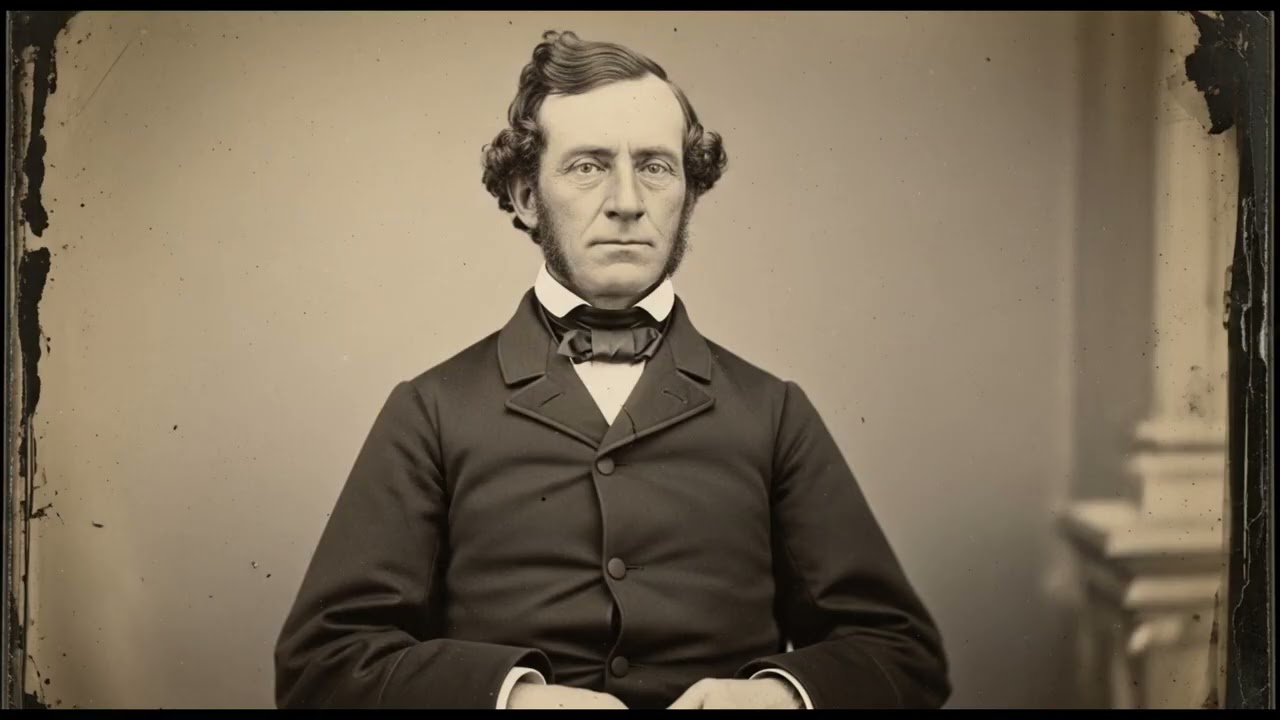
In the autumn of 1887, Vernon Attekus Crow, a timber surveyor for the Chesapeake Lumber Company, walked into a section of West Virginia forest the locals called the Shrouded Hollows. He was a solitary man, hardened by years of manual labor, with pale gray eyes that seemed to look through people rather than at them. On the eighth day of his survey, he reached an old logging site that had been cleared twenty years earlier. The land had not regenerated as it should have.
The ground was bare, the stumps of old trees weathered and gray, with only patches of stunted grass and twisted shrubs. It looked less like a recovering forest than a place that had been poisoned. As he made camp at the edge of this clearing, he noticed something else: the silence. No birds, no insects, no rustling of small creatures.
The quiet was complete. That night, as the fog rolled in thick and heavy, he heard humming. A wordless tune, distinct and rhythmic, rising and falling like a lullaby. He stood listening, but the fog played tricks with sound, and he could not determine the direction.
The humming lasted five minutes, then stopped. He told himself it was the wind moving through a hollow tree, but he knew wind, and this had not been wind. At dawn, he spent the day surveying the perimeter of what he had begun to call the dead zone. He found the boundary sharp, almost unnaturally so.
In the afternoon, he discovered a structure, partially collapsed and reclaimed by vines, the remains of a small building from the old logging operation. Inside, on a rough-hewn table, arranged in a neat line, sat seven glass bottles. The first was a third full of human teeth. The second held fingernails.
The third contained small bones, finger bones. The fourth held hair, long strands faded to the color of old straw. The fifth contained eyes, shriveled and dark, floating in a liquid that had turned brown with age. He did not touch the last two.
Whoever had gathered these things had done so deliberately, and the bottles were clean of debris, suggesting they had been maintained or placed recently. He packed up his camp and moved, but the fog thickened early, and his compass needle spun lazily, refusing to settle on north. He stopped beneath a rocky overhang and built a fire. The humming started again, closer this time, circling his position.
He fired a shot into the fog. The humming stopped, then resumed with two voices, two different melodies weaving in and out of each other in a way that felt wrong. He emptied his rifle into the fog. When the hammer fell on an empty chamber, he heard footsteps, slow and deliberate, coming from multiple directions.
Six figures emerged from the mist at the edge of his firelight. They were human-shaped, but the proportions were wrong. They stood perfectly still, then began to circle his camp in perfect synchronization. He fired at the nearest figure and saw the impact clearly, center mass.
It staggered, stopped for a moment, then resumed walking. Nothing human could take three rifle rounds and keep moving. He spent the night feeding the fire, and the figures maintained their vigil at the edge of the light. When dawn came, the fog thinned, and he saw them clearly.
Their skin was a grayish pale that seemed to absorb light. Their eyes were completely black, their mouths too wide and filled with sharp, irregular teeth. Their bodies were emaciated, limbs too long and jointed in too many places. They wore the rotted remnants of clothing.
As the sun rose, they backed away, never turning, and melted into the forest. Vernon walked for hours until exhaustion forced him to stop. His compass worked normally again. He corrected his course and reached Sourwood Springs three days later.
At the company office, he told the office manager, Gideon Fairweather, everything. Gideon went pale and told him a story he had never heard before. The logging crew that had worked that section twenty years ago had not stopped because of timber or weather. All twenty-three men had gone into the woods on a Monday morning and never come back.
The camp was found intact, but no bodies, no signs of struggle. The company had kept it quiet. A surveyor named Ira Moss had gone in ten years later, returned after two days, refused to say what he had seen, quit, and moved away. A hunter named Dalton Reed had gone in five years later and emerged three days after, naked, covered in scratches, speaking in gibberish.
He died in an asylum six months later. Vernon wrote his report, making clear the area was unsuitable for logging. The company thanked him and reassigned him to a territory farther north. But he could not let it go.
He did research in the town library and found records of people vanishing in and around the Shrouded Hollows dating back to the early 1800s. One account stood out: a journal entry from 1823 by a state surveyor named Obadiah Winters, who had written about voices in the darkness, figures at the edge of his firelight, and bottles filled with what he could only describe as trophies. He had recommended the region be declared uninhabitable. The recommendation was ignored.
Vernon sought out an old woman named Temperance Willoughby, who lived on the outskirts of town and was known to remember old things. She told him that what lived in the hollows was older than the mountains. The indigenous people who had lived there before had called them the ones who collect, and had considered the area forbidden ground. The things in the hollows were not a single entity but multiple beings, perhaps a dozen or more, people who had been taken and transformed over time, kept alive and conscious during the process.
The bottles were part of their ritual. They could not survive extended sunlight, which was why they came out only at night or in heavy fog, and they retreated to caves during the day. Fire might work, she said, but you would have to find their refuge, and that could be anywhere in miles of honeycombed mountains. She advised him to stay away.
In December, a trapper named Silas Weatherbee went missing near the edge of the hollows. Search parties found nothing. Vernon followed a hunch back to the ruined structure. The bottles had been rearranged in a circle, and in the center sat a new bottle containing fresh teeth, still red at the roots.
He reported it to the sheriff, who told him officially there was nothing that could be done. The official story became that Silas had fallen into a ravine or been killed by a bear. In March of 1888, Vernon requested a transfer and moved to Pennsylvania to survey land for railroad expansion. He married in 1895, a school teacher named Prudence Holstead.
He never told her what he had seen. They had no children, which was a source of sadness for his wife, but perhaps a relief for him. In 1903, he received a letter from Temperance. The Shrouded Hollows had been purchased by a lumber baron from Pittsburgh who planned to clear-cut the entire area.
Temperance had tried to warn the company, but they dismissed her as a superstitious old woman. Vernon did nothing, and he would regret that inaction for the rest of his life. The logging operation began in April of 1904 with a crew of nearly fifty men. Within ten days, five had disappeared.
The company sent an investigator, a former Pinkerton man named Morton Hadley. On the fourth day, Hadley himself disappeared. The crew abandoned the operation, all forty-three remaining men walking out together. No one would take the job after that, and the site was left abandoned.
The final letter from Temperance came in the summer of 1905. She was ninety-eight years old. She had made one last trip into the hollows and found the structure expanded, rebuilt, with multiple rooms filled with shelves. On those shelves sat hundreds of bottles, perhaps thousands, each containing pieces of people, a collection spanning decades, possibly centuries.
She wrote to Vernon because he was the only other person who had seen it and survived with his mind intact. She died in November of that year, and her cabin burned down three days later. Vernon lived until 1927, dying quietly in his sleep at the age of seventy-eight. In his final years, he had become obsessed with documenting what he had seen, writing it all down in journals he kept locked in a trunk.
After his death, Prudence found the journals, read them, and burned every page. She told herself she was protecting her husband’s reputation, but really she was protecting herself. Some knowledge, she decided, was too terrible to preserve. The Shrouded Hollows remain.
The land has changed hands many times, and various companies have considered logging there, but none have succeeded. People still go missing sometimes, hikers, hunters, curious teenagers, one every few years, maybe two in a bad year. The authorities investigate, search when practical, and eventually file the cases as unsolved, attributing the disappearances to the hazards of wilderness. They never find the bottles.
They never see the figures in the fog. Vernon Attekus Crow tried to warn people. His warnings were ignored, his documentation destroyed, and the thing he had encountered continued unchanged, patient and methodical, adding to its collection piece by piece, year by year.