In the decades after Appomattox, a story took root across the American South. It held that Robert E. Lee, the Confederacy’s greatest general, had devised a brilliant plan at Gettysburg that would have shattered the Union center and changed the course of the war. One man, the narrative insisted, ruined it all: James Longstreet, Lee’s most senior corps commander, the man Lee himself called “My Old Warhorse.
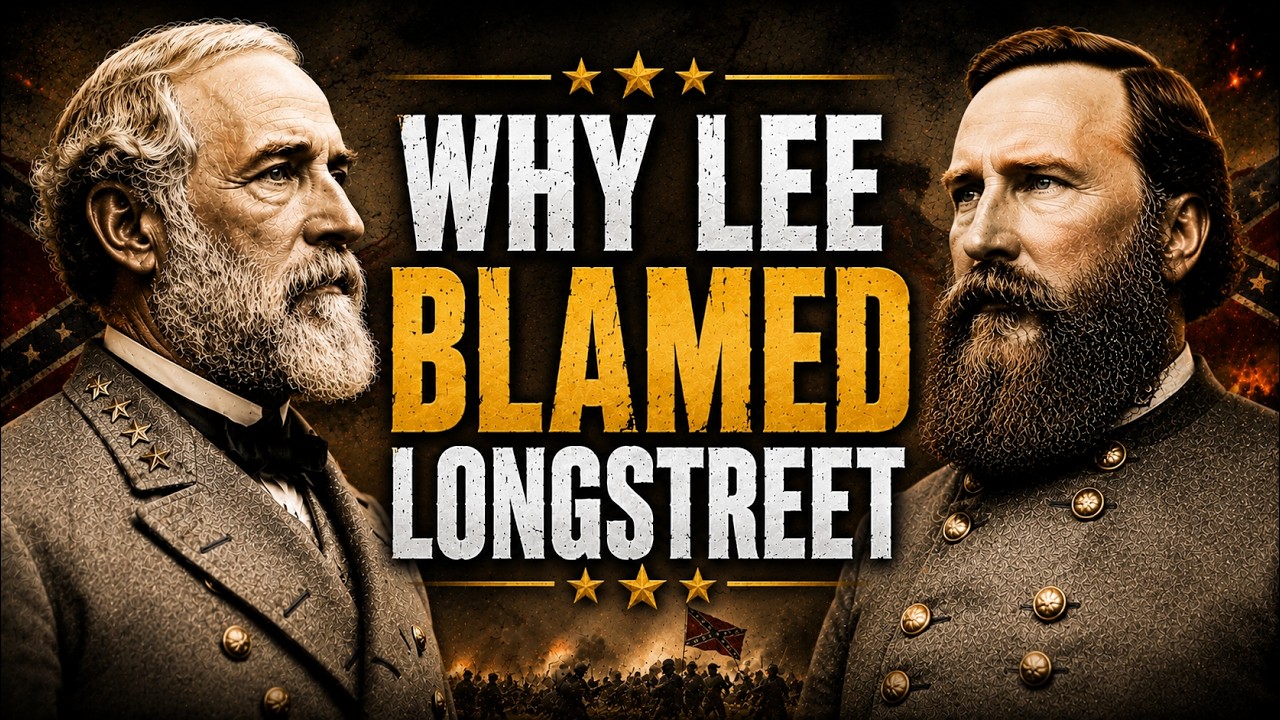
” In this telling, Longstreet sulked, delayed, and disobeyed orders until the moment for victory had passed. Gettysburg was lost, the war was lost, and the blame belonged to Longstreet. The story was repeated in speeches, printed in journals, and taught to generations of Southerners as settled history. There was only one problem with it.
It was not what Robert E. Lee actually said. Longstreet had not been a peripheral figure in the Army of Northern Virginia. He was its senior corps commander and, by the judgment of most modern historians, one of the finest tactical commanders on either side of the war.
Lee’s nickname for him was not affectionate condescension but a description of his role. At Second Manassas in August 1862, Longstreet’s massive counterattack shattered John Pope’s left flank and turned a stalemate into a decisive Confederate victory. At Fredericksburg in December 1862, his corps anchored Marye’s Heights, built a killing zone behind a stone wall, and held it against wave after wave of Union assaults. These were not the performances of a passive resister or a lieutenant half loyal to his chief.
The break between Lee and Longstreet did not come out of nowhere at Gettysburg. It grew from a genuine strategic disagreement. Before the first shot was fired in Pennsylvania, Longstreet had objected to Lee’s plan. Lee had decided that if he could bring the Army of the Potomac to battle, he would fight a major engagement and try to destroy it.
Longstreet believed this was the wrong use of their position. His argument, repeated in the weeks before Gettysburg, was simple: use the invasion offensively, but by maneuver. Move around the Union army, get between it and Washington, find strong ground, and force the enemy to attack them there, fighting a defensive battle that would bleed the North at a lower cost to the South. Lee disagreed.
He was deep in enemy territory, the Union army was in front of him, and he wanted a decisive engagement. On July 2, Lee ordered Longstreet to attack the Union left. Longstreet obeyed, though he did not hide his belief that the plan was wrong. His corps marched to its attack positions, and the movement was slowed by attempts to avoid Union observation, by countermarching when roads were misjudged, and by the friction that hits every army moving large bodies over unfamiliar ground.
The attack went in late in the afternoon instead of early morning. Some of those delays were probably avoidable. Whether an earlier assault would have changed the outcome is something no one can prove; the Union left was being reinforced throughout the day, and the terrain was broken and brutal. On July 3, Lee proposed the assault that would become known as Pickett’s Charge, a frontal attack across open ground against the Union center on Cemetery Ridge.
Longstreet told him plainly: no fifteen thousand men ever arrayed for battle could take that position. Lee overruled him. The attack went forward. Roughly six thousand five hundred Confederate soldiers became casualties in less than an hour.
Every regimental commander in Pickett’s division was killed or wounded. The assault failed completely. Afterward, Lee rode among the survivors near Seminary Ridge and spoke directly to men trying to reform shattered units. More than one later remembered him saying, in some version, “It is all my fault.
” Not Longstreet’s fault, not theirs, his own fault. That is what Lee said in the moment. What came later was something else. After Appomattox, Lee became president of Washington College in Lexington, Virginia.
He was revered across the South and, in many Northern circles, seen as a model of dignity in defeat. He understood that everything he wrote or said would be treated almost as scripture, and he was careful. He refused to write a comprehensive memoir and turned down repeated requests to give his full history of the war, usually explaining that it would stir up old animosities. In the formal statements he did make, his explanation for Confederate defeat was consistent.
In his general orders announcing the surrender of the Army of Northern Virginia, he told his men they had been compelled to yield to overwhelming numbers and resources. In private letters, he sometimes wrote of failures of coordination among Confederate leaders and of a weakening of Southern resolve. But in all of it, one thing is striking. He never wrote that James Longstreet lost Gettysburg.
He did not mark Longstreet as the man who lost him the war. His private displeasure with Longstreet was about politics, about Longstreet’s postwar choices, not about the battle. Lee died in 1870. He left no memoir.
He left that vague explanation of overwhelming numbers and resources. And he left silence where a verdict would later be needed. Into that silence stepped Jubal Early. Early was a capable Confederate general and an even more energetic sore loser.
He had led a daring raid up the Shenandoah Valley and threatened the outskirts of Washington before being driven back, but his record in independent command ended in defeat. After the war, he went into exile nursing grievances, then returned to Virginia to wage a different kind of campaign. He became one of the architects of what is now called the Lost Cause, a coordinated effort to shape how the South remembered the war. He helped found the Southern Historical Society and effectively ran its journal, which became the main vehicle for the South’s official memory of itself.
The Lost Cause narrative needed several things to be true at the same time. The Confederate cause had to be noble, about states’ rights and constitutional principle, not about preserving slavery. Confederate soldiers had to be unsurpassed in courage and skill, outnumbered but never outfought. And Robert E.
Lee had to be nearly perfect, a military genius whose decisions had been sound and whose defeats were the result of forces beyond his control. Gettysburg was the problem. There, Lee had ordered frontal assaults against strong positions on two consecutive days and lost thousands of men for no gain. If Lee was nearly perfect, someone else had to be responsible.
In 1872, seven years after Appomattox and two years after Lee’s death, Early gave the South its answer. In a speech that was widely published, he claimed that on July 2 at Gettysburg, Lee had ordered Longstreet to attack at sunrise, and that Longstreet, sulking over his rejected advice, had deliberately delayed until late afternoon, costing the Confederacy any chance of winning the battle. The accusation was specific and devastating. It was also unsupported by any wartime evidence.
No written order for a sunrise attack survives. No report written during or right after the battle mentions it. Early himself had not mentioned such an order in his immediate postwar writings, when Lee was still alive to confirm or deny it. The sunrise order appeared only later, when a scapegoat was needed.
The accusation needed documentation, and that is where William Nelson Pendleton entered. Pendleton had served as Lee’s chief of artillery. He was a clergyman by training, a general by necessity, and widely regarded by his own officers as out of his depth. In 1873, Pendleton delivered a public address that did something crucial for the emerging story.
He did not just repeat Early’s claim about a sunrise order. He said there had been a written order, a tangible document from Lee directing Longstreet to attack at dawn. No such order was ever produced, and none has ever been found. But Pendleton’s claim was printed in the journal Early controlled, and it began to be cited as fact.
Articles referenced the order as though it were a matter of record, then cited one another in a closed loop of evidence. Longstreet was still alive for all of this. He answered in his own articles, in interviews, and in his memoir. He flatly denied that a sunrise order had ever been given.
He described the actual orders he received and explained the delays as the inevitable friction of moving a corps into position, not deliberate sabotage. His account was dismissed, not because his evidence was weaker, but because his accusers had the platform and the ear of a white Southern public that had already decided Longstreet deserved to be guilty. That decision had been made easier by what Longstreet did after the war. He accepted defeat publicly and urged Southerners to obey Reconstruction laws.
He joined the Republican Party, the party of Lincoln and emancipation, and supported Black suffrage. Then, in New Orleans, he crossed a line white Southern opinion would never forgive. He accepted a position commanding the integrated metropolitan police and state militia under Louisiana’s Reconstruction government. In September 1874, when an armed white supremacist organization known as the White League attempted to overthrow that government by force, Longstreet was on the other side of the barricades.
He led Black and white troops in defense of a Republican government against armed former Confederates. His forces were driven back, and Reconstruction in Louisiana was effectively broken, but the symbolism mattered more than the outcome. Longstreet, Lee’s old lieutenant, had stood with Black troops against white Confederate veterans. In the eyes of the Lost Cause, that was betrayal.
So when Early and Pendleton needed someone to carry the blame for Gettysburg, they chose the man whose postwar choices had already made him an object of hatred. His politics became proof of his alleged wartime character. Of course he had sulked. Of course he had dragged his feet.
Look what he had become afterward. The alternative was something the Lost Cause could not live with. If Longstreet was right at Gettysburg, then Lee was wrong. He was wrong to attack that strong position on high ground, wrong to insist on those frontal assaults, wrong to ignore his most experienced lieutenant’s advice, and wrong in a way that cost the Army of Northern Virginia tens of thousands of irreplaceable men.
To admit that would be to admit that the South’s most revered general had helped bleed its best army to death, so the blame had to go elsewhere. Modern historians who have returned to the wartime documents have found little to support the myth. There is no contemporary evidence for a written sunrise order, no copy in official records, no mention in Lee’s dispatches. Longstreet’s march on July 2 was slow and his attack late, but the delays matched the realities of moving a corps on bad roads while trying to stay out of sight.
And the weight of scholarship has moved away from the view of Lee as infallible. His brilliance is real, and so are his mistakes. The casualty figures of his campaigns are simple arithmetic. At Gettysburg, he attacked a strong position three days in a row and lost badly.
Longstreet, who wanted to maneuver and who warned him bluntly that no force of fifteen thousand could take that ridge, was advocating something closer to the strategy the Confederacy actually needed. The myth survived for nearly a century because it protected what the culture most wanted to protect: its icon, its sense of nobility, and its refusal to look too closely at the causes and conduct of the war. James Longstreet died in 1904, thirty-nine years after Appomattox. He lived long enough to see himself transformed from “My Old Warhorse” into the man who supposedly lost the Confederacy.
He never stopped insisting that the famous sunrise order never existed. On that point, the documents back him up. Lee himself never endorsed the story told in his name. He left only his dignified explanation of overwhelming numbers and resources, and his silence functioned as consent.
The story Southerners told themselves required a culprit, and it found one in the man who had dared to be right.