In the spring of 1864, Robert E. Lee had never lost a major battle. He had met every Union commander Virginia sent against him and sent each one northward in retreat, bloodied and broken. His name filled the front pages of Confederate newspapers from Richmond to Charleston.
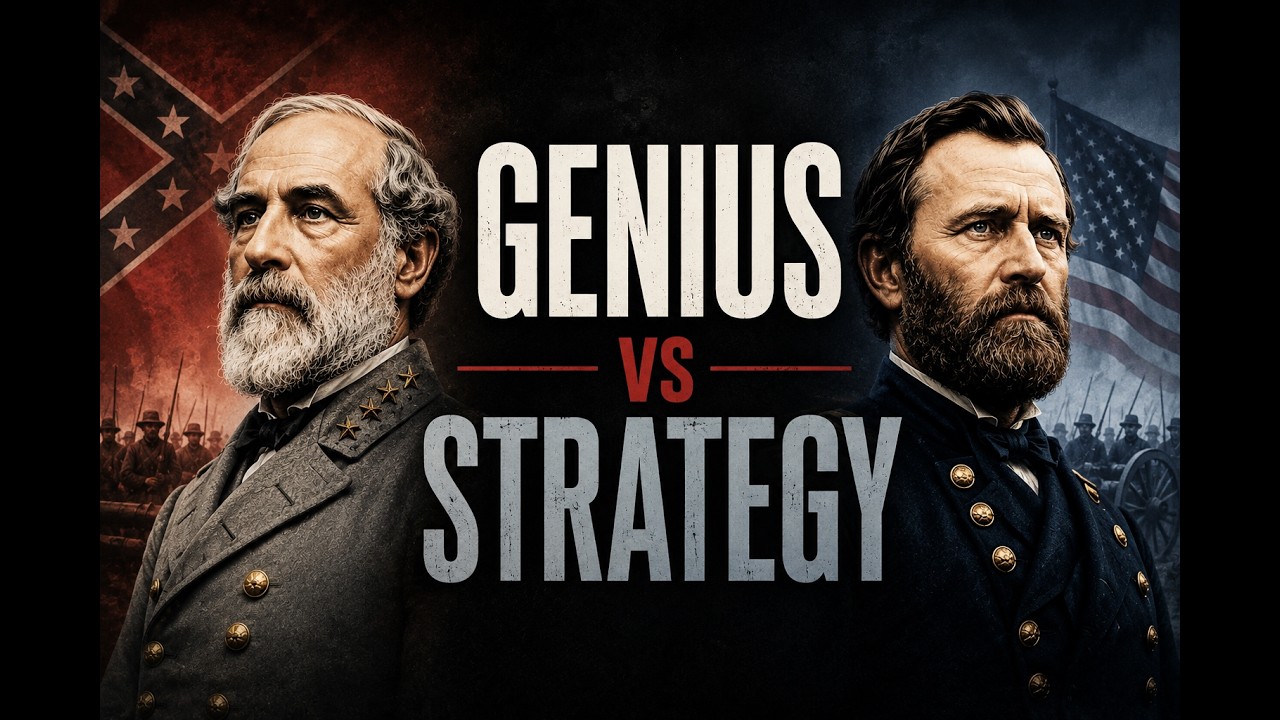
His soldiers believed in him with the fervor of scripture. One lieutenant from Georgia wrote home that summer that this army was the South’s last hope and predicted it would win the war by its own strength alone. For three years, that belief had proven true. Then Ulysses Grant arrived in Washington, and he was not planning to fight that war at all.
The story of how Lee lost the Confederacy is not a story of tactics. It is a story of ledgers, railroads, and arithmetic. By 1864, Grant had stopped asking the battlefield question: Can I defeat this army today? He had started asking an industrial question: How long can this nation keep feeding, arming, and replacing this army?
One general was trying to defeat an army. The other was trying to defeat a nation’s ability to keep an army in the field at all. The first test came in early May 1864, in a tangled thicket outside Fredericksburg called the Wilderness. Lee met Grant there on May 5.
Two days of fighting followed, fought mostly blind in woods so dense that smoke ignited the brush and wounded men burned where they fell. Union casualties exceeded 17,000. Historians still argue about who won. Lee had stopped Grant again, just as he had stopped every Union commander before him.
Nine days later, he stopped him again at Spotsylvania Court House. Three weeks after that, at Cold Harbor on June 3, Grant sent waves of men into fortified rifle fire. Within the first hour, thousands of Union soldiers were already dead or wounded. By every rule of the previous three years, that record should have ended the campaign.
An army of the North that had taken such a beating turned back. It had happened every time before. But Grant did not retreat. The Confederate collapse began in minds months before it reached the soldiers.
It began in the Wilderness. On the evening of May 7, 1864, Grant ordered the army south instead of north, toward Spotsylvania, toward Lee. Charles Dana, a War Department observer traveling with the army, recorded the moment. As the army began to realize that they were truly moving south and might at that moment be much closer to Richmond than the enemy, the morale of officers and men rose to the highest pitch of enthusiasm.
Soldiers who had taken 17,000 casualties in that burning thicket began cheering along the road. Not because they had won—but because for the first time in the entire war, this army was not retreating. Grant had to send orders down the column to quiet the noise. Confederate pickets were close enough to hear it.
Lee spent that war perfecting a single equation: bleed the invader, and the invader will go home. It had never failed him once. Now he watched it fail. He fought Grant to a stalemate in the Wilderness, and Grant advanced.
He held the line at Spotsylvania at terrible cost, and Grant advanced again. At Cold Harbor he achieved his clearest tactical victory of the campaign, and Grant still did not retreat. After every battle, the same report reached Lee’s headquarters: the enemy was sitting closer to Richmond than they had been the week before. Lee was a master of tactics, but the war had moved to a battlefield he could not defend.
The Confederacy had fewer than 6 million free people to draw upon against the Union’s roughly 22 million. Every soldier the South lost was a wound the nation could not heal. The North could absorb losses that would cripple most countries and put a whole new army in the field within a single season. Confederate soldiers, by the testimony of both sides, fought with ferocity equal to anything in the war.
But they were running out of men to feed into that ferocity. Josiah Gorgas, the Confederate chief of ordnance, had performed a miracle. Roughly two out of every three Confederate rifles reached soldiers aboard blockade-runners slipping through Union naval patrols. By early 1864, Gorgas wrote with genuine pride that the Confederacy was producing rifles, pistols, swords, and ammunition in quantities it could not have managed three years earlier.
He was not exaggerating. When Lee finally laid down his arms at Appomattox, his men had gone three days without food—and every one of those starving soldiers was still carrying 75 rounds of ammunition. Gorgas solved the gun problem. No one solved the food problem.
No one solved the manpower problem. You could make a rifle from melted church bells and copper, Grant would later explain, when the opposing army is gone. On June 3, the dawn at Cold Harbor revealed the price of this new kind of war. Grant’s attack collapsed within the first twenty minutes.
Hundreds of wounded Union soldiers lay trapped in the open ground between the lines, pinned down by Confederate sharpshooters who fired at anything that moved. For two full days, no one rescued them. Then the letters began. Grant proposed an informal arrangement on June 5.
neither side revealed any real satisfaction at the surrender, only the discomfort of a man who had just defeated an opponent who had fought with such determination for so long. The following morning, Lee issued his farewell order to the army he had commanded for two years. He never claimed his men had been beaten in combat or in tactics. The Army of Northern Virginia had been forced to surrender to overwhelming numbers and resources.
Numbers and resources, not tactics. In private, and in his own hand, the finest field commander of his generation settled the question with which this story began. The answer did not stay confined to 1865. Both world wars turned entire national economies into extensions of the battlefield.
Shipyards and steel mills mattered as much as any single front. Strategic bombing campaigns targeted factories and rail junctions because armies lived or died on what those factories sent them. From Appomattox onward, wars between industrial nations were decided not by who won the most battles, but by who could keep supplying their army after the other side ran out. Grant saw this first, not because he was smarter than every general before him, but because he took a question they all considered background noise and made it the very core of war.
One more thing before the close. The railroad records and foundry ledgers explain how this war was won. But they tell nothing of the cost to the humans behind those numbers. Grant’s system worked precisely because it treated soldiers, for planning purposes, as a resource measured alongside iron and grain.
The same coordination that broke the Confederacy’s ability to fight also drove the Overland Campaign’s total toll past 80,000 men in one brutal month. Nearly 55,000 Union casualties, over 33,000 Confederate. Secretary of the Navy Gideon Welles watched those numbers come in through the spring and wrote his own verdict in his diary: Grant was unmindful of human life. Northern newspapers seized on a harsher word that same spring—butcher—and it followed Grant for the rest of his public life.
The historical record holds two truths at once. The same commander who left hundreds of his wounded lying between the lines at Cold Harbor for four days while letters about protocol went back and forth. And the same commander who, eleven months later, silenced his own victory salutes and fed the army he had just defeated. Both actions are documented.
Both are the same man. The production charts do not show a widow reading a telegram on her front porch. The railroad schedules do not show a Confederate officer counting 75 rounds still on the belt of a starving soldier at Appomattox. The food ran out, and the ammunition somehow remained intact to the very end.
The machine this war described was built entirely of human beings. Their labor in the factories that fed it, their bodies in the fields that absorbed its verdict. Understanding the calculations does not make the suffering smaller. If anything, it makes it sharper, because it means the suffering was not chaos.
It was a system working exactly as designed. Grant knew the price of his strategy before he issued the order that set it in motion. He said so himself, in the same memoirs in which he described Cold Harbor as the mistake he never stopped regretting. Perhaps no single image captures that knowledge more than the exhausted Union infantryman standing in Virginia mud outside Appomattox, a tin cup of coffee cooling in his hands.
Somewhere down the line, a train whistle sounds—the same sound that had followed this army all year. He looks up, then keeps walking. He has no idea he stands at one of the true turning points in the history of warfare. All he knows is that the army never stopped moving all year.
And so he never stopped either. Lee won every battle Grant needed him to win. It was never enough.