On February 7, 1952, a BOAC Argonaut named Adalanta touched down at London Airport after a nineteen-hour flight from Entebbe. On board was a twenty-five-year-old woman who had left Britain a week earlier as heir to the throne. She returned as queen. King George VI had died in his sleep at Sandringham the previous morning, and his daughter, in Kenya at Sagana Lodge, had received the news before beginning the long journey home.
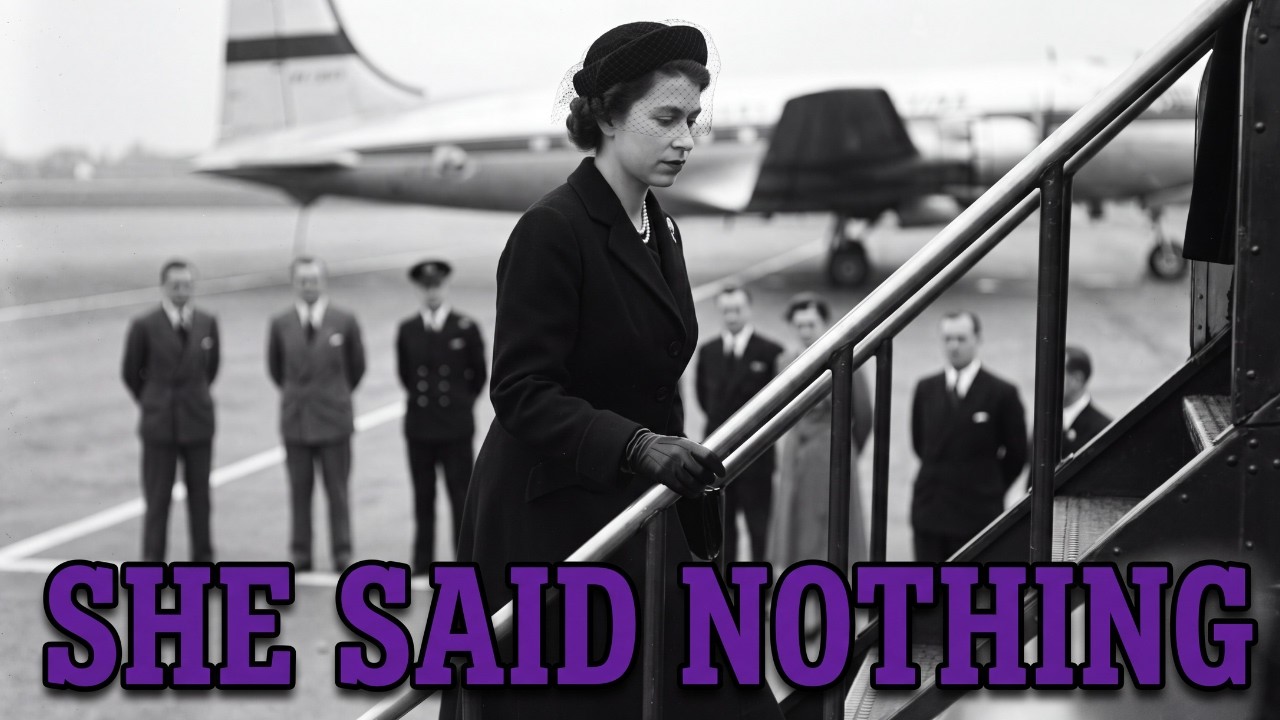
A Dakota DC-3 carried her from Nanyuki to Entebbe, where a thunderstorm held the aircraft on the ground for two hours. The Argonaut then flew north and west across the continent to London. Contemporary newsreels recorded the landing as arriving exactly on schedule. On the tarmac stood Winston Churchill, Clement Attlee, Clement Davies, and the full receiving line of ministerial grief.
She descended the steps in black, a black coat and black hat, having boarded the homeward flight in the summer clothes she had worn in Kenya. A black dress had been passed to her before she stepped off the aircraft. She accepted Churchill’s formal condolences, gave no statement, made no remark to the press, and betrayed nothing in her expression. Later that afternoon, the Royal Standard flew over Clarence House for the first time.
Elizabeth II never gave an interview, never wrote a memoir, and never placed an unguarded sentence on the public record. Across seventy years, she authored a continuous text in clothing, the only medium she could fully control without ministerial approval or parliamentary constraint. The framework that produced that silence had crystallized over centuries. The British Constitution is unwritten and runs on convention rather than statute.
The Victorian theorist Walter Bagehot, writing in 1867, drew the distinction that still governs the institution: a constitution has dignified parts that preserve reverence and efficient parts that actually govern. The monarchy belongs to the dignified category. Its political function consists of the right to be consulted, the right to encourage, and the right to warn, exercised privately in weekly audiences with the prime minister, the contents sealed by convention. A reigning monarch does not vote, does not publicly support political parties, and does not express partisan opinions.
The Queen’s Speech is written entirely by ministers. She reads it. She does not author it. This constraint was enforced in public.
In 2014, when pressed on whether the Queen had privately expressed a view on the Scottish independence referendum, Buckingham Palace issued a statement describing her constitutional impartiality as an established principle of our democracy. Two years later, after a newspaper claimed she supported Brexit, the palace complained formally to the press regulator and secured a correction. Alongside the structural constraints ran something more personal: a dual discipline, structurally required and temperamentally chosen. The phrase “never complain, never explain” is sometimes traced to Disraeli, sometimes to the Queen Mother, but Elizabeth made it both a constitutional principle and a private code.
Biographer Sally Bedell Smith wrote that there was never a moment when Elizabeth II was not the Queen and that she had not granted an interview in sixty years. Robert Hardman confirmed the same: the Queen never granted an interview in seventy years. One permitted channel existed. Since 1932, when George V inaugurated it on the BBC Empire Service, the Christmas broadcast had been the sovereign’s annual opportunity to speak directly to her subjects in the first person.
Elizabeth delivered her first from Buckingham Palace on December 25, 1952, using the same desk and chair her father had used. Linguistic studies confirm the careful architecture of these broadcasts: politically neutral throughout, always from a managed height, never descending into personal revelation. The prime minister’s weekly Tuesday evening audience gave her a genuine private voice, and every account of those meetings confirms she used it to express real views, but the content remained strictly confidential. She never published a memoir.
Before the black coat of 1952, there was a white dress that taught her, five years earlier, what a garment could do. On November 20, 1947, Princess Elizabeth, aged twenty-one, married Lieutenant Philip Mountbatten in a ceremony heard by an estimated 200 million people worldwide. Britain was still rationing cloth. The princess used her own ration coupons for the material, and the government allocated her two hundred additional ones.
When news of this spread, women across the country mailed their own precious coupons to Buckingham Palace. The gesture was touching and entirely illegal, as rationing regulations made coupons non-transferable. Every coupon had to be returned with a personal thank-you note. Norman Hartnell designed the gown, made of ivory duchess satin, the silk produced at Lullingstone in Kent.
Approximately ten thousand seed pearls from the United States covered the embroidery, with motifs drawn from Botticelli’s Primavera. The train ran to thirteen feet. The final design was kept secret until the morning. After the wedding, the dress was put on public display and toured the major cities of the United Kingdom, becoming a national object.
The lesson absorbed: a garment can carry the weight of a nation’s need, can perform the work of morale when political speeches and public celebrations are constrained by scarcity or caution. On June 2, 1953, Hartnell again designed for Westminster Abbey. In reviewing his designs, Elizabeth made two specific requests that transformed the coronation gown from a ceremonial robe into a political document. First, she wanted color introduced into the embroidery.
Second, and more importantly, she asked that the floral emblems of every Commonwealth realm of which she was sovereign be incorporated into the design. The Royal Collection Trust records it plainly: her own instruction, not Hartnell’s initiative. Thirteen emblems in total, arranged in three scalloped tiers across the skirt: a Tudor rose for England, a thistle for Scotland, a shamrock for Ireland, a leek for Wales, a maple leaf for Canada, a wattle for Australia, a silver fern for New Zealand, a protea for South Africa, a lotus for India and Ceylon, and for Pakistan three separate motifs of wheat, cotton, and jute. The embroidery took a team of six needleworkers approximately nine weeks and three thousand hours.
Twenty-seven million people watched the coronation on television, eleven million more on radio. Unknown to the queen, Hartnell had sewn a single four-leaf shamrock on the left side of the skirt, where her hand would rest during the ceremony. She walked into Westminster Abbey wearing a luck charm she did not know she had. The coronation gown was not filed away.
At receptions in 1953, and then on her first Commonwealth tour as reigning monarch in late 1953 and 1954, she wore it again. The Australian Women’s Weekly confirmed in January 1954 that the gown had been flown from London to New Zealand specifically so it could be worn at the parliamentary openings in Wellington and Canberra. In Wellington, the coronation gown opened the New Zealand Parliament, the first time a reigning monarch had performed that function. In Sydney on February 4, 1954, she opened the New South Wales Parliament in the same dress, and in Canberra on February 15, she opened the Commonwealth Parliament.
In April, she opened the Parliament in Colombo. In Ottawa in 1957, the Canadian Parliament. The dress performed its argument in the chamber itself. The most immediately visible element of the system that developed across the following decades was color.
She dressed in solid, bright, high-visibility colors for virtually every public engagement. Angela Kelly, her personal assistant, adviser, and curator from 1993 until the Queen’s death, made the doctrine explicit in her memoir: bright colors were chosen so that the Queen stands out and is visible to crowds. The Queen herself, according to Robert Hardman, distilled it plainly: “I can never wear beige because nobody would know who I am. ” The doctrine predated Kelly by decades.
What changed with Kelly’s tenure was rigor: researching venues, studying the color significance of host nations before state visits, engineering garments that photographed well from crowd level. The clearest documented case of diplomatic dressing was the 2011 state visit to the Republic of Ireland, the first by a reigning British monarch since 1911, following decades of conflict. The security operation was the largest in the history of the Republic. When Elizabeth landed at Casement Aerodrome on May 17, the BBC reported that she arrived wearing green, a Stewart Parvin design in jade green.
That evening at the state banquet at Dublin Castle, she wore a gown embroidered with silk shamrocks and began her speech in Irish, causing President Mary McAleese to turn to those beside her and say, “Wow. ” Kelly confirmed to Reuters that colors and embroidered motifs were deliberately chosen to reflect the host country’s symbols, describing the wardrobe as a diplomatic asset. The system reached its most professionalized phase when Kelly arrived at Windsor Castle in 1994. Born in Liverpool in 1957, the daughter of a dock worker and a nurse, she was hired as an assistant dresser and rose to the full title of personal assistant, adviser, and curator in matters of jewelry, insignias, and wardrobe.
The Diamond Jubilee in 2012 required two years of advanced planning, documented in Kelly’s authorized book. In 2019 came The Other Side of the Coin, the only time in Elizabeth’s seventy-year reign that a serving member of the household was authorized to write about their work for the sovereign. After the Queen’s death on September 8, 2022, Kelly received the Commander of the Royal Victorian Order. In 2016, the Royal Collection Trust mounted the first substantial public reading of the body of work, “Fashioning a Reign,” displaying garments from across her reign in chronological sequence.
The system did not survive the autumn of 1997 without cost. Princess Diana died in Paris on August 31. The Queen remained at Balmoral, and Buckingham Palace stayed silent. Public anger over the perceived coldness became a political crisis.
On September 5, five days after Diana’s death, Elizabeth gave a televised address of 416 words, speaking “as your queen and as a grandmother. ” Thirty-two million British viewers watched, and the crisis resolved. But 1997 revealed the architecture’s structural limit: the same silence that constituted dignity in ordinary times could read as coldness in a moment of extreme public grief. She returned to the architecture immediately afterward and maintained it for the remaining twenty-five years of her reign.
She died at Balmoral on September 8, 2022, at age ninety-six, after a reign of seventy years and two months, the longest in British recorded history. She left no memoir and gave no interview. The argument running through all of it is simple. At the most practical register, color as visibility so that a woman at the back of a fifteen-thousand-person crowd could say she saw the queen.
At the diplomatic register, jade green arriving in Dublin, the maple leaf brooch on Canadian visits, the Commonwealth emblems embroidered into a skirt flown to open parliaments across four continents. At the constitutional register, the coronation gown designed at her instruction to carry the floral emblems of every realm she governed, worn at each of those realms’ parliaments. At the most personal register, a twenty-five-year-old woman who emerged from an aircraft in mourning black on a February afternoon, saying nothing with her mouth and saying everything with her coat. She never told us what she felt.
She told us what the moment required, what the nation needed, what the Commonwealth meant to her, in silk, in wool, in color, chosen the way other women choose words. The wardrobe was never decoration. It was the only sentence she ever wrote alone, and she spent a lifetime writing it.