On August 24, 2025, a man stumbled into a remote ranger station near the village of Soraypampa in Peru’s Salkantay region. His beard was matted, his clothes were torn, and on his feet were hiking boots three sizes too large. The station log described him as disoriented, dehydrated, and unable to clearly state his identity. When asked his name, he whispered, “Eduardo.
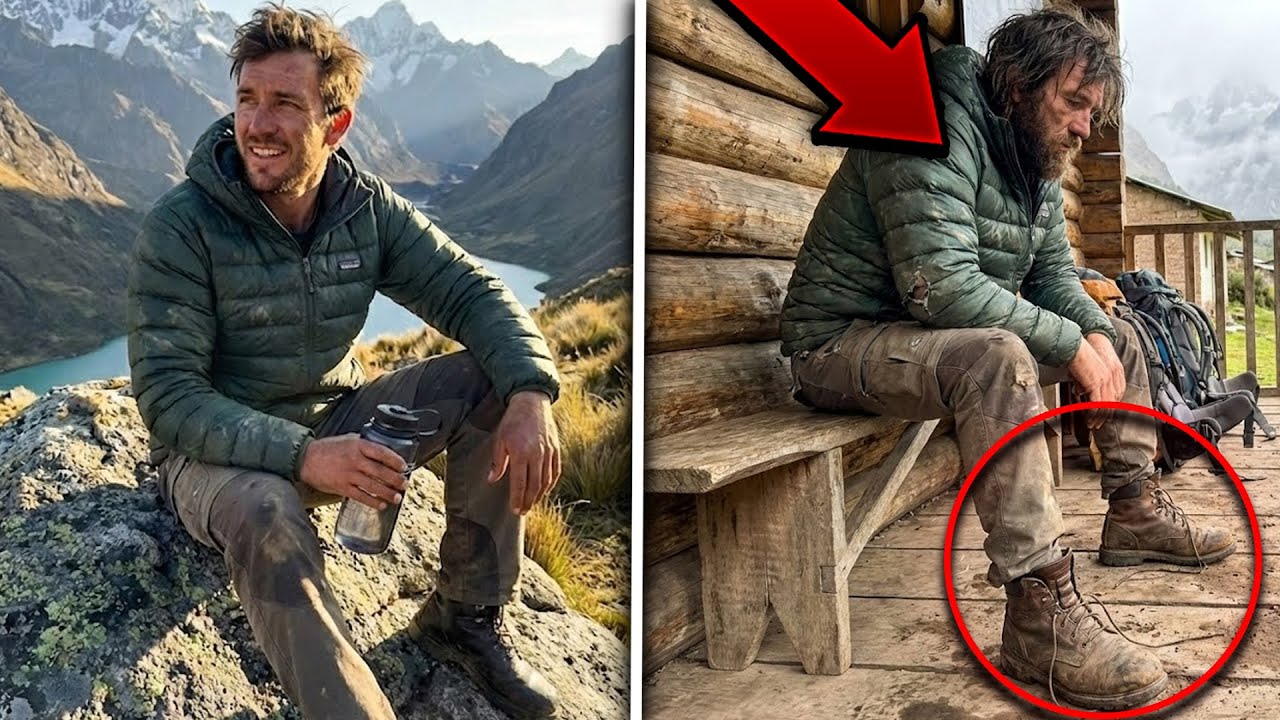
Eduardo Sanchez. ” The boots he wore had another name written inside: Miguel Herrera. Eduardo claimed he had never met anyone by that name. Eduardo Sanchez had worked as a hiking guide in Peru for six years, specializing in off-the-beaten-path treks.
On July 15, 2021, he met with two American tourists, James and Rebecca Miller from Seattle, at the Cusco office of Andean Pathways. They had requested a private three-day trek to a series of high mountain lakes, specifically avoiding the crowded Inca Trail. The next morning, at 5:47 a. m.
, Eduardo arrived at the office and was captured on security cameras checking his distinctive red and black North Face backpack before leaving at 6:12 a. m. A gas station camera recorded him and the Millers in a white Toyota Land Cruiser at 6:37 a. m.
That was the last confirmed sighting of Eduardo Sanchez. The itinerary filed with Andean Pathways called for the group to drive to a trailhead near the village of Chillca, begin hiking by 9:30 a. m. , and reach their first campsite by 4:00 p.
m. Eduardo was scheduled to check in via satellite phone that evening. When no call came, company protocol dictated a 24-hour grace period. After a second missed check-in, authorities were alerted on July 18, and the search began the following day.
The white Toyota Land Cruiser was found at the designated trailhead with three large backpacks inside, containing camping gear, food, and personal items. The satellite phone was still in Eduardo’s pack, which immediately concerned search coordinators. A guide would never leave the trailhead without essential equipment. A local shopkeeper reported seeing the group purchasing additional water at approximately 9:15 a.
m. on July 16, appearing to be in good spirits. She was the last person to report seeing them. The search expanded quickly, involving Peruvian National Police, mountain rescue teams, and volunteers.
Helicopter sweeps were limited by terrain and unpredictable weather. Search dogs followed a scent trail for about two kilometers before losing it near a rocky stream bed. On the third day, searchers made a disturbing discovery approximately 3. 5 kilometers from the trailhead in a direction not on the planned route.
They found a single hiking boot partially buried in mud. It was confirmed to be Eduardo’s based on photographs and the distinctive wear pattern on the sole. Blood was present on the boot’s interior. Nearby, searchers found a walking stick belonging to James Miller, identifiable by a Seattle Seahawks sticker near the handle.
The search continued for two weeks, covering over 200 square kilometers of rugged mountain terrain. Teams recovered a water bottle with Rebecca Miller’s name, a torn section of blue fabric matching Eduardo’s jacket, and a single lens from a pair of sunglasses found nearly five kilometers from where the boot was discovered. Heavy rains made ground operations increasingly dangerous, and on August 7, 2021, the official search was suspended. The Millers’ families, well-connected—James’ father was a former state senator—maintained pressure on Peruvian authorities.
The US Embassy issued regular inquiries. Eduardo’s girlfriend established a foundation to raise awareness about missing hikers in the Andes. The prevailing theory was that all three had been victims of a tragic accident, perhaps a fall or flash flood, but without bodies, this remained speculation. For four years, there was nothing.
When Eduardo appeared at the ranger station, he was severely malnourished, weighing 48 kilos down from his documented 76. Medical reports documented multiple healed fractures in his right arm and three ribs, extensive scarring on his back consistent with lacerations, vitamin D deficiency indicating prolonged absence of sunlight, and fungal infections. The boots he wore were size 46 European, much larger than his size 42. Inside the right boot, written in black marker, was the name Miguel Herrera.
Eduardo’s initial account was fragmented. He claimed the group had encountered a sudden storm and sought shelter in a cave where the ground gave way, causing all three to fall into an underground chamber. He said James Miller died from the fall, while Rebecca survived but was severely injured. He claimed they became disoriented in underground tunnels, that Rebecca died several days later, and that he wandered alone before finding an exit.
When questioned about the four-year time gap, he became unresponsive, trembling and refusing to continue. Detective Carlos Torres of the Peruvian National Police noted significant inconsistencies. The medical examination contradicted several elements of the story. Eduardo’s vitamin D deficiency indicated prolonged time without sunlight, yet his story suggested he had been moving through the mountains.
His healed fractures were professionally set, suggesting medical intervention. Most tellingly, his hands were soft, with no calluses consistent with long-term survival in the wilderness. The official report concluded that his physical condition was inconsistent with prolonged wilderness survival and suggested periods of confinement and possible medical care. Torres grew suspicious, shifting from treating Eduardo as a victim to considering him a potential suspect.
Forensic analysis of the boots revealed they were relatively new, with manufacturing dates indicating they had been produced only two years earlier, contradicting Eduardo’s claim of finding them during a four-year ordeal. Soil samples from the boot treads matched a region near the Choquequirao ruins, an area not on the planned trekking route. Most significantly, DNA testing found traces of blood inside both boots that did not match Eduardo’s, consistent with two distinct DNA profiles. Torres requested information on all reported crimes in the Cusco region during Eduardo’s absence.
The response revealed something unexpected. Three other hiking guides had disappeared under similar circumstances over the past five years. All were experienced, all were leading small groups on remote treks, and none had been found. Expanding the search throughout the Andean region revealed a disturbing pattern: twelve guides or solo hikers had vanished in remote areas of Peru, Bolivia, and northern Chile since 2019.
None had been found except Eduardo. Now there was a new name. Miguel Herrera was a 29-year-old Argentine guide who had disappeared while leading a German couple near the Bolivia-Peru border in 2023. His body had never been recovered.
The boots Eduardo wore were sent to Argentine authorities. Herrera’s family confirmed they were similar to those he typically wore hiking. The writing inside was identified by his mother as his handwriting. During one therapy session, Eduardo became extremely agitated when a hospital maintenance worker wearing a blue uniform passed by his room.
He attempted to hide under his bed, and when coaxed out, repeatedly said, “Blue means counting. ” Torres changed his approach, showing Eduardo photographs of remote Andean locations, hiking equipment, and other missing guides. The breakthrough came on September 17, 2025, when Eduardo was shown a photograph of a remote stone structure near the Choquequirao ruins. He began to tremble violently and said, “The counting house.
That’s where they take you for counting. ”
Over several days, through fragmented statements, a different story emerged. Eduardo revealed that he, James, and Rebecca had been approached on the trail by men wearing blue uniforms who identified themselves as park rangers. They claimed there had been a security incident ahead and offered to lead the group to a safer route.
Instead, they led them off the main trail to an isolated area where three other armed men were waiting. Eduardo and the Millers were taken to a remote compound and separated. Eduardo was kept in a stone room with no windows for an extended period. He mentioned other captives who spoke different languages and came and went.
When asked what the counting meant, his explanation was fragmented: “They count you. Your worth. What you know, where you’re from, your people, if you can pay. ” Torres interpreted this as ransom evaluation.
Eduardo indicated that the Millers, deemed valuable, were taken away. He never saw them again. Eduardo described being moved between multiple locations over the years. He mentioned another captive, a guide who spoke Spanish with an Argentine accent.
Shown Miguel Herrera’s photograph, Eduardo identified him as someone held in the same facility. According to Eduardo, Miguel attempted to escape and was taken for punishment. He never returned. Later, one of the guards gave Eduardo Miguel’s boots, telling him his old ones were worn out.
The evidence pointed to an organized operation targeting tourists and guides in remote areas of the Andes, assessing victims for ransom potential. Those deemed valuable were held while demands were made through difficult-to-trace channels. The operation appeared to have multiple holding sites across the Peru-Bolivia border region, exploiting jurisdictional complications. A significant breakthrough came when Torres connected Eduardo’s case to a Bolivian investigation.
Three months earlier, Bolivian authorities had arrested two men transporting illegal weapons near La Paz. One mentioned working as security for a collection operation in the mountains. Confiscated items included passports, one belonging to an American hiker who had disappeared in 2022. A joint Peru-Bolivia task force was formed.
Eduardo provided descriptions of locations where he had been held, including a distinctive detail: a stone building with a red metal roof visible from one facility. On October 3, 2025, Peruvian and Bolivian forces raided three suspected facilities simultaneously. At a remote compound 23 kilometers from the Choquequirao ruins, they found evidence of long-term habitation, restraint equipment, and documentation suggesting a sophisticated operation. The site had been recently abandoned.
Among recovered items were passports, watches, and hiking equipment belonging to at least seven missing persons, including a backpack identified as Rebecca Miller’s. Seized computer equipment contained encrypted files recording kidnapped individuals and their assessed value. Approximately 800 meters from the main compound, forensics recovered partial remains of at least eleven individuals. Preliminary analysis confirmed that two sets of remains belonged to James and Rebecca Miller.
James died from blunt force trauma to the skull, consistent with Eduardo’s account of their initial capture. Rebecca’s cause of death could not be determined. Arrest warrants were issued for four individuals identified as leaders of the operation. Two additional facilities in remote regions of Bolivia were identified, both abandoned before they could be raided.
The evidence suggested the operation had likely relocated rather than disbanded. Thirteen families still waited for confirmation of their loved ones’ fates as forensic work continued. Eduardo Sanchez returned to his family home in Cusco. He has not resumed work as a guide and expresses no interest in ever returning to the mountains.
His medical file notes that he still wakes up checking for restraints that are no longer there. He refuses to wear boots of any kind, insisting on sandals regardless of weather. In one recorded session, he said of Miguel Herrera’s boots, “They make you wear the dead one’s things, so you remember. So you know what happens.
”
When asked during his last official interview if he had any message for the families of those still missing, Eduardo responded briefly: “Tell them to look for the buildings with red roofs. That’s where they keep the valuable ones. ” He provided no further explanation. His last recorded statement to investigators: “I was only valuable because I knew the mountains.
The Americans were valuable because of who they were. We’re all just numbers to them. Just counting. ”
The boots Eduardo wore when he emerged from the mountains remain in an evidence locker in Cusco.
Inside the left boot, partially obscured by wear but still visible, is the name Miguel Herrera—a guide who, like Eduardo, ventured into the Andes and encountered something far more dangerous than the mountains themselves. Unlike Eduardo, he never made it back. The investigation file remains open.