For decades, a story has circulated among firearms collectors and across the internet claiming that Allied commandos carried out a mission to assassinate Hermann Göring, head of the German Air Force, at his vast estate of Carinhall north of Berlin. The sole piece of evidence offered for this raid, it is said, is one of the rarest German submachine guns ever made, supposedly captured as a prize from that attack. The German MP 40 submachine gun is an icon of the Second World War. It evolved from its more expensive and higher-quality predecessor, the MP 38, and was originally designed to equip paratroopers and armored vehicle crews, though the MP 40 became the standard submachine gun for squad and platoon leaders in the German Army and the Waffen-SS.
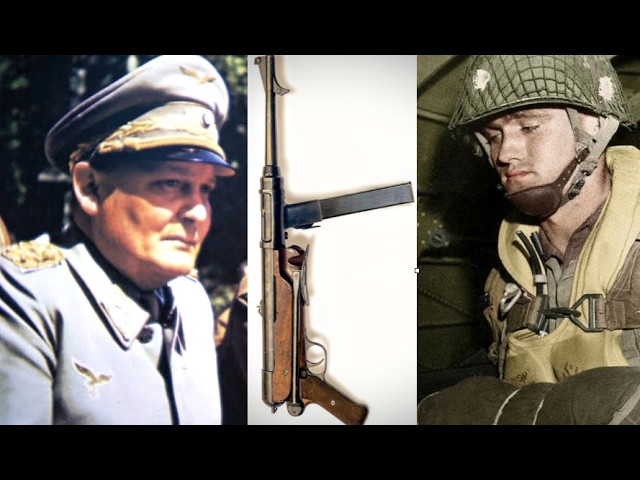
It was a lightweight, compact, and fast-firing 9mm weapon. There was, however, another version of these two iconic weapons, the MP 38 and the MP 40, that actually existed. This version is the MP 36, a weapon almost unknown today. Unlike the MP 38/40, the MP 36 is a selective-fire weapon machined from steel with wooden parts.
It shares many characteristics with the MP 38 and MP 40, but it is also completely different from them. Its magazine catch is of the protruding type instead of the button found on the MP 38 and MP 40, and it is located at the rear of the magazine housing. The bolt group is similar to that of the other weapons, except that the front of the MP 36 bolt is a separate piece. The front sight is of an adjustable design and unshrouded.
The weapon carries no identifying markings except for the underside of the wooden foregrip, which bears the marking “EMP 36,” where “EMP” stands for Erma Erfurt. The magazine housing also differs from that of the MP 38 and MP 40, protruding at a 30-degree angle towards the front. No dedicated MP 36 magazine has ever been found; the weapon uses MP 40 magazines. The only example in the United States today bears serial number 014, has a high-quality finish, and is believed to be a prototype presented as a gift.
Presented to whom? Well, that was to Reich Marshal Hermann Göring, head of the German Air Force, because the paratroopers in Germany were part of the air force. And how did this weapon end up in Allied hands? Well, the story goes as follows.
In 1943, a group of volunteers was organized for a highly secret mission. The objective was to assassinate Reich Marshal Hermann Göring. The assassination attempt was planned for Carinhall, located about 40 miles northeast of Berlin. Allied intelligence sources reported that Göring would be at Carinhall and that the area would be under light guard.
The Allied team parachuted quietly into the area at night, without being detected. Once they reached the grounds surrounding Carinhall, they quickly discovered that the palace was guarded by a private army of Göring’s elite Fallschirmjäger troops, all highly trained and heavily armed. After the German forces detected the team, a firefight broke out and quickly intensified. In the chaos, a certain American major managed to infiltrate the main building to search for Göring.
While wandering through the main hall, he spotted a strange, unfamiliar weapon hanging on the wall. Thinking it might interest American intelligence, he took it down and placed it in his bag. He then decided the mission had failed and attempted to fight his way out of a rapidly deteriorating situation. He and a very small part of the original Allied team managed to escape and return to safety.
The weapon remained in the major’s possession for the rest of the war. In 1945, when he returned to the United States, he brought the MP 36 home as a war souvenir. He stored the weapon away and went on with his post-war life. That specific story comes from an article titled “MP 36, The Missing Link,” published by Frank Iannamico in a magazine called Small Arms Review in 1998, and it has sparked much debate on the internet.
In my opinion, the weapon is completely genuine, but the story of its capture is not, and I will explain why. The first question is how an Allied commando team, or in this case American paratroopers, could have been successfully inserted that deep into Germany in 1943. What type of aircraft could have been used? Well, for example, a C-47 Skytrain, used in airborne operations throughout the war, could fly from eastern England to the Carinhall area and back without refueling.
The distance, depending on the English airfield used, was between 1,150 and 1,250 miles. However, when loaded to its full capacity of up to 6,000 pounds, the C-47’s range was limited to between 1,026 and 1,180 miles. This would have left the aircraft short on fuel for the return flight over occupied Europe or the North Sea. The Allies did not have air superiority over Europe in 1943.
A slow, heavy, unpressurized, and unarmed transport would have been extremely vulnerable to fighter attack, anti-aircraft fire, and radar detection. So what if they did not use a C-47? Neither the B-17 nor the B-24 was equipped for parachute drops. Jumping through the bomb bays was possible, but it was dangerous and slow.
For example, German agents were dropped over England and Ireland from modified German bombers during World War II, specifically Heinkel 111s, but only individually, with a single supply container also dropped by parachute automatically. The RAF’s Avro Lancaster was not equipped to drop paratroopers, and while it could technically hold up to 10 paratroopers sitting on the floor, they could jump from the bomb bay or the ventral hatch, but the process would have been too slow and dangerous. Of course, there were alternative aircraft types actually used for paratrooper drops, such as the Halifax or the Stirling. In the case of the Stirling, up to 10 fully equipped paratroopers could be dropped, and it was indeed used to drop them on D-Day, particularly pathfinder units.
But here we run into a problem with the size of the attacking force. Infiltrating a heavily fortified position like Carinhall, a large estate surrounded by dense forest, would require dealing with a garrison of about 200 heavily armed soldiers from the Hermann Göring Panzer Division. These soldiers were always present at the site, and assassinating Göring would have been extremely difficult, as he was also protected by a small platoon of Reich Security Service guards, the same government unit that protected Hitler and other Nazi leaders. Any form of attack would have required a large assault force and more than one aircraft to land that number of men and their equipment.
Ten men dropped from a Stirling or 18 to 22 from a C-47 do not constitute a large force for a mission that seems to lack the precision of known assassination missions carried out or planned by the British Special Operations Executive during the war. The British always worked with small teams on such dangerous covert missions. In the case of the assassination of Reinhard Heydrich in Prague in 1942, only two agents were parachuted in to join an existing resistance network in Czechoslovakia. The method of attack was to ambush Heydrich while he was driving through Prague in an open Mercedes without an escort.
Sten guns and grenades were used in the attack. The operation succeeded, although most of the assassins and their helpers were later killed in the German crackdowns that followed. Another operation was Foxley, an SOE mission to kill Hitler at his mountain home in Obersalzberg. Again, the assassination team consisted of only two agents dressed in German mountain troop uniforms.
The plan was an ambush, this time shooting Hitler with a scoped Mauser K98k rifle from among the trees while he was taking his daily walk from his house at the Berghof to his favorite tea house on the nearby Mooslahnerkopf. The backup plan was to attack the Volkswagen he used to return to his home after tea, using a British PIAT anti-tank weapon. The agents also carried modified silenced Luger pistols prepared by the SOE for personal protection. Several examples of this modified British pistol exist in the Royal Armouries in Leeds and at the Joint Services Museum in Maldon, Essex, where I had the opportunity to examine one personally.
I highly recommend visiting that museum, which has a huge exhibition on spies and special operations. It is clear that a batch of these weapons was assembled as part of some kind of SOE assassination program inside Germany. Operation Foxley was cancelled for well-known and various reasons. For any assassination team to remain on the ground at Carinhall for any length of time, they would have had to wear German military uniforms instead of American paratrooper uniforms and be armed accordingly.
Think of the film Where Eagles Dare. Could they have been dropped from a captured German aircraft as in the film, which was also set in 1943? A Junkers Ju 52, for example. It is not impossible.
The Allies captured some examples in various situations, particularly in North Africa, although no evidence has emerged of such aircraft being used to drop Allied agents into German-occupied Europe. Allied aircraft were always used for that task. Also, a Ju 52 could not have flown from eastern England to Carinhall and back without refueling, as its range was only between 540 and 620 miles, depending on its load. And how would any team of American paratroopers be extracted from the Carinhall area after assassinating Göring?
Presumably, this was not meant to be a suicide mission. There was no friendly resistance organization in Germany at that time to help. If any assassination attempt against Göring at Carinhall was to be carried out, I would have thought an ambush of the Marshal’s vehicle was the best option, while he was traveling between his heavily fortified home deep in the forest at Carinhall and the airfield he used to fly in and out of the area, which was a few kilometers to the north. The problem is that any such attack would have relied entirely on the agents knowing Göring’s schedule and travel arrangements, which would have meant having an actual agent inside Göring’s headquarters capable of passing on that crucial information.
As far as we know, there was no such information or secret agent. So we have a rare and strange submachine gun of dubious origin, which is undoubtedly genuine and a very rare weapon of immense historical interest and value, attached to a story that is, at best, fanciful and practically impossible to have been carried out in the manner published. An attack by a force of American paratroopers on a large, well-fortified estate like Carinhall to get close enough to kill Göring. Alistair MacLean would have rejected such a scenario as far too improbable.
So, where did the MP 36 actually come from? As with many stories associated with items belonging to Nazi leaders, there is likely a grain of truth beneath all the lies and empty claims. Here is my theory, which I cannot prove. The MP 36 was indeed a prototype presented by the Erma company to Göring, whose paratroopers were looking for a lightweight submachine gun that worked well in their type of operations.
That weapon would eventually become the MP 40, a much cheaper version to manufacture than the costly MP 38 and its relative with wooden parts, the MP 36. In 1945, Göring ordered the evacuation of Carinhall as the Red Army approached, and all his possessions were moved via three trains to Berchtesgaden, where he owned a smaller mountain villa near Hitler’s villa at Obersalzberg. Much of Göring’s art treasure was hidden in a cellar beneath the air force officers’ club, or casino, in Berchtesgaden. Meanwhile, a huge amount of material, including his large collection of weapons, remained in a freight train at Berchtesgaden station.
On May 4, 1945, American forces captured Berchtesgaden after the SS withdrew. And on May 5, paratroopers from the American 101st Airborne Division took over garrison duties from the infantry in the area. For example, Major Dick Winters, famous from the Band of Brothers series, was among the first American officers to find and explore Göring’s art cache. It is easy to connect the fictional story of the raid on Carinhall by American paratroopers with the discovery of the MP 36.
It is likely that the weapon was among Göring’s guns and on one of the trains that were partially looted by American paratroopers. I believe the creator of the Carinhall raid story was an officer in the 101st Airborne Division, who took the MP 36 from a freight car in Berchtesgaden in early May 1945 and kept it. Perhaps he invented a good story about his capture of the MP 36, claiming American paratroopers had landed on Göring at Carinhall, and the myth stuck. Especially with the usual “it’s still secret” phrase covering a mountain of fiction and fabricated stories used to justify World War II heroics.
That is my view on this myth or urban legend, whatever you call it, attached to the genuine MP 36, one of only two known examples of this rare German submachine gun of the war. It is difficult to determine how many pieces the Erma company made. The weapon in the United States bears serial number 014. There is another known example in a military museum in Prague, Czech Republic, bearing serial number 001.
So, at least 14 pieces were made. The example in the United States is valued at up to $40,000, and possibly much more.