Irma Grese was twenty years old when the British arrested her at Bergen-Belsen in April 1945, a golden-haired young woman with piercing blue eyes and a face that survivors would later describe as almost angelic. She looked as though she belonged on a propaganda poster, not in a death camp. But beneath that appearance was a record of cruelty that made hardened prisoners pray they would never cross her path. She carried a whip.
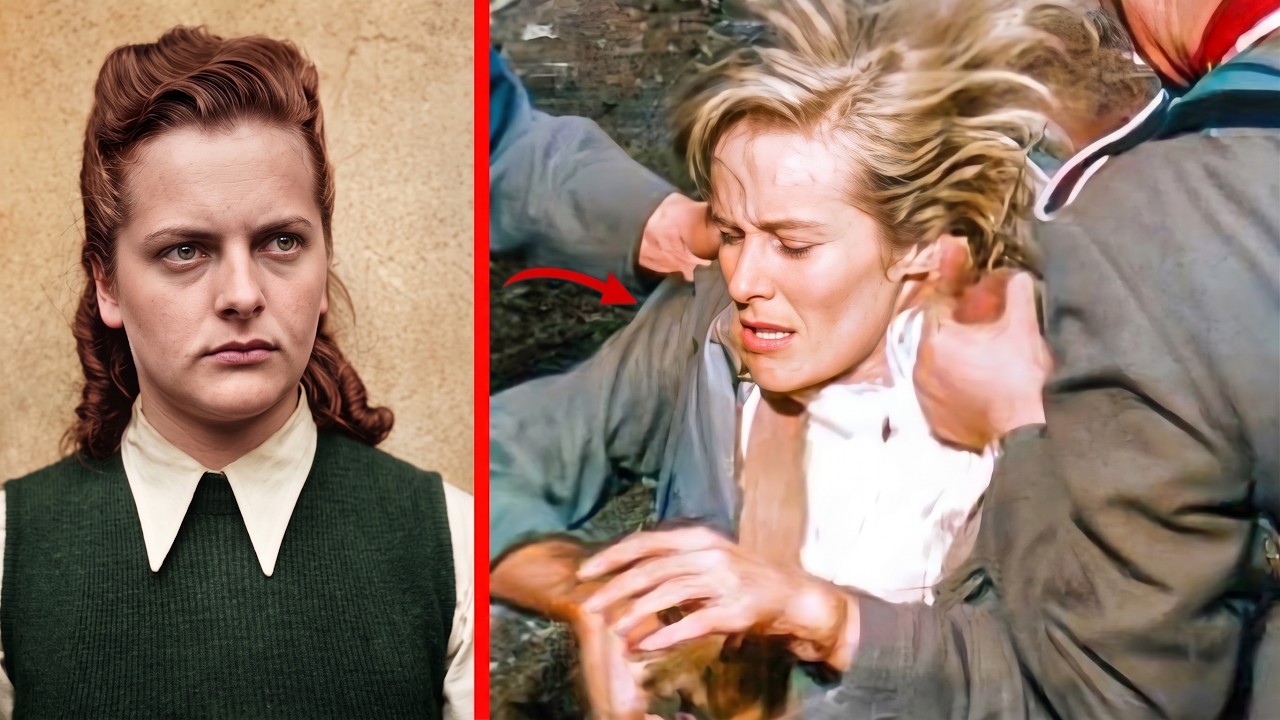
She carried a pistol. She kept dogs trained to tear human beings apart, and she used all three on people who had already lost everything. Within months, she would stand trial for her crimes. Within the year, she would become the youngest woman executed under British law in the entire twentieth century.
Irma Ilse Ida Grese was born on October 7, 1923, in the small village of Rekken in northern Germany. She was the third of five children in a modest working-class household, and nothing about her early life suggested the notoriety to come. She struggled academically, reportedly endured bullying from classmates, and left school entirely at fourteen. She worked on a farm, then took a job in a small dairy shop.
At sixteen, there was nothing about her that suggested history would remember her name at all. But Germany was changing around her. The Nazi Party was consolidating control over every corner of society, and like millions of young Germans her age, Irma was drawn into the League of German Girls, the female counterpart to the Hitler Youth, an organization built to indoctrinate the next generation into unwavering loyalty to the Reich. She embraced it enthusiastically.
She applied more than once for nursing training at an SS-run sanatorium and was rejected each time, eventually working there in an untrained assistant capacity. It was a small, unremarkable foothold in the world of the SS. It would not stay small for long. In the summer of 1942, at just eighteen years old, Irma Grese took a job that would set the course for the rest of her short life.
She became a guard, an Aufseherin, at Ravensbrück, a concentration camp built specifically to imprison women. The job was not automatic. Applicants had to pass a medical exam, demonstrate a clean criminal record, and show a basic grasp of Nazi ideology. Grese cleared every hurdle without difficulty.
What is genuinely unsettling in hindsight is how unremarkable her first days on the job reportedly were. Some accounts describe her as almost hesitant at the start. There is even a story of her apologizing to a prisoner after accidentally stepping in front of her. But the SS training pipeline at Ravensbrück was not designed to accommodate hesitation.
Over three grueling weeks, recruits were systematically hardened, drilled, indoctrinated, and conditioned until any instinct toward compassion for prisoners was treated as a dangerous flaw to be corrected. Whatever reluctance the eighteen-year-old carried with her into that camp did not survive the process. In March 1943, Grese was transferred to the camp that would ultimately define her name in history: Auschwitz-Birkenau. She was not yet twenty years old, and in a system built almost entirely around cruelty, obedience, and hierarchy, she climbed the ranks with startling speed.
Within months, she had been promoted to senior SS supervisor, the second highest ranking female guard in the entire camp complex. At the height of her power, she held direct authority over an estimated 30,000 Jewish women prisoners. This is where the nickname Hyena of Auschwitz was born. Grese carried a plated leather whip and used it constantly, inflicting beatings so severe that weakened, malnourished prisoners sometimes did not survive them.
She carried a pistol, and according to multiple survivor accounts given after the war, she used it to kill inmates arbitrarily, without process or provocation. She kept trained dogs, which she allegedly set loose on prisoners who had no way to defend themselves. Beyond the physical brutality, survivors described something even more chilling: a guard who seemed to derive genuine satisfaction from psychological torment. She reportedly tormented prisoners before selections, the horrifying screening process by which SS officials decided who would be sent to forced labor and who would be sent directly to the gas chambers.
One of the most haunting descriptions of Grese comes from Dr. Gisella Perl, a Jewish physician imprisoned at Auschwitz who worked desperately, at enormous personal risk, to keep fellow inmates alive. In her post-war writing, Perl captured the disturbing contradiction at the heart of Grese’s reputation, describing her as strikingly beautiful with flawless skin and eyes that looked almost innocent, while insisting she was simultaneously one of the cruelest, most disturbingly creative sadists she had encountered in the camp. That contrast, a young woman who looked gentle and behaved monstrously, is part of what made Grese such a uniquely unsettling figure to the people who survived her command.
Survivor testimony gathered after the war also implicated her in participating directly in selections for the gas chambers, contributing to the deliberate starvation and neglect of prisoners, and, according to some accounts, involvement in mass shootings. Whatever debate exists around individual details, one thing is not seriously disputed: by every account from those who lived under her command, Irma Grese was one of the most feared figures in a camp that was already defined, from top to bottom, by terror. As the tide of the war turned decisively against Germany and the Red Army pushed westward through Poland, the Nazi regime began dismantling and evacuating its camp system. Grese was transferred once more, this time to Bergen-Belsen, a camp that by early 1945 had spiraled into catastrophic overcrowding, starvation, and disease.
Conditions there were in many ways even worse than what she had presided over at Auschwitz, with typhus tearing through a population that had swelled far beyond anything the camp could sustain. It was at Bergen-Belsen in April 1945 that British forces finally arrived, and what they discovered stunned the world: thousands of unburied corpses, survivors so emaciated they could barely stand or speak. It remains one of the most infamous liberation scenes of the entire war. Among those the British arrested in the chaos that followed was Irma Grese, alongside camp commandant Josef Kramer and dozens of other guards and officials.
Grese did not enter custody quietly, and she did not face her trial quietly either. Photographs taken of her awaiting proceedings at Celle in August 1945 show a young woman who struck several observers as almost defiant. The trial that followed became known to history as the Belsen trial, held in Luneburg between September and November 1945. Grese stood alongside 44 other defendants, all accused of participating in the systematic brutality of the camp system.
She was defended by a British officer, Major L. S. W. Cranfield, and she pleaded not guilty to every single charge brought against her.
But the testimony stacked against her was overwhelming. Survivor after survivor took the stand and described in painstaking detail what they had witnessed: the beatings, the arbitrary shootings, the dog attacks, her role in selecting prisoners for death. Grese herself took the stand in her own defense, at one point claiming she had been conscripted against her will into service at Ravensbrück. The historical record tells a very different story: she had in fact volunteered for the role.
Throughout the trial, she largely minimized the severity of the accusations against her and offered no genuine expression of remorse. The court was not persuaded. On November 17, 1945, Irma Grese was found guilty of war crimes and crimes against humanity. The sentence was death by hanging.
She had less than a month left to live. According to multiple accounts, she spent part of her final night singing Nazi songs, apparently unshaken, defiant, and unrepentant to the very end. On December 13, 1945, at Hameln Prison in Germany, Irma Grese was hanged. She was 22 years old.
Her execution made her the youngest woman put to death under British law in the twentieth century, and she was one of three female Bergen-Belsen guards hanged for their crimes that same year. What makes Grese’s story so difficult to sit with is not just the brutality itself. The Holocaust was tragically filled with individuals capable of horrifying cruelty. It is her age.
She was a teenager when she joined the SS. She was barely out of her teens when she held life and death power over tens of thousands of people at Auschwitz. She was only 22 when she was executed for what she had done with that power. Historians have spent decades debating how someone so young became so deeply embedded in a machinery of mass murder.
Some point to the ideological conditioning she absorbed from childhood onward through years in the League of German Girls. Others point to the deliberate psychological training built into SS guard programs, engineered specifically to strip away hesitation and empathy in new recruits. At the same time, scholars studying female perpetrators of the Holocaust have cautioned that portrayals of women like Grese have sometimes been shaped over the decades by sensationalism and gendered stereotyping. Even so, the documented survivor testimony from her trial leaves little room for doubt about the severity of what she actually did.
In the end, Irma Grese’s story is not really about one person’s cruelty existing in isolation. It is a case study in how an entire system, built on hatred, obedience, and dehumanization, could take an ordinary young woman from a small German village and turn her into an instrument of genocide in under three years. The machinery of the Holocaust was not operated only by aging generals issuing orders from command centers. It was carried out, day after day, by thousands of ordinary people, some barely out of childhood themselves, who chose, again and again, to participate.
Irma Grese walked to the gallows unrepentant, but the testimony of the survivors she brutalized outlived her by decades, and it is their voices, not hers, that history has ultimately chosen to remember.