At dawn on March 31, 1913, in a first-floor suite of the Grand Hotel in Rome, John Pierpont Morgan died. He was seventy-five years old and had been the most powerful financier in the United States for decades, the man who had twice stopped national panics with his own money. In his final hours, four relatives were at his bedside: his son-in-law and partner, his daughter, his granddaughter, and a distant cousin. His wife of forty-eight years was not there.
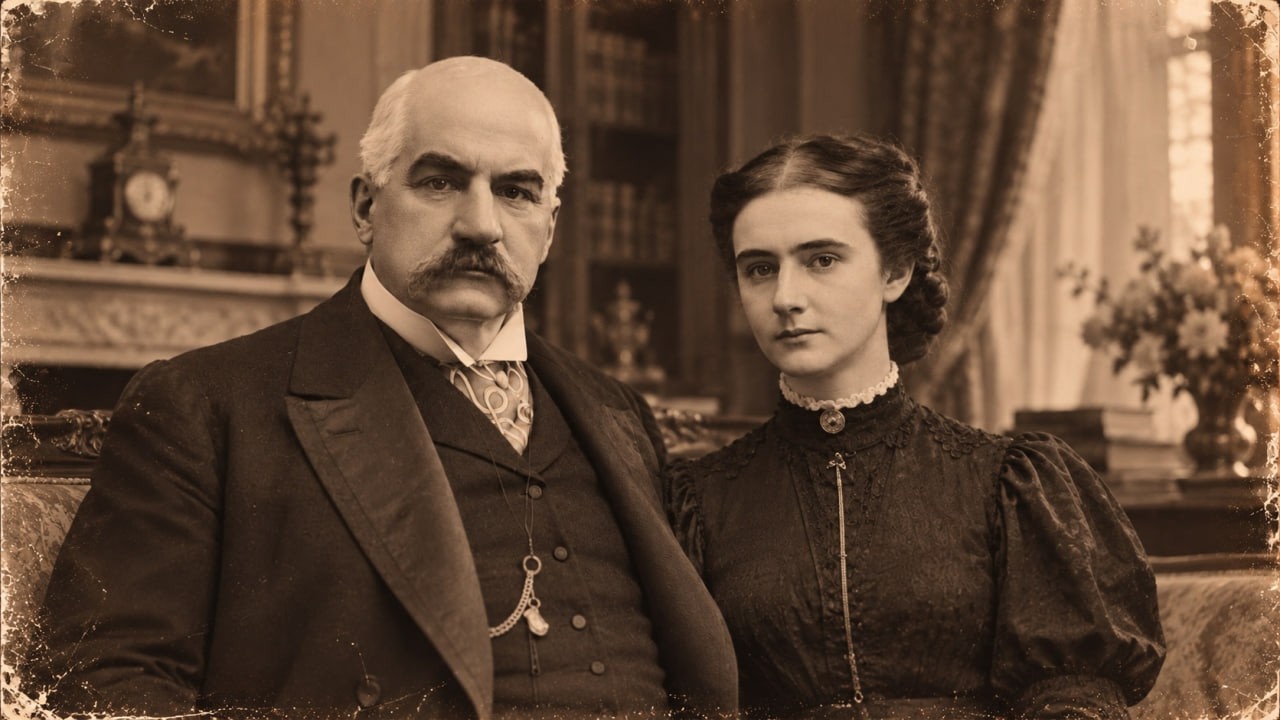
She was more than four thousand miles away, in the brownstone at the corner of Madison Avenue and Thirty-Sixth Street in New York, and no one in Rome thought to send for her. The news of his death could not simply be announced. The New York Stock Exchange would open in a matter of hours, and the world had to be prepared. So the death was managed.
Rome was six hours ahead of New York. Morgan died at 7:05 a. m. New York time, leaving a window of two hours and fifty-five minutes before the exchange opened at ten.
Within that window, his son-in-law Herbert Satterlee arranged for the family first to receive the news, then for the newspapers to publish a deliberately brief medical report, and finally for the market to absorb the shock. The papers described Satterlee’s care with admiration. He wanted to protect the family from rumors and the exchange from surprise. The sequence was timed, coordinated, and executed.
No account survives of how Fanny Morgan was told, who carried the message, or when the bell rang at her door. That detail, the most ordinary one, was not recorded. She was Frances Louisa Tracy Morgan, called Fanny. She had married J.
Pierpont Morgan in May 1865, three years after his first wife died. That first marriage had lasted only four months. His bride, Amelia Sturges, was already ill with tuberculosis. He had carried her up and down seven flights of stairs in Paris twice a day, brought her food she loved, and bought her birds when the rooms grew too quiet.
She died in Nice in January 1862. He never learned what that marriage would have become. With Fanny, the marriage began differently. She was the daughter of a New York lawyer, comfortably middle class, not an heiress.
The children came quickly: Louisa, then Jack, then Juliet, then Anne. For a decade or so, the marriage was ordinary for their social circle. Then the differences emerged. He loved New York, the crowds, the movement.
She loved home, the children, the quiet. She wanted to leave the city for the suburbs of New Jersey. He was passionate about art; she cared little for it. He was, by all accounts, nearly impossible to talk to.
One partner said the closest he came to conversation was an occasional grunt. He never discussed his business with her, nor the railroads, nor the financial crises, nor money itself. In 1880, he bought a brownstone on Madison Avenue and Thirty-Sixth Street, emptied it, and moved the family in two years later. Around the same time, he bought his first yacht.
In those same two years, without any recorded conversation, the seasons of their marriage were set. He crossed the Atlantic to Europe in the spring and summer, sometimes with one of his daughters, and in later years with a woman who was not his wife. In the fall and winter, he sent Fanny in the opposite direction. For nearly thirty years, he kept the Atlantic Ocean between them.
Fanny did not simply wait. Forty miles up the Hudson River, at a farm called Cragston in Highland Falls, she built a life. He used the place as somewhere to sail to. She used it as somewhere to live.
She opened the land, built terraces overlooking the river, and planted thousands of daffodils along the bank. Each spring they bloomed whether anyone came to see them or not. In the town, she was known and genuinely liked. She owned a simple white wooden building there, a reading room with books and newspapers, open to anyone who wished to enter.
Around 1884, she gave it to the town. She did not lend it or put her name on it or hold a ceremony. She simply gave it and continued to pay for it out of her own money for the rest of her life. Twelve years later, the state of New York formally adopted it as a library.
It was the smallest kind of gift a woman in her position could make. It was also, as far as the documents show, the only thing within her marriage that was entirely hers to give. By then she had been married nineteen years. During that same decade, her husband began arranging his calendar to guarantee the two of them were never on the same continent.
None of it was hidden. Ships left from public docks, passenger lists were published in the newspapers. Society could count the months as easily as anyone else. They knew when he sailed and with whom.
They knew when she sailed. The dates never matched, and neither of them ever said a word about it. But New York had its own way of speaking. A weekly gossip paper called Town Topics, read by everyone and admitted to by no one, printed stories without names, hints about a summer at Bar Harbor or a prominent financier on his yacht.
Then, nearby on the same page, it printed the names of the people involved in some harmless other matter. You had to know the code, and everyone who mattered did. The editor was a blackmailer, and after a trial years later, the names came out alongside payments ranging from two thousand to ten thousand dollars. Morgan’s name was among them.
When asked about the payment, he called it a loan. The woman in question was Edith Seville Randolph, a young widow with two children and no fortune of her own. The biographer Jean Strouse, who spent fifteen years in the Morgan family archive, describes her as the first documented mistress. The relationship began around 1890, when Morgan was in his early fifties, and lasted about five years.
He took her to Europe, took her on his yacht, and continued to invite her to his houses in the city where his wife was present. There were always so many people around Morgan that no guest could be tied to him exclusively. A widow at a dinner party was simply a widow at a dinner party. Fanny kept a diary, as women of her generation did.
The weather, the visits, the children, who came and who went. For nearly a century, those documents sat unfiled. No biographer reviewed them. Strouse, who eventually read them, describes them as sad, not angry, not accusatory, just sad.
The name of Mrs. Randolph appeared again and again in the careful handwriting of the woman who received her. She wrote the guest lists, welcomed the guests, sat at the table, and then, alone, took out her book and wrote the name. No one forced her to do that last part.
She could have ignored the name, and on paper the evening would have looked like any other. But she wrote it down, year after year. Then, in the early eighteen-nineties, she wrote something different. Six words, in the same hand, among the ordinary affairs of an ordinary day: “Spoke to P.
about Mrs. R. ” That is all. We do not know what she said, what he answered, or whether he answered at all.
After that entry, the name of Mrs. R. never appeared in her diary again, not in any of the years that followed. There are two ways to read this, and the documents favor neither.
Either he ended the relationship, or she accepted that she would stop recording it. What happened next suggests the latter. Morgan did not stop. He grew more careful, more European in his methods, organizing his life the way the men he admired in London did.
Edith Randolph eventually married another man from his circle, the former Secretary of the Navy William C. Whitney, and Morgan turned to her closest friend, Adelaide Louise Townsend Douglas. She was not beautiful, according to those who knew her. She had presence, enormous energy.
She cared about paintings and travel in a way his wife never did, and she could handle a room full of difficult men without appearing to try. Strouse, who tracked her down through her descendants, describes her as a magnificent spirit. Morgan began the relationship around 1895 and was still with her in some form when he died. He took her to Europe, not to quiet hotels, but to the circles he genuinely moved in.
She was with him when he met Edward VII. She was with him when he met Kaiser Wilhelm. She rose fully to that world, Strouse writes. His wife did not belong to it and was never invited to it.
The man was also deeply religious. He belonged to St. George’s Church in New York, gave it five hundred thousand dollars in 1892 alone, read the Book of Common Prayer himself, and could recite chapters from memory. Every three years, he took three weeks in the middle of the busiest calendar in American finance to sit in a hall and listen to clergy discuss church policy.
He traveled to those conferences in a private train, crossing the country with bishops and ladies together. The most watched man in the United States crossed the country in a private car full of clergy, and everyone could see who traveled with him. In 1902, he commissioned a building. Charles McKim, the great American architect, designed it in the Italian Renaissance style.
It took four years and was sheathed in marble. Inside were the illuminated manuscripts, the drawings, the printed books he had been buying for a decade. He built a library to preserve what he loved. Fanny had given away her library eighteen years before, a wooden room in a town she gave to people who owned nothing, never bearing her name.
He built his of stone, attached it to the back of the house where she slept, and kept the key for himself. Then came a summer in Maine. The Archbishop of Canterbury was visiting the United States, and Morgan, a prominent layman, was one of his natural hosts. He received the archbishop in Maine.
Mrs. Douglas was there. A few weeks later, the archbishop went to Washington, where he was to meet President Roosevelt. Morgan also went to Washington, and there, beside Morgan, was his wife.
The archbishop met one woman at Morgan’s table in Maine and another at Morgan’s side in Washington, both in the same season. Strouse writes that the bishops must have seen Mrs. Douglas on some occasions and Mrs. Morgan on others, and he does not know what they concluded.
What they concluded was nothing at all. No letter survives. No one declined an invitation. No one stopped speaking to Morgan.
He kept giving to the church, and the church kept accepting. Fanny never discovered anything, because there was nothing hidden. Her husband did not sneak. He did not hide his tracks.
He moved in broad daylight before the most important witnesses the Christian world could offer, and the world had agreed in advance not to see him. That agreement, not the deception, was what she faced. It explains the six-word entry in a way nothing else can. That night she did not discover anything.
She told one person, quietly, a truth that a few hundred people already knew and had decided, quietly, was not true. After that, the man’s name disappeared from her diary. She had learned what she was allowed to write, which was exactly what the others were allowed to say. In 1909, two things happened.
On Park Avenue, near her home, a new mansion was built for Mrs. Douglas with a private rear entrance, and orders were given that children were to disappear when Mr. Morgan arrived. That same year, someone called for a Spanish painter.
They asked him to paint Mrs. Morgan. The painter was Joaquín Sorolla of Valencia. The canvas was large, more than four feet wide, the size a house reserves for something it wishes to keep.
She sat for him. He signed it in the lower right corner and dated it 1909. That is all the record says. No letters survive about the commission, nothing about what she wore, what they discussed, or how many mornings it took.
We do not know whose idea it was. We do not know what her husband said when he saw it, or whether he was even in the country. After the panic of 1907, when he had personally saved New York City from bankruptcy by issuing millions in clearing certificates while playing his favorite card game, patience, in the middle of the room, the country turned on him. By 1912, a congressional committee was investigating whether a small group of men controlled the money of the United States.
In December of that year, at seventy-five, Morgan testified. The hearings drained him. That winter, he sailed for Egypt, as he had done in recent winters. The household calendar had quietly changed.
It was no longer a matter of one of them crossing the ocean in spring and the other in autumn. In the end, he simply left. On the Nile, the worst depression of his life seized him and did not let go. They moved him from the river to Naples, then to Rome.
He arrived at the Grand Hotel on March 13, 1913. The papers reported mildly that he had spent the evening in his suite playing his favorite game of solitaire. He had eighteen days left. The will was read after the funeral in April at St.
George’s Church. It began with faith. Before any figures, Morgan commended his soul to his Creator. Then the numbers came: three million dollars for each daughter, for his wife the houses and a trust established years earlier, not by him but by his own father, and everything else to his son.
The estate was valued for tax purposes at roughly eighty million dollars. A Texas newspaper summed it up plainly: “Morgan leaves his soul to the Creator and the money to his son. ”
Fanny remained in the brownstone on Thirty-Sixth Street for eleven years. She stayed as the city changed around her, as the great private houses were torn down or converted to offices, quietly giving money as she always had, including to a young deaf and blind woman named Helen Keller.
In 1923, she sold the white wooden library building in Highland Falls to the town library association. The price was ten dollars. She had owned it for nearly forty years, allowed its use since 1884, and paid for it out of her own money. Now she made the transfer final.
In March of the following year, her son Jack decided his father’s collection was too important to remain in private hands. On March 28, 1924, the marble building behind his father’s house was established as a public institution and opened to the world. Two libraries, transferred within eight months. His became a landmark with his name on the door.
Hers changed ownership for the price of a hat, recorded nowhere except in the town records. On November 16, 1924, Frances Louisa Tracy Morgan died in the brownstone, wall by wall with the building that held everything her husband had loved enough to keep. Afterward, the places disappeared quickly. Cragston left the family in 1926.
The Hudson house burned in the nineteen-forties, its land divided into lots. The daffodils still bloom along the bank each spring. The little white library burned in 1952. The reading room, the games, the shelves of books and papers, all gone.
Almost nothing she touched remains. One thing survived. In 1909, for reasons no document ever explains, someone called for a painter from Spain, and Fanny Morgan stood to have her portrait made. It hangs on a wall in New York.
Visitors pass by it all day on their way to the Gutenberg Bible, the Rembrandt drawings, the manuscripts, and most do not even look. None of them know who she is. She has been in that building for over a hundred years, the only wife there, included entirely on the terms he set for everything else he owned. Catalogued, numbered, preserved, 134.
62 centimeters by 109. 22. She is still there.