The last thing Cleomenes heard before silence closed over him was the scrape of stone against stone, but for the other two men who defined Sparta’s slow collapse, the ending arrived in different shapes. One sat bound in wooden stocks in the agora, carving his own body apart with a knife. Another lay stripped and looted in a ditch beneath a minor town’s wall. Each had climbed to the summit of Greek power.
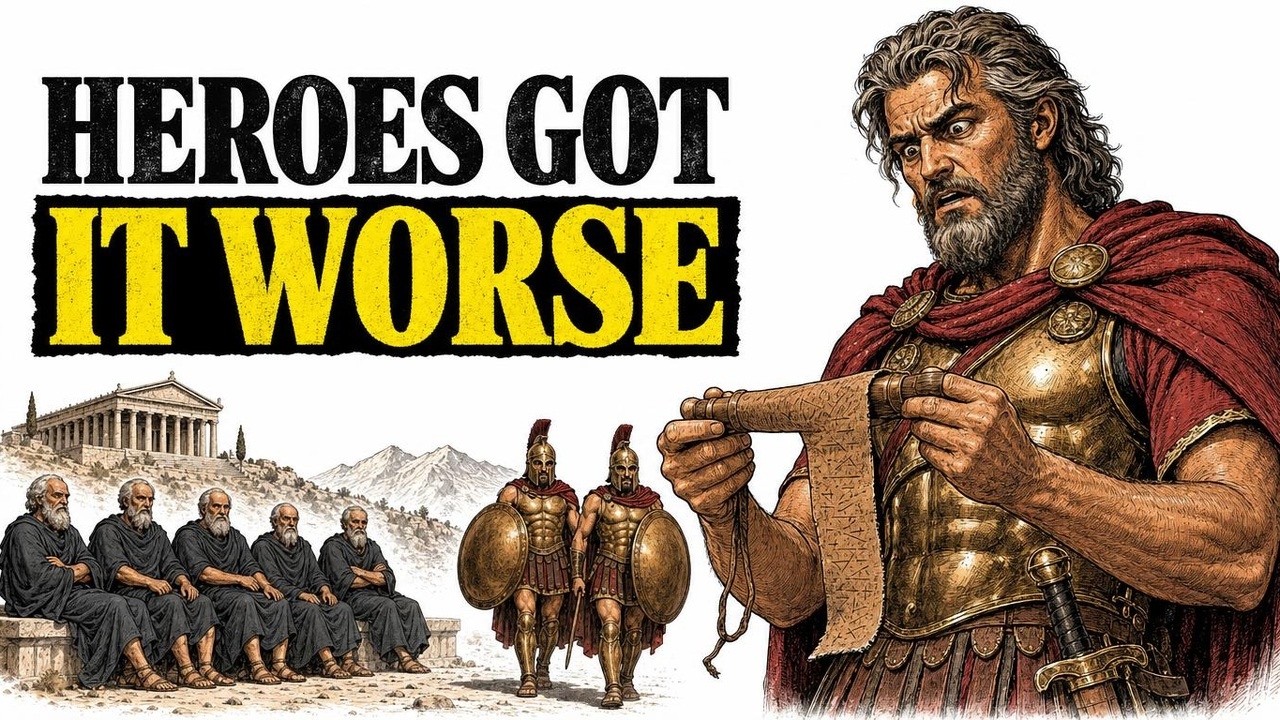
Each had been devoured by the state that made him. Their story is the story of Sparta’s true enemy: itself. Cleomenes was born already marked. His father, King Anaxandridas II of the Agiad house, was called mad, and the whisper followed the son before he could speak a full sentence.
His birth had been a scandal. The ephors had ordered the king to put aside his first wife, who had given him no sons. Anaxandridas refused, and so a bargain never before struck in Sparta was arranged: the king kept his first wife and took a second, maintaining two households at once. The second wife bore Cleomenes.
Then, as though the gods had a taste for irony, the first wife conceived and bore three more sons. Four sons where there had been none—and the eldest carried the stain of a broken rule. When Anaxandridas died around 520 BC, Sparta preferred his brother Dorieus, a perfect specimen of the agoge, first in every contest. But law was law.
Cleomenes was eldest, and the throne belonged to him. Dorieus, unwilling to kneel, sailed off to found a colony and died in Sicily chasing a kingdom that was never his. What surfaced in Cleomenes was not the madness the city feared. It was ambition—cold, patient, boundless.
He looked at Sparta’s sacred traditions and saw a cage. Other Spartans stared at their feet; Cleomenes looked at the horizon. He saw Persia swelling in the east and Athens tearing at its own politics, and he understood what almost no one around him grasped: Sparta could not hide behind its spears forever. It had to become the hand that decided things for all Greece.
He began to move. Around 519 BC, Plataea came begging for protection against Thebes, and instead of helping, Cleomenes sent the city to Athens, a colder calculation that pitted two rivals against each other while Sparta watched. In 510 BC, he drove the tyrant Hippias out of Athens—an act that inadvertently cleared the ground for Athenian democracy, the very system that would become Sparta’s mortal enemy. Twice more he marched on Athens to crush the new democracy.
Then he turned on Argos. Near Sepea in 494 BC, he used a herald’s false order to trick the enemy army into sitting down to breakfast while his Spartans charged, then burned the survivors inside a sacred grove. Not the work of a hoplite standing in line. The work of a warlord who had decided the gods were an inconvenience.
His true obstacle sat on the other throne. Sparta was ruled by two kings, and his co-king, Demaratus, was a traditionalist loyal to the machine. At Eleusis in 506 BC, Demaratus publicly withdrew his support during a campaign against Athens, and the invasion collapsed. After that day, a law was passed that both kings could never march out together again.
The humiliation burned in Cleomenes. The final clash came at Aegina around 491 BC, when Demaratus undercut him again. Cleomenes returned with one fixed purpose: Demaratus had to fall. Killing a king was unthinkable.
But legitimacy could be attacked. A rumor began to move through Sparta that Demaratus was not the son of King Ariston. Cleomenes found an ally in Leotychides, a man of the same house who hated Demaratus and stood ready to take the throne. And he needed the gods to say the words.
At Delphi, the Pythia’s riddles started wars and ended reigns. Cleomenes understood that priests could be bought. Through a powerful man named Cobon, he bribed the priestess Perialla. When the official Spartan delegation climbed the mountain road and asked whether Demaratus was the true son of Ariston, the answer was waiting: Demaratus was illegitimate.
There was no appeal. Leotychides took his throne. At a festival in the agora, Cleomenes sent a servant to the fallen king with a cruel question: how did it feel to hold a common office after having been king? Demaratus wept, then answered that he had known both offices while the new king had known only one.
Then he pulled his cloak over his head and walked out. He went east to Persia, to the court of Darius, becoming a gift beyond price—a disgraced Spartan king who knew every weakness of the land Persia meant to conquer. Years later, at Thermopylae, he would stand at Xerxes’s side, explaining why the Spartans combing their long hair before battle meant they had come to die. Cleomenes had won his private war, corrupted the holiest voice in Greece, and driven a king into exile.
But the men who helped him buy the oracle grew careless. The story leaked. Cobon fled; Perialla was stripped of her office. The ephors, five magistrates each year who were the true keepers of Spartan law, saw their chance.
Cleomenes fled the city into Arcadia, gathered a coalition of cities, and pointed it at Sparta’s throat. The ephors panicked and lied, offering to restore him to the throne if he came home. He came back. The moment he crossed inside the walls, hands closed around him.
The ephors declared by law that King Cleomenes had gone mad. A madman needs no trial, cannot mount a defense. They dragged him into the agora and locked him in wooden stocks, a beast in a cage for citizens to jeer at. One helot was left to guard him—a slave of the state with every reason to hate the king bound in front of him.
Cleomenes spoke to him low and steady, and somehow talked him into handing over a knife. He did not open his throat. That would have been an escape. Instead, he set the blade against his own shins and began to cut.
He sliced himself apart methodically—thighs, flanks, then the belly—until he died. The threat to Sparta was finished. The invasion arrived in 480 BC. Xerxes had spent four years gathering his army, bridged the Hellespont, and marched over the mountains.
At Thermopylae, King Leonidas and his 300 held the pass for three days until a local man named Ephialtes showed the Persians the goat path around. Their deaths bought Greece time. At Salamis, the Athenian navy broke the Persian fleet. But a Persian army still sat in the heart of Greece under Mardonius, marching south to burn Athens a second time.
Sparta needed a new commander. It found one in Pausanias, nephew of Leonidas, made regent because his young cousin Pleistoanax wore the crown too small to command. He was the pure product of the agoge, disciplined past the point of feeling. In 479 BC, he stood at the head of the largest hoplite army Greece had ever fielded on the plain of Plataea.
After eleven days of stalemate, Mardonius threw his whole force across the river. The Spartans held under a storm of arrows until Pausanias gave the word. Mardonius died, crushed by a stone, and his army broke. The threat to Greece was finished on that field.
Pausanias was no longer a regent. He was the man who had saved every Greek there was. And that was the flaw the machine could not tolerate. The system knew how to make soldiers.
It had no place for a victor. After Plataea, the allies handed him the fleet. He took Cyprus, then Byzantium, prying it loose from Persia. For the first time he sailed beyond the reach of the ephors.
He saw how the wealthy of the east lived—silk, gold, men bowing low—and the system that had forged him began to look like a cell. He put off his plain Spartan cloak and wrapped himself in Median robes, gathered a personal guard of Median and Egyptian soldiers, and treated allied captains as servants. He even had his own name cut into the victory tripod dedicated at Delphi, a boast the Spartans ordered scraped away. Then came the charge that turned Spartan blood to ice: he was talking to the helots, promising them freedom and weapons in their hands.
He would arm the slaves and lead a rising that would gut Sparta from the inside. He was writing to Xerxes, offering to hand over all Greece in return for the king’s daughter and rule. A letter surfaced from a courier named Argilius, who had noticed that every man who carried Pausanias’s letters never came back. He broke the seal, found an order at the bottom that the bearer of the letter be killed, and walked the letter straight to the ephors.
They built a trap. Argilius fled to the sanctuary of Poseidon at Taenarum, and the ephors hid in a chamber nearby. Pausanias came after his messenger and confessed everything—his dealings with Persia, his plot—while the ephors crouched a few feet away and heard every syllable. As he made his way back toward Sparta, they moved to arrest him.
One ephor caught his eye and gave a small warning tilt of his head. Pausanias turned and ran. There was one place in all of Sparta that could still hold him: the temple of Athena of the Brazen House, by law inviolable. No blood could be spilled within it.
He reached the precinct and ducked into a small building. The ephors ringed it but could not step through the door. So they landed on an answer so cold it has never been forgotten. They could not drag him out.
They would seal him in. They stripped off the roof, so the sky looked down on him. Then masons were called, and they began to block the doorway course by course. A figure moved through the crowd: an old woman with a single brick in her hands.
It was Alcmene, the mother of Pausanias, of royal blood herself. She walked to the doorway, bent steady-handed, and set her brick down across the threshold—the first stone. If she could condemn her own son, who among them would hold back? The wall climbed.
Pausanias died inside, sewn into the house of a goddess. Not a drop of blood touched sacred ground. The ephors timed it so he was pulled out just as he drew his final breath, laid on unhallowed ground beyond. The victor of Plataea, the savior of Greece, wasted away while the city he rescued went about its errands.
The killing of their supreme commander shook Sparta’s allies. Byzantium, Ionia, the islands had seen Sparta’s finest turn tyrant and vanish behind a wall. They wanted no more of Spartan leadership at sea. Into that void stepped Athens, and the Delian League grew into the Athenian Empire.
A new war, longer and more terrible than anything yet, was now certain. The Peloponnesian War ground on for a generation, twenty-seven years. Athens would not break, fed by its fleet behind long walls; Sparta owned the land but could not touch the city that fed itself by ship. The Spartan system knew one kind of victory, two armies on a flat field.
That victory meant nothing against wooden hulls and rowers. So the state reached for a man who was everything a Spartan was forbidden to be. His name was Lysander. He belonged to no royal house, raised as a mothax, an outsider who had lived inside the system his whole life.
Where other Spartans saw a sacred order, Lysander saw a game of leverage. Sent as admiral in 407 BC, he did not go looking for a battle. He went to Sardis and made himself a friend of Cyrus, the young prince of Persia. When Cyrus offered him any gift, Lysander asked only that each sailor’s daily wage be raised by an obol.
The prince, struck by a man who thought of his crew before himself, opened the treasury. Lysander raised the wages, and the best oarsmen of the Aegean began slipping across to him. He was assembling a modern war fleet paid for with the enemy’s own money. He learned his captains’ names, rewarded brave men in the open, and let it be understood that loyalty to Lysander personally was the road up.
The cities of Ionia raised altars and offered sacrifice to him as though he were a god—the first living Greek ever honored so. His fleet loved him. Not Sparta. Him.
In 405 BC, he sailed into the Hellespont, the throat of water through which every grain ship bound for Athens had to pass, and took Lampsacus. The Athenians chased him and beached across the strait at Aegospotami. For four days, the pattern held. The Athenians offered battle; Lysander refused.
Each afternoon, the crews scattered inland to forage. On the fifth day, he watched them empty out again, flashed a polished shield as a signal, and fell on the beach. It was not a battle but a slaughter. He took 170 ships and put thousands of Athenian citizens to death on the shore.
In one afternoon, Athenian sea power ceased to exist. He sailed to Athens and closed the port while the Spartan kings sat outside the walls. The city began to starve. When the terms came in 404 BC, the long walls were torn down to the sound of flute girls while the men believed that day was the first day of freedom for Greece.
Lysander came home as a maker of kings. In conquered cities he set up councils of ten, handpicked from his own partisans, backed by Spartan garrison commanders who answered to him. In Athens, the Thirty Tyrants put 1,500 citizens to death in a single year. Lysander was building a private empire paid for by Persia, run by his clients.
The kings and ephors watched it grow, and their blood ran cold. Coined wealth poured into a city that by ancient law used only iron bars for money. A Spartan named Gylippus, the man who had saved Syracuse, was caught skimming silver from the bags Lysander sent. The gold was already turning Spartans into men their grandfathers would not have known.
They called him home and put him through audits, hunting for a crime that would let them take him apart within the letter of the law. King Pausanias, grandson of the regent who had starved behind the temple wall, loathed him. In 403 BC, Pausanias made peace with the Athenian democrats and let the democracy stand—jealousy dressed as policy, a stroke aimed at humiliating the man who had ended the war. Sidelined and bitter, Lysander turned to a larger revenge: he planned to abolish the rule that only the two royal houses could hold the kingship and throw it open to election by merit.
There was only one man certain to win. He prepared a speech and sent agents to buy prophecies at Delphi, Dodona, and even the oracle of Ammon in Libya. Every oracle turned him away. Before he could bring any of it into the open, a border quarrel flared with Thebes in 395 BC.
Sparta sent two armies north. Lysander was handed one; King Pausanias marched with the other, and the two were to meet at the town of Haliatrus. Lysander arrived ahead of the king’s column and did not wait. He threw his troops at the gate.
The Thebans had circled behind through low ground by the lake. In confused fighting pressed against the ramparts, the conqueror of Athens went down, run through by a spear from a man whose name no chronicle kept. When Pausanias arrived the next day, he found Lysander’s corpse in the mud beneath the wall, stripped of its armor. The victor of the longest war Greece had known lay in a ditch outside a town most Greeks could not place on a map.
Pausanias, rather than fight, asked for a truce to gather his dead—an admission that cost him his own crown. Both commanders were destroyed by that one small wall. With its one brilliant mind dead, Sparta was left holding an empire in the hands of men trained only for the phalanx. Its governors squeezed the cities, turned allies into enemies, and sold the Ionian Greeks back to Persia to keep its grip a while longer.
The reckoning came from Thebes. At Leuctra in 371 BC, the Theban general Epaminondas stacked his left wing fifty shields deep, drove it straight at the Spartan king, and broke the line. Of roughly seven hundred full Spartan citizens present, four hundred were killed in an afternoon. The legend of invincibility died with them.
Then he marched into the Peloponnese, stood within sight of unwalled Sparta, and turned west into Messenia. He freed the helots, founded a new city, and gave the slaves who had fed Sparta for three centuries a home of their own. The farms that fed the barracks were gone. The engine that let a few thousand men train for war their entire lives was torn out by the root.
Sparta never rose again. Within a century, its own kings would try to rebuild the state, and the machine would break them too. The code had done exactly what it was built to do. It had purged every man exceptional enough to save it.
It had swallowed the ambition of Cleomenes, starved the pride of Pausanias, and erased the genius of Lysander. In perfect obedience, it had scraped itself hollow—an empty barracks with the door hanging open, waiting for the enemy to walk in.